
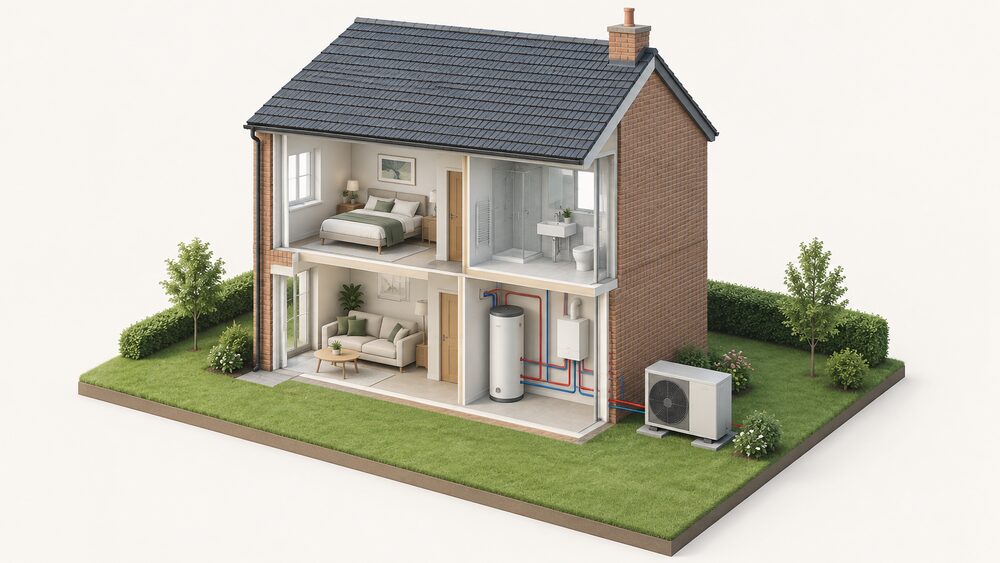
In this guide
Rinnai is a Japanese manufacturer of hot water and heating appliances, operating on each of the five continents and an Industrial Associate of CIPHE, the Chartered Institute of Plumbing and Heating Engineering1. Its UK arm sells a range that covers all forms of fuels and appliances currently available: electric, gas, hydrogen, BioLPG, DME, solar thermal, low GWP heat pumps and electric water heaters1. The heat pump side of that range is built around the H3 family, which Rinnai describes as inclusive of R290 liquid refrigerant low-GWP air source heat pumps2.
For a UK household, the practical question is what Rinnai actually offers a home rather than a plant room. Rinnai states that its R290 heat pump technology will satisfy the central heating and hot water demand of a wide range of applications from domestic to light commercial2, and that the system can switch between heating mode, hot water, and cooling mode2. The company's own commercial water heating units run to 48 to 58kW outputs1, and its Monobloc air source heat pump technology allows up to seven units to be cascaded together2, which is how the range scales from a house to a building.
The range: heat pumps, water heaters, cylinders and electric products
Rinnai's product scope is wider than heat pumps alone. The H1, H2 and H3 range consists of hot water heating units in gas, BioLPG and DME, hydrogen ready units, electric instantaneous hot water heaters, electric storage cylinders and buffer vessels, a comprehensive range of heat pumps, and solar, hydrogen-ready or natural gas in any configuration of hybrid formats for either residential or commercial applications1. The company frames the whole catalogue as suited to both commercial and residential applications4, and describes its expansion as covering heating and water heating in all fuels: gas, electric and renewables4.
The H3 designation is the heat pump line, described as Low-GWP heat pumps4. The H1 designation covers hydrogen and DME ready water heaters4. That naming matters when reading a specification sheet, because the three families share a brand and a service network but not a fuel.
| Family | What it covers | Fuel or technology |
|---|---|---|
| H1 | Hydrogen and DME ready water heaters4 | Hydrogen blend, DME |
| H2 | Hot water heating units1 | Gas, BioLPG, DME |
| H3 | Low-GWP heat pumps4 | R290 and R32 refrigerants2 |
| Electric | Instantaneous and storage water heaters, cylinders, buffer vessels1 | Electricity |
| Solar | Solar thermal in hybrid configurations1 | Solar thermal |
Rinnai's commercial water heaters come with stainless steel heat exchangers3, a material choice that bears on hard water areas and on service life. The company also promotes scale protection, including Aquabion, as a standard part of domestic hot water installations, a position it took to Installer Show 20251.
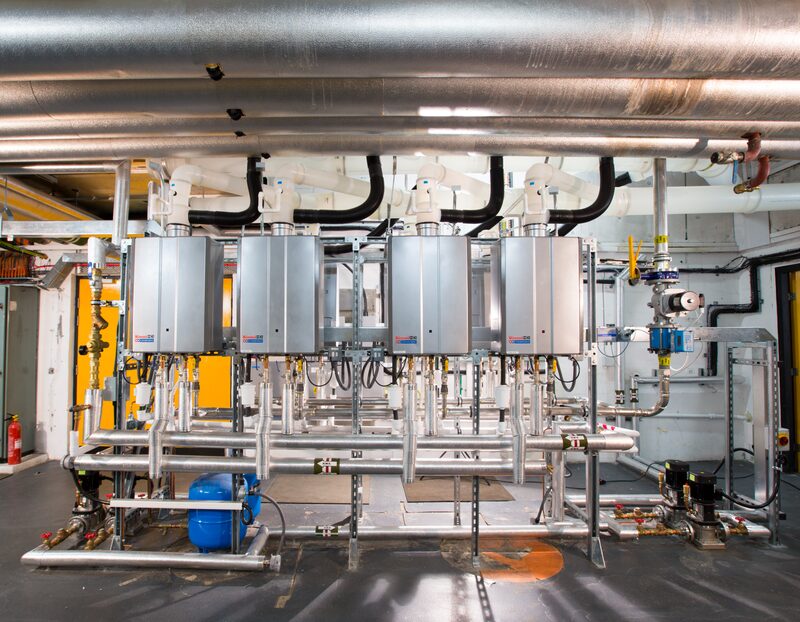
Heat pumps: R290 and R32, 48 to 58kW and cascade set-ups
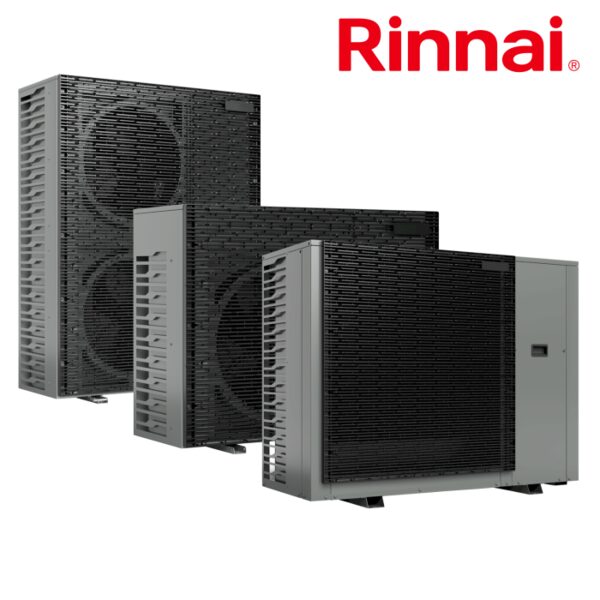
Rinnai states that the H3 range utilises low global warming potential refrigerants like R290 and R322. R290 is the refrigerant now dominant in the wider market: a 2025 government consultation on F-gas regulation notes that the majority of hydronic monobloc heat pumps may use R290 (propane)5. R290 carries a far lower global warming potential than the fluorinated gases it replaces, which is why F-gas rules favour it.
The output figures in Rinnai's own material sit at the larger end. Its hot water heating unit models include 48 to 58kW units1, and the company's commercial water heaters are capable of more than 1500 litres per hour at load profile XXL of temperature-accurate hot water3. Those are commercial-scale numbers, not domestic ones, and they explain why the cascade arrangement exists.
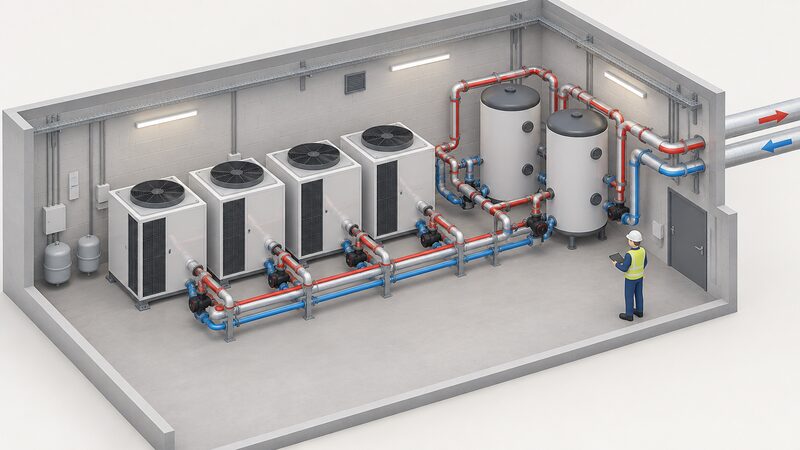
Cascading is the mechanism that makes the range flexible. Rinnai states that its Monobloc air source heat pump technology allows up to seven units to be cascaded together2, and that its hot water heating technology can be cascaded to create limitless supply for even the heaviest industrial process needs3. Independent guidance defines a cascaded heat pump system as one that allows more than one heat pump unit to work together to meet a property's heating and hot water needs6. Cascading is not unique to Rinnai: Vaillant's aroTHERM Split air source heat pump can also be cascaded for commercial application7.
For a household, the significance is that a single Rinnai monobloc unit can serve a home, while the same platform scales by repetition for a larger building. The design work sits in sizing and in the hydraulic arrangement, not in a different product family.
Hybrid systems: heat pumps paired with gas, electric or solar thermal
Rinnai states that it has a range of hybrid heat pump technology that incorporates gas boilers or water heaters, electric water heaters or solar thermal2. That is a broader definition of hybrid than the market usually uses. Independent guidance from the Heat Pump Association describes hybrid heat pumps as combining two technologies in a single heating system: a heat pump and a gas boiler8, and the Energy Saving Trust describes a hybrid as a standard heat pump with another heat source, usually a gas, oil or LPG boiler9.
The most common configuration in the UK is an air source electric heat pump alongside a gas condensing boiler10. Systems running on an electric heat pump along with natural gas, LPG, or oil are described as an effective interim solution10, and hybrid heat pumps are recognised as a practical and affordable solution for both existing on-grid and off-grid homes10. A regular hybrid system, with a regular boiler, hot water cylinder and electric heat pump, can optimise for different conditions10.
There are two kinds of hybrid system, bivalent and packaged9. Hybrid heat pump and hybrid controls can be fitted to different heat sources and boiler types such as regular or combination boilers10. Northern Ireland's official guidance notes that hybrid heat pumps can work with another heating system in a building, such as a gas boiler11, and the Energy Systems Catapult describes a hybrid as combining an air source heat pump with another type of heating system such as a gas boiler12.
Rinnai's inclusion of solar thermal and electric water heating in its hybrid definition is wider than the gas-boiler norm. Hybrid heat pumps can also be upgraded easily to a range of future low- or carbon-free heating options, including all-electric, electric-hydrogen, electric-biofuel, and electric heat pump with instantaneous electric10. That upgrade path is the main argument for a hybrid where a full heat pump is not yet practical.
Commercial applications: schools, restaurants, leisure and caravan sites
Rinnai's centre of gravity is commercial. A heat pump is a device that can provide heating, cooling and hot water for buildings, districts and even for industry13, and CIBSE publishes best practice guidance for residential heat pump applications covering system design, commissioning and operational performance14. Official guidance sets out the split: air source heat pumps are suitable for residential homes, apartments and small commercial buildings, while ground source heat pumps suit single-family homes, larger residential buildings and commercial properties11.
Rinnai's own commercial water heating units run to 48 to 58kW1, and the company's Head of Technical has set out the case for hybrid heating and hot water systems in non-domestic buildings, citing installations at a City of London complex and a national gym chain1. That is the sector where the brand's cascade and hybrid options do the most work: buildings with steady, high hot water demand and plant rooms rather than kitchens.
The types of heat pump available across the market include open and closed source underground, air source and water source15. Water source units absorb warmth from nearby water sources like rivers, lakes, and canals16. For a leisure centre or a site near water, that opens an option a domestic air source unit does not have.
Design support, training and warranty registration
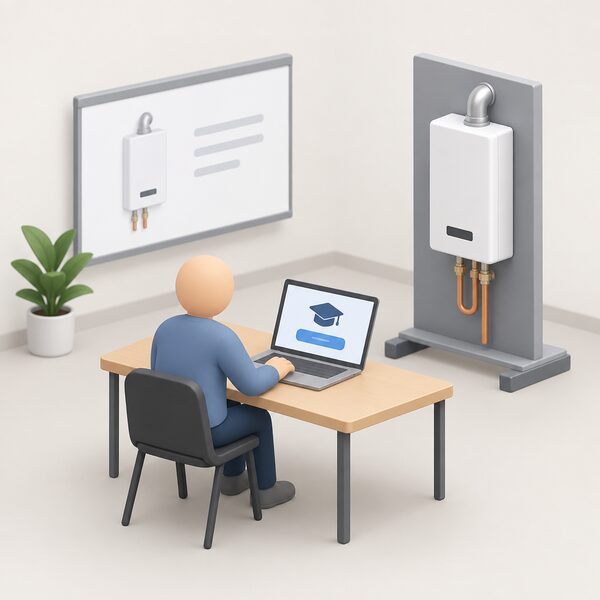
Rinnai states that it offers free design support services that include capital and operational expenditure and carbon modelling of multiple water heating technologies across all future energy sources3. It also runs a free training course that installers can book onto2. Both are trade-facing: a household reaches them through the installer quoting for the work rather than directly.
On warranty, the terms differ by product. Rinnai states that it is launching a wide range of newly certified Rinnai condensing continuous flow water heaters with an extended warranty of 12 years3. That figure applies to those water heaters, not to the heat pump range, and the registration route runs through the maker's own channels.
Rinnai's UK contact line for pre-launch pack enquiries is 0300 373 06604. Its products are available for purchase 24/7, 365 days a year through its distribution route1, which is how a household would normally encounter the brand: specified by an installer or a merchant rather than bought direct.
What owning a Rinnai system means for household energy independence
The independence question turns on fuel, not on brand. A Rinnai gas continuous flow water heater keeps a home on the gas grid and on a gas supplier, with an electrical dependence for ignition and controls. Rinnai describes its Infinity PLUS storage as offering cost-effective gas fired water heating4. A Rinnai heat pump moves the same hot water demand onto electricity, which shifts the dependence from a gas supplier to the grid and to whatever generates the electricity.
That shift is the one independent analysis treats as material. Insulating homes and running electric heat pumps and cars on an even split of wind and solar would boost energy independence, according to the Energy and Climate Intelligence Unit17. A heat pump also brings a dependence on the electricity connection itself: a new or upgraded supply may be needed, and the local network operator handles that application, with Electricity North West offering a connect and notify route by email18.
The system-side dependence is the same as any wet heating system. To get the best out of any heat pump system, a home needs to be well insulated, and homes with radiators typically need them oversized19. Air-to-water heat pumps work well in combination with large radiators and underfloor pipes20. Heat pumps can provide domestic hot water21, and there are already companies that offer heat pump readiness assessment services22. Where a full heat pump is not yet practical, a hybrid keeps a gas or LPG boiler in the system, which means the household retains its existing fuel dependence alongside the new electrical one.
Sources22 cited
- Rinnai UK market and product review, CIPHE, 2026-03-25
- Rinnai H3 heat pumps, Rinnai UK, 2026-09-17
- Rinnai hydrogen and renewable gas ready water heaters, Rinnai UK, 2025-03
- Rinnai new product launch programme, Rinnai UK, 2024-01-16
- F-gas regulation in Great Britain: HFC phasedown reform, Defra, 2025-09-02
- Heat pumps, Energy Saving Trust, 2026-09-17
- Vaillant aroTHERM Split air source heat pump, Quiet Mark, 2026-09-17
- Hybrid heat pumps, SGN, 2026
- Hybrid heat pumps, Energy Saving Trust, 2026-07-16
- Heat pump and hybrid controls, HHIC, 2026-09-17
- Heat pumps, nidirect, 2025-02-24
- Electrification of heat: heat pump user guides, Energy Systems Catapult, 2024-02-22
- About heat pumps, European Heat Pump Association, 2026-04-24
- Heat pumps, CIBSE, 2026-09-17
- Heat pumps, REA, 2026-09-17
- Ground and water source heat pumps, MCS Certified, 2026-06-09
- Household energy buying British, ECIU, 2024-04-15
- Heat pumps and new connections, Electricity North West, 2026-09-19
- Heat pump systems, CIPHE, 2026-09-17
- How heat pumps work: a guide for homeowners, NICEIC, 2025-09-17
- Heat pumps explained: experts answer your questions, GOV.UK, 2024-03-28
- Getting a heat pump should be a small step, not a giant leap, Nesta, 2024-12-12