
In this guide
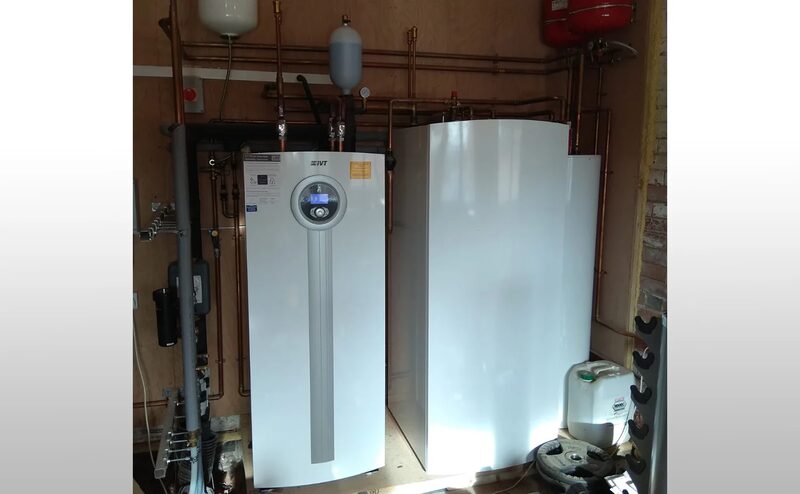
IVT is a Swedish ground source heat pump brand that has been installed in UK homes for well over a decade, supplied here through a single agent rather than a national dealer network. The range is built around the Greenline family, with E-Series and C-Series models appearing in UK case studies from 2017 onwards, including a 17kW three phase unit in Nottinghamshire and an 11kW unit in Lancashire1.
The brand's UK position is narrow but real. Alto Energy describes itself as the sole UK manufacturer's agent for IVT and has published installation case studies, recycling scheme offers and range articles between 2018 and 20243. For a household, that means the practical questions are less about brand recognition and more about who specifies, installs and supports the system locally, and whether the ground conditions suit a borehole or a horizontal loop.
Ground source heat pumps of any brand are supported by the Boiler Upgrade Scheme, which covers ground source units including water source heat pumps and shared ground loops6. They are mostly suited to large homes with lots of outdoor space, because the collector has to go somewhere8.
A Swedish brand with a long UK installation history
IVT's engineering heritage is Nordic. NIBE, the group the brand sits within, describes itself as a Swedish company whose heat pumps "have been manufactured and adapted to the challenges of the Nordic" climate9. That matters for ground source specifically, because the technology's advantage is that it draws on stable ground temperatures rather than outdoor air, which is exactly the condition a long Nordic winter tests.
The UK record stretches back at least to 2017. In October that year a 17kW three phase IVT Greenline HE heat pump was installed under a design, supply and commissioning package for a house rebuild in Nottinghamshire1. Two months later an 11kW IVT Greenline HE unit with underfloor heating went into a new build replacement dwelling in Lancashire2. Further installations followed: a Greenline HE E14 three phase unit at a Buckinghamshire barn conversion in July 2020, and an IVT HE E11 replacing an oil boiler at a County Durham retrofit in March 2022, supported by the Renewable Heat Incentive12.
Those projects share a pattern. They are larger, off-gas properties, often barn conversions, self-builds or rural replacements, where a ground loop or borehole was practical and where the alternative fuel was oil. That is the natural territory for the brand in the UK, and it is a narrow slice of the market rather than a mass-market position.
Where IVT sits in the UK market today
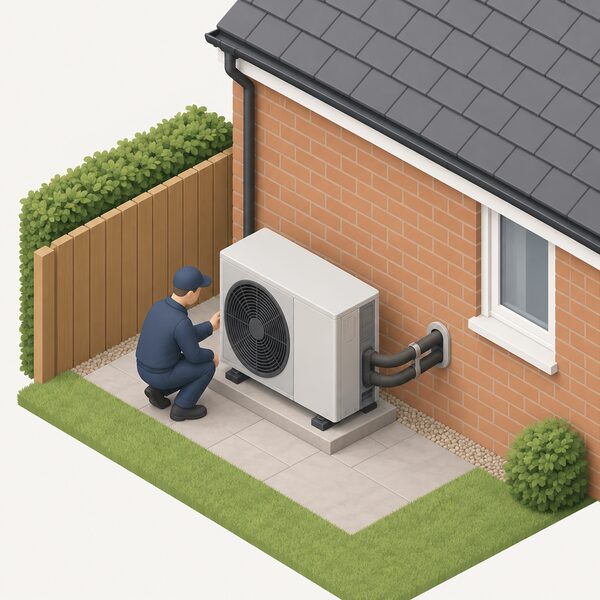
The UK heat pump market is dominated by air source, and specifically by air-to-water. Air-to-water heat pumps are the most common type currently installed in UK properties14. The installed stock reached 544,600 units by the end of 2024, which is 19 heat pumps per 1,000 households15. Against that backdrop, ground source is a specialist corner, and IVT is a specialist brand within it.
The manufacturing picture is also concentrated. There are at least 33 manufacturers supplying air source heat pumps in the UK, with Mitsubishi Electric, Vaillant, Daikin and Samsung accounting for nearly two-thirds of total annual UK sales16. The main companies manufacturing air source heat pumps in the UK in 2024 were Mitsubishi Electric, Vaillant, Ideal and Octopus Energy, with a combined 34% market share, and the UK's domestic manufacturing sector meets just over 30% of UK demand16. IVT does not appear in those figures, which is consistent with a brand sold through one agent into a niche segment.
For a household, the practical consequence is that IVT is not a brand a local installer will typically suggest unprompted. It is found by searching for ground source specifically, or by approaching the agent directly. The trade-off is a narrower support base in exchange for a range that has been designed around ground source rather than adapted from an air source platform.
The Greenline range: E-Series and C-Series explained
The UK range has centred on the Greenline HE family, with E-Series and C-Series designations appearing across the case studies and scheme offers. The E-Series models in the UK record include the E11 and E17, with outputs of 11kW and 17kW respectively, and the E14 appears in a Buckinghamshire barn conversion1. The C-Series appears as the C7 in a Monmouthshire replacement17.
Alto Energy has also promoted an IVT GEO range alongside the HE models, describing its IVT HE and IVT GEO product range in a 2023 article10. The AirX name appears in a separate recycling offer aimed at householders trading in an IVT Greenline unit18.
| Model | Output | UK installation example | Date |
|---|---|---|---|
| IVT Greenline HE E17 | 17kW, three phase | Nottinghamshire house rebuild | October 20171 |
| IVT Greenline HE E11 | 11kW | Lancashire new build | December 20172 |
| IVT Greenline HE E14 | Three phase | Buckinghamshire barn conversion | July 202012 |
| IVT HE E11 | 11kW | County Durham oil boiler replacement | March 202213 |
| IVT Greenline HE C7 | Not stated | Monmouthshire replacement under recycling scheme | May 201917 |
The pattern in the table is a range built around larger outputs. An 11kW unit is at the lower end of what appears in the UK record, and the E17 sits at the top. That reflects the properties the brand has been fitted to: detached rural homes and conversions with enough heat demand and enough land to justify a ground array.
How the heat pump draws heat from the ground or water
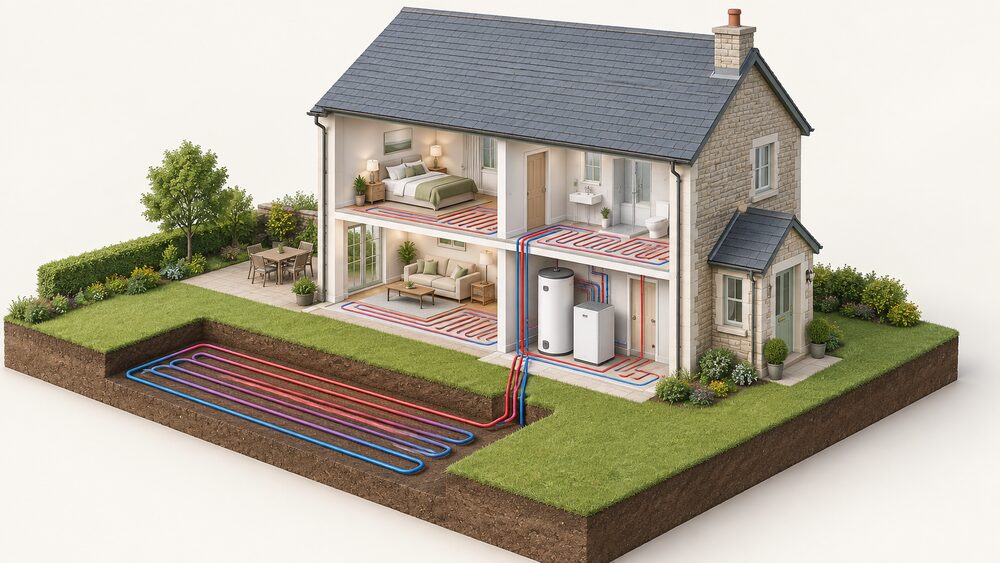
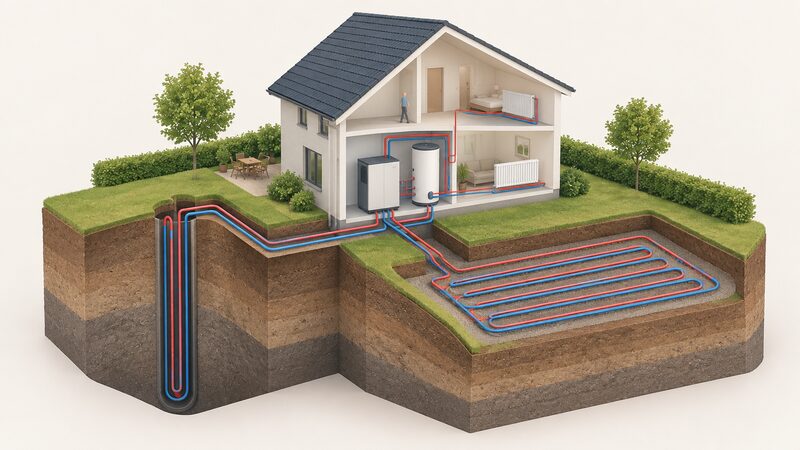
A heat pump extracts energy from the air, ground or water and converts it into heat19. Ground source units do this with a collector buried in the ground, either vertical or horizontal20. Water source heat pumps, which the Boiler Upgrade Scheme treats alongside ground source, use the energy stored in ground water, surface water, or sea or sewage water20.
The mechanics are straightforward. Ground source heat pumps use electricity to transport heat from the ground, compress it to a higher temperature and transfer it into a home via water in radiators or underfloor heating8. The extracted heat is usually distributed around the home via the hot water system, just like an air-to-water model21. That last point matters: a ground source heat pump is a wet system, so it needs emitters and a cylinder, not ductwork.
The advantage over air source is the stability of the source. Ground temperature at depth varies far less across the year than air temperature, so the unit works against a steadier input. The cost is the ground works: boreholes or a horizontal loop, which need space and a survey. Ground source heat pumps are mostly suited to large homes with lots of outdoor space8.
"They extract heat from the ground either by a vertical or horizontal collector."
What an IVT system means for household energy independence
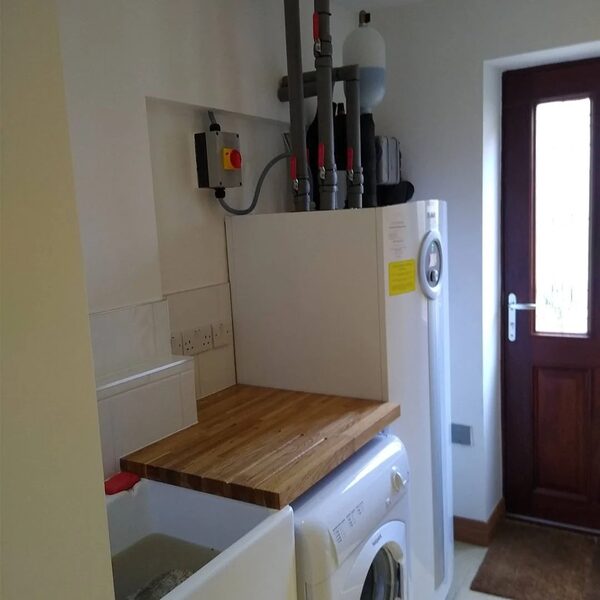
A ground source heat pump changes what a home depends on. It removes the fuel delivery, whether that was oil, LPG or mains gas, and replaces it with electricity, which can increasingly be generated on site. A heat pump is a versatile system capable of providing heating, cooling and hot water for homes, commercial buildings and industrial applications19. For an off-gas rural property, that is a genuine shift: no tanker, no tank, no flue.
What remains is electricity. The system runs on mains power, so the household still depends on a supplier and the grid, and on the electricity price rather than the oil price. That dependence can be reduced with solar and a battery, but it is not removed. The compressor, pumps and controls all draw power.
There is also a manufacturer dependence. IVT in the UK runs through a single agent, so spares, technical support and commissioning knowledge sit with that relationship rather than with a broad installer base. That is a real consideration for a system expected to run for many years. The ground loop itself is the most durable part of the installation and is not brand-specific, but the unit, its controls and its software are.
As fossil fuel boilers are slowly being phased out, heat pumps will become more common in the UK22. For a household with land and an off-gas property, ground source is the version of that transition with the least visible external equipment and the steadiest source temperature.
Grants, VAT and the cost picture
Ground source heat pumps are supported by the Boiler Upgrade Scheme8. The scheme's eligible technologies are air-to-water heat pumps, ground source heat pumps including water source heat pumps and shared ground loops, and biomass boilers7. Ground source heat pumps, including water source heat pumps and shared ground loops, are named explicitly in the installer guidance6.
The application route is installer-led. Your installer will apply for the grant on your behalf through Ofgem11. Vouchers for ground source heat pumps must be used within 6 months23. The grant is not paid to the household directly, and the installer has to be certified for the scheme.
On VAT, heat pump installations benefit from being exempt from VAT11. Ground source heat pumps are listed among the energy saving materials that qualify for a lower rate of VAT24. Water source heat pumps were added to the list of energy-saving materials that can qualify for the reduced rate, and to those qualifying for the temporary zero rate25. Where heating equipment work is funded through an energy efficiency grant, 5% VAT applies in Great Britain and Northern Ireland24.
On cost, there is no published IVT list price. Ground source installations are quoted after a survey, because the ground works dominate the total and vary with geology, access and loop type. Independent guidance puts air-to-water heat pumps at around £11,000 to install with a £7,500 Boiler Upgrade Scheme grant, bringing the average upfront cost to around £5,00016. Ground source systems carry additional ground works on top of that pattern, so the figure should be treated as context rather than a ground source price.
The IVT Heat Pump Recycling Scheme and trade-in discounts
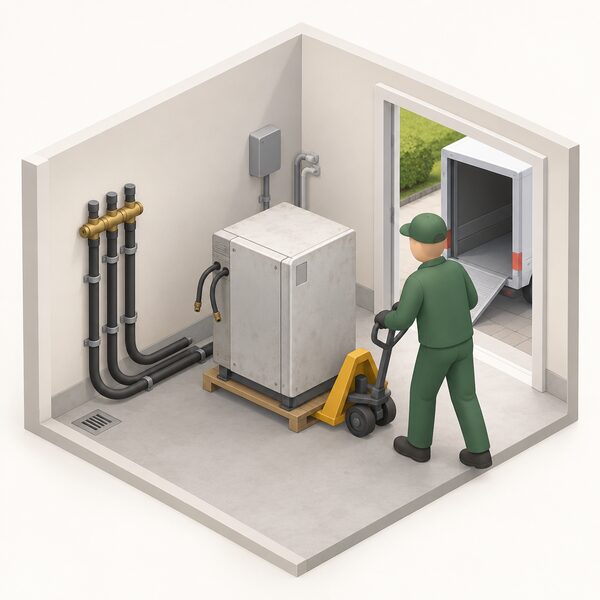
The recycling scheme is the most distinctive commercial feature of the IVT UK offer, and it has taken several forms. In February 2018 Alto Energy launched a scheme offering up to £1,200 off a new IVT heat pump when trading in an old unit, with free collection and recycling of the old heat pump3. A separate C-Series offer gave £1,000 off a new IVT Greenline HE C-Series to customers trading in an old heat pump of 15 years or more27. An E-Series offer advertised up to £1,200 off a new IVT Greenline HE E-Series heat pump and IVT DS300 cylinder on the same trade-in condition28. A further offer applied up to £1,200 off a new IVT AirX to householders trading in an IVT Greenline heat pump of 15 years or more18.
The scheme has been used in practice. In May 2019 Alto Energy replaced a customer's existing ground source heat pump with an IVT Greenline HE C7 under the IVT Heat Pump Recycling Scheme, saving £1,00017.
The logic of the scheme is that a ground source installation's ground loop outlives the unit. Replacing only the heat pump, and reusing the existing collector, is far less disruptive and less costly than a new installation, which is why a trade-in discount against an old unit of 15 years or more makes commercial sense for the supplier.
Choosing an installer and getting a system specified
It is advisable to contact an installer who can provide the necessary advice, preferably one who belongs to either the Microgeneration Certification Scheme or the relevant Competent Person Scheme29. That applies to heat pumps generally, and it is the condition that keeps a project eligible for grant support.
For a ground source system the specification work is heavier than for air source. The installer has to assess heat demand, decide between a vertical borehole and a horizontal collector, and size the ground array to the building's load and the ground's thermal properties. The collector choice is a function of available land and geology, not preference.
The application process runs in a fixed order:
- Get a quote from an installer, using the MCS find a heat pump installer tool or by contacting an energy supplier11.
- The installer applies for the grant on the householder's behalf through Ofgem11.
- The installation is completed and commissioned, and the voucher is redeemed within the scheme's validity period23.
For IVT specifically, the practical route is through the UK agent, which designs, supplies and commissions systems and has worked with developers, self-builders and homeowners across the UK31. A householder weighing the brand should establish early who will service the unit locally, what the spares position is, and whether the ground loop design has been signed off against the actual ground conditions.
Sources31 cited
- IVT ground source heat pump, Nottinghamshire, Alto Energy, 2017-10
- IVT ground source heat pump, Lancashire, Alto Energy, 2017-12
- IVT heat pump recycling scheme, Alto Energy, 2018-02
- Benefit from design expertise with our heat pump suppliers, Alto Energy, 2024-06-25
- Introducing our best selling ground source heat pumps, Alto Energy, 2022-08-18
- Boiler Upgrade Scheme guidance for installers v5.1, Ofgem, 2026-07-02
- Boiler Upgrade Scheme guidance for property owners v5 draft, Ofgem, 2026-03-25
- Ground source heat pumps, individual, Nesta, 2025-02-03
- Looking after your heat pump in winter, NIBE, 2026-09-17
- What are the advantages of ground source heat pumps, Alto Energy, 2023-01-16
- EHPA Market Report 2025 executive summary, European Heat Pump Association, 2025-07
- IVT ground source heat pump case study, Buckinghamshire, Alto Energy, 2020-07
- IVT ground source heat pump, County Durham, Alto Energy, 2022-03
- Heat pumps, CIBSE, 2026-09-17
- EINAS 2025: heat and buildings, Department for Energy Security and Net Zero, 2025
- Heat pumps vs boilers, Which?, 2025-09-22
- Ground source heat pump recycling scheme, Monmouthshire, Alto Energy, 2019-05
- IVT AirX recycling scheme, Alto Energy, 2018
- Heat pumps, Energy Saving Trust, 2026-06-11
- About heat pumps, European Heat Pump Association, 2026-04-24
- How heat pumps work: a guide for homeowners, NICEIC, 2025-09-17
- Boiler Upgrade Scheme installers, Ofgem, 2026-09-17
- Tax on shopping: energy saving products, GOV.UK, 2026-09-17
- VAT energy saving materials relief, GOV.UK, 2024-01-11
- Building regulations: heat pumps, Planning Portal, 2026-09-17
- The Value Added Tax (Energy Saving Materials) Regulations 2024, legislation.gov.uk, 2024-02-01
- IVT Greenline C-Series recycling scheme, Alto Energy, 2018
- IVT Greenline E-Series recycling scheme, Alto Energy, 2018
- Building regulations: heat pumps, Welsh Government, 2026-09-17
- Heat pump installations, GOV.UK, 2026-09-10
- Accredited heat pump installers for projects across the UK, Alto Energy, 2023-06-05