

In this guide
Glow-worm is a British heating brand owned by Vaillant, and it is one of the names a householder is most likely to find already attached to the boiler on the wall. The brand has been making heating equipment for more than 90 years, began producing boilers at the Derwent Foundry in Derbyshire, and remains rooted in Belper today1. Its parent company describes Glow-worm as offering more budget-friendly options than the boilers made under the Vaillant name2.
For anyone weighing a heat pump, the relevant part of the range is the GeniaAir air source heat pump, sold in 5kW, 7kW and 11kW outputs3. All three are specified with flow temperatures of up to 70 degrees C, which is the figure that makes them a candidate for renovation projects where existing radiators stay in place, and all three are tested in temperatures down to -25 degrees C4.
The brand therefore sits in an unusual position for household energy independence. A Glow-worm heat pump moves a home off gas and onto electricity, but it keeps a dependence on the grid, on an electricity supplier and on a manufacturer's app for remote control. A Glow-worm boiler keeps the home on the gas grid entirely. This page sets out what the range offers, what it costs, what the guarantees actually cover, and where the limits lie.
Glow-worm: a British brand under the Vaillant group
Glow-worm's ownership matters more than most brand histories, because it determines who honours the warranty and where the parts come from. The brand is owned by Vaillant, which positions it below its own name on price while keeping it inside the same group2. That makes Glow-worm a budget route into a Vaillant-group product rather than an independent manufacturer.
The British manufacturing story is genuine and long-running. Glow-worm began producing boilers at the Derwent Foundry in Derbyshire, and the brand remains rooted in Belper, with a heritage dating back to 19341. Independent guidance lists Glow-worm boilers among those that are British-made6. That matters for a household thinking about supply chains: a boiler assembled in the UK is easier to get parts for and service than one shipped in, though the group's engineering sits with Vaillant.
The brand has also appeared in UK heat pump research. A Heat Pump Ready Programme project called Glow Heat Pump Community was led by Hildebrand Technology Ltd, with partners including Build Test Solutions Ltd, NJV Limited, Richard Carmichael Research & Consulting Ltd, Davies and Mckerr Ltd and SE2 Limited7. That is a monitoring and demonstration project rather than a product endorsement, but it places the brand inside government-funded UK heat pump work.
For independence, the ownership structure cuts both ways. Being part of a large group means the warranty is backed by a company with a substantial UK manufacturing base, which is a form of security. It also means the household's relationship is with a manufacturer's registration platform, its approved installer network and its app, rather than with a local firm alone.
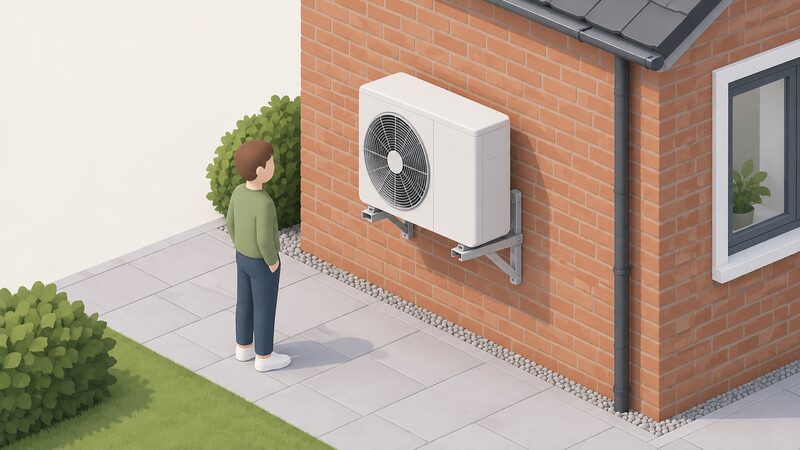
The GeniaAir range: 5, 7 and 11 kW air source heat pumps
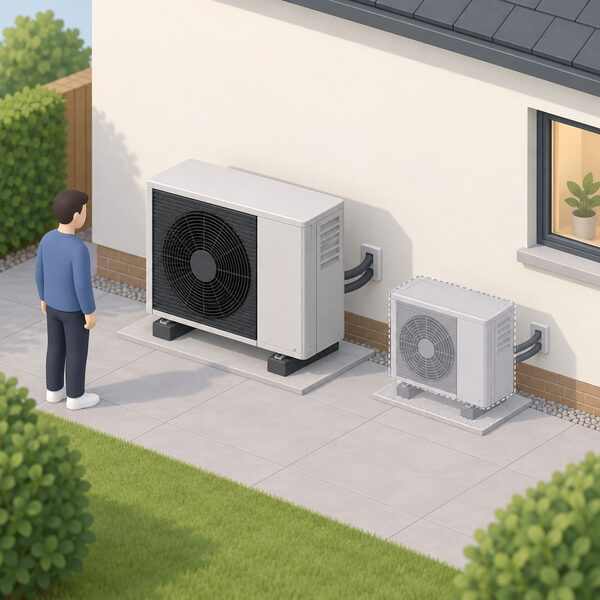
The GeniaAir is a monobloc-style air source heat pump sold in three outputs: 5kW, 7kW and 11kW3. The 5kW and 7kW units share the same physical footprint at 1,104 x 750 x 454mm, while the 11kW unit is larger at 1,169 x 1,103 x 454mm4. That difference is worth knowing before siting is decided, because the 11kW unit needs noticeably more wall space and clearance.
All three are listed on Quiet Mark, the noise certification scheme, as tested quiet products3. The 11kW unit uses R290 refrigerant, which the product listing gives a 100-year global warming potential of 0.024. R290 is the refrigerant now common in high-temperature heat pumps, and its low global warming potential is the reason it appears in this class of product.
| Model | Output | Dimensions (W x H x D) | Flow temperature | Cold weather test |
|---|---|---|---|---|
| GeniaAir 5kW | 5kW3 | 1,104 x 750 x 454mm3 | up to 70 degrees C3 | -25 degrees C3 |
| GeniaAir 7kW | 7kW5 | 1,104 x 750 x 454mm5 | up to 70 degrees C5 | -25 degrees C5 |
| GeniaAir 11kW | 11kW4 | 1,169 x 1,103 x 454mm4 | up to 70 degrees C4 | -25 degrees C4 |
Remote control runs through the MiGo Link app, which requires the MiPro Sense control and the MiGo Link internet gateway to be installed alongside the heat pump4. Without that chain, the heat pump still runs, but scheduling from away and energy monitoring do not. That is the clearest dependence the range creates: a working broadband connection, the manufacturer's servers and a phone app sit between the household and its own heating data.
Flow temperature: up to 70°C, tested to -25°C
The headline specification for the GeniaAir is a flow temperature of up to 70 degrees C, described by the maker as making the unit suitable for renovation projects and for delivering reliable warmth4. That figure is what allows a heat pump to be considered where existing radiators are being kept, because a system designed around a lower flow temperature usually needs larger emitters.
The wider evidence on flow temperature is more nuanced. The Product Characteristics Database records heat pump values at 35 degrees C, 45 degrees C and 55 degrees C, and the lower-temperature thresholds used in assessments are 45 degrees C or 35 degrees C design flow water temperature, as stated on the commissioning certificate and rounded to the nearest whole number8. Independent guidance puts standard or low temperature heat pumps at their most efficient when running at 35 to 45 degrees9, and underfloor heating is described as working well at a flow temperature of 35 to 40 degrees C10.
On cold weather, the GeniaAir's -25 degrees C test figure sits at the edge of what most current models manage. Independent guidance states that most current models work fine down to about -25 degrees C, while some advanced cold-climate heat pumps work in temperatures as low as -35 degrees C11. The GeniaAir is therefore at the mainstream figure rather than beyond it.
The practical point is that a 70 degrees C capability is a ceiling, not a target. A system that runs at 70 degrees C most of the winter will cost more to run than one designed to run at 45 degrees C, because efficiency falls as flow temperature rises. The design flow temperature recorded at commissioning is the number that determines how the system actually performs, and it is set from the home's heat loss rather than from the heat pump's maximum.
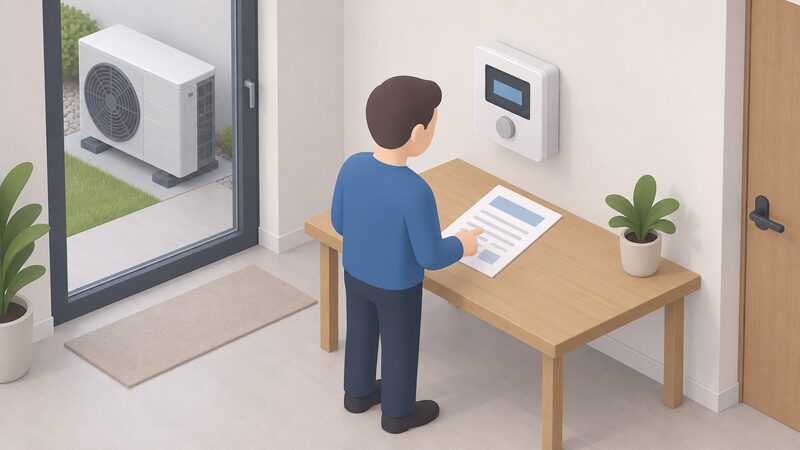
Sizing a GeniaAir to your home's heat demand
Choosing between 5kW, 7kW and 11kW is a question about the home, not about the brand. Heat pumps are described as suitable for almost all types of home, and the savings depend on what heating system is being replaced12. The output figure has to match the calculated heat demand at the design outdoor temperature, which is why two similar houses can need different units.
The design flow temperature and the heat loss calculation are linked. The lower-temperature thresholds used in assessments are 45 degrees C or 35 degrees C, recorded on the commissioning certificate8. A home with good insulation and generous emitters can be designed at 35 degrees C and will run more efficiently; a home with smaller radiators may be designed at 45 degrees C or higher, which reduces efficiency but keeps the existing emitters.
Where a wet system is not present at all, the picture changes. Air-to-air heat pumps may be a good option for smaller properties and flats13, and they are described as a practical option for smaller properties and apartments that lack wet heating systems14. The trade-off is hot water: with an air-to-air unit, an additional system in the home may be needed to deliver it15. The GeniaAir is an air-to-water product, so it serves both heating and hot water through a cylinder, which is why the extended guarantee is tied to a HydraCyl cylinder being fitted.
For a household, the sizing decision is the point at which independence is either gained or lost. An oversized unit cycles, runs inefficiently and costs more; an undersized one cannot hold temperature in a cold snap. Neither outcome is a fault of the brand. Both are settled by a heat loss survey before the order is placed, and the certificate that records the result is the document worth keeping.
Boilers alongside heat pumps: the wider Glow-worm range
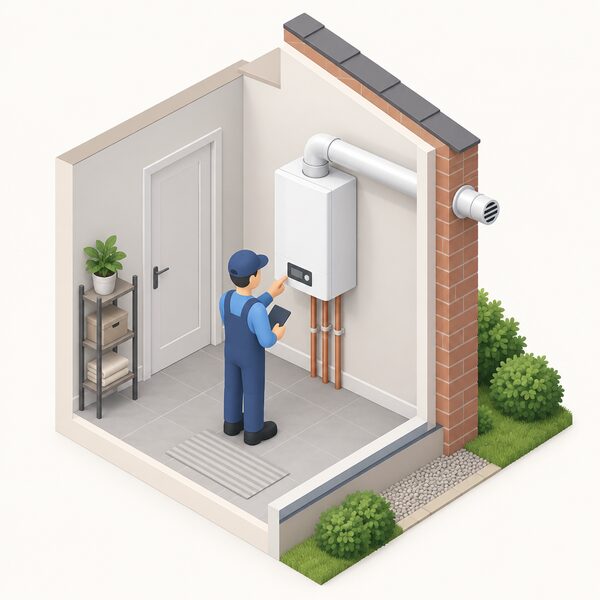
Glow-worm's boiler range is what most households will already know, and it is priced at the budget end. The Energy combi comes at £1,061 to £1,425 supply only, the Energy regular at £892 to £1,082, the Ultimate 3 combi at £550 to £600, the Ultimate 3 system and regular at £550 and £615, the Easycom 3 combi at £469 to £501, the Easycom 3 system at £430 and the Easycom 3 regular at £615, and the Compact combi at £421 to £4532. These are supply-only prices from an independent product review, not installed prices.
The range also connects to hybrid arrangements. Hybrid heat pumps can work with another heating system in a building, such as a gas boiler16, and Glow-worm's own Clearly Hybrid product was configured as a monobloc air unit17. A hybrid keeps the gas boiler as a backup for the coldest periods while the heat pump carries the milder majority of the year.
For grant purposes, the technology matters. The Boiler Upgrade Scheme covers ground source heat pumps, including water source heat pumps and shared ground loops18, and air-to-water heat pumps including exhaust air are within the scope of UK heat pump statistics20. Ground and water source heat pumps are also described in official guidance as able to augment existing heating systems in the same way as solar panels21. Air-to-air units sit outside the grant, which is why the wet-system GeniaAir is the relevant product for a grant-funded installation.
Efficiency: what the figures actually measure
Efficiency claims for heat pumps need care, because the figure depends on what is being measured. The Glow-worm boiler range is assessed on combustion efficiency, and the wider regulatory picture for oil-fired systems gives minimum figures of 91% for a wet heating regular boiler and 86% for a wet heating combi boiler23. Those are combustion benchmarks, not heat pump performance.
Heat pumps are measured differently, by the ratio of heat delivered to electricity consumed. The GeniaAir's efficiency in practice is governed by the flow temperature it runs at, which is why the design figure on the commissioning certificate matters more than any headline number. Independent guidance puts standard or low temperature heat pumps at their most efficient at 35 to 45 degrees9, and the PCDB records values at 35, 45 and 55 degrees C8.
One independent source gives 300 to 400%, another gives 200 to 400%, and the two figures have not been reconciled. Both describe the same physical relationship: a heat pump moves more heat than the electricity it consumes, and the ratio falls as the flow temperature rises and as outdoor temperatures drop.
What this means for a household is that the efficiency figure quoted at purchase is a design target, not a guarantee. A well-designed system running at 35 to 45 degrees C will sit at the upper end; one running at 70 degrees C in a poorly insulated house will sit at the lower end. The brand does not determine which of those two outcomes a home gets.
Warranty: 2 to 10 years depending on the model
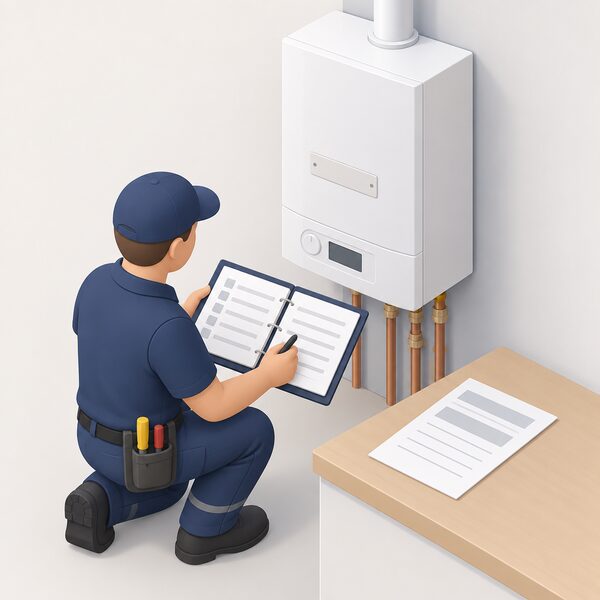
The guarantee terms differ sharply between the heat pump range and the boiler range, and within each. The GeniaAir heat pump carries a standard 2-year guarantee, extendable up to 5 years4. The extension is conditional: it applies when the unit is installed by a qualified installer with a HydraCyl cylinder and registered on myREWARDS4.
On the boiler side, the terms are longer. The Energy combi, Energy regular, Ultimate 3 combi, Ultimate 3 system and Ultimate 3 regular all carry a 10-year standard warranty, while the Compact combi, Easycom 3 combi, Easycom 3 system and Easycom 3 regular carry 5 years2. The extended warranty figures match the standard terms on those models, so the headline number is the one that applies.
For context, most heat pump systems come with a two to three-year warranty24, so the GeniaAir's standard term sits inside the normal band and its extended term sits above it. A well-maintained heat pump should last for 20 years or longer24, which means the guarantee covers only the early part of the unit's life. Servicing and system cleanliness determine what happens after that.
Registration is the step that activates the longer term, and it is the householder's responsibility to see it done. The serial number and the commissioning paperwork are what the registration route asks for, and the installer's benchmark logbook carries the same details.
Cost: supply-only boiler prices and installer-quoted heat pumps
Glow-worm boiler prices are published as supply-only figures by an independent product review: £421 to £453 for the Compact combi, £469 to £501 for the Easycom 3 combi, £550 to £600 for the Ultimate 3 combi, £1,061 to £1,425 for the Energy combi, £892 to £1,082 for the Energy regular, £430 for the Easycom 3 system, £550 for the Ultimate 3 system and £615 each for the Easycom 3 and Ultimate 3 regular models2. These are not installed prices, and installation adds labour, flue work and any system changes.
For heat pumps, the GeniaAir is sold through Glow-worm's own site and through retailers5. Grant funding changes the net position. The Boiler Upgrade Scheme is applied for by the installer on the householder's behalf through Ofgem, and a quote can be obtained through the MCS find a heat pump installer tool or from an energy supplier25. Government grant information is also available through the Clean Energy website26.
The grant route has a limit worth stating plainly. Air-to-air heat pumps do not receive the Boiler Upgrade Scheme grant, which is why the wet-system GeniaAir is the product that fits a grant-funded installation. For a household in a flat without a wet system, an air-to-air unit may be the practical option13, but it will not attract the grant.
On VAT, official guidance treats ground source and water source heat pumps as able to augment existing heating systems in the same way as solar panels21, which places them within the energy-saving materials rules. The VAT position on a specific installation is a matter for the installer's invoice, and the published boiler prices above should be read as quoted rather than as confirmed VAT-inclusive figures.
Where the range has limits

The limits fall into three groups: technical, contractual and informational. Technically, the GeniaAir's -25 degrees C test figure is the mainstream figure rather than an exceptional one, since most current models work down to about that temperature and some advanced cold-climate units reach -35 degrees C11. A household in an exposed location should treat the test figure as the boundary of normal operation, not as a margin.
Contractually, the longest guarantee depends on a cylinder and a registration platform. The 5-year GeniaAir term requires a HydraCyl cylinder and myREWARDS registration4, and the boiler terms vary from 5 to 10 years by model2. A household that changes installer, or that fits the heat pump without the specified cylinder, gets the shorter term.
Informationally, diagnosis stays with the manufacturer. On heat pumps, a common fault is a heating blocked message, which might mean the unit is running at temperatures that are too high, and the recommended action is to check the fault log for recurring messages and speak to the installer and the manufacturer27. That route runs through the maker's own systems rather than through an independent third party.
The dependence that remains after installation is therefore threefold: the electricity grid and a supplier for power, the manufacturer's app and servers for remote control and monitoring, and the manufacturer's registration platform for the guarantee. None of those is unusual for the sector, and none of them is removed by choosing this brand over another. What a heat pump does change is the fuel: it takes the home off the gas grid, which is the largest single step a household can take towards energy independence.
Sources27 cited
- Glow-worm brand page, Quiet Mark, 2026
- Glow-worm boilers review, Which?, 2025
- Glow-worm GeniaAir 5kW air source heat pump, Quiet Mark, 2026
- Glow-worm GeniaAir 11kW air source heat pump, Quiet Mark, 2026
- Glow-worm GeniaAir 7kW air source heat pump, Quiet Mark, 2026
- Different boiler types, Uswitch, 2026
- Heat Pump Ready Programme Stream 2 projects, GOV.UK, 2026
- Low temperature heating, NCM PCDB, 2026
- An introduction to heat pumps, Which?, 2025
- Heat pumps, CAT, 2025
- Heat pump fact check, Energy Saving Trust, 2026
- Heating your home: heat pumps, Energy Saving Trust, 2026
- Air-to-air heat pumps, Nesta, 2025
- Air-to-air heat pumps added to Boiler Upgrade Scheme, HHIC, 2026
- Air-to-air heat pumps, MCS, 2026
- Heat pumps, nidirect, 2025
- Domestic hybrid heat pumps, BEIS, 2016
- Boiler Upgrade Scheme guidance for installers, Ofgem, 2026
- Boiler Upgrade Scheme guidance for installers v5.1, Ofgem, 2026
- From carbon to competitiveness, HPA UK, 2026
- VAT energy saving materials VENSAV3080, HMRC, 2026
- VAT energy saving materials VENSAV3081, HMRC, 2026
- Approved Document L Volume 1 consultation, Welsh Government, 2025
- Heat pumps, Home Energy Scotland, 2026
- Heat pump installation, Clean Energy Campaign, 2026
- Homes and energy, Manchester City Council, 2026
- How to ensure a heat pump runs efficiently, Energy Saving Trust, 2026
 Glow-Worm boilersGlow-Worm gas boilers for UK homes: the combi, system and regular range, supply-only and installed prices, lifespan, warranty registration and the Gas Safe rules that apply.