In this guide
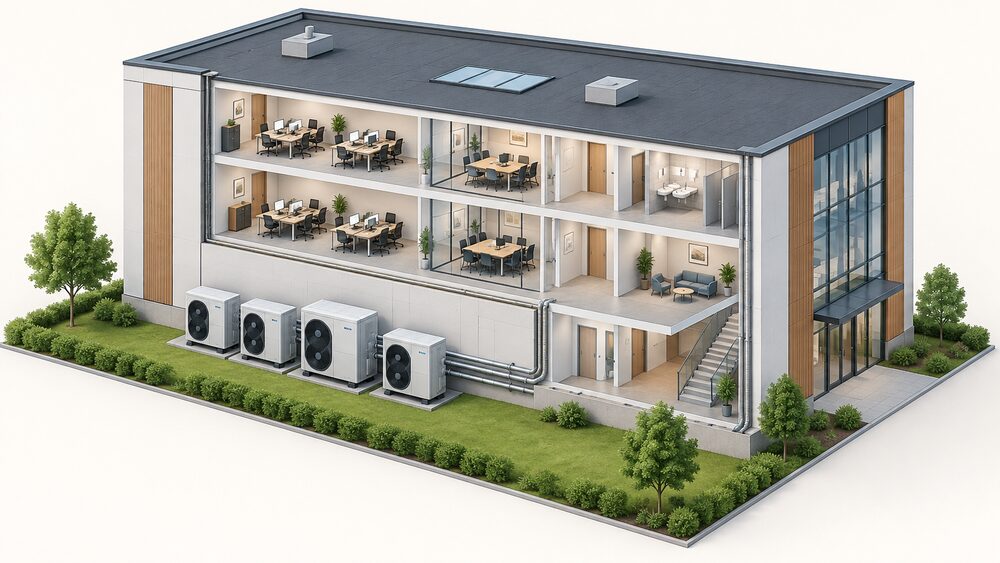
Amicus is the electrification range of Lochinvar, a UK heating manufacturer whose product lines cover heat pumps, electric water heaters and solar thermal solutions1. The range divides into air source models (Low Temperature and High Temperature), water source models (Boost), the AquaStore heat pump water heater, and the Altus 112, announced in January 2026 as a modular air-to-water heat pump for commercial applications.
The published specifications point at commercial and larger buildings rather than the domestic market. The High Temperature model lists a heating capacity of 219kW and a cooling capacity of 184kW, with a maximum output of 63 degrees C and up to six units in cascade1. The LAHP-292HTS datasheet gives a 28.5 kW heating capacity on a 400/3+N/50 three-phase supply, a COP of 4.17 W/W and a minimum water content of 300 litres in the user circuit2.
For a household, the practical question is whether any of this fits a single-phase domestic installation. The evidence in the published figures says the largest models do not, and the smaller air source and water source categories are where a domestic comparison would start. What follows sets out each part of the range, the temperatures and system types it supports, and what the equipment implies for a home's energy independence.
The Amicus range: what Lochinvar makes and who it suits
Lochinvar describes its electrification portfolio as "our range of heat pumps, electric water heaters and solar thermal solutions"1. That is a wider brief than a domestic heat pump catalogue. The categories listed on the range page are Air Source Heat Pumps, Electric Water Heaters and Electrification, with the Low Temperature and High Temperature air source models sitting under the first, the AquaStore under the second, and the Boost water source range under the third1.
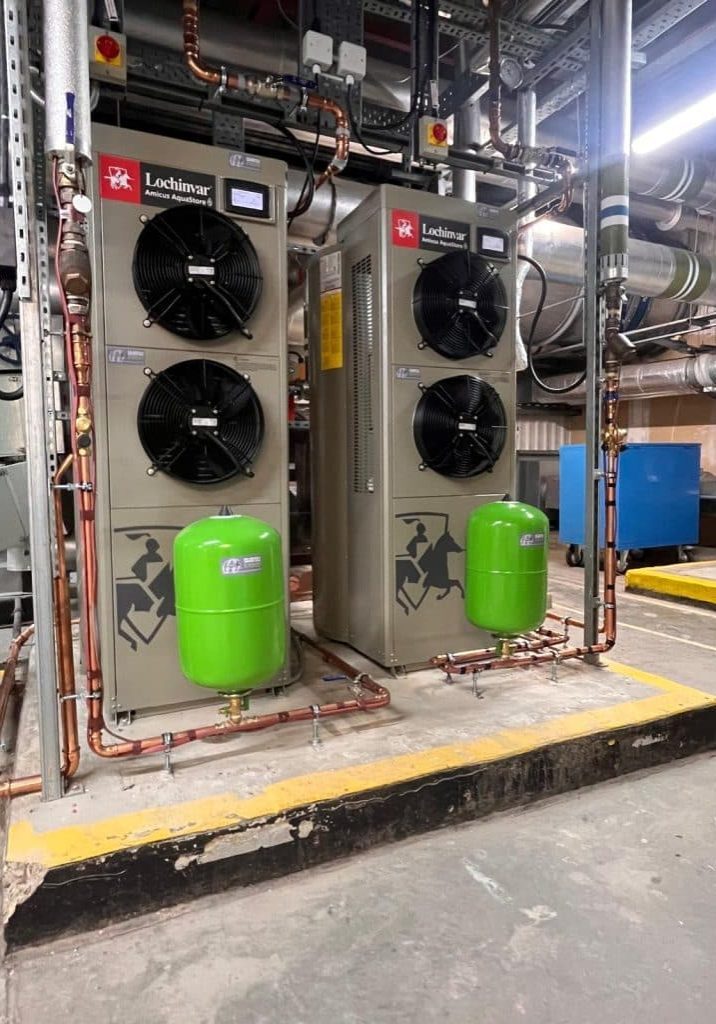
The scale of the equipment is the clearest guide to who it suits. The High Temperature model is externally positioned, reaches 219kW in heating and 184kW in cooling, and can be cascaded up to six units1. The LAHP-292HTS is a 28.5 kW machine with two compressors, two capacity steps and a minimum capacity step of 50%, and it needs 300 litres of water content in the user circuit2. These are figures for plant rooms, communal systems and commercial buildings, not for a semi-detached house.
That does not make the range irrelevant to a householder researching heat pumps. It sets a boundary. A domestic installation normally works in single figures to the low tens of kilowatts, on a single-phase supply, with a cylinder sized to the occupants rather than to a circuit volume. The Amicus range as published sits above that line, and the categories a home would compare against are covered in the wider guide to air source heat pumps and water source heat pumps.
Amicus Low Temperature: low-temperature air-to-water heat pumps
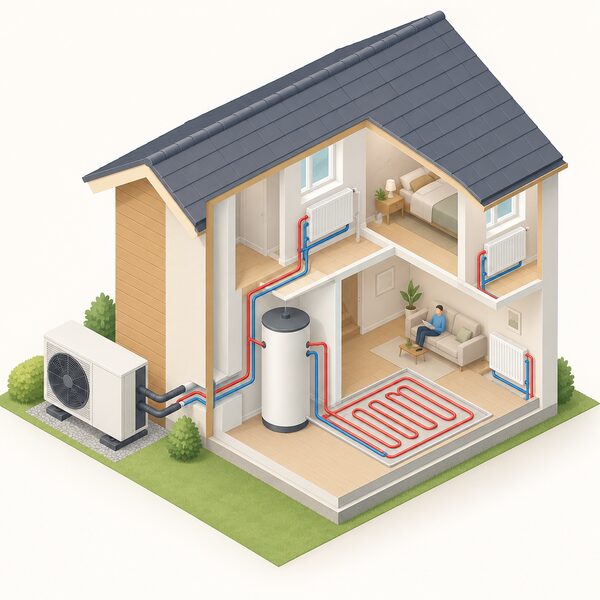
The Low Temperature range is listed under Air Source Heat Pumps and Electrification, with a stated maximum output of 60 degrees C and system compatibility of 2-pipe and 2-pipe reversible1. That places it in the air-to-water family: it heats water, which then serves the building's emitters, rather than heating air directly.
Air-to-water heat pumps "tend to heat water to lower flow temperatures than boilers", which is the defining characteristic of the category and the reason emitter sizing matters3. Independent guidance on system design puts the target at supplying flow temperatures of only 40 to 45 degrees to radiators when it is minus 3 degrees outside, which is a long way below the 60 to 70 degrees C that conventional radiators were sized around4. A 60 degrees C maximum output therefore sits at the top of the low-temperature band rather than in the middle of it.
The reversible variant adds cooling. Independent guidance notes that a hydronic air-to-water heat pump needs the right sort of emitters to make the most of cooling, naming heat pump convectors and underfloor heating5. That is a design point rather than a product point: a system that cools through the same pipework needs emitters that can handle condensation risk and lower flow temperatures.
Air-to-water heat pumps, including exhaust air residential space heating, are counted within the deployment statistics that track the UK market, so the category is well established6. For a household, the Low Temperature model's relevance is as a reference point for what a 60 degrees C ceiling means in practice: workable with a well-sized emitter system, less so as a drop-in replacement for a boiler running hotter.
Amicus High Temperature: a 63 degrees C output for existing radiator systems
The High Temperature model is the part of the range aimed at buildings whose radiators were sized for a boiler. It lists a maximum output of 63 degrees C, a heating capacity of 219kW, a cooling capacity of 184kW, operating temperatures of minus 20 degrees C in heating and plus 40 degrees C in cooling, and system compatibility of 2-pipe, 2-pipe reversible and 4-pipe1. Up to six units can be cascaded1.
The 63 degrees C figure is the one that matters for retrofit. Independent guidance states that homes with high-temperature heat pumps, which operate at around 60 degrees C, are less likely to need radiator upgrades7. Against the 60 to 70 degrees C that conventional radiators were designed around, a 63 degrees C output sits inside that band8. That is the argument for the category: it reduces the emitter work that a lower-temperature machine would require.
The trade-off is efficiency. The same independent guidance states plainly that these heat pumps are generally less efficient than low-temperature heat pumps7. Official consultation work sets the test point for a high-temperature heat pump at delivering its declared capacity for heating at an indoor heat exchanger outlet temperature of 65 degrees C, which is the standard the category is measured against9. MCS has also moved to define heat pumps as Low, Intermediate, Medium or High temperature, so the labels now carry a defined meaning rather than a marketing one10.
For a household, the honest reading is that a high-temperature machine buys compatibility at the cost of running efficiency, and the size of that cost depends on the building. The wider subject is set out in high-temperature heat pumps.
"These heat pumps are generally less efficient than low-temperature heat pumps."
Amicus Boost: water source heat pumps for hybrid heating and hot water
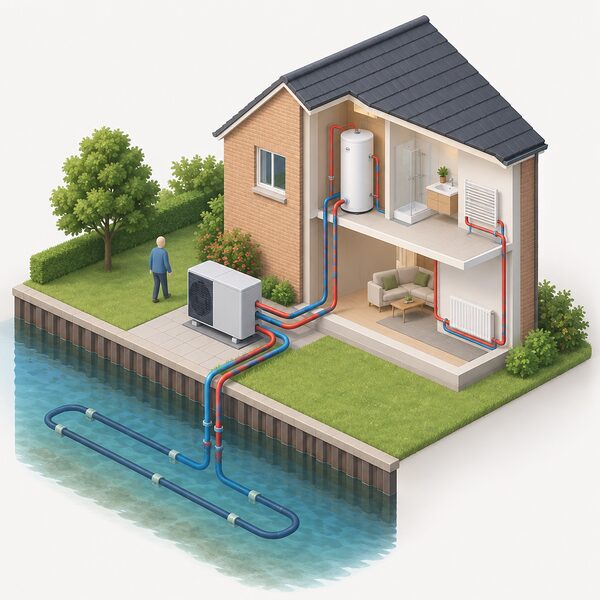
The Boost range is listed under Electrification and Water Source Heat Pumps1. Water source heat pumps take their heat from water rather than air: independent guidance describes them absorbing warmth from nearby water sources like rivers, lakes and canals, and using the heat energy from water to provide heating and hot water for the home11. The stated benefits are an efficient and low carbon source of heating, the ability to heat the home and provide hot water, and reliable performance throughout the year12.
The hybrid angle is where the Boost range is positioned. Official guidance notes that water source heat pumps can also be used to augment existing heating systems in the same way as solar panels13. That is a different proposition from a full replacement: the heat pump contributes to a system that already has another heat source, rather than carrying the whole load.
The policy framework recognises the arrangement. Warm Homes: Local Grant rules list hybrid heat pumps, retrofit and packaged only and for mains gas heated homes, among the eligible low carbon heat measures, alongside air source heat pumps, ground source heat pumps, shared ground loops, high heat retention storage heaters and biomass boilers14. Northern Ireland guidance states that hybrid heat pumps can work with another heating system in a building, such as a gas boiler15.
Water source heat pumps are also eligible heating systems under the Domestic Renewable Heat Incentive, which is the older support scheme for the technology16. The practical constraint is the water source itself: a river, lake or canal has to be available, accessible and permitted, which rules the option out for most homes. The wider subject is covered in water source heat pumps and hybrid heat pumps.
Amicus AquaStore: the heat pump water heater
The AquaStore is listed under Air Source Heat Pumps, Electric Water Heaters and Electrification, with a stated maximum output of 65 degrees C1. It is a heat pump water heater rather than a space heating appliance: it produces hot water and nothing else.
That places it in a distinct category. Heat pumps generally can provide domestic hot water, and air source heat pumps can heat water as well as the home17. A water-only heat pump cylinder does that job without touching the space heating circuit, which suits buildings that already have a heating system they are keeping, or where hot water is the dominant load.
The 65 degrees C maximum output is the highest in the Amicus range as published, above the 63 degrees C of the High Temperature model and the 60 degrees C of the Low Temperature model1. Hot water storage generally needs to run hotter than space heating to manage legionella risk and to deliver usable volumes, so a higher ceiling on a water-only product is consistent with its purpose.
For a household, the equivalent domestic category is the heat pump cylinder, covered in hot water heat pumps and hot water cylinders for heat pumps. The AquaStore's published specification is at commercial scale, but the principle, that a heat pump can serve hot water on its own, is the same one those pages describe.
Amicus Altus 112: the newest addition to the range
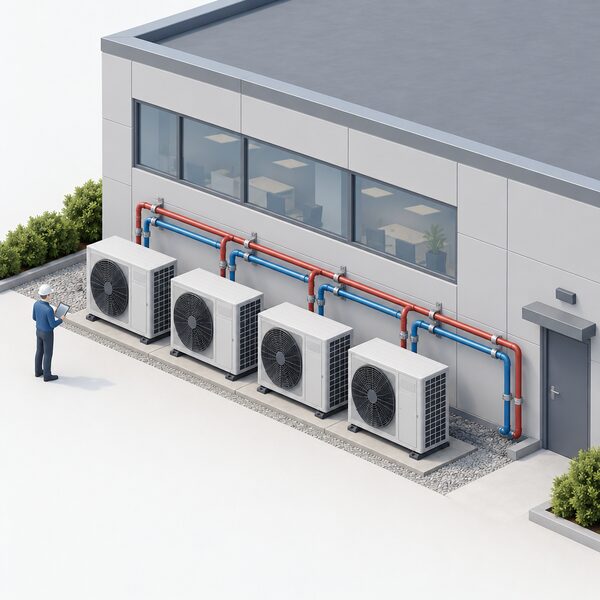
The Altus 112 was announced in January 2026 as an all new modular air-to-water heat pump for commercial applications. It is the most recent addition to the electrification range and continues the pattern of the rest of the portfolio: air-to-water, modular, and aimed at commercial buildings rather than homes.
Modularity is the design idea. The High Temperature model already supports up to six units in cascade, which is the same principle of building capacity from repeated units rather than one large machine1. A modular approach lets a system be sized to the building and extended later, and it keeps individual units within transportable and serviceable dimensions.
There is no published domestic specification for the Altus 112 in the material available, and no price. For a householder, the announcement is context rather than a purchasing option: it shows where the manufacturer is investing, which is commercial electrification of heat and hot water. The domestic equivalents of that direction are covered across the heat pumps guide.
Specifications and system compatibility
The published figures for the two named models show how far apart the range's ends sit. The LAHP-292HTS is a single 28.5 kW machine with a detailed datasheet; the High Temperature model is a 219kW unit that cascades. Both are three-phase or large-scale plant.
| Specification | Amicus High Temperature | Amicus LAHP-292HTS |
|---|---|---|
| Heating capacity | 219kW1 | 28.5 kW2 |
| Cooling capacity | 184kW1 | 29.8 kW2 |
| Maximum output temperature | 63 degrees C1 | Not stated |
| Operating temperatures | minus 20 degrees C heating, plus 40 degrees C cooling1 | Not stated |
| System compatibility | 2-pipe, 2-pipe reversible, 4-pipe1 | 1 circuit2 |
| Power supply | Not stated | 400/3+N/50 V/Ph/Hz2 |
| COP | Not stated | 4.17 W/W2 |
| SCOP | Not stated | 3.13 high temperature2 |
| Energy label | Not stated | A++ low temperature2 |
| Seasonal efficiency | Not stated | 152% low temperature2 |
| Refrigerant | Not stated | R410A2 |
| Compressors | Not stated | 22 |
| Capacity steps | Up to 6 in cascade1 | 2, minimum step 50%2 |
| Maximum input current | Not stated | 25.4 A standard unit2 |
| Peak input current | Not stated | 56 A with soft start fitted2 |
| Minimum water content | Not stated | 300 litres in the user circuit2 |
| Design air flow rate | Not stated | 9030 m3/h cooling2 |
Two figures in the LAHP-292HTS datasheet are disputed within the same document. Seasonal efficiency is given as both 152% and 122%, peak input current as both 56 A and 84.6 A, design air flow rate as both 9030 m3/h and 9390 m3/h, and pressure drop as both 36.1 kPa and 28.2 kPa.
On controls, independent guidance notes that heat pumps support automated controls that optimise performance, and smart meter arrangements are part of the wider picture for any electrically heated home19. The Amicus range page does not publish a controls specification.
What Amicus equipment means for household energy independence
The independence question for any heat pump is what it removes and what it leaves. A heat pump that runs on electricity takes a building off gas for heating, which is the main shift: the household stops buying a fuel that is largely imported and starts buying electricity, which is increasingly generated domestically. Independent analysis states that insulating homes and running electric heat pumps and cars on an even split of wind and solar would boost energy independence20.
What remains is the grid and a supplier. A heat pump does not store energy; it converts it, and it does so when the grid supplies power. The dependence that stays is on the electricity network, on a tariff, and on the reliability of both. For off-gas homes, the alternative to a heat pump is usually a more expensive and higher-carbon fuel, and independent guidance for rural homes notes that installing a heat pump or other home energy upgrades can reduce energy costs21.
There is also a performance dependence that is specific to the technology. Independent guidance states that for newer products such as heat pumps, performance benefits will depend on people understanding the correct way to use the technology in their homes22. That is a real limit: a well-specified machine run badly underperforms, and the household carries that risk rather than the manufacturer.
For the Amicus range specifically, the independence gain is a commercial-scale one. A building that replaces a gas-fired water heater with an AquaStore, or a gas boiler plant with cascaded High Temperature units, moves its heat load onto electricity and off gas. The dependence that remains is the same grid and supplier dependence, plus the manufacturer for parts and service, and the three-phase supply for the larger models. Households weighing the domestic version of that trade-off have a wider field to compare, set out in heat pumps and household energy independence and replacing a gas, oil or LPG boiler with a heat pump.
Sources22 cited
- Electrification product ranges, Lochinvar, 2026
- LAHP-292HTS technical submittal, Lochinvar, 2023
- Planning for your boiler's replacement, Which?, 2026
- Heat pumps, Centre for Alternative Technology, 2025
- Renewable heating: what are the options for your home, Energy Saving Trust, 2024
- From Carbon to Competitiveness, Heat Pump Association, 2026
- Will I need bigger radiators or underfloor heating?, Nesta, 2025
- Low energy buildings, Centre for Alternative Technology, 2025
- Raising minimum standards for heat pumps: options assessment, Department for Energy Security and Net Zero, 2024
- Consultation MCS 026: Seasonal Coefficient of Performance calculator, MCS, 2025
- Ground and water source heat pumps, MCS, 2026
- Water source heat pumps, Energy Saving Trust, 2024
- VAT energy saving materials and grant funded heating supplies: VENSAV3081, HM Revenue and Customs, 2026
- Warm Homes: Local Grant policy guidance, Department for Energy Security and Net Zero, 2026
- Heat pumps, nidirect, 2025
- Eligible heating systems, Ofgem, 2025
- Heating your home, Energy Saving Trust, 2026
- Sustainable home energy solutions, Planning Portal, 2024
- Smart meters, MCS, 2026
- Household energy buying British, Energy and Climate Intelligence Unit, 2024
- Support for people in rural homes, Home Energy Scotland, 2026
- Response to BEIS call for evidence on energy related products, Citizens Advice, 2020