In this guide
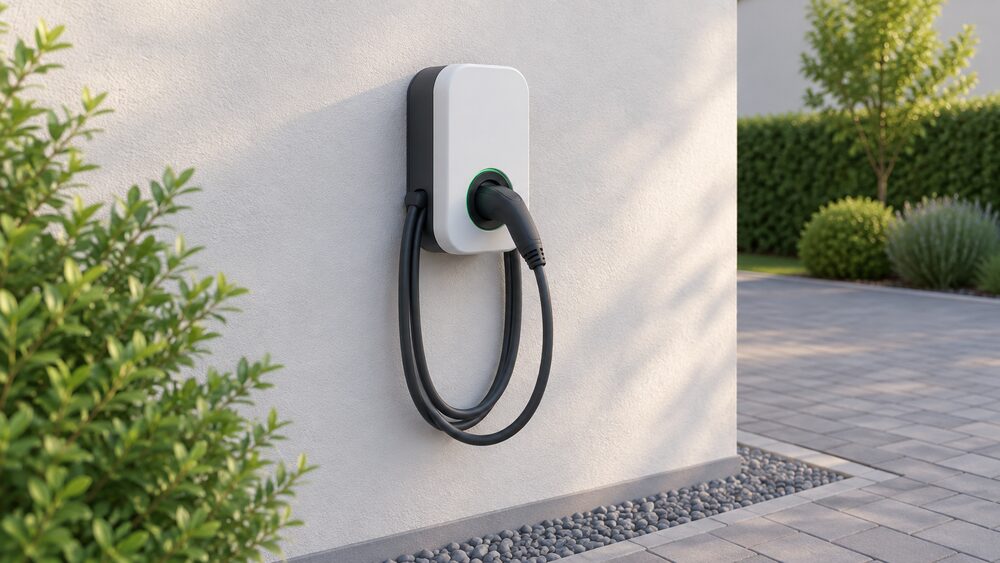
An EVlink home charger is one of the domestic wallboxes sold under Schneider Electric's EVlink name, and most people arriving at this page want one of two things: the user guide for the unit on their wall, or confirmation of which firmware and which document applies to which model. Schneider Electric publishes the guides itself, as PDFs on its product information portal, and the two domestic documents sit under different product sections rather than replacing one another.
The EVlink Home Smart device user guide dates from February 2024 and sits under the Wiser EU section. It covers commissioning, pairing with the Wiser app, tariff configuration and technical data for the charger and its anti-tripping modules. A second guide, published in May 2026, sits under Wiser Home and covers eSetup commissioning for the France and International variants, Wiser Home app pairing, charging modes and technical data.
The firmware question is separate and belongs to a different product. From January 2026 the EVlink Pro AC charging station firmware must be version 1.3.10 minimum, a requirement set out in Schneider Electric's eMobility infrastructure commissioning guide. The Pro AC is the commercial side of the range, and no published statement extends that floor to the domestic units, or excludes them.
The EVlink Home range at a glance
The domestic EVlink line sits in a crowded market. More than 50 manufacturers provide charging units suitable for EV charging at home, and there are estimated to be around 1 million home EV chargers in the UK1. Schneider Electric is one of the larger electrical equipment makers in that group, and the EVlink name covers both domestic wallboxes and commercial charging stations, which is the source of most of the confusion around the documentation.
The split matters because the two halves of the range are documented separately. The domestic units are documented under the Wiser sections of Schneider Electric's product information portal, alongside the Wiser home energy products. The commercial charging stations are documented under the eMobility infrastructure section, which is where the commissioning guide and the firmware requirement live.
For a householder, the practical consequence is that searching for "EVlink" documentation can land you on a commercial commissioning guide that has nothing to do with a wallbox on a driveway. The domestic guides are named for the model and the app they pair with, so the model name on the unit and the app name on the box are the two things worth checking before downloading anything.
Home chargers themselves come in two physical forms: tethered, which come with a cable and connector installed, and untethered, which just have a socket where a cable plugs in4. The EVlink Home Smart documentation covers charging modes and technical data rather than cable options, so the form of the unit is a question for the supplier rather than the guide.
EVlink Home Smart: the device and its user guide
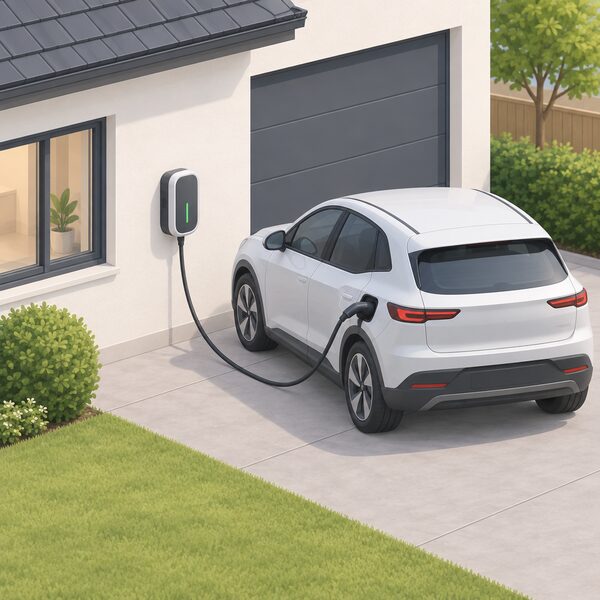
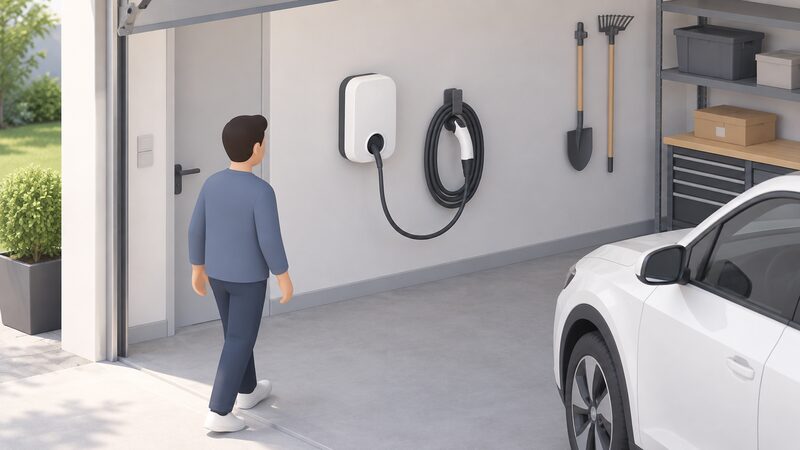
The February 2024 document is the one to look for if your charger pairs with the Wiser app. It is titled EVlink Home Smart device user guide and sits under the Wiser EU section of Schneider Electric's product information portal. It is a PDF download rather than a web page, which means it does not update in place: the edition you download is the edition you have.
What the guide covers is commissioning, Wiser app pairing, tariff configuration and technical data for the charger and its anti-tripping modules. Those four areas map onto the questions a householder actually has after installation. Commissioning covers getting the unit into service. App pairing covers the link between the charger and the phone. Tariff configuration covers the settings that let the charger work with a time-of-use electricity tariff, which is the main reason a household would want a smart charger in the first place. Technical data covers the electrical specification.
The anti-tripping modules are worth noting because they are the part of the system that manages load. A charger drawing 7kW alongside an electric shower, an oven and a heat pump can exceed the capacity of a domestic supply, and the modules exist to prevent that. The guide documents them as part of the charger system rather than as separate accessories.
Installation itself is not a documentation question. Building regulations approval is always required when installing an EV home charger, and a competent and reputable installer should be used, with specific processes for notifying the local building control authority3. Installing a home charger is classified as development, so it is up to the householder to ensure the correct permissions are in place6. Local planning authorities may also publish free Technical Advice Notes that cover EV charging installations, available on the relevant authority's website7.
EVlink Home Smart Wiser: the updated guide and how it differs
The May 2026 document is a different guide for a different pairing. It sits under the Wiser Home section rather than Wiser EU, and it covers eSetup commissioning for the France and International variants, Wiser Home app pairing, charging modes and technical data. Where the 2024 guide documents the Wiser app, the 2026 guide documents Wiser Home.
The differences are not cosmetic. eSetup commissioning is a different commissioning route from the one in the 2024 document, and the app pairing instructions differ because the app differs. Charging modes appear as a documented topic in the 2026 edition, which suggests the unit exposes selectable charging behaviour to the householder through the newer app.
The Wiser Home ecosystem itself is a broader home energy platform. The Wiser 1 Channel 2nd Generation kit, for example, offers Eco, Comfort and Away modes plus Moments scheduling8. A charger that pairs with Wiser Home is joining a system that already manages heating and hot water scheduling, which is the point of the pairing: one app for the house rather than one app per device.
Which guide applies to a given unit depends on which app it was supplied to work with, and the two documents do not supersede one another. A householder with a Wiser EU unit still needs the 2024 guide. A householder with a Wiser Home unit needs the 2026 guide. The model name on the unit and the app name on the packaging are the two identifiers that settle it.
| Guide | Published | Section | Covers |
|---|---|---|---|
| EVlink Home Smart device user guide | February 2024 | Wiser EU | Commissioning, Wiser app pairing, tariff configuration, technical data, anti-tripping modules |
| EVlink Home Smart device user guide | May 2026 | Wiser Home | eSetup commissioning (France and International variants), Wiser Home app pairing, charging modes, technical data |
Firmware: the minimum version requirement for EVlink Pro AC
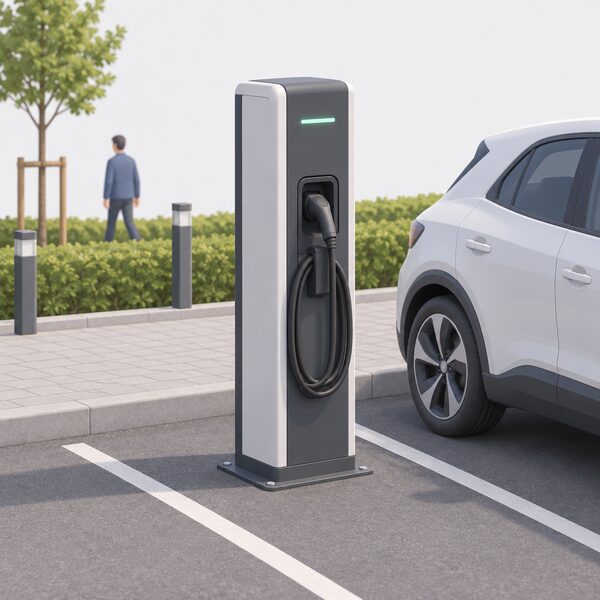
From January 2026 the EVlink Pro AC charging station firmware must be version 1.3.10 minimum. That requirement is set out in Schneider Electric's eMobility infrastructure commissioning guide, which is the document covering installation and configuration of the commercial charging stations. It is a floor rather than a target: a unit running older firmware falls outside the published commissioning requirement.
The Pro AC is not a domestic wallbox. It belongs to the commercial and fleet side of the EVlink range, and the commissioning guide that carries the firmware rule is written for that context. No published statement extends the January 2026 floor to the domestic EVlink Home Smart units, and none excludes them either. A householder with a Pro AC unit on the premises should treat the requirement as applying; a householder with a Home Smart unit has no published equivalent to work from.
Firmware floors of this kind are common across home energy equipment, and they usually exist because a feature or a safety behaviour depends on the newer software. SolarEdge, for instance, publishes a minimum firmware bundle version of 4.23.36 and above for its home battery alongside a MySolarEdge app version of 2.37 and above9. Victron publishes a minimum GX device firmware of v2.42 for new systems, and a minimum Venus firmware of v3.50 for a list of compatible batteries10. The pattern is the same: the maker sets a version below which the equipment is not supported in the configuration being described.
What that means in practice is that firmware is a maintenance item rather than a one-off. A charger commissioned in 2025 may need updating to meet a requirement that took effect in January 2026, and the update route runs through the maker's own tools rather than through the householder's app.
Documentation: where Schneider Electric publishes EVlink guides
Schneider Electric publishes the EVlink guides on its product information portal, as PDFs, under sections named for the product family. The domestic guides sit under the Wiser sections. The commercial commissioning guide sits under the eMobility infrastructure section. There is no single index page that gathers them.
That structure is worth understanding because it explains why the two domestic guides are easy to confuse. They carry the same document title, EVlink Home Smart device user guide, and differ only in the section they sit under and the app they document. The file names carry the distinguishing words: one is marked Wiser SE, the other Wiser Home.
Official documentation of this kind is not the only source a householder will meet. The Office for Zero Emission Vehicles introduced the residential landlord chargepoint grants, with the Energy Saving Trust delivering webinars on them11. Ofgem publishes licence guidance covering smart metering, switching, and metering, billing and payments, all as guidance documents rather than regulations12. The pattern across the sector is that the regulator and the grant administrator publish process guidance, while the equipment maker publishes the technical documentation for its own products.
For a householder, the practical rule is to match the document to the model and the app. The model name is on the unit. The app name is on the packaging or in the app store listing. The guide that names both is the right one.
What an EVlink Home charger means for household energy independence
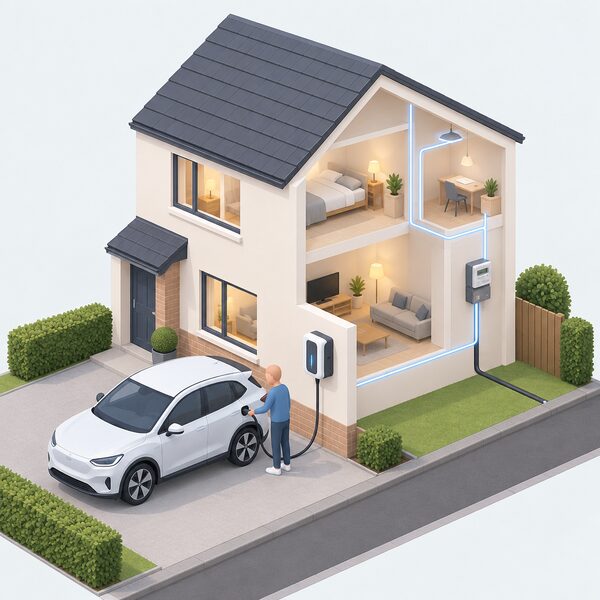
A home charger moves most of a household's car fuelling onto its own electricity supply, which is the main independence gain. It is simply cheaper and more convenient to charge your car at home, especially if your energy provider offers cheaper off-peak electricity or a specialist EV charging tariff1. That is a real shift: the fuel comes through your own meter rather than a public network, and the price is the price you have already negotiated.
The dependence that remains is on the grid and on a supplier. A charger does not generate anything. It draws from the same supply that runs the rest of the house, and the off-peak rates that make home charging cheap are a tariff product, not a property of the charger. You will also need a home EV charger, because there is no point having an EV tariff if you cannot actually charge your EV when you are at home15. The charger is the piece of equipment that unlocks the tariff, and the tariff is where the saving sits.
There is a second dependence, on the manufacturer. The EVlink Home Smart documentation covers app pairing and tariff configuration, which means the smart functions run through Schneider Electric's app and, by implication, its servers. The guides are published as fixed PDFs, so the documentation does not update itself either. A householder relying on the app for scheduling is relying on the maker's platform continuing to work.
Vehicle to home operation is a separate matter and not something the EVlink Home documentation covers. Your EV and EV charger will need to be bi directional charging compatible for that to work at all2. Nothing in the domestic EVlink guides describes bidirectional operation, so there is no basis for expecting a Home Smart unit to supply a house during a power cut.
Where the charger does help independence is in shifting load to cheaper hours and, where a household has solar, in timing charging to match generation. More homegrown energy means greater energy independence16, and a charger that can be scheduled is the device that lets a household use its own generation for the car rather than exporting it. The limits are firm: the grid connection remains, the supplier remains, and the app remains.
Sources16 cited
- Navigating the network: how to improve the consumer journey when installing low carbon technology, Citizens Advice, 2026
- Home charging, Zapmap, 2025
- Building regulations, Planning Portal, 2026
- Electric vehicle charger installation and maintenance, NICEIC, 2025
- Electric vehicle charging, Planning Portal, 2026
- Planning permission, Planning Portal, 2026
- Pre-planning advice, Planning Portal, 2026
- Wiser by Drayton 2nd Generation 1 Channel kit, Drayton, 2026
- Residential inverters firmware, SolarEdge, 2026
- Pylontech battery compatibility, Victron Energy, 2026
- Residential landowners EV chargepoint scheme, Energy Saving Trust, 2025
- Licence guide: smart metering, Ofgem, 2019
- Licence guide: switching, Ofgem, 2019
- Licence guide: metering, billing and payments, Ofgem, 2019
- EV energy tariffs, Uswitch, 2025
- Solar Energy Scotland manifesto, Solar Energy UK, 2026