
In this guide
The practical questions are the same ones that decide any home charger purchase: what output the unit delivers, whether it comes with a cable attached or a socket, what the smart layer depends on, and what the installation actually requires at the property.
The figures that matter most are not brand-specific.
What a NexBlue charger does for a household's energy independence is real but partial. It moves the fuel for the car from petrol forecourts to the home electricity supply, which is a genuine shift in where the money and the control sit. It does not remove the grid connection, the electricity supplier, the smart meter, the broadband line or the manufacturer's app, and the installation itself is not a do-it-yourself job.
NexBlue Point: what the range covers
The NexBlue Point is a domestic wallbox, and the range logic follows the rest of the UK home charging market rather than departing from it. Home charge points are tested and certified for both home and commercial use, which is why the same hardware families appear on driveways and in workplace car parks6. A domestic unit is a Mode 3 charge point, the mode defined for AC charging through a dedicated connection rather than a domestic plug7.
The distinction that shapes a purchase is not the badge but the cable arrangement. Home chargers are sold either tethered, with the cable and connector permanently attached to the unit, or untethered, with a socket on the wallbox and the cable kept in the car3. Both are Mode 3 devices and both deliver the same power; the difference is convenience against flexibility.
For a household, the range question is really a question about the property. A driveway with one car and one driver suits a tethered unit, because the cable is always there and cannot be left behind. A household with two EVs of different connector types, or a car that is sometimes parked on the street, is better served by a socketed unit and a cable carried in the boot. The NexBlue Point is offered in both forms, and the choice is made at order rather than at installation.
There is a wider certification layer worth knowing about. Charge points can be assessed under the BSI Kitemark scheme for EV charging, which covers testing and certification for home and commercial units6. Certification is not the same as a warranty, but it is the independent evidence a householder can point to when comparing one wallbox against another.
Point models and specifications
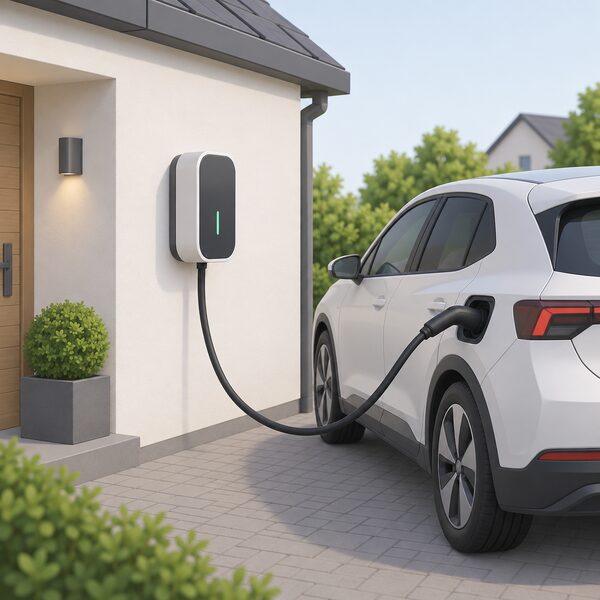
Specifications for a home wallbox fall into a small number of categories: the charging mode, the connector type, the power output, the cable arrangement and the smart layer. The Mode 3 designation applies across domestic AC charging, and the connector on the vehicle side is Type 1 or Type 2 depending on the car7.
| Specification | Domestic AC home charger |
|---|---|
| Charging mode | Mode 37 |
| Connector | Type 1 or Type 27 |
| Cable arrangement | Tethered cable and connector, or Type 2 socket3 |
| Typical single-phase output | 7.4kW, 32A1 |
| Three-phase output | 11kW, 16A1 |
| Certification route | BSI Kitemark for EV charging, home and commercial6 |
The connector point deserves emphasis because it is the most common source of a wrong purchase. Home chargers are available either with a tethered Type 1 or Type 2 cable that plugs straight into the car, or with a Type 2 socket for use with the vehicle's own charging cable2. A tethered Type 2 unit will not suit a car with a Type 1 inlet without an adapter, and a socketed unit depends on the driver remembering the cable.
Public destination charging shows the same pattern from the other direction. Tesla destination chargers are Type 2 and tethered, and are available to any EV driver with a Type 2 inlet on their car, not only Tesla owners8. That is the standard the UK market has settled on for AC charging, and a home wallbox is a private instance of it.
Power output and charging speeds
The REA published the same three results in its three-phase report, at 12h00, 24h00 and 08h00 respectively9.
The two sets of figures are consistent once battery size is accounted for: a smaller battery fills sooner at the same power.
Rapid and ultra-rapid public charging sits in a different category entirely, at 50 to 350kW, and is the fastest option available for EVs10. The Energy Saving Trust's table for 350kW DC charging gives 3 minutes for 25kWh, 7 minutes for 50kWh, 11 minutes for 75kWh and 15 minutes for 100kWh, assumed from 20% charged11. Those speeds are not available at home and are not what a wallbox is for.
A car limited to 7.4kW single-phase will not charge faster on an 11kW wallbox. Charging speeds and times are set out in more detail in EV charging speeds and times.
Tethered or socketed: which suits your driveway
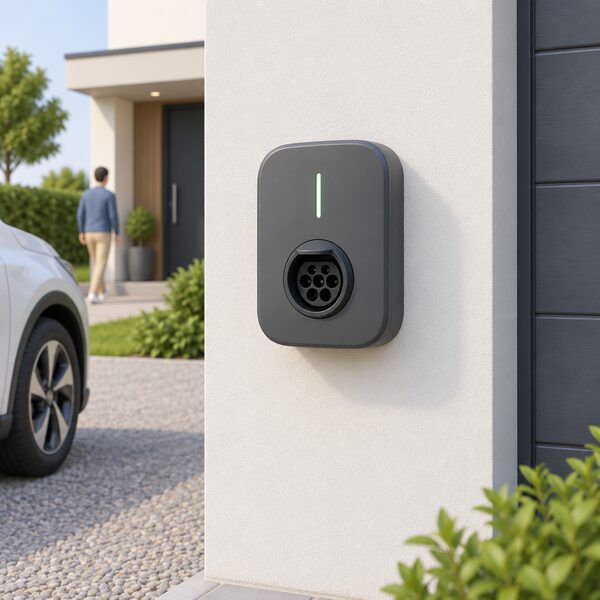
The choice between a tethered and an untethered wallbox is the single decision most likely to be regretted later, and it turns on how the car is parked rather than on the charger. Tethered units come with the cable and connector installed on the unit; untethered units have only a socket, and the cable lives in the car3.
A tethered cable is quicker to use and cannot be forgotten, which suits a single-car driveway where the same vehicle charges in the same place every night. It also means the cable is exposed to weather permanently, and a damaged tethered cable is a repair rather than a replacement. An untethered unit keeps the cable out of the weather and lets a household with two different connector types use one wallbox, at the cost of handling the cable every time.
The connector standard narrows the field further. Home chargers are sold with a tethered Type 1 or Type 2 cable, or with a Type 2 socket for the vehicle's own cable2. Type 2 is the European standard for AC charging and the connector used on destination chargers across the UK8. A car with a Type 1 inlet needs either a tethered Type 1 unit or an adapter.
There is a third consideration that is easy to miss: cable length and parking position. A tethered unit fixes where the car must be parked, and a socketed unit does not. The comparison is set out in full in tethered vs untethered EV charger, and the wider range of unit types is covered in types of home EV charger.
Smart features and app control
The smart layer on a home wallbox is what turns it from a socket into a device that can be scheduled, monitored and, in some cases, paid for through a tariff. The features that appear across the market are secure access, load balancing and the ability to manage multiple chargers from one system, which matters more in commercial settings than on a single driveway12.
Load balancing is the one that affects a household directly. The subject is covered in load management and load balancing.
App control is where the dependence sits. Most EV tariffs require a smart meter as well as an EV charger, so the tariff itself is conditional on metering rather than on the charger4. Some tariff products are operated through the supplier's own app: OVO's Charge Anytime plan is added to an OVO account and operated through the OVO Charge app to smart charge the car13. That means the scheduling intelligence may sit with the energy supplier rather than with the wallbox maker.
The regulatory backdrop is the Electric Vehicles (Smart Charge Points) Regulations 2021, which define a non-smart charging cable as one that cannot send and receive information14. The distinction matters because a charger that cannot communicate cannot participate in the time-of-use tariffs and flexibility arrangements that make home charging cheap. Connectivity, firmware and data are covered in EV charger apps and connectivity and EV charger cybersecurity and data.
Installation and what a household needs
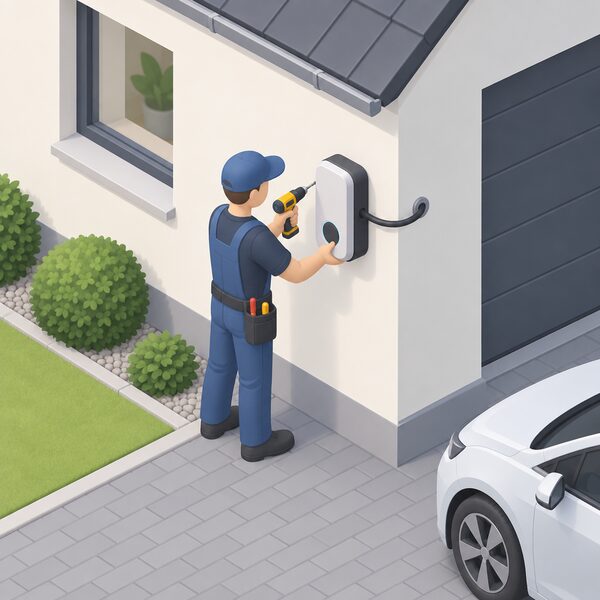
Installing a home charger is classified as development, and it is the householder who is responsible for ensuring the correct permissions are in place15. In most cases a wallbox on a driveway falls within permitted development, but the classification is the starting point rather than an afterthought, and the position differs where a property is listed or in a conservation area.
The electrical requirements are firm. An EV charger must be installed in line with the current edition of BS 7671, the national standard for electrical installations3. The work should be done by a qualified and certified electrician16, registered with a recognised certification body such as NICEIC, and electricians registered on a Competent Person Scheme are deemed competent to self-certify their own work, which saves the householder time and money3. Building regulations approval for the electrical work is covered in building regulations for an EV charger.
Earthing is assessed before the charger goes on the wall. Most local authorities that fund cross-pavement channels specify a dedicated EV charger with protective earth neutral fault protection, and some require an earth rod with photographic proof before the channel is installed17. The installer's responsibilities under the IET Code of Practice include assessing the adequacy of the supply capacity for the new EV load plus existing load, assessing the adequacy of the earthing, and notifying the network operator18.
In Northern Ireland the process is explicit. Homes sharing a looped electricity cable with a neighbour need their own dedicated cable installed before an EV charger can go ahead19. Network connection and notification are covered in telling the network operator about a home EV charger, and the full process in home EV charge point installation.
Cost and warranty
There is no published NexBlue list price in the material available, so a NexBlue Point is installer-quoted. What can be said is what the market charges for comparable hardware. One UK maker's own product pages list an untethered 7.4kW charger at £359.98 including delivery, a tethered 7.4kW unit at £374.98 including delivery, and the same units with installation included at £769.98 and £909.98 respectively12. Those are one maker's prices for its own products and are not a NexBlue price.
The pattern they show is the one that applies across the market: the hardware is a few hundred pounds and the installation is the larger part of the bill. A householder comparing quotes should expect the installed figure to be several times the unit price, and should ask what the quote covers. The full cost picture is in how much does a home EV charge point cost, fitted.
Warranty terms are set by the maker and are not published for NexBlue in the material available. The general position is that a warranty claim needs proof of purchase, proof of who installed the unit and when, and a serial number. Registration matters beyond the warranty: independent safety guidance is to register charging equipment with the manufacturer so the owner can be contacted if a safety recall is issued20. Warranty structures across the market are compared in EV charge point warranties and aftercare.
What a NexBlue charger means for energy independence
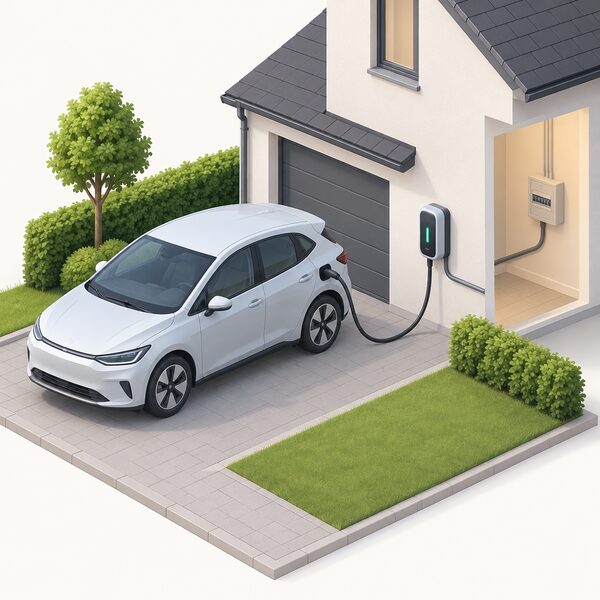
A home wallbox changes where a household buys its motoring energy. Instead of filling at a forecourt, the car is charged from the domestic supply, which means the cost of the miles driven is set by the electricity tariff and by whatever generation sits behind the meter. That is the substance of the independence a home charger offers, and it is a real shift rather than a marketing one.
What remains is a list of dependencies. The charger needs a grid connection and an electricity supplier. Most EV tariffs require a smart meter as well as an EV charger, so the cheap overnight rate depends on metering infrastructure the household does not own4. Where the scheduling runs through a supplier's app, the intelligence sits with the supplier13. Where it runs through the maker's app, it sits with the manufacturer, and remote features depend on a working broadband connection.
Solar changes the picture but does not remove the dependencies. Charging an EV from solar panels reduces the carbon footprint of the miles driven, and the compatibility of the charger, the solar system and any battery storage should be considered from the outset, with installation by a qualified electrician with relevant experience24. Whether a specific NexBlue model offers solar-aware charging modes is a question for the maker's documentation. The subject is covered in charging an EV from solar panels and do I need a special EV charger to charge with solar.
The direction of travel in the standards is towards chargers that can respond to the grid rather than simply draw from it. EEBUS describes a future in which the car identifies when it is best to charge itself, or even to feed electricity back into the house25. That capability depends on the charger, the car and the tariff all supporting it, and it is not something a wallbox delivers on its own. The wider picture is in EV charging and household energy independence.
Sources25 cited
- Home electrical infrastructure of the future, BEAMA, 2021
- Home charging, Zapmap, 2025
- Electric vehicle charger installation and maintenance, NICEIC, 2025
- EV charging, Uswitch, 2026
- Future Homes Standard for your home's future, Low Carbon Hub, 2026
- Powering trust in electric vehicle charging with BSI Kitemark certification, BSI Group, 2026
- Scottish Building Regulations: proposed changes to energy standards, Scottish Government, 2021
- Destination charging, Zapmap, 2026
- EV three-phase report, REA, 2018
- Electric vehicle charging, SMMT, 2025
- Charging electric vehicles, Energy Saving Trust, 2026
- EV chargers, EVEC, 2026
- OVO EV energy tariffs, Uswitch, 2025
- Guide to EVSCP regulations 2021, Department for Transport, 2022
- Planning permission for electric vehicle charging, Planning Portal, 2026
- EV charger regulations in England: what's changed, NICEIC, 2026
- Cross-pavement charging solutions, Energy Saving Trust, 2025
- EVs and heat pumps FAQs, NIE Networks, 2026
- EVs and heat pumps, NIE Networks, 2026
- E-bikes, batteries and chargers safety advice, Electrical Safety First, 2026
- EV charging cable SEVA-24016P recall, Electrical Safety First, 2026
- Electric vehicle charging cable sold via eBay recall, Electrical Safety First, 2026
- Voltage changes in your home or business, UK Power Networks, 2026
- Can solar panels charge electric cars?, The CPA, 2026
- E-mobility on a massive scale will need an intelligent charging system, EEBUS, 2018