
In this guide
DETA is a British electrical manufacturer, and its name appears on domestic wiring accessories, consumer units and, more recently, EV charging equipment. The company's own product material does not publish a domestic wallbox specification sheet in the sources available here, so this page sets out what is known about the DETA range alongside the standards, costs and installation rules that apply to any home charge point sold in the UK. Where a figure comes from another manufacturer or from official guidance, that is stated plainly.
The practical position for a household is this: a home charger is a 7kW class appliance in most UK driveways, costing £500 to £1,200 to buy and install, with 7kW units typically around £9001. Installation is notifiable work, the installer must assess supply capacity and earthing, and the network operator must be told within one calendar month2. A charger is a grid-tied device: it draws from the same supply as the rest of the house, and its smart features depend on a broadband connection and a manufacturer's app.
DETA EV chargers: what the range covers
DETA's domestic catalogue is built around wiring accessories, and the EV charging line sits within that same electrical-installation context rather than as a standalone energy brand. The company does not publish a model-by-model wallbox specification in the material available here, so a householder comparing DETA against better-documented brands will find less to read. That is a documentation gap, not evidence about the hardware.
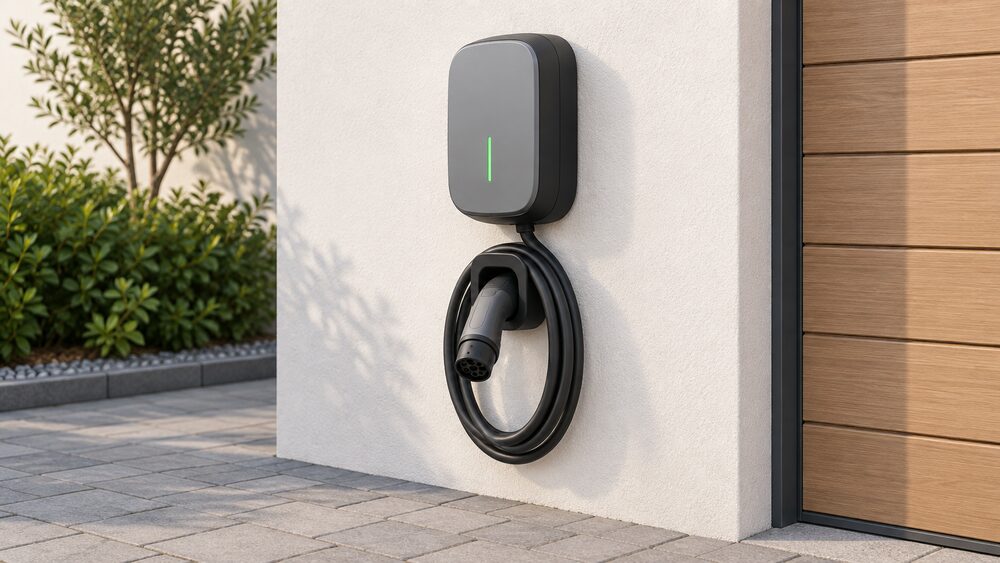
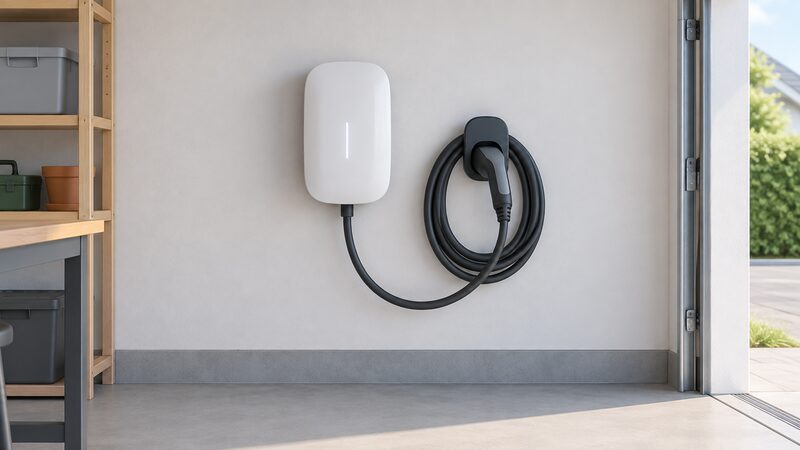
What can be said with confidence is the shape of the market the range sits in. Home chargers are wall-mounted units, available either with a tethered Type 1 or Type 2 cable that plugs straight into the car, or with a Type 2 socket for use with the vehicle's own charging cable6. Most domestic installations are single-phase 7kW, with three-phase 22kW units available where the supply supports them. The conflict between a 22kW and a 7kW figure for the same charger class is unresolved in the material available here, and the two ratings describe different supply arrangements rather than a single product.
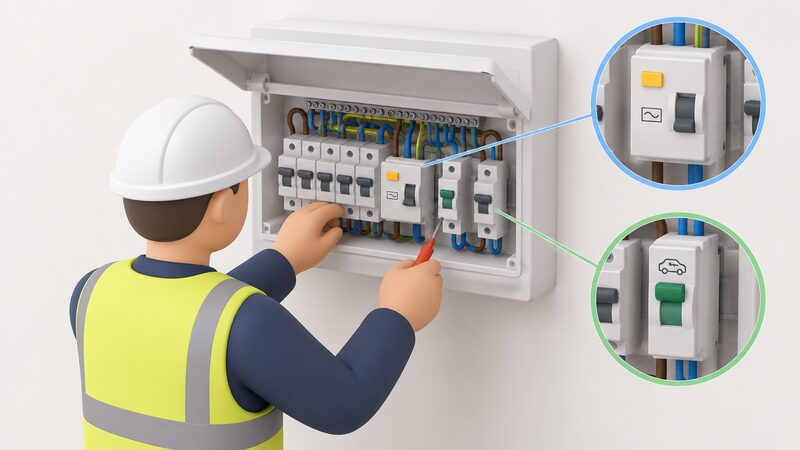
For a household, the range question matters less than the electrical question. A charger is only as good as the circuit behind it: the installer must assess the adequacy of supply capacity for the new EV load plus existing demand, assess earthing, and notify the network operator once the work is complete7. Those duties apply to every brand, DETA included.
Wallbox models and specifications
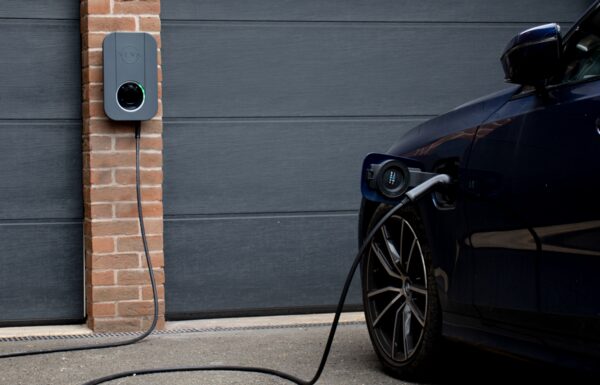
Specification detail for DETA domestic wallboxes is thin in the published material. What exists for the wider market gives the frame. A 7kW unit is the standard domestic choice, and the Which? guidance is that 7kW chargers cost around £900 to buy and install and are a good choice for most households1. Three-phase 22kW units exist but require a three-phase supply, which most UK homes do not have.
Where a manufacturer does publish detail, it shows what a specification sheet normally contains. Delta's DC Wallbox 50 kW, a commercial unit rather than a domestic one, is listed with a 7-inch screen, RFID card reader, integrated meter and status indicators to guide the driver to an available charge point8. That is the level of detail a buyer would want for a home unit: connector type, cable length, enclosure rating, RCD arrangement, load management capability and warranty term.
| Specification | What applies to a UK home wallbox |
|---|---|
| Typical power | 7kW single-phase; 22kW needs three-phase supply |
| Connector | Tethered Type 1 or Type 2, or Type 2 socket6 |
| Mounting | Wall-mounted, occasionally post-mounted6 |
| RCD arrangement | Type A 30mA sufficient where the charger has 6mA DC fault detection4 |
| Earthing | PEN fault protection or an earth rod, depending on the unit9 |
| Notification | Network operator told within one calendar month2 |
Tethered or socketed: which suits which driveway
The choice between a tethered and an untethered charger is the first decision most households face, and it turns on cable management rather than on charging speed. Tethered chargers come with a cable and connector installed at the factory, while untethered chargers have only a socket where a cable is plugged in10. A tethered unit means no cable to retrieve from the boot on a wet evening; an untethered unit means the cable lives in the car and can be used at public points as well.
Connector type follows the car. Home chargers are available with a tethered Type 1 or Type 2 cable, or with a Type 2 socket for use with the vehicle's charging cable6. Type 2 is the European standard for AC charging and the connector on virtually every EV sold in the UK today, so a Type 2 socket or tethered Type 2 cable covers the widest range of vehicles. A Type 1 tethered unit only makes sense for an older car with that inlet.
Driveway geometry decides the rest. A tethered cable has a fixed reach, so the unit must be mounted where the cable comfortably reaches the car's charge port without straining. An untethered unit needs somewhere to store the cable when not in use. For households with two EVs of different connector types, an untethered socket is the more flexible arrangement. More on the trade-offs is at tethered vs untethered EV charger.
Power ratings and charging speeds
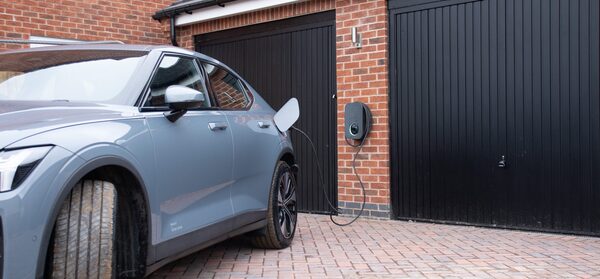
Domestic charging is slow by design. A 7kW wallbox adds roughly 30 miles of range per hour to a typical EV, which is ample for overnight charging and the reason 7kW dominates the UK market. A 22kW unit only delivers its full rate where the car's onboard charger accepts three-phase AC and the house has a three-phase supply; most UK homes are single-phase, so a 22kW wallbox on a single-phase supply performs no better than a 7kW one.
The car is often the limiting factor. The Kia EV6, for example, is capable of ultra-rapid charging at up to 235 kW DC from public points, but that rate depends on a DC rapid charger and has nothing to do with the home wallbox11. Home AC charging and public DC charging are different systems, and a household should not expect home equipment to approach public rapid speeds. The comparison is set out at EV charging speeds and times.
Load management matters more than headline power for many homes. Where the maximum demand of the whole customer connection exceeds 13.8 kVA, the distribution network operator must be contacted before connection2. That threshold is reached more easily than many households expect once an EV charger, a heat pump and an electric cooker share a supply, and it is the reason load management devices are fitted. The subject is covered at load management and load balancing.
Smart features, apps and solar integration
Smart charging is now the default rather than an upgrade. Independent guidance identifies three features that matter most: solar diversion, which lets the charger prioritise solar power for EV charging and minimise reliance on the grid; app control; and dynamic scheduling, which shifts charging to cheaper or greener periods12. A charger without those capabilities is a plain socket with a timer.
Solar integration is the feature most often asked about. Charging an EV from solar panels can significantly reduce carbon footprint, and the compatibility question is one of configuration as much as hardware13. The Energy Saving Trust's position is that EV chargers should be installed by a qualified electrician with relevant experience, and that compatibility between the charger, the solar system and any battery storage should be considered from the outset13. Retrofitting solar awareness to a charger that lacks it is not straightforward.
For DETA specifically, no published solar diversion mode appears in the material available here. A household considering solar-linked charging should confirm with the installer whether the chosen unit supports it, and should treat that as a specification question to settle before ordering. The wider subject is at charging an EV from solar panels.
Installation, cost and what to expect
Installation cost depends on the charging station model, the charging speed and the electrician's fees10. The published range for a home charger is £500 to £1,200 to buy and install, with 7kW units around £9001. Landlords and flat tenants may be eligible for a government grant of up to £350, which can reduce the cost to as low as £6503. Prices are otherwise installer-quoted, and VAT treatment is not stated in these figures.
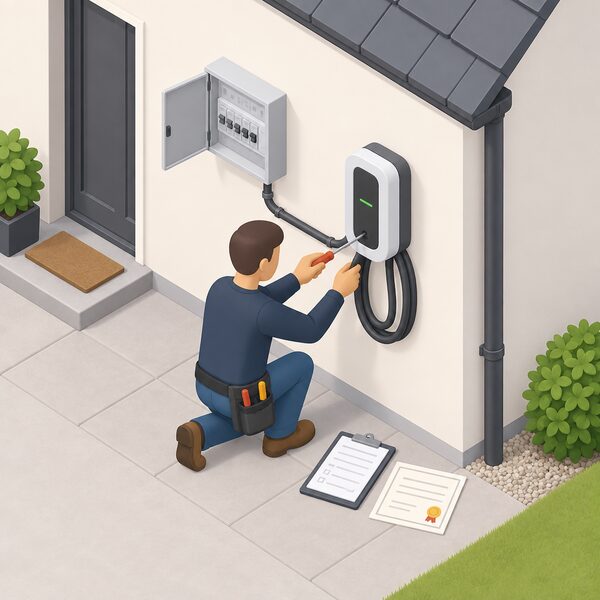
The installation itself is a regulated process. The IET Code of Practice sets out the installer's responsibilities: assess the adequacy of supply capacity for the new EV load plus existing demand, assess the adequacy of earthing, and notify the network operator once the charge point is installed7. Notification must happen within one calendar month of the installation2. Part P self-certification registration through a competent person scheme also applies4.
Planning permission is usually not needed, because a home charger falls within permitted development rights, with exceptions for listed buildings, conservation areas and cross-pavement solutions10. Installing a home charger is nonetheless classified as development, and it is the householder's responsibility to ensure the correct permissions are in place14. Where off-street parking exists, the installation is likely to fall under permitted development rights15. The full position is at planning permission for a home EV charge point.
Warranty and registration
Warranty terms for DETA wallboxes are not published in the material available here, so a household should obtain the written term from the installer before ordering. What can be described is how charger warranties in this market are structured, which shows what to look for. One UK maker, evec, offers a 3-year parts and labour guarantee, with products registered outside a 30-day period receiving a 12-month part and labour guarantee only, and products not registered receiving no warranty benefit at all16. Another, VEVA, publishes a 3-year warranty17.
The pattern is consistent: registration is the trigger, and the clock usually starts at delivery rather than at installation. The evec terms state that the warranty remains effective from the date of delivery, and that service under the warranty neither extends the term nor starts a new one16. Coverage is typically against defects in materials and workmanship, with defective parts repaired or replaced at the maker's discretion16.
Exclusions are worth reading closely. Typical exclusions include damage by transport, misuse or improper installation and assembly; use of parts not recommended by the maker; routine maintenance and wear-and-tear; installation faults; consumables and cosmetic parts; second-hand or refurbished units; and consequential loss16. Improper installation is the exclusion most likely to bite, which is why the installer's competence and paperwork matter as much as the hardware.
Registration of the installation itself is separate from the product warranty. The installer must notify the network operator within one calendar month2, and Part P self-certification runs through a competent person scheme4. More on the subject is at EV charge point warranties and aftercare.
Faults, error codes and who to call
Error codes on a home charger are frequently a supply problem rather than a charger problem. Voltage drop or surge is a recognised cause of EV charger errors18, and the first action recommended is to speak to the installer or electrician to check there is no problem with the equipment19. A charger may also need switching off and on at the isolator switch to clear a fault19.
Where a fault is confirmed, the response depends on what it is. For a suspected sub-standard or faulty charger, the guidance is to stop using it immediately and report the fault to the manufacturer or retailer20. For a recalled charging cable, the instruction is to stop using it immediately and contact the retailer for further advice21. Safety notices for imported chargers have identified serious defects, including failure of the earth bond test, indicating that the continuity of the protective earthing path may be inadequate, and an output cable earthing conductor the same length as the live and neutral conductors, meaning that in a cable strain or drive-off incident the protective earth could disconnect before the live conductors22.
Those findings are a reminder that the charger is a mains electrical product, and that certification and earthing are not paperwork. A household with a fault should work through the installer first, then the manufacturer or retailer, and should stop using any unit showing signs of overheating, burning or cable damage. Troubleshooting guidance is at EV charge point faults and troubleshooting.
What owning a DETA charger means for energy independence
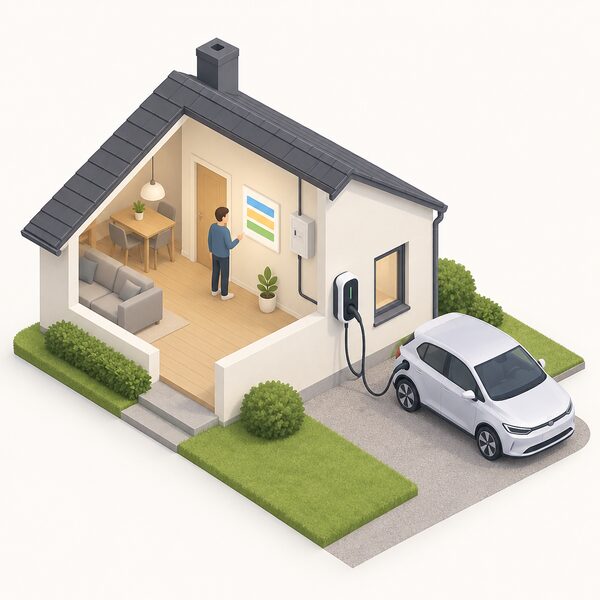
A home charger improves a household's position in one specific way: it moves the energy for transport onto the home supply, where a time-of-use tariff can be used. Energy UK puts the annual saving from an EV charger on a time-of-use tariff at £680, with EV ownership required5. That saving depends on having a charger at home, because there is no point having an EV tariff if the car cannot be charged at home23.
The dependence that remains is substantial. A charger draws from the grid, so the household stays on a supply and a supplier. Smart features add a dependence on broadband, the manufacturer's servers and an app that must keep working. Solar diversion reduces grid draw during daylight but does not remove the connection. And the charger itself is a single-brand device whose warranty, firmware and fault support run through one company.
For DETA specifically, the independence question turns on documentation. A household that cannot find a published specification, a solar mode or a warranty term is being asked to trust the installer's word. That is not unusual in this market, but it is a reason to get the specification and the warranty in writing before the unit is ordered. The wider picture is at EV charging and household energy independence.
Sources23 cited
- Electric car charging at home, Which?, 2026-02-25
- Voltage changes in your home or business, UK Power Networks, 2026-09-17
- EV charging statistics, Uswitch, 2025-12-15
- Section 722 EV charging complete guide, Elec-Mate, 2026-07-02
- EV energy tariffs, Uswitch, 2025-09-17
- Home charging guide, Zapmap, 2025-06-19
- Connections to the networks FAQ, Energy Networks Association
- Delta DC Wallbox 50, Delta, 2026-09-17
- Clean heat and low income households, Energy UK, 2026-06-11
- EV charger installation and maintenance, NICEIC, 2025-08
- Kia EV6 charging, Zapmap, 2026
- Integrating solar panels with EV charging, Uswitch, 2025-07-02
- Cross-pavement charging solutions, Energy Saving Trust, 2025-07-18
- EV charging planning permission, Planning Portal, 2026
- EV charging permitted development, Planning Portal, 2026
- VEVA car charger, Marlec, 2026-09-02
- Growatt THOR smart charger, Growatt, 2026-09-17
- E-bike and charger safety, Electrical Safety First, 2026-09-17
- Managing voltage changes in your property, Electricity North West, 2026-09-19
- SEVA-24016P charging cable recall, Electrical Safety First, 2026-09-17
- ROMADA charging pile safety report, OPSS, 2026-09-15
- ROMADA EV charger and cable safety report, OPSS, 2026-09-11
- evec warranty information, evec, 2026-09-17