In this guide
evec is a British EV charger maker founded in April 2022, selling a domestic range built around a Type 2 connector and a 7.4kW single-phase output1. The company's own account of its growth is that revenue rose from £500k in 2022 to £4 million in 2025, with 174% year-on-year sales growth2. Its chargers are sold both as hardware alone and with installation bundled in, and the warranty is a 3-year parts and labour guarantee that depends on registration within 30 days of delivery3.
The headline numbers for a household are these. A 7.4kW untethered VEC01 charger is listed at £349.99 including VAT, the same unit with installation included at £789.99 including VAT, and a version with installation plus a 5-year extended warranty at £889.99 including VAT1. Every charger in the range uses a Type 2 connector, the UK and European standard, and each single-phase unit includes built-in Wi-Fi1.
What an evec charger does for energy independence is real but partial. It moves the fuel for motoring from petrol or diesel to electricity, and it allows that electricity to be bought on a time-of-use tariff or drawn from a home solar system. It does not remove the household from the grid, from an electricity supplier, or from the manufacturer's warranty terms and registration process. Most home chargers are "fast chargers" (typically 7kW), which can fully charge an average EV overnight, which is why the home unit matters more than any other piece of charging equipment a household buys4.
Who evec is and what the company does
evec was created in April 2022 with what it describes as a single mission: to break down barriers to EV adoption by making EV charging accessible and affordable2. That positioning explains the shape of the product line. Rather than competing at the premium end of the wallbox market, evec sells a small number of single-phase domestic chargers, offers them with or without installation, and prices the hardware at the lower end of what a UK home charger costs.
The company's own figures put revenue at £500k in 2022 rising to £4 million in 2025, with 174% year-on-year sales growth2. Those are maker-reported numbers rather than audited accounts, and they describe a young business rather than an established one. For a household, the relevant question is not growth but continuity: a charger is a piece of fixed electrical equipment with a warranty and, potentially, a software service behind it, so the age and scale of the maker bear on what happens in year four or year eight.
The range is deliberately narrow. Every charger uses a Type 2 connector, the UK and European standard for electric vehicle charging, and each single-phase unit includes built-in Wi-Fi for connectivity1. The commercial side of the business extends beyond homes: evec lists secure access, load balancing and smart features for managing multiple chargers, aimed at sites running more than one unit1. That matters to a household only indirectly, in that the same firmware and app platform serves both markets.
The company has also taken public positions on policy. Its managing director criticised the September 2023 announcement delaying net zero commitments from 2030 to 2035, which places evec among the makers that have argued for a faster transition rather than a slower one. For a buyer, that is context rather than specification.
The range: Veva smart home charger and the VEC01
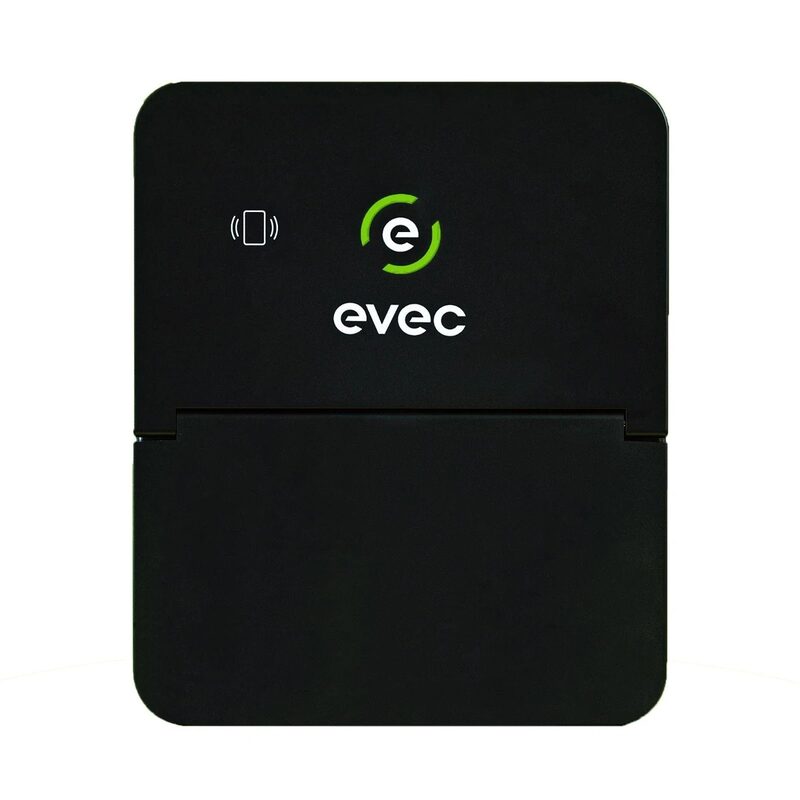
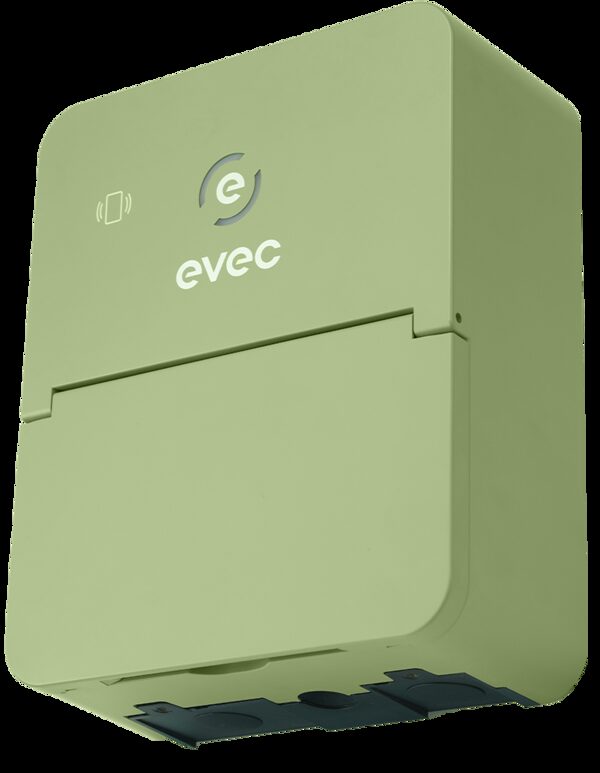
The domestic line is built around the VEC01, sold as an untethered 7.4kW unit compatible with both Type 1 and Type 2 vehicles, single phase1. Untethered means the charger has a socket rather than a fixed cable, so the household uses the cable that came with the car or a separate one. That choice affects cost, tidiness and convenience, and it is covered in more detail in tethered vs untethered EV charger.
The VEC01 appears in three commercial forms on evec's own product pages, and the differences are about what is bundled rather than what is inside the box1:
| Product | What is included | Price including VAT |
|---|---|---|
| 7.4kW EV Charger, Type 1 and Type 2, single phase, untethered | Charger only | £349.991 |
| 7.4kW Domestic EV Charger with Installation Included, untethered, single phase | Charger plus installation | £789.991 |
| 7.4kW Domestic EV Charger with Installation and 5-year extended warranty | Charger, installation, extended warranty | £889.991 |
The installation-included VEC01 is listed at £789.99 including VAT on the product page, and separately at £799.98 including delivery. Both figures come from the same maker page dated 18 September 2026, and the difference is not resolved in the material available, so a buyer comparing quotes may see either.
The Veva smart home charger sits alongside the VEC01 in the domestic range. evec's charger pages describe the range as offering secure access, load balancing and smart features for managing multiple chargers, which is the functionality set the Veva draws on1. Load balancing matters where the charger shares a supply with an electric shower, an oven or a heat pump, and it is explained in load management and load balancing.
Power and specifications: why most home chargers are 7kW
evec's single-phase chargers range from 3.7kW to 7.4kW, with an internal switch to move between the two depending on the demand of the property1. That switch is the practical answer to a common constraint: a home with a single-phase supply and a modest main fuse may not be able to support the full 7.4kW alongside everything else running at once, and derating the charger to 3.7kW is one way to stay within the supply.
The wider market context explains why 7kW is the default. Independent guidance describes home chargers as tending to be slower, usually around 7kW5, and states plainly that the standard power rating for a home charger is 7kW6. Most home chargers are either rated at 3 kW or 7 kW8. The reason is the supply rather than the equipment: most UK homes have a single-phase electricity supply, and 7kW is the natural fit, while higher outputs generally require a three-phase supply.
What that means in practice is charging speed. A 7kW charger adds roughly the energy a typical electric car needs overnight, which is why home charging dominates: most home chargers are "fast chargers" (typically 7kW), which can fully charge an average EV overnight4. The relationship between power, battery size and time is covered in EV charging speeds and times.
The specification points a household should check before buying are the connector, the phase, the output and the connectivity. On the evec range, the connector is Type 2 across the board, the units are single phase, the output is switchable between 3.7kW and 7.4kW, and Wi-Fi is built in1. Type 2 is the standard for UK and European charging, and the difference between it and the DC connectors used at rapid chargers is explained in Type 2 vs CCS.
Warranty, installation and who can self-install
evec's warranty is a 3-year parts and labour guarantee, and it is conditional in ways that matter3. The product is guaranteed against defects in materials or workmanship, with defective parts repaired or replaced at the maker's discretion. Registration must be completed online within 30 days of the delivery date, and the 30-day period is calculated from delivery, not from installation3. Products registered outside that window receive a 12-month parts and labour guarantee only3.
The conditions on installation are explicit. The warranty requires that a suitably qualified professional has installed the charger, that installation was carried out in accordance with the instructions and current legislation, and that no unauthorised person has attempted modification or repair, where an authorised person means an evec appointed professional3. The exclusions list is long and includes damage by transport, misuse or improper installation and assembly, use of parts not recommended by evec, routine maintenance and wear and tear, installation faults, consumables and cosmetic parts, second-hand or refurbished chargers, accidental damage, and damage from contact with unsuitable materials3.
Self-installation is therefore not a route the warranty supports, and it is not a route the regulations support either. Building regulations approval is always required when installing an EV home charger, and a competent and reputable installer should be used, with specific processes for notifying the local building control authority9. The approval produces a certificate proving the work complies with building regulations10. Independent guidance is consistent that the work should be done by a qualified and certified electrician11, by a registered electrician with experience in this type of installation12, and that installers need competence in the IET Code of Practice for Electric Vehicle Charging13. The charger must be installed in line with the current edition of BS 7671, the national standard for electrical installations5. The full process is set out in home EV charge point installation, and the self-install question is answered at can I install an EV home charger myself.
Does evec offer an installation service?
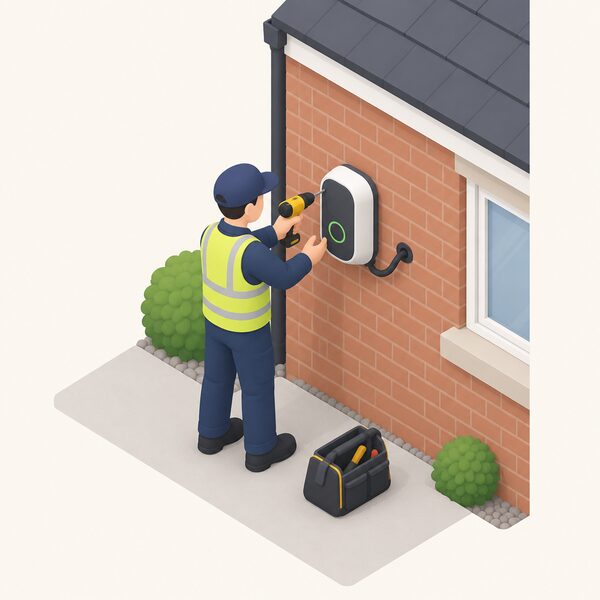
Yes. evec sells chargers with installation included, and lists a premium install package that it says gets the charger installed in as little as a week, subject to location and availability2. The installation-included VEC01 is priced at £789.99 including VAT, and the version with installation and a 5-year extended warranty at £889.99 including VAT1.
That bundled approach differs from the more common pattern, where a household buys hardware and then obtains a separate quote from a local installer. Bundling makes the total easier to compare, but it also means the price covers a standard installation rather than whatever the property actually needs. Longer cable runs, a consumer unit upgrade, a garage supply or a three-phase conversion are the usual reasons a quote moves, and none of those is priced in the published figures.
Where a household prefers to arrange its own installer, the official route is to contact an installer approved by the Office for Zero Emission Vehicles to find out how much installation costs14. The planning portal recommends using a reputable company and ensuring the installer has the relevant qualifications10. For a charger that will be paired with solar or battery storage, independent guidance adds that compatibility between the charger, the solar system and any battery storage should be considered from the outset, and that the installer should have relevant experience15. That pairing is covered in charging an EV from solar panels.
Delivery, registration and the 30-day clock
The warranty clock starts at delivery, not at commissioning, and that is the single most consequential administrative detail in the evec terms3. A charger bought in advance of an installation date, or held while a consumer unit upgrade is arranged, is already partway through its registration window. Registration is by email to customer.services@evec.co.uk3.
The published material does not state a cut-off time for next-day dispatch, so no time can be given here. What is documented is the registration deadline of 30 days from the delivery date, and the consequence of missing it: a 12-month guarantee instead of 3 years3.
Two other timing points are worth noting. The premium install package is described as completing in as little as a week, subject to location and availability2. And the vecFLEX rewards scheme, which all vecGO chargers are eligible for, suffered a temporary onboarding outage on 9 March 2026 that caused login issues; evec confirmed the form issue was resolved the following day, 10 March 2026, as of 10:26 AM GMT2. The scheme is a grid rewards arrangement rather than a warranty matter, and it is discussed in smart charging, flexibility services and reward schemes.
Cost, growth and what owning an evec charger means for independence
The cost picture for a home charger in the UK is broad. Independent guidance puts a home EV charger at £500 to £1,200 to buy and install as of February 202616, and official guidance for Northern Ireland states that an EV charger can be up to £1,00017. evec's own prices sit inside that band: £349.99 for the untethered unit alone, £789.99 with installation, and £889.99 with installation and a 5-year extended warranty, all including VAT1.
The running cost side is where independence is won or lost. Energy UK lists electric vehicle chargers as saving £680 a year on a time-of-use tariff, where EV ownership is required18. That saving depends on the household having a tariff with a cheap overnight window and on the charger being able to schedule into it, which is why smart charging functionality matters more than the badge on the box. The tariff side is covered in EV energy tariffs and how they change home charging, and the running cost arithmetic in what it costs to charge an electric car at home.
There is also a property effect. Installing an EV charger could increase a property's value by between £3,000 and £5,000, according to the National Association of Property Buyers, depending on location, charger type and local public charging availability5. That is an estimate from a trade body rather than a measured transaction effect, and it is covered further in do electric car chargers increase your home's value.
What remains dependent is straightforward. An evec charger keeps the household connected to the grid and to an electricity supplier, and the smart features depend on a home broadband connection, the maker's servers and the maker's app. The warranty depends on registration within 30 days and on an approved installer having done the work. The fuel independence is real: electricity can come from a home solar array or a cheap overnight tariff in a way that petrol cannot. The infrastructure independence is not.
Where evec sits among more than 50 home charger makers
The UK home charging market is crowded. More than 50 manufacturers provide charging units suitable for EV charging at home6. Against that field, evec is a young British entrant with a narrow domestic range and a bundled installation offer, competing with established wallbox makers and with charger brands owned by energy suppliers and automotive groups.
The scale of the installed base explains why the market supports so many. There are estimated to be around 1 million home EV chargers in the UK as of July 202619. Public charging is a separate and much smaller part of the picture by volume, though it matters for anyone without off-street parking. For context on the public side, the South East had 16,881 chargers of all types as of August 202620, and 10,852 public chargers as of July 202519. Network operators include Be.EV, with 2,457 chargers across 589 locations, and FOR EV, with 155 chargers across 39 locations21. Those figures describe the public network rather than the home market, but they set the backdrop against which a household decides how much it needs to charge at home.
For a household choosing between makers, the useful comparison points are the connector, the output, the warranty length and conditions, the app and connectivity, and whether installation is bundled. evec's answers are Type 2, 3.7kW to 7.4kW switchable, 3 years with a 30-day registration condition, built-in Wi-Fi, and installation available as a bundle1. Other makers' answers differ, and the comparison pages linked from this site set them side by side without picking a winner.
Support channels and getting help with your charger
Warranty registration and service contact run through email at customer.services@evec.co.uk3. The warranty terms set out what is covered, what is excluded, and the circumstances in which a service call fee applies3.
For faults that may not be the charger's, the first step recommended by network operators is to speak to the installer or electrician to check there is not a problem with the household's equipment23. SSEN recommends first speaking to an electrician or installer to see whether the home wiring can support an EV charger24. That ordering matters because a charger that trips or derates is often responding to a supply issue rather than failing itself.
Where the problem is a product safety matter rather than a fault, the pattern is different. On a recalled EV charging cable sold through a marketplace, the Electrical Safety First advice was to stop using it immediately and contact the retailer for further advice25. That is the general approach to a recalled charging product: stop, then go back to the seller.
Grant support has narrowed. The Electric Vehicle Homecharge Scheme is closed to new applications, ran from 2014 to 2022, funded 340,222 domestic charging device installations in the United Kingdom, and was replaced by the Electric Vehicle Chargepoint Grant26. The successor grant assists with the cost of installing an EV chargepoint29. For households without off-street parking, the electric vehicle pavement channels grant is provided by the LEVI support body30. The closed scheme is covered in the Electric Vehicle Homecharge Scheme, and the current grant in the Electric Vehicle Chargepoint Grant.
Planning rules vary by nation and by property. In England, exceptions to permitted development include listed buildings, conservation areas and world heritage sites, among other protected buildings and landscapes12. Where a charger is located in a designated area such as a conservation area, there are increased chances that an accepted application will carry conditions affecting the size, appearance and placement of the charger31. The position across the four nations is set out in planning permission for a home EV charge point.
Sources31 cited
- evec chargers product range, evec, 2026
- Fully installed, evec, 2026
- Warranty information, evec, 2026
- Electric car charging costs: all you need to know, Zapmap, 2026
- EV charger installation and maintenance, NICEIC, 2025
- Home charging guide, Zapmap, 2025
- Home charging guide, Zapmap, 2025
- Smart search: electric vehicle charging, Planning Portal, 2026
- Electric vehicles for home charging, Electricity North West, 2026
- Building regulations for electric vehicle charging, Planning Portal, 2026
- EV charging guide, Uswitch, 2026
- EV charger regulations in England: what's changed, NICEIC, 2026
- Section 722 EV charging complete guide, elec-mate, 2026
- Electric vehicle chargepoint installers, GOV.UK, 2026
- Can solar panels charge electric cars?, The CPA, 2026
- Electric car charging at home, Which?, 2026
- Electric vehicles, nidirect, 2026
- Clean heat: supporting low-income households, Energy UK, 2026
- EV charging statistics, Uswitch, 2025
- FOR EV network guide, Zapmap, 2026
- Be.EV network guide, Zapmap, 2026
- Nissan LEAF model charging, Zapmap, 2026
- Existing electricity supplies, SSEN, 2026
- Grid impacts of heat pumps, EVs and solar revealed, Energy Systems Catapult, 2025
- Integrating solar panels with EV charging, Uswitch, 2026
- Grant schemes for electric vehicle charging infrastructure, GOV.UK, 2026
- Electric Vehicle Charging Device Grant Scheme statistics, October 2024, GOV.UK, 2024
- Electric Vehicle Charging Device Grant Scheme statistics, July 2024, GOV.UK, 2024
- Voltage changes in your home or business, UK Power Networks, 2026
- Apply for the electric vehicle pavement channels grant, GOV.UK, 2025
- BSI Kitemark certification for EV charging, BSI, 2026