In this guide
The EO Mini Pro 2 is a discontinued British home EV charger. EO Charging states that the unit "will soon reach its official End of Life (EOL)", and that from 30 November 2025 the company would no longer provide repair services, replacement parts or software updates for it1. The same date ended access to the EO Smart Home app, which was the only way to schedule charging, monitor energy use or lock the unit remotely2.
For owners, the practical position is narrower than the headlines suggest. The charger keeps working: EO says it "will still function as a basic plug-and-charge device"2. What ends is everything smart. Any existing charging schedules set through the app are cleared and all devices are automatically unlocked when the service stops2. The unit becomes a 7.2kW socket with no remote control, no energy data and no manufacturer support.
The withdrawal was regulatory, not commercial. EO ceased selling the Mini Pro 2 in Great Britain in November 2022 to comply with the UK Smart Charge Point Regulations introduced in June 2022, and states that the product "no longer meets the necessary smart functionality requirements for sale or replacement in Great Britain"1. The company has since moved its focus to commercial fleets, and in 2026 was acquired by Pod3.
EO Mini Pro 2 End of Life: what stopped and when
EO announced the wind-down in July 2025 and set out two dates. The first was 5 August 2025, the deadline for warranty claims. The second was 30 November 2025, from which the company would "no longer provide repair services, replacement parts, or software updates for the EO Mini Pro 2"2. The company describes itself as "preparing to cease the service, repair, and replacement of installed units for all users worldwide", so the withdrawal is global rather than limited to the UK1.
The two dates matter because they closed different things. The August deadline governed claims under the existing warranty. The November date governed the ongoing relationship: after it, there is no manufacturer route for a failed unit, no spare parts supply and no firmware. EO's wider statement that it had "taken the decision to cease sales and services globally" confirms the direction of travel2.
Owners should note that the End of Life notice applies to the Mini Pro 2 specifically. The original EO Mini Pro and the EO Mini Smart Home are separately listed as discontinued products, and the EO Basic and EO Mini carry the same 3-year product warranty as the newer units5. The Mini Pro 3 is the current model and was not affected by the November 2025 shutdown; EO told those users they "don't need to do anything for now"9.
What the Mini Pro 2 was: specifications and design
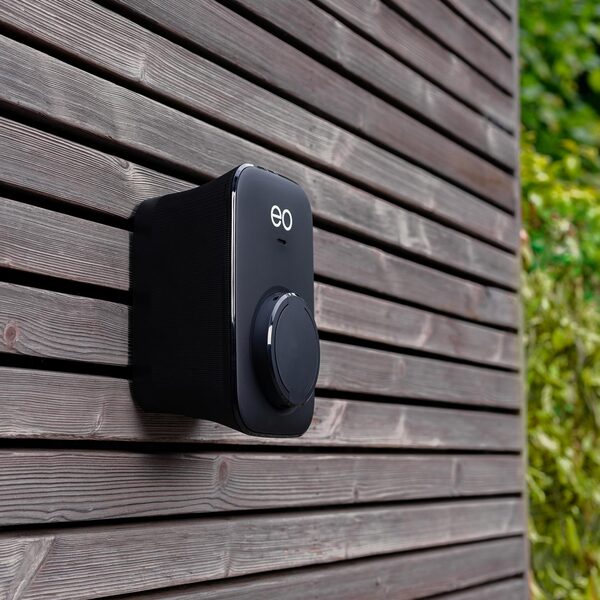
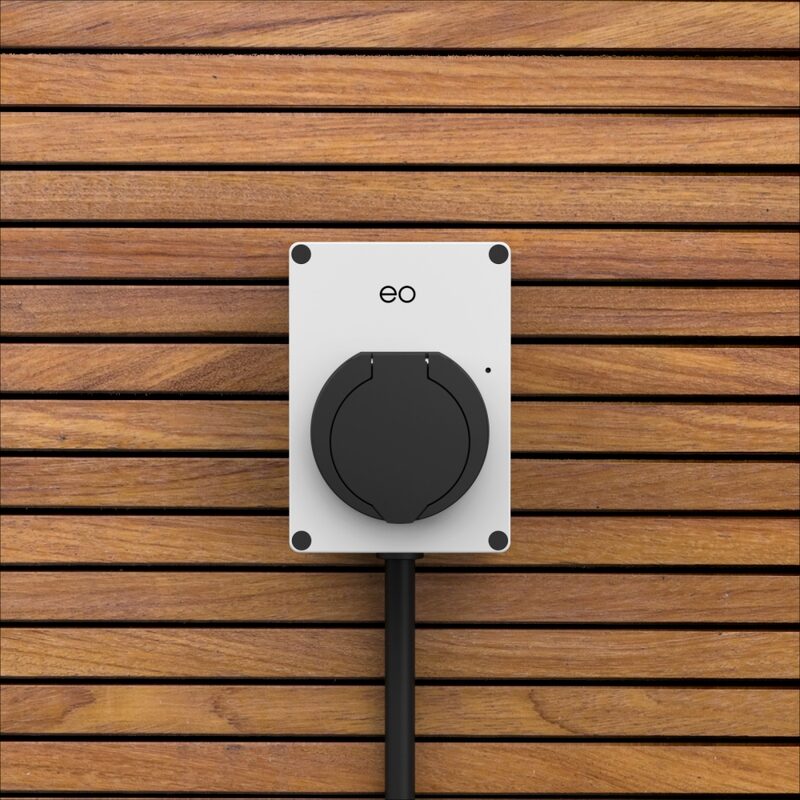
The Mini Pro 2 was "released as the world's smallest smart home charger it was designed for the everyday electric vehicle driver"1. Its dimensions were 175mm high, 125mm wide and 125mm deep, which is the basis of the size claim and the reason it suited garages and narrow driveways where a larger wallbox would foul a door or a gate1.
| Specification | EO Mini Pro 2 |
|---|---|
| Power rating | up to 7.2kW1 |
| Connector | Universal socket or tethered (Type 1 or Type 2)1 |
| Dimensions | 175mm (H) x 125mm (W) x 125mm (D)1 |
| Warranty | 3-year product warranty1 |
| Smart features | Energy monitoring, charging schedules, solar matching and load management as optional extras1 |
| Certification | Conforms to international safety standards1 |
| Grant status | OZEV approved: Home Charge Grant (UK only)1 |
The 7.2kW figure is the standard single-phase domestic ceiling and matches the current Mini Pro 3, which EO lists at "7.2kW (single-phase), perfect for overnight charging"3. The Mini Pro 2 was sold in both untethered and tethered forms, so a household could use its own cable or have one fixed to the unit1. Solar matching and load management were optional extras rather than standard, which means not every installed unit has them1.
The OZEV approval is now historical. The Mini Pro 2 was approved under the Home Charge Grant, but the grant landscape has changed and the unit can no longer be sold in Great Britain, so the approval has no bearing on a replacement purchase1. For the wider picture of what a home charger does and how the categories differ, see types of home EV charger and what is a smart EV charger.
Smart features: app control, solar matching and load management
The Mini Pro 2's smart layer ran through the EO Smart Home app. EO describes the app as supporting two products: the legacy EO Smarthome setup, "which is now a legacy product and no longer available", and the EO Mini Pro 210. Through it, owners could "monitor energy usage and set charging schedules"1. The app also allowed a single car profile to be set, though EO notes that any vehicle will charge even if it is not set as the vehicle, with the caveat that "the data recorded by the charger will be less accurate"10.
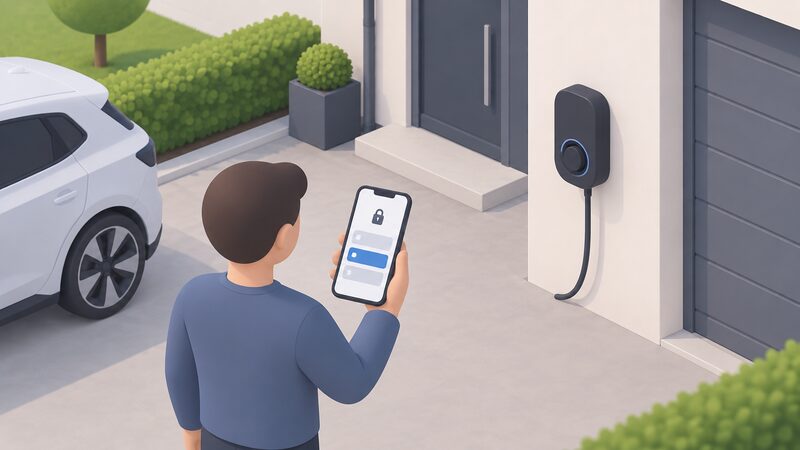
Locking was app-dependent. EO's support article describes a padlock on the home screen: pressing it closes the lock so the charger is unable to be used10. That is a meaningful security feature for a driveway unit, and it is one of the functions that disappears with the app. Without it, the only way to disable the charger is to isolate the power at the supply10.
Solar matching and load management were sold as optional extras on the Mini Pro 21. Where fitted, they allowed the charger to work with a home solar array and to limit total draw so the charger did not overload the incoming supply. Both functions were configured through the app, so both are affected by its closure. The general principles are covered in charging an EV from solar panels and load management and load balancing.
What happens after the app service ends
EO set out the consequences plainly. From 30 November 2025, owners could "no longer be able to access or manage your EO Mini Pro 2 through the EO Smart Home App", and "any existing smart charging schedules set via the app will be cleared and all devices will be automatically unlocked"2.
Three things follow. First, schedules cannot be preserved. There is no export, no migration path and no replacement app for the Mini Pro 2, unlike the Mini Pro 3, whose users were moved to the ev.energy platform from 4 August 202511. Second, the automatic unlocking is a security change: a unit that was locked to prevent unauthorised use becomes open, and the only remaining way to disable it is to isolate the power10. Third, energy monitoring stops, so a household loses the record of how much electricity the car consumed and when.
The loss of scheduling has a cost consequence as well as a convenience one. Off-peak charging depends on the charger starting and stopping at set times, and without that the household either charges whenever the car is plugged in or relies on the vehicle's own timer if it has one. The tariff structures that reward overnight charging are described in EV energy tariffs and how they change home charging.
Can you still use it as a basic charger?
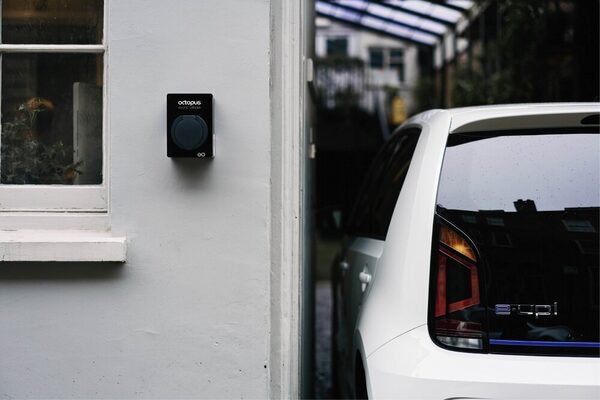
Yes. EO's own statement is that "your charger will still function as a basic plug-and-charge device"2. The charging hardware, the socket or tethered cable, the internal protection and the 7.2kW power stage are unaffected by the software shutdown. A household that plugs in and lets the car draw power will see no change.
What is lost is control, not capability. There is no scheduling, no energy monitoring, no remote lock and no firmware updates. The unit will not receive security patches, which is a consideration for any internet-connected device, though with the app closed the charger's network exposure is reduced rather than increased. The wider question of what connectivity a charger needs is covered in EV charger apps, Wi-Fi, 4G and firmware.
The practical limits are worth stating. A charger with no smart functions cannot respond to time-of-use tariffs on its own, cannot be instructed to charge from solar surplus, and cannot be included in a flexibility scheme. It also cannot be repaired by the maker after 30 November 2025, so a failure means replacement rather than fix2. For a household weighing whether to keep or replace, the relevant comparison is against current smart units, described in EV charge point warranties and aftercare and EV charge point faults and troubleshooting.
Warranty claims and repair support: deadlines and limits
The Mini Pro 2 carried a 3-year product warranty1. EO's notice confirmed that "any warranty coverage you have will remain valid until the end of this period", but set a hard deadline for making a claim: owners were asked to get in touch with the online support team "no later than Tuesday 5 th August 2025", providing proof of purchase, serial number and evidence of installation by a certified installer2.
That deadline has passed. The three items required are the standard evidence set for a charger claim, and the installation evidence matters because a self-installed unit would not qualify. Consumer guidance on warranty claims generally notes the importance of checking the time limit, since "this'll be when the warranty or guarantee expires", and of providing "details of what the problem is"13.
Registration is a separate step from claiming. EO's warranty registration form lists the EO Genius 2, EO Mini Pro 3 and EO Mini Pro 2 as selectable products, with England, Northern Ireland, Scotland and Wales among the country options, and asks for the energy provider and the number of cars returning to the address14. The serial number format for the Mini Pro 2 is EM-12345, which distinguishes it from the original Mini Pro at EMP-12345 and the Mini Smart Home at EO-12345 and EH-123451.
Why it was withdrawn from sale in Great Britain
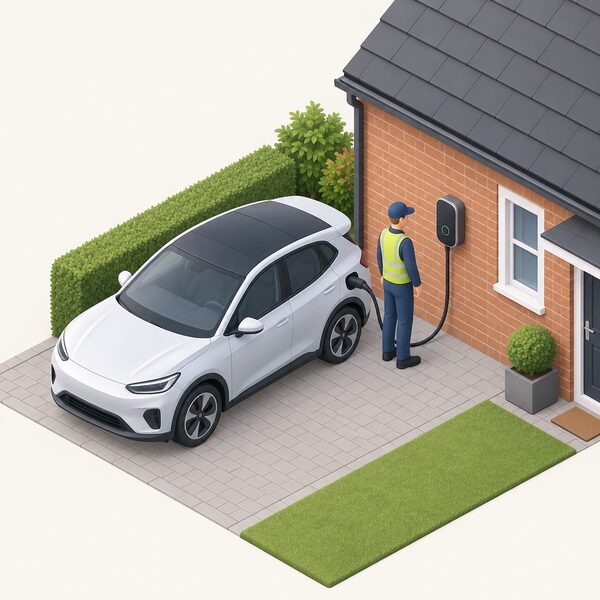
The withdrawal was driven by regulation. EO states that the decision "follows the introduction of the UK Smart Charge Point Regulations in June 2022", and that the Mini Pro 2 "no longer meets the necessary smart functionality requirements for sale or replacement in Great Britain"1. The company ceased selling the product in Great Britain in November 2022 to comply1.
The regulations themselves require that "all charge points sold in Great Britain for private (domestic or workplace) use must have smart functionality to help manage the increase in electricity demand from the transition to electric vehicles"15. Their territorial extent is Great Britain only, covering "charge points sold in Great Britain (GB) only", and they do not apply to "sales of charge points for export outside of Great Britain, which are not intended for use within Great Britain at any time"16. That is why the restriction is described as applying to Great Britain rather than the whole UK, and why Northern Ireland sits outside it.
The regulations also exclude some product categories, including "charge points for electric vehicles" in the context of consumer connectable product security rules and "smart meter products"17. The current Mini Pro 3 is described as meeting UK smart charging regulations, with built-in PME that "prevents the need for unsightly earth rods"3. The full regulatory picture is set out in the Electric Vehicles (Smart Charge Points) Regulations 2021.
EO Charging today: fleet focus, ownership and the Pod acquisition
EO Charging still trades, but it is no longer a domestic charger business in the way it was. In December 2023 the company "took a strategic step to focus solely on the commercial fleet market, continuing to offer our home charging solutions through trusted partner networks"12. In July 2025 it restated the position: "as our long-term focus moves to commercial EV fleets"9.
Its fleet customer list includes "Amazon, DHL, UPS, Tesco, and FedEx", and the company states it is "backed by leading sustainability investors Zouk Capital, manager of the UK Government's Charging Infrastructure Investment Fund, and Vortex Energy"4. It also claims "an unrivalled market uptime of over 99% across its customer base"4. Those are the maker's own figures for its commercial operation, not for domestic units.
The ownership position changed in 2026. Pod acquired EO Charging in May 2026, in a transaction that expands Pod's commercial fleet offering and energy management capabilities18. Separately, OVO Energy, one of the domestic suppliers listed in EO's own warranty registration form, "is due to be acquired by E.ON in the near future"14. Neither transaction restores support for the Mini Pro 2.
For a household, the independence question is straightforward. An EO Mini Pro 2 that still works is a 7.2kW socket with no cloud dependency left, because the cloud service has gone. That is a form of independence, but a bare one: no scheduling, no monitoring, no solar matching, no repair path and no parts. The charger ties the household to nothing except the electricity supply, and offers nothing beyond it. Households weighing what a charger contributes to energy independence, and what dependence it creates, can read EV charging and household energy independence.
Sources19 cited
- EO Mini Pro 2 support page, EO Charging, 2026
- Important service update: EO Mini Pro 2, EO Charging, 2025
- EO home charging, EO Charging, 2026
- Download the EO app, EO Charging, 2023
- EO Mini Pro support page, EO Charging, 2026
- EO Mini Smart Home support page, EO Charging, 2026
- EO Mini support page, EO Charging, 2026
- EO Basic support page, EO Charging, 2026
- A smarter way to charge: EO Charging partners with ev.energy, EO Charging, 2025
- EO Smart Home app support article, EO Charging, 2026
- EO Mini Pro 3 ev.energy app migration, EO Charging, 2026
- EO Charging partners with ev.energy to enhance Mini Pro 3 home charging, EO Charging, 2025
- Claim using a warranty or guarantee, Citizens Advice, 2026
- Register your warranty, EO Charging, 2026
- Approved documents: infrastructure for charging electric vehicles, FAQs, GOV.UK, 2023
- Guide to EV smart charge point regulations 2021, Department for Transport, 2022
- Regulations: consumer connectable product security, GOV.UK, 2024
- Electric car news, Pod Point, 2026
- Big six energy suppliers guide, Uswitch, 2026