
In this guide
Pod Point is one of the most familiar names in UK home charging, and since August 2025 it has been a wholly owned subsidiary of EDF, having been bought out through EDF's British arm, EDF Energy Customers Ltd1. For a householder, that ownership matters in a practical way: the company behind the charger is a large energy supplier rather than a standalone startup, and Pod Point chargers sit inside EDF's own EV tariff line-up.
The company now trades as Pod. It rebranded from Pod Point to Pod in May 2025, and the rebrand came with the launch of Pod Drive, described as the UK's first home EV charging subscription2. Pod Point chargers keep their product branding and sit alongside Pod Drive under the new Pod brand2. The company's site has moved to podenergy.com3.
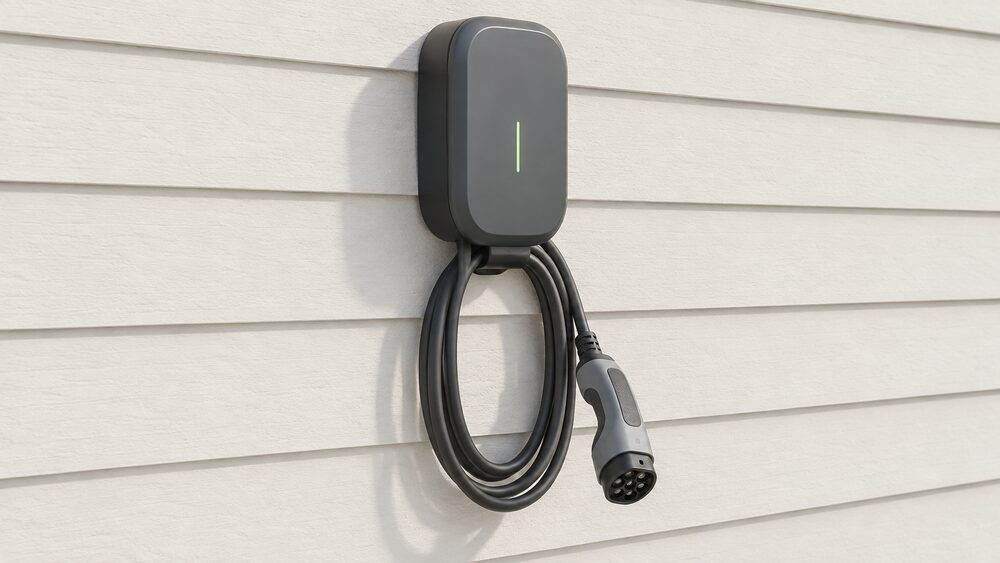
The current domestic product is the Solo 3, sold in a tethered form with a cable attached and an untethered form with a socket. Pod Point states that a Solo 3S home charger costs from £999 to install, and elsewhere gives a figure of around £849 for installing a home charge point4. The Solo 3 Home is available in models offering charging rates of 3.6kW, 7.4kW and 22kW5. It is compatible with all plug-in vehicle brands and with all energy suppliers, and it is Wi-Fi enabled6.
What follows is what the published documents say about the range, the costs, the connectivity and the support, and where the limits of a Pod Point charger lie for a household trying to keep its motoring costs under its own control.
Who owns Pod Point, and what that means for buyers
EDF, through its British subsidiary EDF Energy Customers Ltd, completed the acquisition of all outstanding shares of Pod Point Group Holdings PLC in August 2025, marking the transition to a privately held company1. The buyout offer had been recommended by the Pod board in June 2025, at which point EDF already held a 53% stake in the business1. Pod Point Group Holdings had previously been listed on the London Stock Exchange under the ticker symbol "PODP"8.
For a buyer, the change is about who stands behind the warranty and the support line rather than about the hardware. Pod Point Limited is registered in England, number 06851754, at 222 Gray's Inn Road, London WC1X 8HB, and it acts as a credit broker rather than a lender, introducing customers to Klarna Bank6. It also conducts consumer hire activities through its Pod Point Hire Services, which is the structure behind subscription-style deals6. The company is an appointed representative of Product Partnerships Limited, authorised and regulated by the Financial Conduct Authority6.
The warranty itself is governed by the laws of England9. That is a detail worth knowing if you are buying from Scotland, Wales or Northern Ireland: the terms are drafted on an England basis, though the consumer protections that apply where you live still apply to the sale.
The ownership question also shapes the tariff side. Pod Point chargers appear in EDF's own EV charging pages and in its tariff names, so a household buying a Pod Point charger is buying into an ecosystem where the charger maker and one of the energy suppliers are the same corporate group4. That does not lock you to EDF, as the compatibility statement below makes clear, but it explains why the two are so often mentioned together.
The domestic range: Solo 3 and the options around it
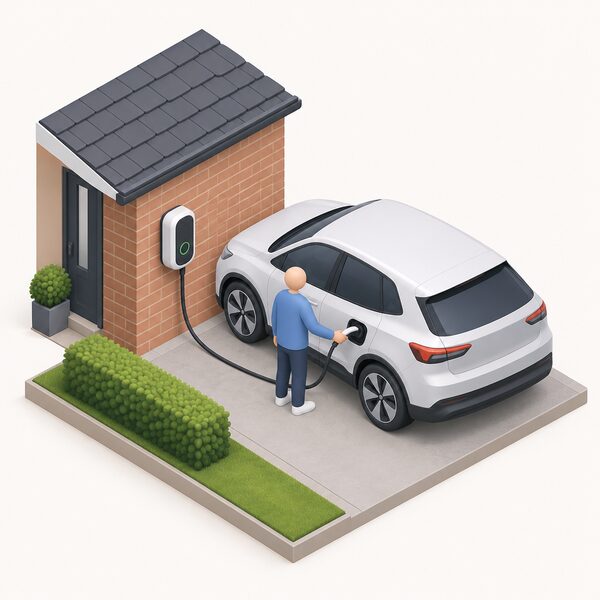
The Solo 3 is the core domestic product, and Pod Point describes its Solo chargers as Wi-Fi enabled and coming with a host of smart features10. The Solo 3S is the variant most often quoted in current pricing, and Pod Point describes it as compatible with all plug-in electric vehicles, OZEV approved, and fully compliant with the government's latest smart charging regulations11. It is Wi-Fi enabled so that the charger stays up to date with the latest smart features11.
Around the Solo 3 sit several routes to buying one. Pod Point runs a discount page, and students studying full-time can get an exclusive discount on a Solo 3S12. Beyond the direct purchase, there are manufacturer partnerships: Pod Point chargers are described as fully compatible with the Mercedes, Smart and DS electric and plug-in hybrid ranges, and Pod Point is one of Mercedes's preferred home charge suppliers for its portfolio of electrified vehicles13. In August 2026 Mercedes-Benz UK chose Pod as its sole home EV charging partner, with an exclusive home charging discount available to all Mercedes-Benz customers16.
There is also a subscription route. Pod Drive brings the upfront cost of a Solo 3S down to £99, with the rest spread over a two-year fixed tariff17. That offer of nothing to pay at checkout on a Pod Drive subscription ends on 1 November 20266. A separate comparison of charging subscriptions puts the Pod Drive upfront cost at £99, or £49 through a special deal for Nissan EV buyers18.
For households without a driveway, Pod Point has partnered with Kerbo Charge so that drivers with on-street parking can get a cross-pavement channel and a £500 grant towards a home EV charger through one process16. That route is covered in more detail under charging without off-street parking.
Solo 3 power ratings and the tethered or socket choice
The Solo 3 Home is available with models offering charging rates of either 3.6kW, 7.4kW and 22kW5. In practice the 7kW unit is the one most domestic supplies can support, and it is the version quoted in Pod Point's own pricing. An independent product listing gives the Pod Solo 3S a maximum charging speed of 7.0kW7.
The choice between tethered and untethered is the other decision. The untethered version works with Type 1 and Type 2 connectors, so it accepts a cable you already own and suits a household with more than one car or a car with an older connector7. The Solo 3 Home datasheet lists Type 1 (SAE J1772) and Type 2 (IEC 62196-2) connectors, and specifies a Mennekes Type 2 socket with a statutory locking mechanism5. The tethered version comes with a 5m cable7.
| Specification | Solo 3 Home |
|---|---|
| Charging rates | 3.6kW, 7.4kW and 22kW5 |
| Connectors | Type 1 (SAE J1772), Type 2 (IEC 62196-2)5 |
| Socket type | Mennekes Type 2 with statutory locking mechanism5 |
| Input voltage | 240 to 400 VAC (50Hz)5 |
| Wi-Fi | IEEE 802.11bgn5 |
| Wi-Fi security | WEP, WPA, WPA2 or Open Wi-Fi5 |
| Data security | Secure HTTPS data encryption5 |
| Certification | CE Certified5 |
The 22kW option is worth understanding before choosing it. A 22kW charger only delivers 22kW to a car whose onboard charger accepts three-phase AC at that rate, and it needs a three-phase supply at the property. Most UK homes have a single-phase supply, which is why the 7kW unit dominates. The general limits of each rating are set out under EV charging speeds and times, and the connector differences under EV connectors and cables.
What the Solo 3 costs, including installation
Pod Point states that a Solo 3S home charger costs from £999 to install4. Elsewhere the company gives the cost of installing a home charge point as starting from around £84917. An independent product listing puts the untethered Pod Solo 3S at £999 fully installed and the tethered version with a 5m cable at £1,0497.
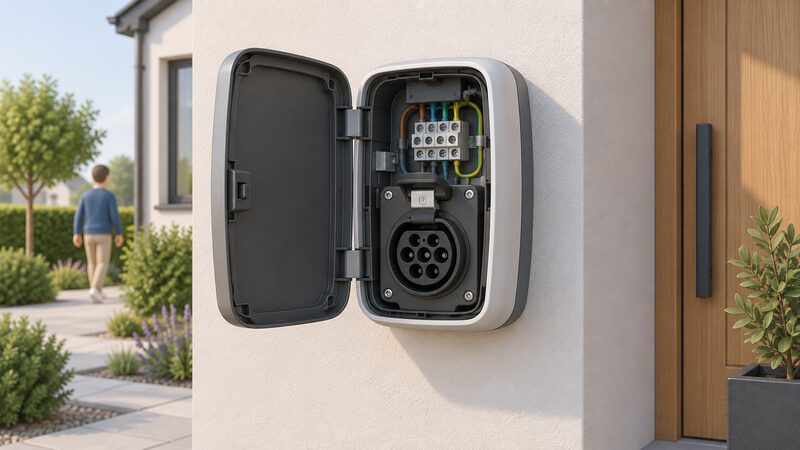
A standard installation can be completed in as little as 2 hours12. That is the straightforward case: a charger on an external wall close to the consumer unit, with a suitable supply. Anything beyond that, a long cable run, a detached garage, an older fuse board, adds work and cost.
On grant support, the picture has narrowed. The Electric Vehicle Homecharge Scheme that once funded home chargers is closed, and the current routes are the EV chargepoint grant for renters and flat owners and the grant for residential landlords. Pod Point publishes a guide to the electric car grant, and its own discount page carries the offers it runs directly19. The £500 towards a home charger mentioned above comes through the Kerbo Charge partnership for on-street parking, not from a general domestic grant16.
The wider cost picture, including what installation involves and how quotes are built, is covered under how much a home EV charge point costs and home EV charge point installation.
Connectivity: Wi-Fi, SIM routers and app control
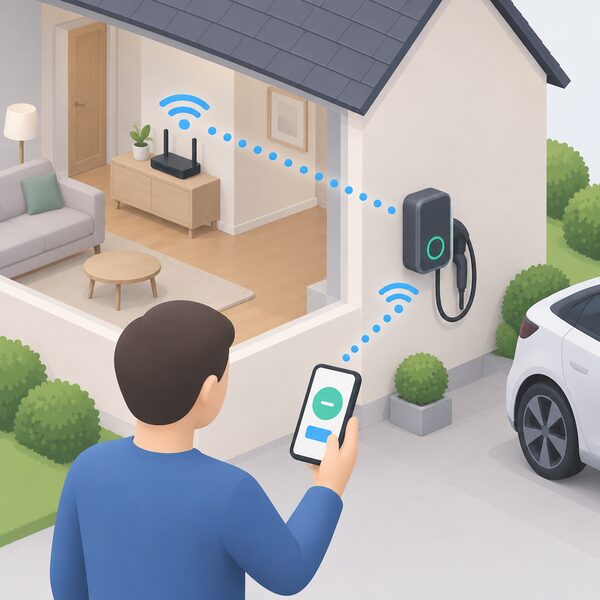
Pod Point home chargers connect either through a Wi-Fi connection at your property or through a SIM router with a 3G or 4G SIM7. The Solo 3 Home datasheet specifies IEEE 802.11bgn Wi-Fi and secure HTTPS data encryption5. The Solo 3S is described as Wi-Fi enabled to ensure the charger is always up to date with the latest smart features11.
Smart charging runs through the Pod Home app7. That is where scheduling and the solar modes live, and it is the layer that turns a wallbox into something that can be told when to charge. The charger itself does not depend on the app to deliver a charge: the app features include Charge Scheduling and Solar and Grid modes, but the charger works without the app and charges whenever a car is plugged in12.
This is the clearest dependence a Pod Point charger creates. Local charging continues without a connection, but scheduling, energy monitoring and remote diagnostics depend on your broadband, Pod Point's servers and the manufacturer's app. The general position on charger apps and connectivity is set out under EV charger apps, Wi-Fi, 4G and firmware, and the data side under EV charger cybersecurity and data.
Pod Point has had a security incident in the past. In 2021 a security flaw in its app was reported as potentially putting the data of 140,000 app users at risk20. Pod Point said it had engaged a cyber security firm to carry out extensive penetration and mobile testing to identify and resolve any security issues, and stated that all issues identified had been resolved20. Which? conducted a search of open and dark web markets and did not find anyone marketing stolen Pod Point data for sale20.
Solar integration and charging around your tariff
The Solo 3S includes solar integration, allowing users to charge their electric cars exclusively with excess solar power or with a mixture of solar and grid energy through solar charging modes16. Once the charger is paired with your account via the Pod Point App, activating Solar charging mode configures the settings16. Pod Point describes the charger as solar compatible, working with solar panels whether you have them now or install them in the future12.
The behaviour differs by mode. When charging using Charge Scheduling or Charge Now, the charger will use available solar energy alongside a larger top-up from the National Grid to reach its maximum charging rate16. In other words, the solar modes are not all pure-surplus modes: some blend grid power in to hit the target rate, which is a different proposition from a charger that waits for surplus only.
On tariffs, Pod Point states that its chargers are compatible with all energy suppliers6. An independent product listing, however, records the Pod Solo 3S as not smart tariff compatible7, which is a narrower claim about tariff-linked automation rather than about which supplier you can buy from. The documents differ on this point, and the distinction matters if you want the charger to respond automatically to a time-of-use tariff.
For households with solar, the tariff question is separate from the charger. Independent guidance recommends a dedicated solar and battery tariff, or a good export tariff matched with a dynamic import tariff or an Economy 7 tariff21. The Smart Export Guarantee is the mechanism that pays for exported electricity, and Good Energy's Solar Savings Exclusive is one such tariff22. The interaction between solar, export payments and EV charging is covered under charging an EV from solar panels and EV energy tariffs.
Pod Point as a company: scale, accreditations and support
Pod Point has been trading since 2009 and describes itself as having 17 years of experience, with 6 billion or more miles powered and 300,000 or more customers already on board6. It reports 21,000 or more 5-star reviews and says it is rated "Excellent" on Trustpilot19. Those are the company's own figures.
On accreditations, Pod Point was accredited as a Which? Trusted Trader for its end-to-end solution and customer-focused service11. Which? Trusted Traders awarded it a Which? Trusted Trader Approved Service for its end-to-end installation service in September 2023, and it was described as the first EV charging company to receive the endorsement8. Which? Trusted Traders is one of several schemes through which households can find traders, alongside Buy with Confidence, TrustMark, Book a Builder and Trusted Traders Scotland23. Independent guidance on choosing an installer suggests using the Which? Trusted Traders directory to find one24.
On the public network side, Pod Point is the third largest network of EV chargers in the UK by charger count15. Its locations include Tesco and Lidl stores, Center Parcs and National Park locations such as the Peak District25. Most of its public chargers require app activation, with no RFID support, though some at supermarkets are free26.
Support is described as available 24/7, and Pod Point states that its customer support team is available around the clock6. For a warranty claim, the terms say you must report the fault to the Pod support team either by completing the contact support form at help.pod-point.com or by calling +44 (0)20 7247 41449. The warranty excludes faults caused by parts of your existing installation or electricity system, including consumer units, breakers, cables or an existing solar PV system9. That exclusion is worth reading before installation, because it puts the state of your existing wiring inside the scope of what can void a claim.
In May 2026 Pod acquired EO Charging, a specialist in EV fleet charging and depot charging software that had entered administration in April 202627. The deal expands Pod's commercial fleet and energy management capabilities, and Pod says it cements its position as the largest EV charging services provider in the UK27. Existing EO Charging customers will continue to receive stable, uninterrupted service27. For a householder this is a commercial fleet story rather than a home charging one, but it is part of the same company that stands behind the domestic warranty.
Sources27 cited
- EDF completes acquisition of EV charging solutions provider Pod Point, EDF Energy, 2025
- Pod Point evolves into Pod and launches new subscription model, Pod Drive | Pod, podenergy.com
- Pod recognised as an Inspiring Workplace, one year on from rebrand | Podpoint, podenergy.com
- Home charger, EDF Energy, 2026
- Solo 3 Home Datasheet, Pod Point, 2026
- Pod Point, Pod Point, 2026
- Home electric vehicle chargers, Carwow, 2026
- Looking to install a home charger for your electric car? Find a trader you can trust, Which?, 2025
- Pod Product Warranty Statement domestic, Pod Point, 2025
- Smart home charger, Pod Point, 2026
- EV charger home installation process, Pod Point, 2025
- Discounts, Pod Point, 2026
- Mercedes home charger, Pod Point, 2026
- DS home charger, Pod Point, 2026
- EV charging statistics, Zapmap, 2026
- Introducing Solo 3S, Pod Point, 2024
- Electric car costs, EDF Energy, 2026
- Best electric car charging subscriptions, Carwow, 2025
- The electric car grant: a complete guide, Pod Point, 2026
- Pod Point electric car chargers security flaw may have put 140,000 app users' data at risk, Which?, 2021
- Tariffs for renewable technology, Energy Saving Trust, 2026
- Smart Export Guarantee, Solar Energy UK, 2026
- Trusted payments: paying for home improvements, Trading Standards, 2026
- How to choose a good solar installer, Low Carbon Hub, 2025
- Destination charging, Zapmap, 2026
- Electric car charging guide, Carwow, 2025
- Pod Point acquires EO Charging in the UK - electrive.com, electrive.com
 Pod Point home EV chargersWondering what a Pod Point home charger costs, whether it fits your car and who owns the company now?
 Pod Point Plug & PowerPod Point Plug & Power bundles a Solo 3S home charger at £499 with a two-year tariff at 6.49p per kWh off-peak, and requires a fully connected smart meter.