In this guide
Zaptec is a Norwegian maker of home EV chargers sold in the UK, and the Zaptec Go is the model most often named in compatibility lists. It is listed at 22 kW, with 4G, WiFi and Bluetooth connectivity1. That combination puts it in the higher-output end of the domestic wallbox market, where most UK homes run a single-phase supply and most wallboxes are sold at 7 kW.
The practical picture is more modest than the headline rating. Independent guidance describes fast charging as spanning 7 kW to 22 kW, so a 22 kW charger is only as fast as the supply behind it2. Comparable wallboxes are sold with selectable 7 kW and 22 kW settings precisely because the same unit has to suit single-phase and three-phase properties3. What the Zaptec Go does for a household is set by the electricity supply, the vehicle's onboard charger and the tariff, not by the badge on the wall.
Where the Zaptec Go stands out in the material available is integration. It appears in the ev.energy compatibility list1, in Polestar's home charging guidance alongside Wallbox and Easee4, and in equiwatt's flexibility instructions, where connecting the charger allows automatic participation in equivents and avoids charging when electricity is dirty and expensive5. Those are the routes by which a Zaptec charger can be steered away from peak grid electricity, and they are the routes by which it also becomes dependent on a third-party app and a broadband connection.
The Zaptec range at a glance
The material available covers the Zaptec Go specifically rather than a full model-by-model range. The Go is listed at 22 kW in the ev.energy compatibility list, which is the clearest single specification point for the model1. Polestar's UK home charging guidance names Zaptec Go alongside Wallbox and Easee as chargers compatible with Polestar Energy, and states that Polestar Energy is compatible with the UK energy supplier Octopus Energy4. That places the Go in a small group of chargers a vehicle manufacturer has chosen to work with, rather than in the general unbranded pool.
For context on what a UK buyer is choosing between, the wider market splits along a few lines. Chargers are sold tethered, with a cable fixed to the unit, or untethered, using the owner's own cable; one competing range is available in both forms6. Output options across the market run from 7 kW single-phase units up to 22 kW three-phase units, and one maker offers selectable 7 kW and 22 kW settings on the same product3. Another maker's range spans 1.4 kW to 22 kW with single-phase or three-phase charging7.
| Feature | Zaptec Go | Typical competing wallbox |
|---|---|---|
| Rated output | 22 kW1 | 7 kW or 22 kW selectable3 |
| Connectivity | 4G, WiFi, Bluetooth1 | WiFi, Bluetooth, local radio8 |
| Cable options | Not stated | Tethered or untethered6 |
| Tariff integration | ev.energy, Polestar Energy1 | Intelligent Octopus Go9 |
| Flexibility scheme | equiwatt equivents5 | Gridpay and solar integration8 |
The comparison is not a ranking. It shows the shape of the market the Go sits in: high output, multiple radio routes, and a dependence on app ecosystems for the features that make a charger smart rather than merely fast.
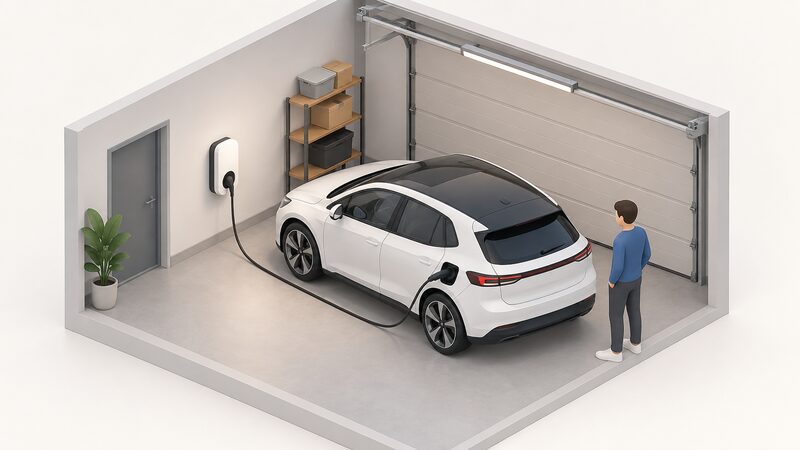
Zaptec Go: up to 22 kW charging
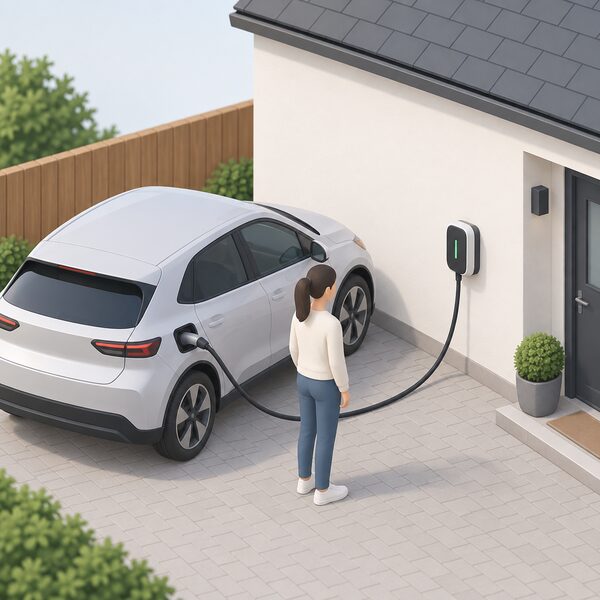
The Zaptec Go is listed at 22 kW1. That figure describes the charger's maximum, not what a typical UK installation delivers. Independent guidance groups fast charging as 7 kW to 22 kW, which is the band a home charge point occupies before rapid charging begins2. A 22 kW unit on a single-phase supply cannot deliver 22 kW, because the supply itself does not carry it.
The market evidence for this is in how other makers sell the same problem. One range offers selectable power settings of 7 kW and 22 kW so the charger adapts to a single-phase or three-phase electrical setup3. Another maker's 22 kW unit charges at up to 4.6 kW on a single-phase vehicle requiring more than 16 amps, and in exceptional cases up to 7.4 kW, with full 22 kW output requiring a 32 amp fuse10. Those figures show how far the delivered rate can sit below the rated one.
The headline figure for a home charger is up to 22 kW, and it is a ceiling rather than a promise. Zaptec states its charging stations offer up to 22 kW, "depending on the setup and the car", which it calls the highest output available11. The same limit appears across the market: the myenergi Zappi is listed at 7.4kW or 22kW, the go-e Charger CORE at up to 22 kW with delivery limited to 11 kW until an installer raises it, and the Fronius Wattpilot Go 22 J at 22 kW12. What a household actually receives depends on the supply: full 22 kW needs three-phase power and a 32 amp fuse, while a single-phase supply gives roughly 7.4 kW, and go-e notes single-phase vehicles generally charge at up to 4.6 kW15.
For a household, the practical expectation is that a Zaptec Go will charge at whatever the property's supply and the vehicle's onboard charger allow, up to the unit's 22 kW maximum. Most UK homes have a single-phase supply, so the realistic figure is the 7 kW end of the fast charging band2. Three-phase properties can go higher. The charger does not change the supply; it works within it. More on the difference between the two ratings is at 7kW vs 22kW home EV charger, and the wider speed picture is at EV charging speeds and times.
Connectivity: 4G, WiFi and Bluetooth
The Zaptec Go is listed with 4G, WiFi and Bluetooth1. Having three routes matters because it changes what the charger depends on. A unit with only WiFi stops being remotely controllable when the broadband drops or the router is replaced. A unit with 4G has a mobile data path that does not run through the home network, and Bluetooth gives a local route for setup and for direct connection at the unit.
Zaptec chargers are described as including WiFi connectivity that enables remote charging monitoring, smart charging, software updates and integration with a smart home4. That is the feature set the connectivity exists to serve: without a data path, a wallbox is a socket with a contactor in it.
The comparison with other makers shows how much this varies. One competing charger supports WiFi, Bluetooth and local radio communication8, and its UK variant supports 2.4GHz WiFi plus Bluetooth for local connection12. Another maker's charger supports 4G, Ethernet, WiFi and Bluetooth11. Zigbee Direct, a separate standard, allows interaction with Zigbee networks using a smartphone, tablet or other Bluetooth-enabled device13, which is the kind of local-first route some households prefer.
The dependence this creates is worth stating plainly. Local charging continues without any network, because the charger still passes current to the vehicle. Remote scheduling, energy monitoring, firmware updates and any tariff-linked automation depend on a data connection and on the manufacturer's or a third party's servers. For a household weighing independence, that is the trade: convenience and cheaper off-peak charging in exchange for a continuing relationship with a software provider. More on this is at EV charger apps and connectivity and EV charger cybersecurity and data.
Smart charging and app integration
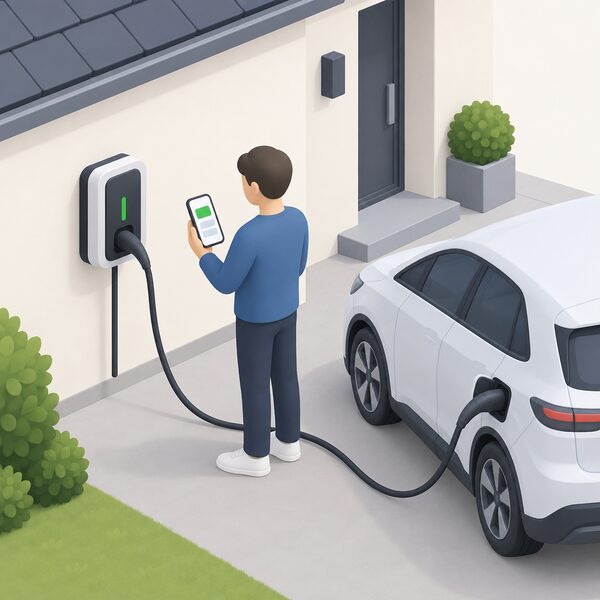
The Zaptec Go's smart charging story runs through third-party apps rather than a single manufacturer platform in the material available. It is compatible with the ev.energy app, and the guidance notes that a compatible vehicle or home charger is all that is needed to get started1. It is also named in Polestar's home charging guidance, where Polestar Energy is compatible with home chargers from Wallbox, Easee and Zaptec Go together with the UK energy supplier Octopus Energy4.
The flexibility route is equiwatt. Connecting a Zaptec charger to the equiwatt app enables automatic participation in equivents and avoids charging when electricity is dirty and expensive5. The setup runs through the equiwatt app: open the Manage tab, select Add New Device, then Add Smart Charger, then select the Zaptec EV charger5. Equiwatt announced the Zaptec integration in September 2024, with 250 bonus points for owners who connected a charger and automatic pausing of charging during events.
That is the mechanism by which a Zaptec charger earns its keep beyond convenience. A charger that can be paused during grid strain events, or shifted to cheaper hours, changes what the household pays and when it draws from the grid. Competing chargers offer similar features under different names, including smart charging that automates energy efficiency with solar integration and rewards customers for pausing during grid strain8.
"Connecting your Zaptec charger to equiwatt enables you to automatically participate in equivents and avoid charging when electricity is dirty and expensive"
What this does not do is make the household independent of the grid. Every one of these schemes works by moving consumption to a different time, or by pausing it, within a supply that still comes from a supplier. The reward is a lower bill and a lower carbon intensity per mile, not self-sufficiency. The wider picture is at Smart charging, flexibility services and reward schemes and EV energy tariffs and how they change home charging.
Installation: included with purchase
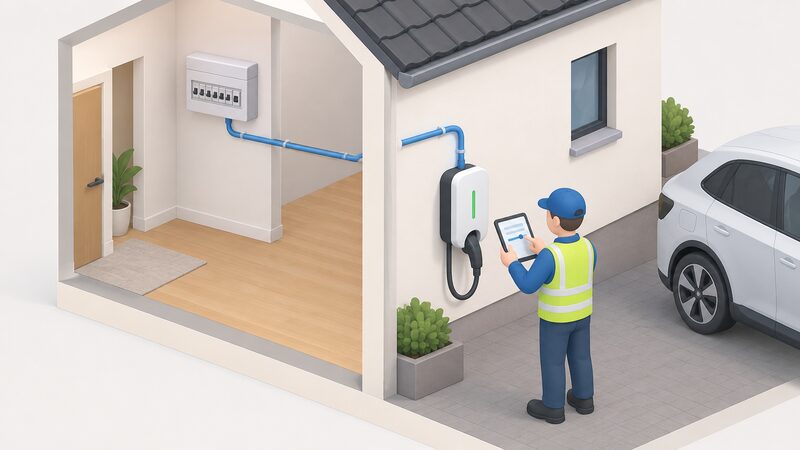
The material available does not state Zaptec's own installation terms, so the process has to be described from how UK home charge point installation works generally. Installation is a fixed piece of electrical work: a site survey, mounting of the unit, a dedicated circuit run from the consumer unit, and commissioning. One competing maker describes exactly this sequence, with the installer using an Installer Assistant app to configure grid limits and safety settings12. The same maker describes a step-by-step setup tool designed to make installation smooth, fast and fail-safe8.
Some routes bundle installation into the purchase. One supplier lists installation as included14, and a group buying scheme describes the installer carrying out the work once the household accepts, with the scheme staying in the loop to quality-check15. Where installation is not bundled, it is quoted separately after a survey.
The electrical work itself is not optional or self-directed. A home charge point needs its own circuit and protection, and the network operator has to be notified of certain installations. The relevant detail is at Home EV charge point installation, Electrical requirements for a home EV charge point and Telling the network operator about a home EV charger. Load management matters where the supply is shared or the main fuse is close to its limit, covered at Load management and load balancing.
Zaptec Go and household energy independence
A home charger's contribution to energy independence is real but bounded, and the Zaptec Go is a clear example of both halves. On the independence side, charging at home means the household buys electricity rather than forecourt charging, and it can choose when to buy it. A charger that responds to a flexibility scheme can be paused during grid strain events5, and one that works with a smart tariff can be shifted into cheaper hours. The Polestar bundle announced in June 2026 offers free home charging over the vehicle lease, with the bundle reported to save drivers an annual £620 on charging4.
On the dependence side, the list is longer than the benefits. The charger draws from the national grid, like any conventional electric vehicle charger16. It depends on an electricity supplier for the energy and on the grid for delivery. Its smart features depend on a data connection and on third-party platforms: ev.energy1, Polestar Energy4 or equiwatt5. Its firmware and app come from the manufacturer. None of that is unique to Zaptec, but it is the honest accounting.
What changes the balance is generation. A charger that can be steered to run when a home's solar panels are producing, or when a home battery is discharging, converts a grid purchase into self-consumption. The Zaptec Go's role in that depends on the app and tariff it is paired with rather than on the hardware alone. The wider subject is at EV charging and household energy independence, Charging an EV from solar panels and EV charging alongside a home battery.
Sources16 cited
- Zaptec integration, ev.energy, 2026
- Electric cars and energy bills, Uswitch, 2026
- zappi, myenergi, 2026
- Home charging, Polestar, 2026
- Connecting your Zaptec charger to equiwatt, equiwatt, 2026
- zappi GLO, myenergi, 2026
- go-e Charger, go-e, 2026
- zappi GLO, myenergi, 2026
- Octopus partnership, myenergi, 2026
- go-e FAQs, go-e, 2026
- EV charger, Haier, 2026
- zappi GLO, E.ON Next, 2026
- Zigbee, Connectivity Standards Alliance, 2026
- New boiler, Uswitch, 2025
- Group buying, Switch Together, 2026
- Electric car charging at home, myenergi, 2026