In this guide
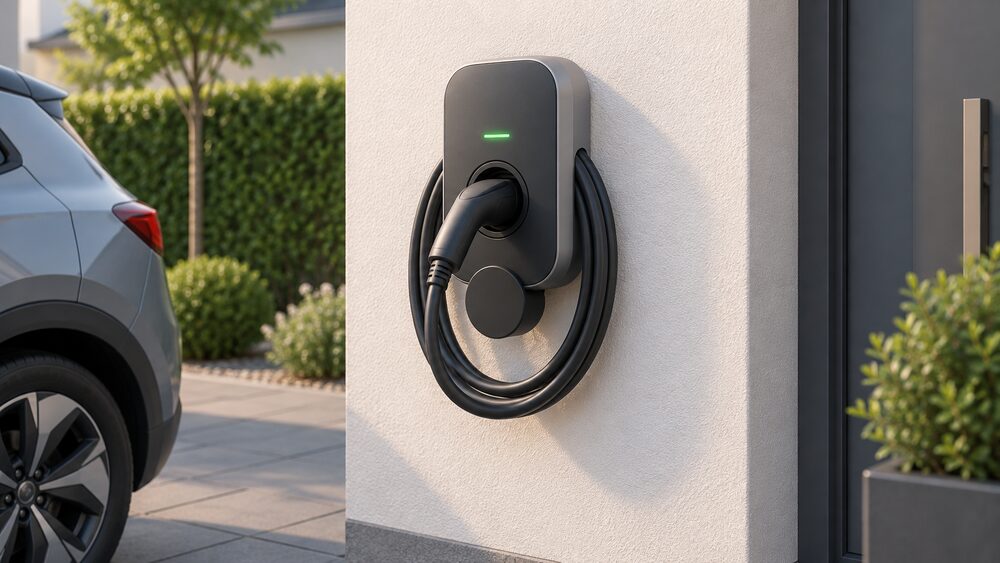
Ratio EV Charging sells two domestic wallbox families in the UK, the io5 and the io6, plus a range of mobile chargers. The wallboxes come in 7.4kW single-phase and 22kW three-phase versions, carry a three-year parts warranty, and are controlled through the free Ratio App1. The company states that its products are fully tested and approved for the UK and EU markets1.
The ownership is mixed, and that matters for how the brand should be read. Ratio EV Charging is a joint investment between FW Thorpe Plc and Ratio Electric in the Netherlands, and it designs and manufactures at a factory in Redditch in the Midlands specifically to suit and serve the UK market4. The parent business, Ratio Electric, was established in 19604. The mobile chargers, by contrast, are made in the Netherlands5.
For a household, the appeal is a UK-built wallbox with app scheduling and no subscription, and the dependence is the usual one: a grid connection, a licensed electricity supplier, and a manufacturer's app and servers for the remote functions. Ratio's own grant approval sits on its workplace product rather than the domestic range, so the household grants that remain are the ones aimed at renters, flat owners and landlords6.
Who Ratio EV is, and where the hardware is built
Ratio EV Charging describes itself as a joint investment between FW Thorpe Plc and Ratio Electric in the Netherlands, and states that it designs and manufactures EV charging products at its factory in Redditch in the Midlands specifically to suit and serve the UK market4. That is a UK manufacturing claim, and it is the maker's own. The wider Ratio business is older than the EV market: Ratio Electric was established in 1960 and specialises in the development, manufacture and supply of electrical power connections4.
The cable side of the business predates the wallboxes. Ratio states that it has been designing and manufacturing EV charging cables for over a decade, and the E-Line cable is described as designed and built in Holland, CE compliant and UV resistant10. The mobile chargers are also made in the Netherlands5. So the picture is a Dutch parent with a UK manufacturing arm: cables and mobile units from the Netherlands, wallboxes built at Redditch.
That split is worth knowing because it affects spares and service. A UK assembly site shortens the supply chain for the wallbox range, while the cable and mobile products follow a Dutch route. Ratio also states that all its products are fully tested and approved for the UK and EU markets, which is the maker's compliance claim rather than an independent certification listing11.

The range: io5 and io6 wallboxes and mobile chargers

The domestic hardware divides into two wallbox families and a set of portable units. The io5 is the older and simpler of the two, listed with an IEC 61851 Mode 3 charging system and an IP54 enclosure rating4. The io6 is the current family, sold in 4G and non-4G connectivity options, with a visual LED charging indicator, RFID enabled operation and a built-in cable storage hub2.
The io6 Pro is the higher-specification variant, described as a high performance wall or pole mounted EV charger available in 7.4kW single-phase or 22kW three-phase power versions3. Its enclosure rating is IP54, and it can connect up to 32 chargers on one mains connection with power sharing, which is a commercial-scale feature rather than a domestic one12. Ratio also notes that the io6 Pro uses charge point management software called Fuuse, allowing flexible management of a charging estate3.
The mobile chargers are a separate proposition. Ratio describes them as built for home and able to charge anywhere there is mains power, with 7.4kW and 22kW power options and a selection of mains connections5. They are not wallboxes and do not carry the same installation requirements, but they extend the same app-based approach to charging away from the driveway.
| Product | Type | Power | Enclosure | Notes |
|---|---|---|---|---|
| io5 | Wallbox | Single and three-phase | IP544 | IEC 61851 Mode 34 |
| io6 | Wallbox | Single and three-phase | Not stated | 4G and non-4G options, RFID, LED indicator2 |
| io6 Pro | Wallbox, wall or pole | 7.4kW single, 22kW three-phase3 | IP5412 | Up to 32 chargers on one supply12 |
| Mobile chargers | Portable | 7.4kW / 22kW5 | Not stated | Made in the Netherlands5 |
Power ratings: 7.4kW single-phase and 22kW three-phase
Ratio's core marketplace is fast destination charging, single and three-phase, up to 32A, which it gives as 7.4kW and 22kW1. The io6 Pro is listed in the same two versions, 7.4kW single-phase or 22kW three-phase3. The mobile chargers carry the same pair of ratings5.
The distinction matters more than the numbers suggest. A 7.4kW single-phase unit is the standard domestic wallbox rating and matches what a single-phase home supply can deliver. A 22kW three-phase unit needs a three-phase supply to reach its full output; on a single-phase supply it will not. For most UK houses the practical charging rate is therefore set by the property's supply, not by the box.
The wider charging landscape gives some context. Of UK public EV chargers, 49% were rated standard at 3kW to less than 8kW, 12% rapid at 50kW to less than 150kW and 12% ultra-rapid at 150kW and above, as of 1 July 202613. Rapid and ultra-rapid units can charge EV batteries within 20 to 60 minutes14. A home wallbox sits in the standard band, which is why home charging is an overnight activity rather than a stop-and-go one. The EV charging speeds and times page sets out how the bands compare.
Built-in lighting and app control: what sets the hardware apart
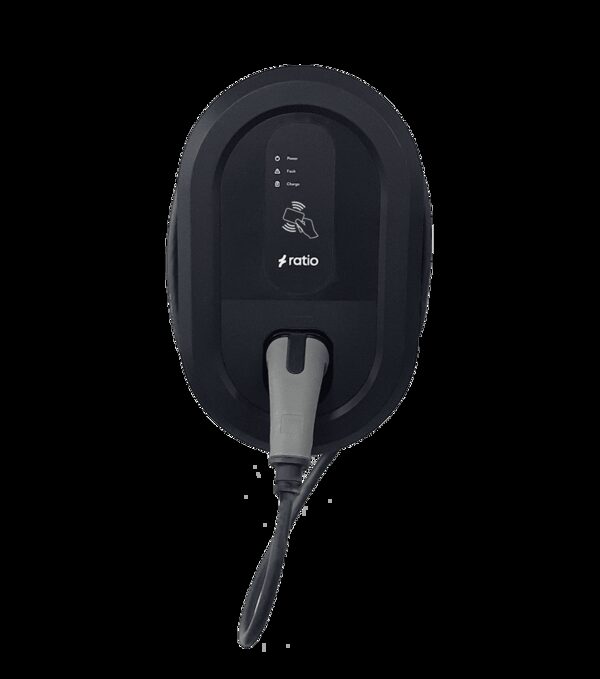
The io6 family carries a visual LED charging indicator, RFID enabled operation and a built-in cable storage hub2. Those are hardware features rather than software ones, and the cable storage hub in particular addresses the common complaint that a tethered cable has nowhere tidy to live.
The app is the other half. Ratio describes the Ratio App as free, and lists remote access to home charging, scheduling and optimisation of charging, and viewing charging history among its functions1. The io5 page repeats the same wording and adds that the app prevents use by unauthorised parties and allows charging times to be configured each day1. The homeowner solutions page describes the products as app-based and eco-friendly chargers and cables9.
The dependence this creates is worth stating plainly. Scheduling, remote access and charging history run through the manufacturer's app, which means a broadband connection, Ratio's servers and a working phone or tablet. Local charging at the wallbox continues without any of that, but the smart functions do not. The EV charger apps and connectivity page covers how that pattern works across brands, and the smart EV chargers page explains what makes a charger smart in the first place.
There is also a regulatory direction of travel. In a consultation on Energy Smart Appliance Regulations, the recommendation for EV supply equipment was that measured consumption should focus on the electricity delivered to the vehicle rather than including the charge point's own internal consumption15. That is a consultation position, not a settled rule, but it signals how charging energy is likely to be measured and reported.
Warranty: three-year parts cover across the range
Ratio states a three-year parts warranty on its home EV chargers, described as complete peace of mind with a three-year parts warranty9. The io5 product page lists a 3-year warranty1. The wording is parts, and that is the term to read carefully: a parts warranty covers the components, and the labour to diagnose and fit them is a separate matter.
The comparison is instructive. Another maker, evec, describes its own cover as a three-year parts and labour guarantee, and defines parts as mechanical and electrical parts only16. It also states that products registered outside a 30-day period receive a 12-month part and labour guarantee only16. That is a different maker's terms, not Ratio's, but it shows that a three-year headline can mean quite different things depending on whether labour is inside it.
Ratio's published material does not set out a registration deadline or a labour position in the same detail, so the safe reading is the one the maker gives: three years on parts. The EV charge point warranties page covers how warranty terms vary across the market and what to check before relying on one.
Installation: using Ratio's installer network
Ratio states that its dedicated support team can assist in ensuring chargers are safely and compliantly installed using its network of installers9. That is the maker's route: a household contacts Ratio, and the installation is arranged through installers the company works with.
The independent requirements sit alongside it. The Energy Saving Trust advises contacting an accredited EV charge point installer17, and Northern Powergrid's guidance says the same where an accredited installer is not already to hand18. NICEIC recommends hiring an electrician registered with a recognised certification body, and states that an EV charger must be installed in line with the current edition of BS 7671, the national standard for electrical installations19.
Building regulations approval is always required when installing an EV home charger, and a competent and reputable installer should be used, with specific processes for notifying the local building control authority20. The certificate issued serves as proof that the work complies with building regulations20. In England, permitted development rights for charger installations carry limitations relating to the size and height of the equipment that can be installed21. The home EV charge point installation page walks through the process, and the electrical requirements page covers the supply side.
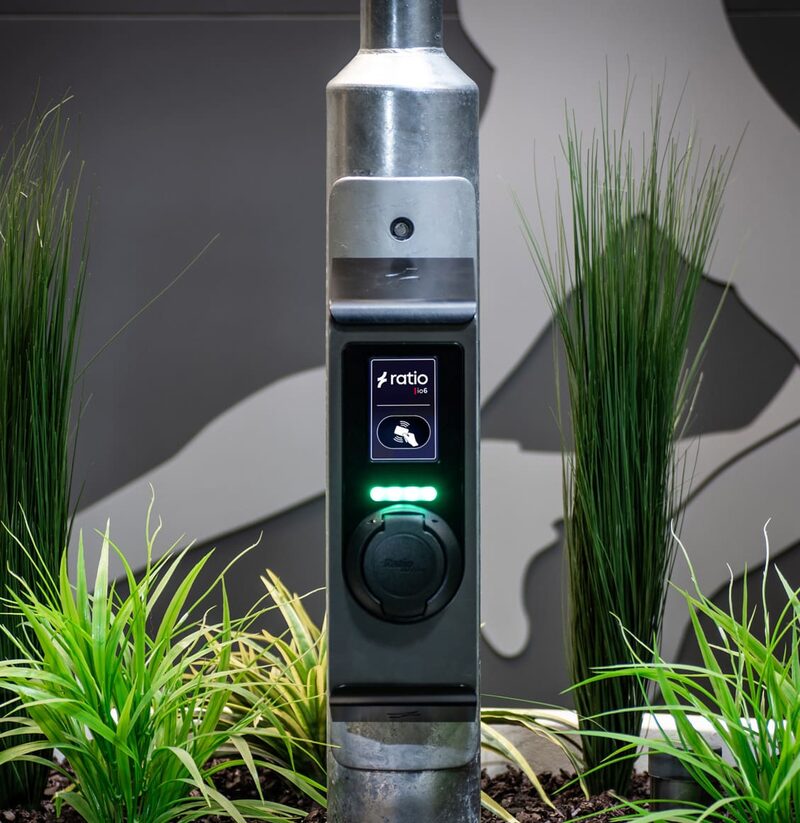
Mounting options extend the installation choices. Ratio's mounting post is suitable for outdoor use, supplied flat packed, and pre-drilled for easy installation of both the io5 and io6 chargers, plus pre-drilled holes for floor mounting22. That gives a pole-mounted alternative where a wall is not available or not wanted.
Grants and OZEV: what Ratio does and does not do
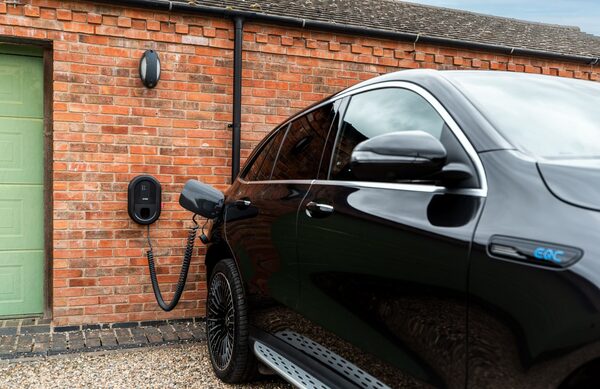
Ratio states that the io6 Pro is an OZEV grant approved compact workplace EV charging solution6. That is the workplace product, and the approval attaches to it rather than to the domestic io5 or io6 wallboxes. The distinction matters because the household grants that remain are aimed at specific groups rather than at owner-occupiers generally.
The Electric Vehicle Chargepoint Grant offers up to £350 per socket for residential landlords, people living in flats and people who rent their homes, and funds the installation of home EV chargers17. It is only for vehicles on the list of OZEV-approved electric vehicles7. For residential landlords, the exclusions are specific: an applicant cannot apply if they live in the property, if the property is not a residential property, if a chargepoint was already installed before OZEV confirms eligibility, if the property is only used for holiday accommodation, if there is no company registration number or VAT registration number, or if the installation is because of a mandatory requirement8.
The application route runs through an OZEV-authorised installer for a quote, then an account and a form submitting details of the property and vehicle to OZEV8. The grant for households with on-street parking requires an OZEV approved installer to complete the installation24. Independent guidance summarises the remaining schemes as offering eligible applicants up to 75% off the cost of installing an EV chargepoint21, and Northern Powergrid describes the charge point grant as up to 75% towards the cost of installing EV charge points, up to a maximum of £350, for rental accommodation or flat owners18.
The Electric Vehicle Chargepoint Grant for renters and flat owners and the grant for residential landlords pages set out the conditions in full. For a household with a driveway and no rental or flat status, no grant applies to a Ratio wallbox.
Where the chargers are made and UK availability
The wallboxes are designed and manufactured at Ratio's factory in Redditch in the Midlands specifically to suit and serve the UK market4. The mobile chargers are made in the Netherlands5, and the E-Line cable is designed and built in Holland10. Ratio describes its products as UK and EU manufactured, which it presents as a quality assurance point9.
The approval position is stated by the maker. The io5 is fully tested and approved for UK and EU markets1, the io6 Pro is fully tested and approved for UK and EU markets6, and all products are fully tested and approved for the UK and EU markets11. The E-Line cable is fully approved for UK and EU markets and CE compliant10. These are the manufacturer's compliance statements rather than third-party listings, and the EV charge point safety and standards page explains what the underlying standards cover.
Availability is a UK-facing operation: a UK factory, a UK support team and a UK installer network4. That is a shorter chain than an imported wallbox, though the app and any remote diagnostics still run through the manufacturer's systems.
What the range means for a household's energy independence
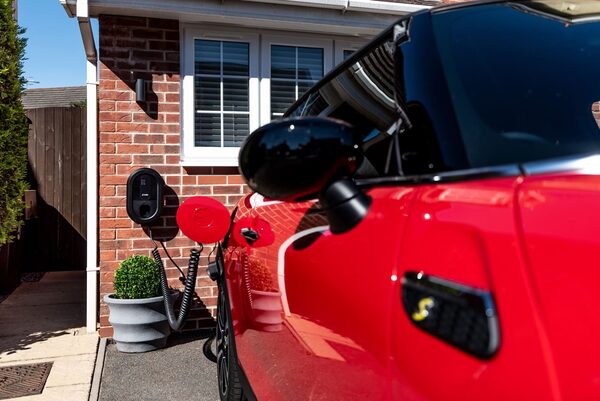
A Ratio wallbox does what any home charger does for independence: it moves refuelling from forecourts to the home electricity supply, so the household buys electricity rather than petrol or diesel, and can schedule charging into cheaper overnight periods through the app1. The free app and the scheduling function are the practical mechanism for that.
What remains is dependence, and it is worth being exact about it. The household stays on the grid and with an electricity supplier. The smart functions depend on broadband, Ratio's servers and the app. The warranty is a three-year parts term, so labour on any repair is a separate cost9. The longest grant support is not available to a typical owner-occupier with a driveway, since the remaining household schemes are aimed at renters, flat owners and landlords17. And the OZEV approval Ratio holds is on the workplace io6 Pro, not the domestic range6.
For a household weighing a Ratio wallbox against the alternatives, the EV charging at home guide sets out the full picture, and the home EV charger cost page covers what installation involves. The EV charging and household energy independence page examines the wider question of what a home charger does and does not change about a household's position.
Sources25 cited
- Ratio io5 product page, Ratio EV Charging, 2026-02-13
- io6 chargers product page, Ratio EV Charging, 2026-09-07
- io6 Pro PC product page, Ratio EV Charging, 2026-09-08
- Ratio io5 brochure, Ratio EV Charging, 2024-11
- Mobile chargers product page, Ratio EV Charging, 2026-03-19
- Ratio io6 Pro product page, Ratio EV Charging, 2026-05-15
- Electric vehicle chargepoint grant for renters or flat owners: eligibility, GOV.UK, 2026-09-17
- Electric vehicle chargepoint and infrastructure grants for landlords, GOV.UK, 2026-09-18
- Homeowner solutions, Ratio EV Charging, 2025-03-12
- E-Line charging cable product page, Ratio EV Charging, 2026-03-19
- Ratio accessories card, Ratio EV Charging, 2026-09-17
- io6 PRO installer product sheet, Ratio EV Charging, 2026-09-17
- Public electric vehicle charging infrastructure statistics, 1 July 2026, GOV.UK, 2026-07-01
- Electric vehicles, nidirect, 2025-06-25
- evec warranty information, evec, 2026-09-17
- Home electric vehicle chargers, Carwow, 2026-01-09
- Charging electric vehicles, Energy Saving Trust, 2026-04-23
- Electric vehicles for home charging, Electricity North West, 2026-09-19
- Electric vehicle charger installation and maintenance, NICEIC, 2025-08
- Building regulations for electric vehicle charging, Planning Portal, 2026
- EV charger regulations in England: what's changed, NICEIC, 2026-08-19
- Ratio EV mounting post, Ratio EV Charging, 2026-03-18
- Ratio EV mounting post PC, Ratio EV Charging, 2026-09-08
- Electric Vehicle Chargepoint Grant for Households with On-Street Parking, GOV.UK, 2026-09-17
- Electric vehicle charging device grant scheme statistics, GOV.UK, 2025-11-26