
In this guide
ABB is one of the largest electrical equipment manufacturers in the world, and its e-mobility business supplies charging hardware for both domestic and commercial use. The company describes itself as having become the expert in medium to low voltage energy distribution over a history of more than 100 years1. That matters for a household because a home wallbox is a piece of electrical distribution equipment as much as a consumer gadget: it sits on a dedicated circuit, it is governed by wiring regulations, and it is installed by an electrician rather than plugged in.
The Terra AC is the wallbox line that reaches UK homes, sold through installers rather than off a shelf. ABB's charging hardware is also widely deployed in public networks: among UK charging operators, ABB and EV Tronic rank in the top five by location count, with totals of 817 and 385 respectively2. A householder buying a Terra AC is therefore buying into a product family with a substantial installed base, though the domestic unit is a different product from the rapid chargers on a motorway services forecourt.
The practical case for home charging is strong. Among battery electric vehicle drivers with a charge device at home, home charging accounts for an average of 85% of their charging needs3. A wallbox is what makes that possible at a useful speed, and it is the piece of equipment that determines how much of a household's motoring energy comes from its own supply rather than the public network.
Who ABB are, and what that means for a home wallbox
ABB's own account of its e-mobility business places it in electrical distribution rather than consumer electronics, and the company's connected charger platform is described as enabling fast global service and proactive maintenance1. For a household, the relevant reading is that the maker is an industrial supplier with an established service organisation, and that the domestic wallbox is one product in a much larger portfolio.
The UK home charging market is crowded. More than 50 manufacturers provide charging units suitable for EV charging at home6. That number is the single most useful fact for anyone weighing an ABB unit against the alternatives: there is no shortage of choice, and the differences between reputable units lie in the details of installation, load management, connectivity and support rather than in the basic function of delivering alternating current to a car.
What a large manufacturer does not change is the regulatory position. An EV charger must be installed in line with the current edition of BS 7671, the national standard for electrical installations7. The work should always be done by a qualified and certified electrician8, and the recommendation is to hire an electrician registered with a recognised certification body such as NICEIC7. The installer may be the one who notifies the building control body, but that should not be assumed9.
The Terra AC range: which models a householder can buy
The Terra AC is the domestic line, and it is not a retail product in the way a kettle is. Units reach households through installers and electrical wholesalers, which means the model a householder ends up with is usually the one the installer supplies. That has a practical consequence: the specification conversation happens at quotation stage, not in a shop.
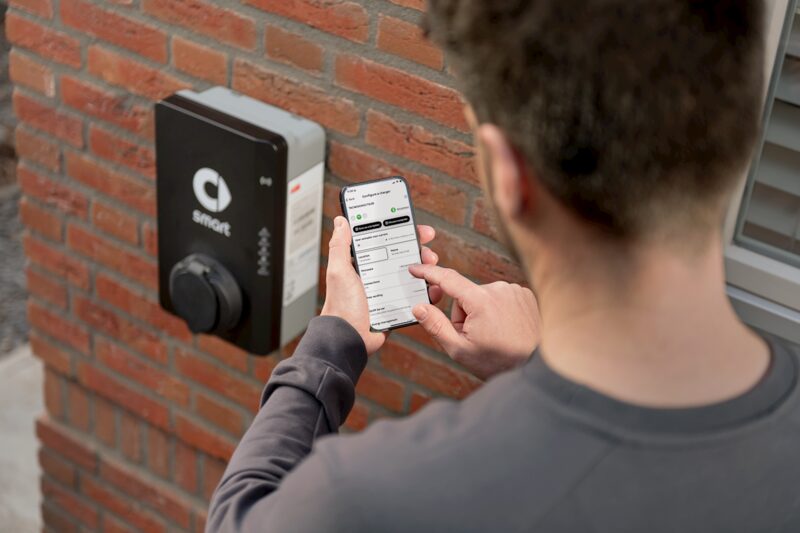
Chargers are sold in two physical formats. They are available either with a tethered Type 1 or Type 2 cable, which can be plugged straight into the car, or with a Type 2 socket for use with the vehicle's charging cable6. A tethered unit is simpler in daily use and leaves no cable to store; a socketed unit is more flexible if the household changes car or runs two vehicles with different connectors. The wider picture on connectors is set out in EV connectors and cables.
Power output is the other variable. Domestic wallboxes are most commonly single-phase 7kW units, and the choice between a 7kW and a higher-output three-phase unit depends on the supply at the property rather than on preference. The comparison is covered in 7kW vs 22kW home EV charger.
| Choice | What it means in practice |
|---|---|
| Tethered Type 1 or Type 2 cable | Cable fixed to the unit, plugs straight into the car6 |
| Type 2 socket | Uses the vehicle's own charging cable6 |
| Single-phase 7kW | The common domestic output, suited to overnight charging |
| Three-phase | Only where the property has a three-phase supply |
Charging speed and what it means for your household supply
A home wallbox is not a fast charger in the public-network sense. Fast charging takes hours and is suitable for longer stays or overnight charging10. That is the correct expectation for a domestic unit: the car sits on the drive overnight and is full by morning, and the speed of the wallbox is matched to the time the car is parked rather than to a motorway stop.
The reason a dedicated unit matters at all is that the alternative is slow. A dedicated EV charge point over a standard household socket is recommended to achieve faster charging speeds11. The public network illustrates the point: 57% of UK public charging stations are between 3 and 8kW, which at best is slightly faster than an at-home charger and at worst would take nearly a full day to charge a car12. A 7kW wallbox is therefore not a compromise against public charging; it is comparable to most of it, and available on the driveway.
The constraint that decides what a household can install is the supply. EV chargers and other low-carbon technologies can push a home's electricity demand above the available supply, which may require an upgrade13. Where that happens, the network operator is the route, and the process differs by region: SSEN, for example, handles EV connection enquiries by email at connections@ssen.co.uk14. The full process is set out in telling the network operator about a home EV charger.
Load management is the alternative to an upgrade. A charger that monitors the whole-house demand and reduces the car's draw when other appliances are running can avoid the need for a supply upgrade in many homes, and the options are covered in load management and load balancing.
Cost, installation and running a Terra AC at home
There is no published ABB list price for a supplied-and-fitted Terra AC, and prices are installer-quoted. The figures that exist are for home charging generally, and they vary widely by source. A report from Checkatrade found that the average cost of installing a home EV charger was £1,0002. Research cited by the planning portal suggests installation costs range between £450 for a basic model, increasing to around £1,200 as the power and capabilities increase15. For most households, 7kW chargers are a good choice and cost around £900 to buy and install4, while the same source notes that it now typically costs between £500 and £1,200 to buy and install a home EV charger4. A typical domestic installation is worth £800 to £1,500 for the electrical work, excluding the charger unit5.
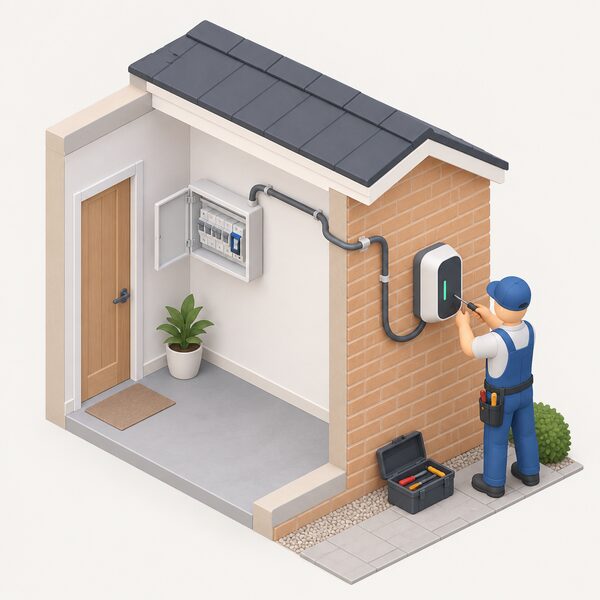
The spread reflects what the job involves rather than disagreement about the hardware. Cable runs from the consumer unit, the position of the unit relative to the parking space, whether the supply needs attention, and whether the installation is a like-for-like replacement all move the figure. A separate MCB or RCBO at the distribution board is required for each charger, with no other loads sharing it5.
Running costs depend on the tariff rather than the wallbox. A home EV charger is a prerequisite for an EV tariff: there is no point having an EV tariff if the car cannot actually be charged at home16. Time-of-use tariffs are where the savings sit, and electric vehicle chargers are associated with an annual saving of £680 on a time-of-use tariff, where EV ownership is required17. The wider arithmetic is in what it costs to charge an electric car at home.
Does the Terra AC work with solar panels?
Charging an EV with renewable energy such as solar panels significantly reduces the carbon footprint of the miles driven18. That is the general case for solar-linked charging, and it applies to any wallbox that can be controlled in response to generation rather than only to ABB units.
The mechanism matters more than the badge. With a home battery, surplus solar energy is captured and held for when it is actually needed, including overnight EV charging, whereas without one unused solar electricity is wasted or exported to the grid, often at a relatively low rate19. A charger that can be told to use surplus generation rather than the grid is the other half of the arrangement, and compatibility between the charger, the solar system and any battery storage is best considered from the outset18.
Whether a specific Terra AC model offers that control depends on the unit and on the equipment fitted alongside it, and it is a question for the installer at quotation stage. The general options are set out in charging an EV from solar panels and EV charging alongside a home battery.
What owning an ABB charger means for energy independence
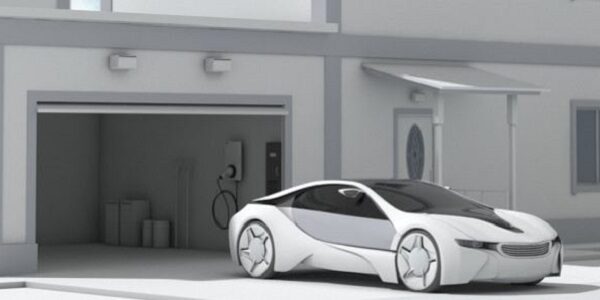
A home wallbox is the single piece of equipment that shifts motoring energy from the public network to the household's own supply. With 85% of charging needs met at home on average for drivers who have a home charge device3, the wallbox is what makes the household the primary energy supplier for its own car.
What remains is dependence, and it is worth stating plainly. The charger draws from the grid through a supplier, so the household is still buying electricity, just at a domestic rather than a public charging rate. Where the unit is a smart charger with an app, remote scheduling and monitoring depend on a home broadband connection and the manufacturer's servers. Where solar or a battery is added, the household generates some of its own energy but remains connected for the rest, and the battery captures surplus rather than removing the grid from the arrangement.
The financial effects are indirect. Installing an EV charger could increase a property's value by between £3,000 and £5,000, according to the National Association of Property Buyers, depending on location, charger type and local public charging availability7. That is a valuation estimate rather than a guarantee, and it depends on the local public charging picture as much as on the unit.
Bidirectional charging is the technology that would change the picture further, allowing EVs to power a home or export energy to the grid19. It is not a feature of a standard AC wallbox, and the position is set out in vehicle-to-grid and vehicle-to-home charging. The broader question of what home charging does for a household's independence is covered in EV charging and household energy independence.
Support, documentation and the EU Declaration of Conformity
Certification is the part of a charger purchase that is least visible and most worth checking. Independent certification for EV chargers covers safety, security, quality and reliability, and is intended to meet legislative, market access, specifier and compliance requirements20. The relevant product standard for the design and performance requirements for EV conductive charging equipment is the BS EN IEC 61851 series22.
Two documents matter after installation. The first is the electrical installation certificate, which records that the work complies with BS 7671. The second is the building regulations compliance certificate, which is issued as proof that the work complies with building regulations9. The installer may be the one who notifies the building control body, but that should not be assumed9, so it is worth confirming who is doing it. The requirements are set out in do you need building regulations approval for an EV charger.
ABB's Terra DC fast charging stations carry an EU Declaration of Conformity signed on 29 June 2022 by the company's CEO and Global R&D Manager, covering the Terra 94, 124 and 184 models. That declaration relates to the DC rapid charging products rather than to the domestic AC wallbox, and it is a useful illustration of the documentation a manufacturer holds for its charging range.
Registration is the other piece of housekeeping. Registering equipment with the manufacturer means the owner can be contacted easily if there is a safety recall26. For a wallbox, that means keeping the serial number and the installer's details on file. The general position on aftercare is covered in EV charge point warranties and aftercare.
Faults, voltage and what to do first
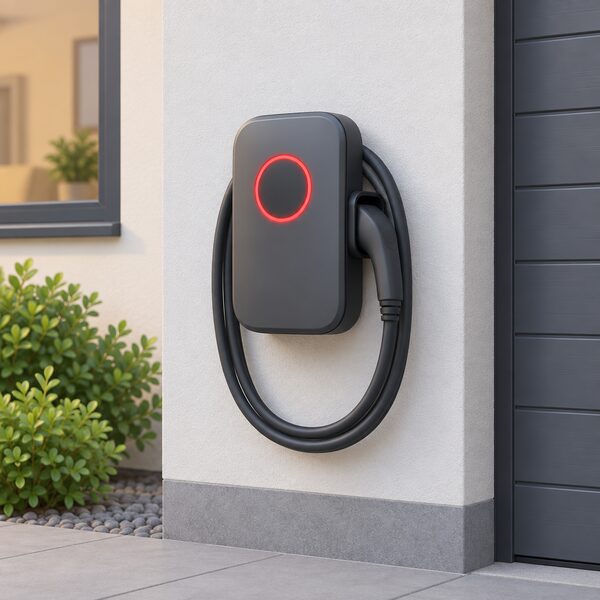
Fault reporting on a home charger is usually a light or a code rather than a diagnosis. Voltage drop or surge is a recognised cause of EV charger errors27, and where the voltage goes beyond the acceptable range, the charger will not function and will display a red ring or an error28. That behaviour is a protection feature rather than a defect: the unit is refusing to operate outside its design envelope.
The first action is not to reset repeatedly. The guidance is to speak to the installer or electrician to check there is not any problem with the equipment28. Where the cause is on the supply side, the network operator is the route, and the voltage enquiry process differs by region, with Western Power Distribution and UK Power Networks both publishing guidance on voltage changes in the property27.
Protective device selection is settled at installation. Where an EV charger has built-in DC fault current detection to 6mA, a Type A RCD at 30mA is sufficient5. That is a design decision for the electrician, and it is one of the reasons a charger installation is not a DIY job. The wider picture is in EV charge point faults and troubleshooting and what RCD protection does an EV charge point need.
Sources28 cited
- Electrification e-mobility solutions, ABB, 2026
- EV charging statistics, Uswitch, 2025
- EV charging VAT, Zapmap, 2026
- Electric car charging at home, Which?, 2026
- Section 722 EV charging complete guide, Elec-Mate, 2026
- Home charging guide, Zapmap, 2025
- EV charger installation and maintenance, NICEIC, 2025
- EV charging, Uswitch, 2026
- Building regulations for EV charging, Planning Portal, 2026
- Home charging guide, Zapmap, 2025
- Connecting to the networks: LCT strategy, Energy Networks Association, 2026
- Should I buy an electric car?, Which?, 2025
- If your electricity supply can't cope with the new equipment, NIE Networks, 2026
- EV connections, SSEN, 2026
- Electric vehicle chargers, Planning Portal, 2026
- EV energy tariffs, Uswitch, 2025
- Clean heat: supporting low-income households, Energy UK, 2026
- Can solar panels charge electric cars?, CPA, 2024
- Integrating solar panels with EV charging, Uswitch, 2026
- Powering trust in EV charging with BSI Kitemark certification, BSI, 2026
- Powering trust in EV charging with BSI Kitemark certification, BSI, 2026
- RCDs for electric vehicle supply equipment, IET, 2024
- Product safety report: Romada New Energy EV charger and cable, Office for Product Safety and Standards, 2026
- Product safety report: Romada New Energy charging pile, Office for Product Safety and Standards, 2026
- Product recall: SEVA-24016P EV charging cable, Electrical Safety First, 2026
- E-bike safety advice, Electrical Safety First, 2026
- Managing voltage changes in your property, Electricity North West, 2026
- Voltage changes in your home or business, UK Power Networks, 2026