


In this guide
The Hypervolt Home 3 Pro is a 7kW tethered smart charger made in the UK, sold from £690 plus installation, or from £1,099 including standard installation and VAT for the 5m cable version1. It is the current generation of Hypervolt's home charger, released in late 2023, and it is the model most people mean when they search for a Hypervolt charger by name3.
What makes it worth a page of its own is the combination of three things: a solar-aware charging mode, a smart tariff link to OVO Charge Anytime, and a UK manufacturing and support base. It is also the charger Hypervolt has used to carry its platform work, including the Solar Insights feature that splits a charging session into solar and grid energy, which runs only on the Home 3 and Home 3 Pro4.
The limits are as clear as the benefits. There is no 4G option, so the charger needs Wi-Fi or an ethernet cable1. The warranty runs for 3 years, shorter than the 10 years some home batteries carry2. And the longest guarantee on the wider Hypervolt range depends on installer registration, so the terms are worth reading before ordering.
What the Home 3 Pro is, and where it is made
The Home 3 Pro is a 7kW tethered wallbox, which means the charging cable is fixed to the unit rather than being a separate lead carried in the boot1. Hypervolt describes it as made in the UK, and the company's own product page carries the line "Beautiful design. Simple to use. Made in the UK."2. That matters for a household weighing energy independence: a domestically made charger keeps the hardware, the spares and the support relationship inside the UK, even though the electricity it delivers still comes from the grid or from the home's own solar.
It is a solar-optimised charger rather than a plain wallbox. Hypervolt's partnership announcement with Heatable describes it as "a top-tier solar-optimized EV charger" integrated into Heatable's solar and storage packages6. The charger itself is the current generation of the range, and Hypervolt's platform updates have been rolled out to Home 3 and Home 3 Pro owners first3.
The unit is compact: 328 x 243 x 101mm, so it fits a standard garage wall or the side of a house without dominating it1. It comes in three finishes, Space Grey, Ultra White and Ultra Black2. The tethered connection is Type 2, the standard for home charging in the UK, and the cable length is chosen at order rather than added later1.

Specifications at a glance

The headline figure is 7kW, which is the standard single-phase home charging speed in the UK1. That is the same rate as most home wallboxes, and it is set by the car's onboard charger and the home's single-phase supply rather than by the box itself. A 7kW charger adds roughly the same range per hour whatever brand is on the wall.
| Specification | Detail |
|---|---|
| Charging speed | 7kW1 |
| Connection type | Tethered1 |
| Cable options | 5m, 7.5m and 10m2 |
| Dimensions | 328 x 243 x 101mm1 |
| Finishes | Space Grey, Ultra White, Ultra Black2 |
| Connectivity | Wi-Fi or ethernet, no 4G1 |
| Voice control | Amazon Alexa1 |
| Warranty | 3 years2 |
The cable choice is the specification most households get wrong. A 5m lead suits a car parked nose-in beside the charger; a 7.5m or 10m lead suits a driveway where the car sits further away or where two cars share the unit2. The 10m option is described as a super-long charging lead, and it is the one to pick if the parking position is not yet settled1.
Connectivity is the other specification worth reading twice. The Home 3 Pro connects over Wi-Fi or an ethernet cable, and there is no 4G option1. A garage at the end of a garden, or a driveway where the Wi-Fi signal is weak, may need an ethernet run or a mesh node before the charger can do anything smart. Unusually, the unit can also be controlled through an Amazon Alexa device1.
Price: £690 plus installation, or from £1,099 fitted
There is no single installed price, because the quote depends on cable run, consumer unit position and whether the supply needs work. The figures that exist are indicative. The charger alone is listed from £690 plus installation1. Hypervolt's own page lists the 5m cable version from £1,099 including standard installation and VAT, the 7.5m version from £1,149 and the 10m version from £1,1992. OVO, which installs the unit whether or not the household is an OVO customer, quotes from £999 for a Hypervolt Home 3 Pro including installation7.
All Hypervolt prices include VAT, which is worth noting because domestic charge point installation is treated differently from most electrical work2. Additional charges apply in a Remote Area, and those are included in the quote rather than added later2.
For context, other chargers sit in a similar band. Carwow's comparison lists the Ohme Home Pro from £999 with installation and the EO Mini Pro 3 from £1,250 with installation1. The Hypervolt sits between them on the published figures, though the fitted price for any of them depends on the same site conditions. A fuller breakdown of what drives the fitted cost is at home EV charger cost.
Charging modes: Boost, Eco and Super Eco

The Home 3 Pro has three charging modes: Boost, Eco (solar and grid) and Super Eco (solar only)1. The naming is Hypervolt's own, and the split is the same idea other solar-aware chargers use: one mode for the fastest charge, one that blends solar with grid, and one that refuses grid power altogether.
Boost is the straightforward mode, charging at the full 7kW rate regardless of what the solar array is doing. Eco draws on solar when it is available and tops up from the grid when it is not, which suits a household that wants the car charged by morning without watching the weather. Super Eco uses only solar generation, so the charge rate rises and falls with the sun and the car may not be full by the end of the day1.
That three-mode structure is common across the market, which helps a household compare like with like. The myenergi zappi uses eco, eco+ and fast9, the Rolec EVO uses ECO, ECO+ and CHARGE NOW10, the Marlec VEVA uses eco charge, hybrid charge and fast charge11, and the Livoltek ROBOT Home uses Fast, Dynamic and ECO12. The Sigenergy SigenStor EV DC splits its modes into Fast Charging, PV Surplus Charging and Battery Boost Charging13. The Fronius Wattpilot describes its Eco Mode as using self-generated solar power or the cheapest mains current14.
What differs is how the solar-only mode behaves when generation dips. The zappi's Eco+ mode charges only when the panels produce more than the home is using, and slows the charge rather than pulling from the grid15. Hypervolt's Super Eco is the equivalent setting on this unit, and the practical effect is the same: on a cloudy day the car charges slowly or not at all.
Hypervolt's app work has added scheduling around these modes. App 5.3, rolled out through March 2024, added an estimate of the energy a scheduled Boost or Eco session would deliver, based on average grid voltage and the configured maximum current limit of the device16. That is a planning aid rather than a guarantee, since the estimate assumes the conditions the charger is configured for.
Smart tariffs and integrations
The Home 3 Pro is compatible with OVO Charge Anytime, and Hypervolt's own product page lists that compatibility as a feature2. Carwow's comparison notes the charger is already compatible with OVO's smart tariff1. The wider Hypervolt platform work named Octopus Intelligent Go and, subsequently, OVO Charge Anytime as the supported tariffs on the V2 platform3.
The Home 3 Pro became compatible with Intelligent Octopus Go in late 2024, joining the group of chargers that tariff supports. That matters because a smart tariff is what turns a 7kW charger from a simple plug into a device that shifts charging to cheaper hours without the household doing anything.
The market context is that smart chargers generally work with most EV tariffs from suppliers such as Octopus, E.ON Next and OVO17. Individual chargers vary in which tariffs they support. The Ohme Home Pro integrates with both Octopus and OVO's smart tariffs1, the Simpson & Partners Home Series V3 supports Intelligent Octopus Go18, and the EO Mini Pro 3 supports British Gas and Hive only1. Indra chargers support Intelligent Octopus Go, OVO Charge Anytime, E.ON Next Drive Smart and EDF's Smart Charging bolt-on18.
For the Home 3 Pro, the practical position is that OVO Charge Anytime and Octopus Intelligent Go are the named integrations, and the supplier's current eligibility list is the one that decides. Tariff structures change, and a charger that works with a tariff today may need a firmware update to keep working with it. The wider picture on how tariffs change home charging is at EV tariffs and home charging.
Solar and battery integration, including Solar Insights
The Home 3 Pro is listed as compatible with solar panels, and Super Eco mode draws only on solar generation2. That is the basic solar capability. The more interesting feature is Solar Insights, launched as a beta in July 2026, which splits charging sessions into solar and grid energy for homes with their own solar generation4.
Solar Insights is restricted by hardware. Hypervolt states the feature is available for Home 3 and Home 3 Pro devices only, and that earlier models do not support it4. It also requires a home with its own solar generation and a compatible setup, so a household without panels cannot use it4. The feature is a reporting and visibility tool rather than a control mode: it tells the household how much of a session came from the roof and how much from the grid.
That visibility is what makes solar charging worth doing. Without it, a household cannot tell whether Super Eco actually ran on sunshine or quietly topped up from the grid on a dull afternoon. The same logic sits behind home battery pairing, where the battery stores surplus generation for the evening rather than exporting it. Battery warranties run longer than charger warranties: the Powervault 3 carries 10 years, and the Tesla Powerwall 3 carries 10 years5. The Powerwall 3 also has an integrated inverter and system controller19.
For a household weighing the two together, the charger and the battery do different jobs. The charger moves energy into the car; the battery holds it for the house. A solar-aware charger without a battery will still export surplus midday generation rather than storing it, and a battery without a solar-aware charger will still charge the car from the grid at whatever rate the tariff sets. The combination is what changes the household's exposure to grid prices. More on that pairing is at EV charging with a home battery.

Warranty, installation lead times and independence

The Home 3 Pro carries a 3-year manufacturer's warranty2. That is shorter than the 10-year terms common on home batteries5, and shorter than the 10-year enclosure warranty Simpson & Partners offers on its Home Series Freestanding V320. A 3-year term is not unusual for a charger, but it is the figure to weigh against the price.
Installation timing is set by the survey. Hypervolt states its team will fit the charger around 6 weeks after the pre-installation survey is completed, and notes that some installations may take longer2. The clock starts when the survey is submitted, not when the order is placed, so the practical wait from deciding to driving on home power is longer than six weeks.
For context, a standard home wallbox installation usually takes around two hours on the day, with the installer coordinating with the Distribution Network Operator21. The lead time is in the queue and the survey, not the fitting. Where a new or upgraded connection is needed, the network operator's own timescales apply: for 2 to 4 domestic connections at 60kVA to 300kVA, the average time from payment to connection is 7 weeks22. Heat pump installations have seen similar queueing, with two to three months reported before installation is even scheduled in some cases23.
What owning one means for independence is a mixed picture. The charger reduces dependence on public charging networks and on petrol or diesel, and Super Eco mode reduces dependence on grid electricity for the miles driven. What remains is a dependence on the home's Wi-Fi or an ethernet connection, since there is no 4G option1, and a dependence on Hypervolt's app and servers for scheduling and monitoring. Local charging at the unit continues without a connection, but the smart features do not. The wider picture on what a home charger does and does not change is at EV charging and household energy independence.
Who Hypervolt are
Hypervolt is a UK-based manufacturer, and the Home 3 Pro is made in the UK2. The company carries a Trustpilot score of 4.9/5 on its own product page2. For comparison, EDF Energy scores 4.6 out of 5, E.ON Next 4.5 out of 5 based on over 162,000 reviews, Scottish Power 4.3 out of 5, and Hive 4.1 out of 524. Uswitch, a comparison service rather than a charger maker, scores 4.7/5 with 41,237 reviews28.
A Trustpilot score measures customer experience with the company, not the reliability of the hardware, and it is self-reported on the maker's own page. It is a useful signal of how the support relationship tends to go, and it is not a warranty or a performance guarantee.
The company's public contact route for media is press@hypervolt.com6. Owner support runs through the app and the account portal, which is where firmware status and charger information sit. The UK base means the support relationship is domestic, and the charger's status as the current generation means it is the model receiving the platform updates, including Solar Insights and the tariff integrations3.

Sources28 cited
- Best home EV chargers, Carwow, 2026-01-09
- Hypervolt Home 3 Pro, OVO Energy, 2026-09-17
- Hypervolt V2 update: dynamic tariffs, Hypervolt, 2026-01-02
- Solar Insights, Hypervolt, 2026-07-08
- Solar panel battery storage, Which?, 2026-05-14
- Hypervolt partners with Heatable, Hypervolt, 2025-03-06
- EV charger installation questions, OVO Energy, 2026-09-17
- Domestic charge point funding, Energy Saving Trust, 2026-08-27
- Zappi EV charger, myenergi, 2026-09-17
- Rolec EVO, Rolec, 2026-09-17
- VEVA car charger, Marlec, 2026-09-02
- ROBOT Home AC Charger, Livoltek, 2026-09-10
- SigenStor EV DC charger, Sigenergy, 2026-09-17
- Wattpilot EV charging solution, Fronius, 2026-09-17
- EV solar panels, Good Energy, 2026-01-22
- Hypervolt app 5.3 release, Hypervolt, 2024-03-26
- Does a hybrid car need an EV tariff?, Uswitch, 2025-07-02
- Buying a 76 plate EV, Indra, 2026-08-20
- Powerwall, Tesla, 2026-09-17
- Home Series Freestanding, Simpson & Partners, 2026-09-17
- Electric car charging guide, Carwow, 2025-07-16
- Indicative connection costs, Electricity North West, 2026-09-19
- Heat pump roundtable report, SNIPEF, 2026-02
- EDF Energy, Energy Helpline, 2026-09-20
- E.ON Next, Energy Helpline, 2026-09-20
- Scottish Power, Energy Helpline, 2026-03
- Tado vs Hive, Energy Helpline, 2026-09-20
- Solar panels, Uswitch, 2026-09-16
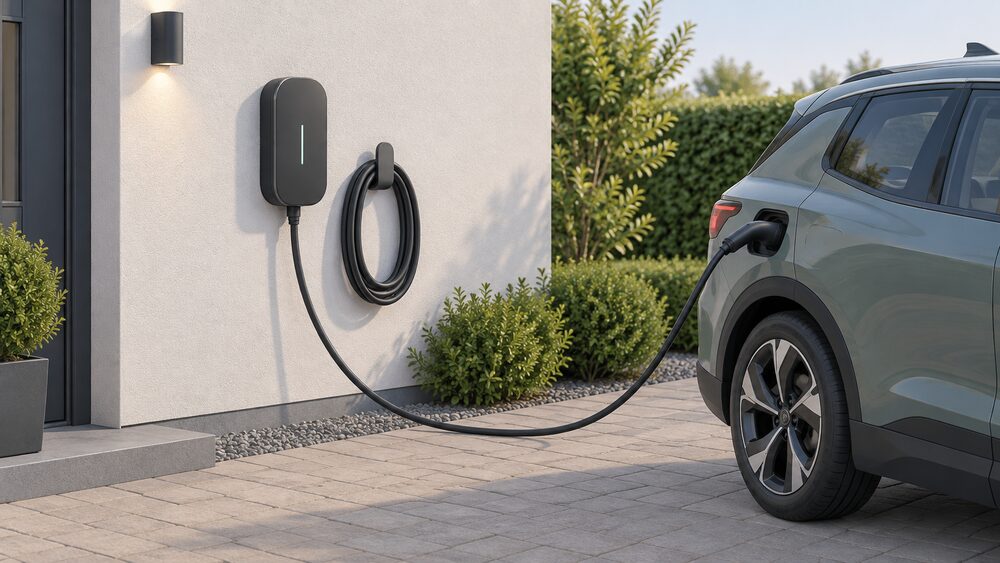 Hypervolt home EV chargersHypervolt is a UK-headquartered charger maker selling direct, with the Home 3 Pro at 7kW, three charging modes and a £1,099 installed starting price.