
In this guide
A Sevadis home charger is a UK-market wallbox that reaches most households through the electrical wholesale trade rather than a direct retail channel. The brand's route to market is the trade counter: an electrician or installer orders the unit through a wholesaler, fits it, and completes the network operator notification on the householder's behalf. In 2024 Sevadis announced a strategic partnership with Mr Charger, combining its charging products with Mr Charger's nationwide installation services, with joint commercial projects already underway at the time1.
That distribution model shapes almost everything a householder needs to know. There is no published manufacturer list price for a fitted Sevadis unit, so costs are installer-quoted. There is no consumer-facing specification table published in the material available here, so the practical way to compare a Sevadis unit against another brand is to ask the installer for the datasheet for the exact model being quoted. What can be stated with confidence is the surrounding framework: who may install it, how the connection is notified, and what a home charger does and does not do for a household's energy independence.
The wider context is a UK public charging network of 123,677 chargers across 47,810 locations as of the end of August 20262. A home charger is the private counterpart to that network, and more than 50 manufacturers provide charging units suitable for EV charging at home3. Sevadis is one of them, sold through a channel built for trade buyers rather than for direct consumer purchase.
What a householder should know about Sevadis chargers
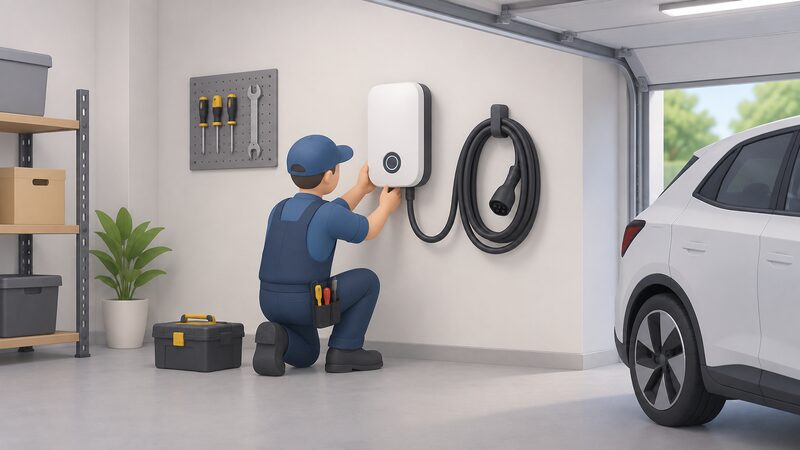
The first thing to understand is that a Sevadis charger is bought as part of an installation, not as a standalone appliance. The sequence starts before any order is placed. SSEN, the distribution network operator for the north of Scotland and central southern England, recommends first speaking to an electrician or installer to see whether the home's wiring can support an electric vehicle charger6. That check determines whether the installation is a straightforward addition to an existing consumer unit or whether supply capacity, earthing arrangements or a separate feed need attention.
Installation itself should always be done by a qualified and certified electrician4. The network operator application that follows is not something a householder files: the chosen installer completes the application form on the householder's behalf via the ENA Connect Direct platform5. That single fact explains why the wholesale route dominates. The installer is already the party holding the trade account, the certification and the notification responsibility, so the hardware naturally travels through the same channel.
For a householder, the practical implications are these. The unit's specification, warranty terms and price arrive as part of an installer's quote rather than from a brand website. Any comparison between a Sevadis unit and another make has to be made on the datasheets the installer supplies. And the electrical work is governed by the same rules regardless of brand: qualified and certified labour, and a notification to the network operator.
Where to buy: over 800 electrical wholesale branches nationwide
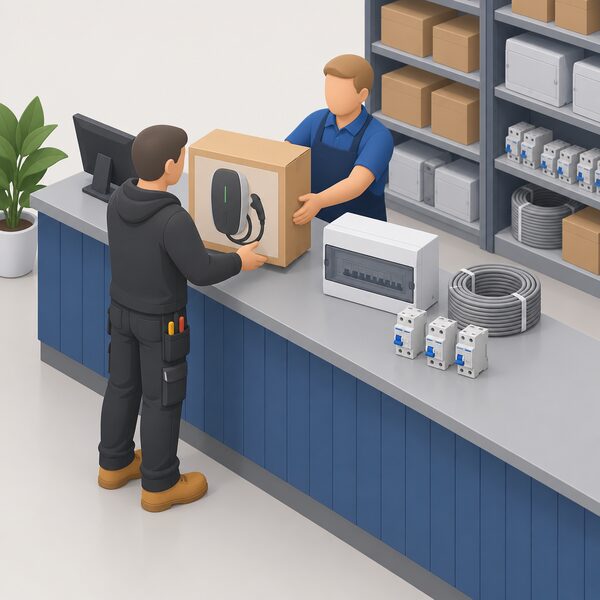
Sevadis chargers are distributed through electrical wholesale branches across the country, which is the channel that gives the brand its reach. The trade counter model matters because it puts the product where the installer already is. An electrician ordering a charger alongside a consumer unit, cable and protective devices collects everything in one transaction, and the householder sees one line in the quote rather than a separate hardware purchase.
The scale of the surrounding market explains why this channel exists. More than 50 manufacturers provide charging units suitable for EV charging at home3, and a wholesaler cannot stock every model from every maker. What a branch network offers is availability on the models it does carry, with the option to order in what it does not hold. For a householder, that means the question to ask is not whether the brand is available nationally but whether the specific model the installer proposes is in stock locally or needs a lead time.
The public charging picture is a useful contrast. The UK network reached 123,677 chargers across 47,810 locations by the end of August 20262, and 13,281 chargers were added to that network during 2025 alone2. Public infrastructure is visible, mapped and counted. The home charging market is not counted in the same way, because it is a trade supply chain rather than a network. That asymmetry is why a householder researching a home charger finds fewer published figures than they would for public charge points.
Next day delivery through the distributor
Delivery speed is a wholesaler's term, not a brand's. The clearest published comparison point in the UK home charging market comes from another brand: Sync Energy offers free next-day delivery on all orders placed by 2pm Monday to Friday, and sells its range of chargers and accessories directly7. That is a direct-sales model, and it shows what a fast delivery promise looks like when a maker controls the warehouse.
A trade-counter model works differently. Where a branch holds the unit, collection is immediate and no delivery is involved. Where it does not, the branch orders from its own distribution centre or from the manufacturer, and the lead time depends on that chain. For a householder, the practical consequence is that the charger's arrival is rarely the constraint on the installation date. The installer's diary, the electrical checks and the network notification are the steps that set the timetable.
It is worth separating the two things a householder is waiting for. The hardware is a box that moves through a supply chain. The installation is a booked visit by a qualified and certified electrician4, preceded by a check that the wiring can support the load6. A next-day charger does not produce a next-day installation, and a charger on a trade counter shelf does not either.

The Mr Charger partnership and what it means for installers
In 2024 Sevadis announced a strategic partnership with Mr Charger, combining Sevadis charging products with Mr Charger's nationwide installation services. Joint commercial projects were already underway when the partnership was announced1. The logic is straightforward: a hardware maker gains access to an installation footprint, and an installation business gains a supply of charging products.
For installers, the significance is that the two halves of a job, the unit and the fitting, can be sourced through one relationship rather than assembled separately. That reduces the coordination a small electrical business has to do, and it means the product knowledge and the installation knowledge sit closer together. It does not change the regulatory position. The work still has to be carried out by a qualified and certified electrician4, and the network operator application is still completed by the installer via the ENA Connect Direct platform5.
Partnerships of this kind are common in the charging market. FOR EV, for example, describes partnering with suppliers like SWARCO8, and Be.EV works with Schroders Capital to expand its UK retail portfolio9. The pattern is a market in which hardware, installation and site hosting are increasingly bundled rather than sold separately.
For a householder, the practical question is what the partnership means for the quote. A bundled route can simplify the process, but the electrical standards, the certification requirement and the notification duty are identical whichever route is used. The partnership is a commercial arrangement, not a regulatory one.
Buying through a wholesaler versus direct: what it means for you
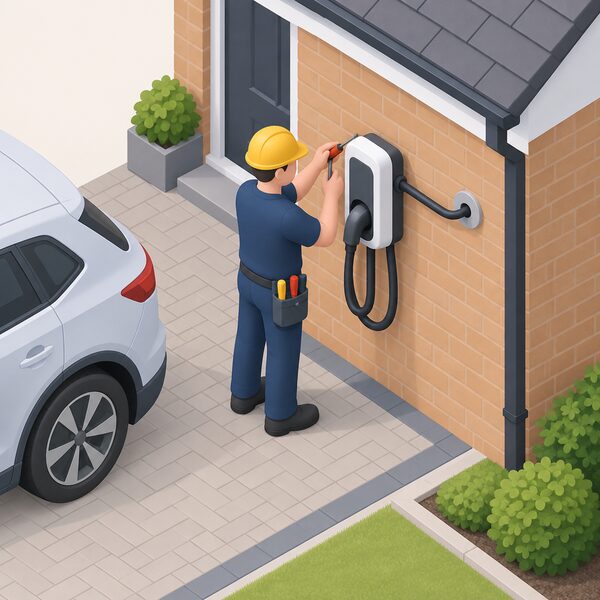
The choice between a wholesaler and a direct order is mostly about who carries the risk and who holds the paperwork. Buying through a wholesaler puts the transaction in the installer's hands, which matches how the rest of the installation works. Buying direct from a maker puts the hardware purchase in the householder's hands, and the installer then fits a unit they did not supply.
There is a wider energy-market parallel worth noting, because it explains why the trade route persists. Energy suppliers buy their power at wholesale cost, the price a supplier pays to buy energy10, and most suppliers offer a discount if a customer pays by direct debit instead of cash or cheque11. Trade channels exist because they aggregate demand and reduce transaction costs. The same logic applies to electrical wholesale: a branch serves many installers, holds stock against their collective demand, and passes the unit through at a trade price.
For a householder, the practical differences are these. Through a wholesaler, the unit arrives as part of a single quote covering hardware and labour, and any warranty conversation starts with the installer. Direct, the householder holds the purchase receipt and the installer holds the fitting. Neither route changes the requirement that the installation be done by a qualified and certified electrician4, and neither changes the network notification duty5.
What owning a Sevadis charger means for household energy independence
A home charger is the single piece of equipment that lets a household stop depending on public charging for everyday motoring. That is the independence it delivers, and it is substantial. It also comes with dependencies that are worth stating plainly.
The first is the electricity supply itself. A home charger draws from the grid through the household's existing connection, and the installation depends on that connection having the capacity to carry the load, which is why the wiring check comes first6. The second is the installer relationship: the network notification runs through the installer via the ENA Connect Direct platform5, so the paperwork is tied to a trade relationship rather than to the householder.
The third is the tariff. An EV tariff requires a home charger, because there is no point having an EV tariff if the car cannot be charged at home13. Those tariffs typically require the bill to be collected by monthly direct debit and are not available to those on prepayment meters14. So the cheapest home charging depends on a charger, a meter type and a payment method all being in place.
Solar changes the picture, but only with the right equipment. Standard EV chargers draw electricity from the home supply without distinguishing between solar-generated power and grid electricity15. A home battery captures surplus solar energy for later use, including overnight EV charging, whereas without it unused solar electricity is wasted or exported to the grid, often at a relatively low rate15. Compatibility between the charger, the solar system and any battery storage should be considered from the outset, and the installation should be done by a qualified electrician with relevant experience15.
"Standard EV chargers will draw electricity from your home supply without distinguishing between solar-generated power and grid electricity"
The dependence that remains, then, is the grid, a supplier, a tariff structure and an installer. What the charger removes is the dependence on public charging for daily use. For a household weighing the two, that is the trade: a fixed installation cost and an ongoing electricity bill in exchange for fuelling at home, on a tariff of the household's choosing, at times the household controls.
Sources15 cited
- Sevadis and Mr Charger partnership announcement, Sevadis, 2024
- EV charging statistics, Zapmap, 2026
- Home charging guide, Zapmap, 2025
- Electric vehicle charger installation and maintenance, NICEIC, 2025
- Connecting to the networks, Energy Networks Association, 2026
- Existing electricity supplies, SSEN, 2026
- Sync Energy EV chargers and accessories, Sync Energy, 2026
- FOR EV network guide, Zapmap, 2026
- Be.EV network guide, Zapmap, 2026
- Check if you are owed money on your energy bill, Ofgem, 2026
- Getting the best energy deal, Age UK, 2026
- EV charging cable SEVA-24016P recall, Electrical Safety First, 2026
- EV energy tariffs, Uswitch, 2025
- Electric cars and energy bills, Uswitch, 2026
- Can solar panels charge electric cars?, The CPA, 2026