

On this page
Warmth on Prescription is a Welsh Government pilot that treats a cold home as a health problem with a financial remedy. From September 2026, a two-winter pilot will run in the Aneurin Bevan University Health Board area, supporting 100 households with £500 each, paid directly to their energy supplier1. The scheme is delivered by the energy charity Severn Wye, and participants are identified and referred through the health board rather than by individual application1.
The idea behind it is simple: some health conditions are worsened by cold, damp homes, and paying the heating bill is part of treating the condition. The pilot targets people with chronic conditions such as chronic obstructive pulmonary disease (COPD), asthma and cardiovascular disease1. It was announced on 31 March 2026 as part of a package of extra support for Welsh households facing high heating costs, alongside a one-off £200 payment for households that use oil and LPG1.
Treating cold homes as a health issue
Warmth on Prescription belongs to a family of schemes that start from the medical evidence rather than from income alone. The logic is that for some people, a cold home is not just uncomfortable but actively harmful, and that the health service has an interest in keeping those homes warm. The Welsh Government's announcement frames the pilot explicitly around chronic conditions worsened by cold and damp housing: COPD, asthma and cardiovascular disease1.
This health-based route into energy support already exists elsewhere in Wales. The Nest scheme, the Welsh Government's main fuel poverty programme, supports people in Wales living on a lower income who receive a means-tested benefit or live with a respiratory, circulatory or mental health condition2. Between April 2024 and March 2025, 2,341 households in Wales were assessed under the health route into Nest3. Warmth on Prescription takes that principle a step further: instead of a health condition widening access to efficiency measures, the health system itself becomes the referrer and the payment goes straight to the energy supplier.
The payment design matters. Because the £500 is paid directly to the energy supplier rather than to the household, the money cannot be diverted to other pressing costs, and the energy debt or bill is reduced at source1. For a household in arrears, that is a different proposition from a cash grant. It also means the scheme depends on the supplier relationship: the household's name must be on a bill, and the supplier must accept the payment.
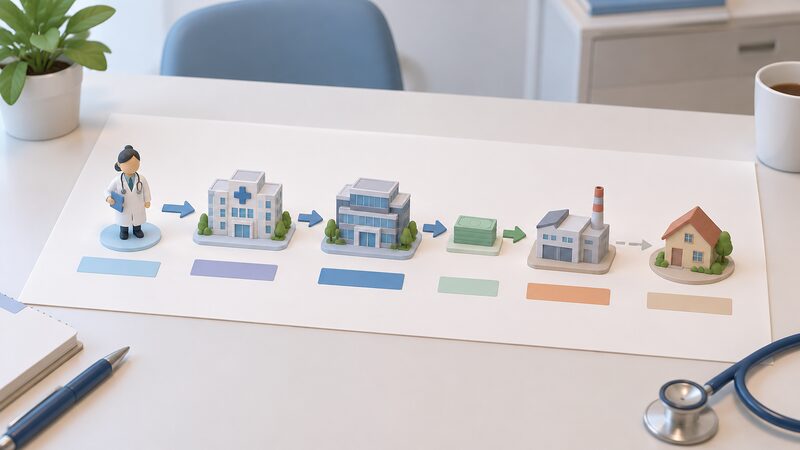
What the pilot covers: the Aneurin Bevan University Health Board area
The pilot is geographically narrow by design. It runs in the Aneurin Bevan University Health Board area, which covers south-east Wales, and nowhere else in Wales for the two winters of the pilot1. The limit of 100 households means that even within the health board area, most households that might benefit will not be in the pilot. This is a test of an approach, not an entitlement.
The choice of area and scale reflects what a pilot is for: the Welsh Government wants evidence on whether identifying households through the health system, and paying their supplier directly, reaches people that benefit-based schemes miss. The two-winter duration gives a full heating season twice over, which allows the effect on health and on energy arrears to be observed across more than one winter1.
For households outside the area, the practical answer is that the same underlying need is met by other routes. Free energy savings advice is available to all householders in Wales4, and the Nest scheme operates across Wales for eligible households5. The pilot's existence does not change eligibility for anything else.
How a health board becomes the route to warmer homes
The most distinctive feature of Warmth on Prescription is that there is no application. Participants are identified and referred through the health board rather than by individual application1. That inverts the usual shape of an energy grant, where the household must know the scheme exists, check its own eligibility, gather evidence and apply.
In practice, this means the health professionals who already see people with COPD, asthma and cardiovascular disease are the ones who identify who might benefit. The energy charity Severn Wye delivers the scheme, bringing the energy-side expertise the health board does not have1. The household's role is to accept the referral rather than to navigate a system.
This referral model has consequences worth understanding. A household that never engages with energy schemes, perhaps because of illness or because the paperwork is a barrier, can be reached through a GP, a clinic or a community health team. The trade-off is that access depends on being known to the health system with a relevant condition: someone with the same financial need but no diagnosed chronic condition will not be referred. The scheme is targeted by health status, not by income alone.
The health route into energy support is well established in Wales. Nest's own eligibility includes people living with a respiratory, circulatory or mental health condition, and the annual report shows thousands of households being assessed that way each year2. Warmth on Prescription is the first Welsh scheme to make the health system the referrer for a direct bill payment.
Who qualifies and how households are referred
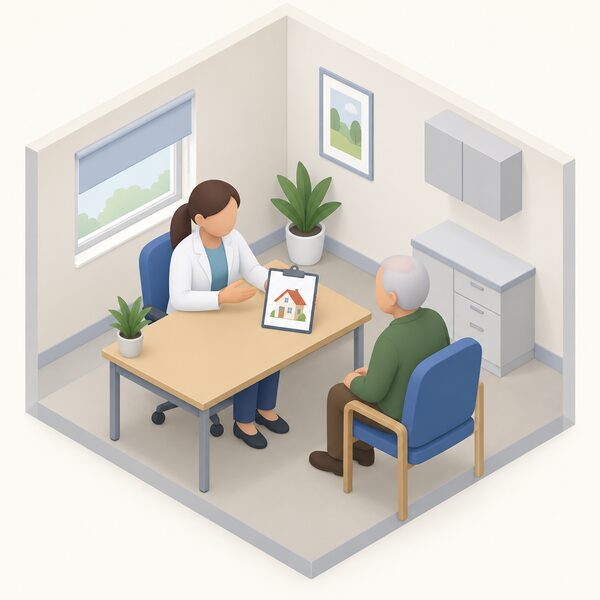
Eligibility for the pilot is clinical rather than financial. The pilot supports people with chronic conditions such as COPD, asthma and cardiovascular disease that are worsened by cold, damp homes1. There is no published income test or benefit requirement attached to the pilot itself; the targeting is done through the health board's identification of patients whose conditions and housing circumstances make them likely to benefit.
- Who is targeted: people with chronic conditions worsened by cold, damp homes, including COPD, asthma and cardiovascular disease1
- How households are chosen: identified and referred through the health board, not by individual application1
- How many: 100 households across the two-winter pilot1
- What they receive: £500 paid directly to their energy supplier1
For households wondering whether they might be referred, the honest answer is that the decision sits with health professionals, not with the household. There is no form to fill in and no phone line for the pilot itself. What a household can do is make sure the health conditions and the housing situation are known to the health professionals they already see.
This is different from the schemes most households will know. The Warm Home Discount in England and Wales is based on receipt of the Guarantee Credit element of Pension Credit or a qualifying means-tested benefit, by the person named on the energy bill6. Nest is based on a lower income plus a means-tested benefit or a health condition2. Warmth on Prescription asks a different question: not what income or benefit the household has, but whether a cold home is making someone ill.
How it sits alongside Wales' other fuel poverty schemes
Warmth on Prescription is a small, targeted pilot inside a much larger landscape of Welsh support, and a household in the pilot area may well be eligible for several other schemes at the same time. Understanding what else exists matters, because the pilot's 100 places cannot carry a household through two winters on their own.
The main structural support is the Warm Homes Programme and its Nest scheme. Nest provides free energy advice and, for eligible households, a suite of home energy efficiency improvements7. The current Nest scheme launched on 1 April 20248, and the wider programme has been the Welsh Government's primary mechanism for tackling fuel poverty, with the New Warm Homes Programme taking over from Nest in that role9. Nest eligibility covers people in Wales living on a lower income who receive a means-tested benefit or live with a respiratory, circulatory or mental health condition2.
Alongside this sit the bill-based schemes that operate UK-wide or across Wales:
| Scheme | What it gives | Who it covers |
|---|---|---|
| Warm Home Discount | A one-off £150 discount off household electricity bills10 | Eligible households in England and Wales, from winter 2026/27 based on Pension Credit Guarantee Credit or a qualifying benefit6 |
| Winter Fuel Support Scheme | A one-off £100 payment toward fuel bills11, with an additional £100 increase announced in 202212 | Eligible people in Wales, on pre-payment or credit meters11 |
| Fuel Voucher and Heat Fund scheme | Fuel vouchers for prepayment meter homes and deliveries of oil or gas for those off the mains gas network5 | Eligible households in Wales that pre-pay for fuel and are at risk of disconnection4 |
| Warm hubs | Over 400 warm hubs across Wales13 | Community level, open locally |
For households on oil and LPG, the context for the pilot's announcement is important. The 31 March 2026 statement was specifically about help with oil and LPG heating costs, including a one-off £200 payment, and the Fuel Voucher and Heat Fund scheme covers deliveries of oil or gas for homes not connected to mains gas1. Off-gas households face a different set of costs from metered households, and the pilot sits in a package that recognises this.
The scale of the underlying problem is measured separately. The Welsh Government's modelled estimates of fuel poverty use a methodology that cannot be directly compared with previous figures, though broad comparisons can be made14. A UK Parliament briefing reports that in Wales, 53% of households using electricity for heating were in fuel poverty15. Households using electricity, oil or LPG rather than mains gas face a higher risk of fuel poverty, which is why the pilot's announcement was aimed at that group.
From pilot to Warm Healthy Homes Fund: where the programme is heading

Warmth on Prescription is one piece of a wider direction of travel in which health and warmth schemes are being redesigned across the UK. The clearest parallel is in Northern Ireland, where a new Warm Healthy Homes Fund will launch in 202716. That Fund is expected to replace the Affordable Warmth Scheme and become the Department's main fuel poverty intervention for private sector dwellings from April 202717, with a consultation describing "a more streamlined delivery model and a whole-house, fabric-first approach, reflecting lessons learned from the Affordable Warmth Scheme"18.
The two programmes are not the same thing, and the difference is worth stating plainly. Warmth on Prescription is a Welsh bill-payment pilot: £500 to the supplier, health-board referral, 100 households1. The Warm Healthy Homes Fund is a Northern Ireland insulation and heating improvement programme with a fabric-first design18. What they share is the framing: both treat warmth as something the state delivers to vulnerable households through redesigned, less bureaucratic routes rather than through open application processes.
In Wales, the direction is set out in the review of the next iteration of the Warm Homes Programme, which recommended smarter, less restrictive eligibility criteria ensuring that any household meeting the definition of fuel poverty can access support when needed, and the creation of an energy efficiency scheme to tackle rural fuel poverty19. The New Warm Homes Programme takes a demand-led approach to support all households across Wales with advice, and the Welsh Government remains committed to offering free impartial energy savings advice to all householders in Wales, not just those in fuel poverty9. The Welsh Government has also published priority actions on tackling fuel poverty8.
For the pilot itself, the two-winter duration is the test period1. What happens after that depends on what the pilot shows, and no Wales-wide rollout has been announced. Households reading about the pilot should treat it as evidence of intent, not as a scheme they can plan around.
What Warmth on Prescription means for household energy independence
The honest assessment of Warmth on Prescription is that it is a relief scheme, not an independence scheme. The £500 payment reduces a household's dependence on being able to afford this winter's energy, but it does nothing to reduce the amount of energy the home needs in the first place. The household remains on the grid or on the oil or LPG delivery round, remains with its supplier, and remains exposed to next winter's prices once the pilot ends.
That is not a criticism of the pilot; it is a statement of what a two-winter bill payment can do. The schemes that change a household's structural position are the efficiency schemes: Nest's free energy efficiency improvements7, the wider Warm Homes Programme's improvements to eligible households21, and the UK-wide schemes such as the Warm Home Discount and ECO4 that reduce bills or improve the fabric of the home. A household that receives both a Warmth on Prescription payment and a Nest efficiency package is in a genuinely different position from one that receives only the payment.
The dependence that remains after the pilot is worth naming:
- On the supplier: the £500 goes to the energy supplier, so the household's account with that supplier is the mechanism of help1
- On the health system: access depends on being identified through the health board with a qualifying chronic condition1
- On the pilot's continuation: two winters of support, with nothing announced beyond1
- On fuel delivery: for oil and LPG households, the underlying cost structure of off-gas heating is unchanged by a one-off payment1
For households in the Aneurin Bevan area with a chronic condition worsened by cold, the pilot is a meaningful reduction in this winter's energy costs, delivered without paperwork. For everyone else, the lasting lesson of the pilot is the direction it signals: warmth is increasingly being treated as a health intervention, and the routes into help are multiplying beyond the traditional benefit-based application. The full guide to home energy grants and schemes sets out what a household can combine, and grants and household energy independence covers which forms of support change a home's structural position rather than its cash flow this winter.
Sources21 sources
- Thousands of Welsh households get help with oil and LPG heating costs, Welsh Government, 2026-03-31
- Nest: a scheme to make your home warmer and more energy efficient, Isle of Anglesey County Council, 2026-09-17
- Warm Homes Nest Scheme annual report 2024-2025, Welsh Government, 2024-04-01
- Extra support for disadvantaged households this winter, Welsh Government, 2024-11-15
- Written statement: tackling fuel poverty, Welsh Government, 2025-01-27
- Continuing the Warm Home Discount Scheme: government response, UK Government, 2026-01-30
- Your essential guide to heat pumps, Welsh Government, 2025-02-20
- Tackling fuel poverty: priority actions, Welsh Government, 2024-04-01
- New Warm Homes Programme: children's rights impact assessment, Welsh Government, 2024-03-08
- Warm Home Discount statistics 2025 to 2026, UK Government, 2026-09-17
- Winter Fuel Support scheme opens Monday 13 December, Welsh Government, 2021-12-11
- Winter Fuel Support doubled to help families with cost of living crisis, Welsh Government, 2022-02-01
- £15 million helping keep communities warm and connected, Welsh Government, 2025-12-22
- Fuel poverty modelled estimates for Wales: October 2024, Welsh Government, 2025-10-16
- Fuel poverty: CBP-9838, UK Parliament, 2024
- Warm Healthy Homes Fund, Department for Communities, 2026-09-17
- Warm Healthy Homes Fund: CBP-9889, UK Parliament, 2026-09-17
- Consultation on the Warm Healthy Homes Fund, Department for Communities, 2026-09-17
- Next iteration of the Warm Homes Programme: review and recommendations report, Welsh Government, 2023-06-13
- New Warm Homes Programme: policy statement, Welsh Government, 2023-06-15
- Buildings and utilities news round-up March 2023, Welsh Government, 2023-03-01
 Heating Oil Help by NationHow much help with heating oil costs can you get in 2026, and how do you claim it?
 Grants for PensionersWhat cash help can pensioner households get towards energy bills?