
In this guide
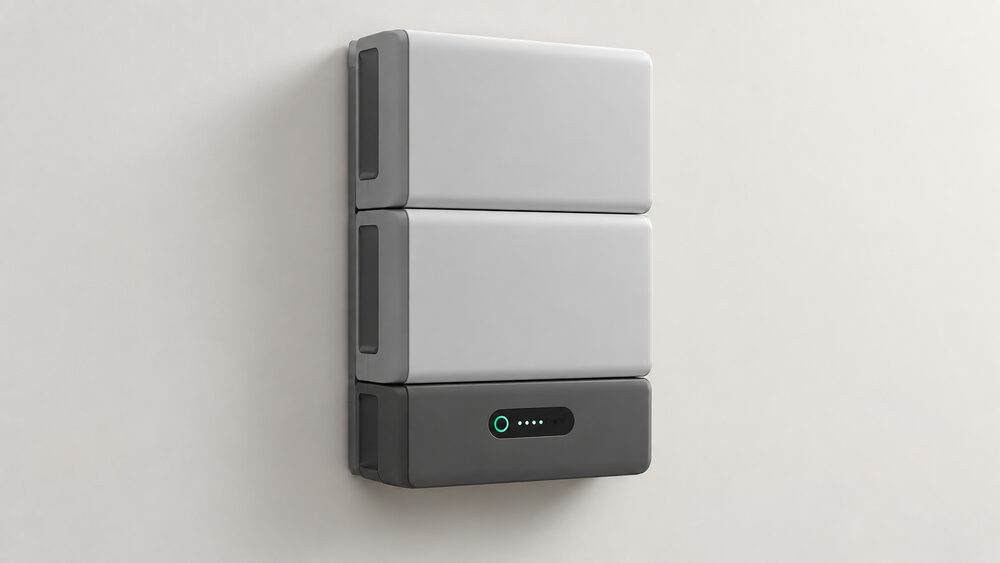
The Solarwatt Battery flex is a modular lithium-ion home battery that connects to a household's alternating current (AC) supply rather than to the solar array's DC side. It is sold as a set of parts: a base AC-1 1.3 electronics and control module, and battery modules called middle pack 1.3 and top pack 1.3, each with 2.4 kWh of usable energy1. A system runs from 4.8 to 19.2 kWh usable, extended in 2.4 kWh steps, and the base unit is rated at 6.0 kW2.
Because it is AC-coupled, the battery does not need a hybrid inverter and Solarwatt states it is suitable for existing and new installations1. That makes it a retrofit option for a home that already has solar panels and a working inverter, as well as a choice for a new system. The cells come from BMW, the modules are assembled in Germany, and the warranty runs for 10 years with a minimum 80% of usable energy retained3.
What the Battery flex is: an AC-coupled, modular home battery
Solarwatt describes the Battery flex AC-1 as a modularly expandable lithium-ion battery storage system1. The modularity is literal: the battery modules connect by plug-in connection without any cabling, so capacity is added by stacking further modules rather than by replacing the unit2. The base AC-1 1.3 is described in Solarwatt's documentation as a highly efficient battery inverter, which is the part that converts between the battery's DC side and the household AC supply6.
The system was developed with the BMW Group, and Solarwatt states that the BMW Group supplies battery components also used in the group's current electric vehicles3. The battery modules are manufactured by Solarwatt in close cooperation with BMW, and the company describes the product as the ideal addition to any photovoltaic system, particularly efficient in conjunction with the Solarwatt Manager flex3.
For a household, the practical meaning of the design is that the battery is a self-contained AC device. It sits alongside the existing solar inverter rather than replacing it, and it can be added to a home that has no solar at all, charging from the grid on a cheap tariff. What it does not do is remove the household from the grid: it shifts when imported electricity is drawn, and it stores surplus generation, but the supply connection remains.
Capacity and scalability: 4.8 to 19.2 kWh in 2.4 kWh steps
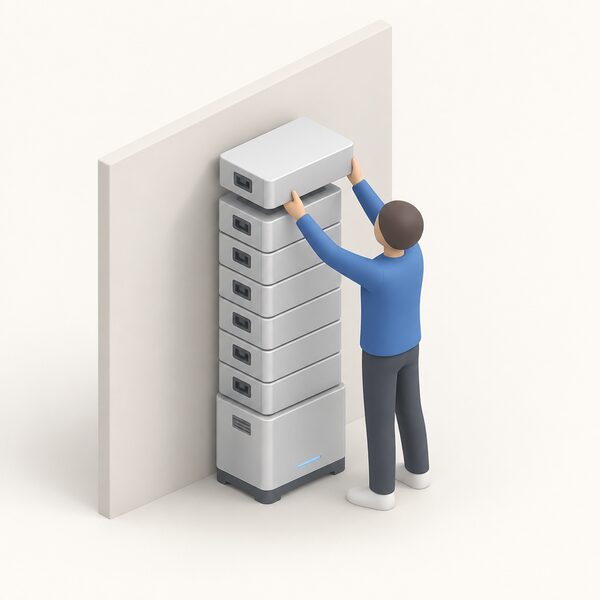
The headline range is 4.8 to 19.2 kWh of usable energy for the AC-1 system2. Each middle pack 1.3 and top pack 1.3 carries 2.4 kWh usable, with a rated capacity of 93 Ah and a nominal voltage of 29.2 V1. The base AC-1 1.3 accepts two to eight battery modules in series, which is where the 4.8 kWh floor and the 19.2 kWh ceiling come from1.
| Configuration | Usable energy | Modules |
|---|---|---|
| Minimum system | 4.8 kWh | 2 modules1 |
| Each added module | 2.4 kWh | 1 module4 |
| Maximum system | 19.2 kWh | 8 modules1 |
The step size matters more than the headline range. A household that starts with a small stack can add 2.4 kWh at a time later, which is a finer increment than many competing systems offer. For comparison, RCT Power's Battery Premium is scalable in 2.5 kWh steps, its Battery range expands in 1.9 kWh steps up to a maximum of 11.5 kWh, and the SMA Home Storage module scales from 3.2 kWh to 16.4 kW7. The Battery flex ceiling of 19.2 kWh is higher than the RCT Power figure and comparable to the SMA range.
Solarwatt also sells a separate DC-coupled line, the Battery vision, with 5.2 to 18.2 kWh usable in a single-phase version and configurations of 5.2 kWh, 7.8 kWh, 10.4 kWh, 13.0 kWh, 15.6 kWh and 18.2 kWh10. The two lines are not interchangeable: the vision is a DC battery that pairs with a Solarwatt inverter, while the flex is the AC unit described here. More on the distinction is at AC-coupled and DC-coupled home batteries, and on how usable capacity differs from nameplate figures at battery capacity and usable capacity.
Specifications: power, connection and housing
The base AC-1 1.3 connects to the grid as a single-phase AC device at 230 V, 50 Hz, with an AC rated current of 30 A1. Its DC voltage range is 25 to 350 V1. The housing is aluminium, the battery fuse is integrated, and the cell separator uses a ceramic coating6.
| Specification | Value |
|---|---|
| Grid connection | AC (1-phase), 230 V, 50 Hz6 |
| AC rated current | 30 A1 |
| DC voltage | 25 to 350 V1 |
| Max. rated real power | 6.0 kW2 |
| Maximum efficiency | 97.5%4 |
| Dimensions (base) | 540 x 248 x 303 mm6 |
| Weight (base) | 23 kg2 |
| Weight (module) | 25 kg2 |
| Ingress protection | IP541 |
| Housing | Aluminium6 |
| Communications | 2x RS485 (RJ11), 1x CAN (RJ45), 2x Ethernet (RJ45), Bluetooth (BTLE), LED status display6 |
The 97.5% figure is a maximum efficiency for the top pack, not a round-trip efficiency for a complete system, and it should be read as such4. Round-trip losses across the inverter, the battery and standby consumption are covered at battery round-trip efficiency.
The communications list is unusually broad for a residential battery: two RS485 ports, CAN, two Ethernet ports and Bluetooth, plus an LED status display6. That gives an installer several routes to connect the battery to a manager or monitoring device, and it means the system is not tied to a single control protocol.
AC or DC coupling: where Battery flex fits
The Battery flex can be integrated into the direct current and alternating current circuit, and Solarwatt states it is suitable for existing and new installations1. In practice the AC route is the one that matters for most buyers, because it allows the battery to be added without touching the solar inverter.
The alternative, a DC-coupled battery, is more complicated to integrate with a Feed-in Tariff system, though possible, particularly if the inverter is being replaced at the same time; it requires a hybrid inverter and a bi-directional meter providing a net reading11. That is the trade-off in plain terms: DC coupling can be more efficient because there is one fewer conversion step, but it usually means replacing working equipment, and it complicates metering arrangements on legacy export tariffs.
An AC-coupled battery such as the Battery flex leaves the existing inverter, its warranty and its metering in place. The cost is a conversion loss each way, since the solar inverter converts DC to AC and the battery converts AC back to DC for storage, then back to AC on discharge. For a household with an older but serviceable inverter, that loss is often the price of not disturbing a working system.

Retrofitting an existing solar installation

Battery storage can be retrofitted to an existing solar PV system in most cases, though some setups may require an inverter upgrade12. Solarwatt states the Battery flex is suitable for retrofitting into any existing system3. The two statements are consistent: the battery itself is AC-coupled and does not demand a hybrid inverter, but the wider installation may still need attention if the existing inverter or consumer unit cannot accommodate the new load.
The retrofit case is the strongest argument for this product line. A household that installed solar years ago, possibly under a Feed-in Tariff, can add storage without surrendering the existing generation tariff or replacing the inverter that earns it. The battery then absorbs surplus generation that would otherwise be exported, and discharges it in the evening.
What a retrofit does not change is the household's underlying dependence. The home still draws from the grid when the battery is empty, still buys that electricity from a supplier, and still relies on the solar inverter, which remains a single point of failure. Storage improves the proportion of self-consumption; it does not make the property self-sufficient. The wider picture is at home batteries and household energy independence, and the sizing question at what size home battery do you need.
Made in Germany: BMW cells and Dresden assembly
Solarwatt describes the Battery flex as quality made in Germany, a claim repeated across the AC-1 range, the battery pack and the base unit1. The battery cells come from BMW: Solarwatt obtains original components, such as the battery cells, directly from BMW, and the BMW Group supplies battery components also used in the group's current electric vehicles3. Final assembly of the Battery flex energy storage system takes place in Dresden13.
The development relationship is documented from the launch. On 9 June 2021, Solarwatt and the BMW Group announced the development of Battery flex, a battery storage system whose battery module uses components also used in the BMW Group's electric cars14. Solarwatt has since opened three new production facilities for energy storage and solar PV modules15.
For a UK buyer, German assembly and BMW-sourced cells are a supply chain claim rather than a performance claim. They indicate where the modules are built and where the cells originate, which matters for parts availability and for the environmental conditions of manufacture, but they do not by themselves make the battery last longer or perform better than a competitor's. The relevant durability evidence is the warranty terms and the cycle life, covered below.
Warranty: 10 years, registration and what is excluded
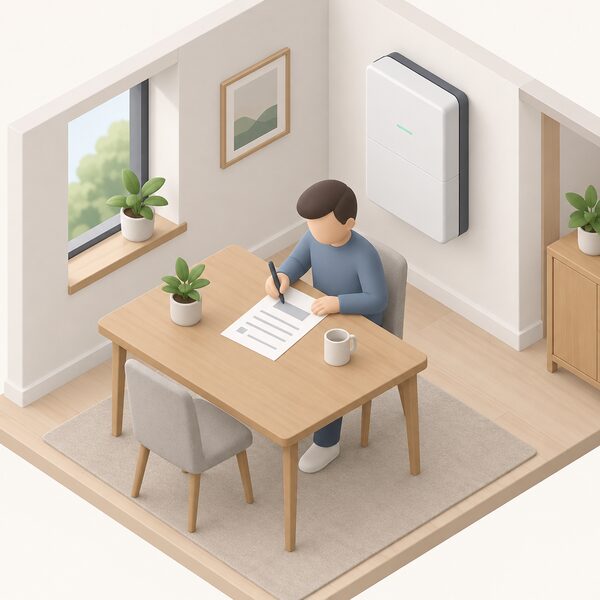
The Battery flex carries a 10 year product warranty, and a 10 year performance warranty for at least 80% of the usable energy content, in each case after successful warranty activation4. The middle and top packs are warranted for 10 years at a minimum of 80% of usable energy, and the cycle service life is stated as an unlimited number of full cycles during the warranty period1.
Two conditions are worth reading closely. First, individual product components are excluded from the warranty, so the cover is not a blanket promise on every part of the assembly1. Second, the warranty is transferred to the new owner of the product to the extent of the remaining warranty period, which matters on a house sale5.
The base AC-1 1.3 also includes five years of FullCoverage insurance, optionally extendable to 10 years1. That is separate from the product warranty and covers a different risk. For context on how these terms compare across the market, the 10 year term is now common: SolaX, Tesla Powerwall, RCT Power Battery Flex and SolarEdge Home Battery all carry 10 year warranties, and plug-in solar panels are typically warranted for 10 years16. The detail that distinguishes them is the retained capacity guarantee and the conditions attached, which is the subject of home battery warranties.
Installation, weight and siting: wall or floor, 25 kg modules
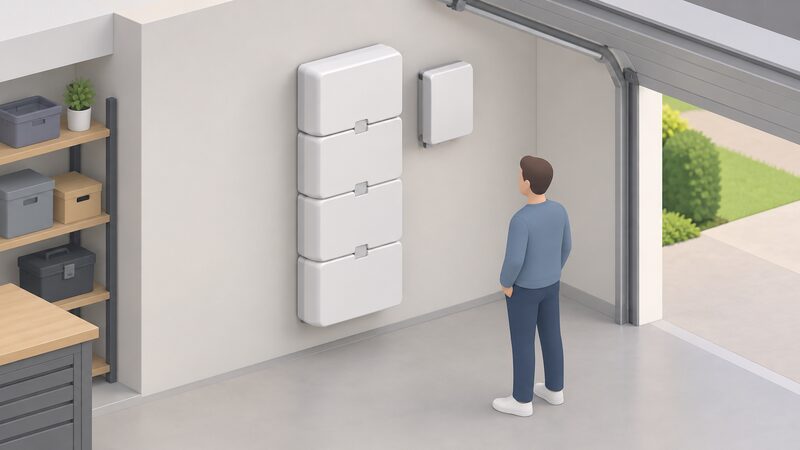
The Battery flex modules weigh 25 kg each and the base unit 23 kg, and Solarwatt notes that single person installation is possible at that module weight1. Installation is by wall mounting, with floor mounting as an option1. The Manager flex, by contrast, weighs 0.22 kg and is a wall-mounted control device1.
The IP54 rating is what determines where the battery can go. It indicates protection against dust ingress and against water splashing from any direction, and Solarwatt states outdoor installation is possible up to 2,000 m above sea level according to the installation instructions1. That is a meaningful allowance: it means the battery can be sited outside, subject to the installation instructions, rather than requiring an indoor plant room.
| Component | Weight | Mounting |
|---|---|---|
| Base AC-1 1.3 | 23 kg2 | Wall, optional floor1 |
| Middle pack 1.3 | 25 kg2 | Wall, optional floor1 |
| Top pack 1.3 | 25 kg2 | Wall, optional floor1 |
| Manager flex | 0.22 kg1 | Wall1 |
The Battery flex is light per module, at 25 kg, which is what makes a single-person lift feasible, but a full eight-module stack still represents a substantial wall load and needs a suitable substrate. Siting rules, clearances and the standards that govern installation are set out at where a home battery can be installed and the standards governing home battery installation.
The Manager, the AC Sensor Flex and remote updates
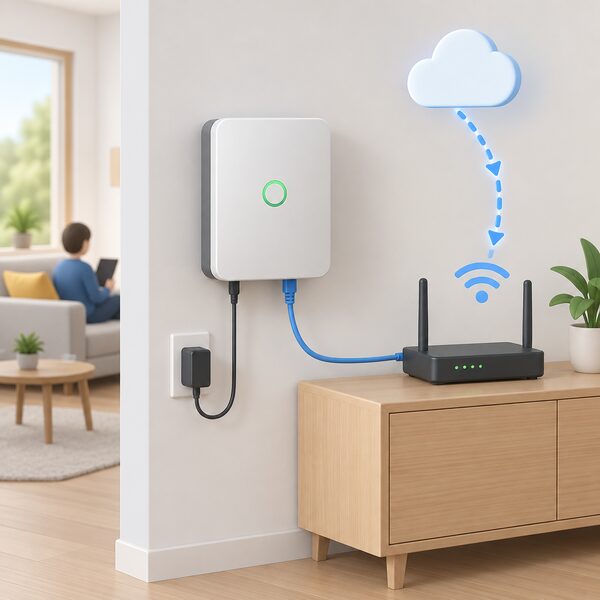
The Battery flex is remotely updatable, and Solarwatt states that using an existing internet connection, the latest software version and new functionalities are always automatically uploaded3. The Manager's firmware and app updates are delivered via an update server8. That is convenient, and it is also a dependence: the battery's software, and therefore some of its behaviour, is controlled by the manufacturer over a link the household does not own.
The control layer is the Solarwatt Manager. The Manager flex 1.0 is listed as Battery flex ready and supports the Battery flex AC-1 and a VARTA battery, with an S0 plug in scope of delivery and AV Home Green Phy powerline communication18. The Manager flex uses an external USB-C power supply at 230 V, 50 Hz and has a USB-2.0 host port8. The EnergyManager pro is also listed as Battery flex ready20. Solarwatt's self-sufficiency figure of up to 80% from PV energy is stated for operation with a Solarwatt Manager2.
The AC Sensor Flex is a separate accessory, made in Germany, listed as supporting the Battery flex AC-17. It appears in the Battery flex documentation as a supported device alongside the base AC-16. It is a measurement accessory for the AC side rather than a battery or inverter component.
The battery management system is a UIT supervisor8. The Battery flex AC-1 is certified as per the Safety guidelines for Li-ion household battery systems1. Monitoring options and what local access looks like are covered at monitoring a home battery.
UK availability and installer route
Solarwatt established a UK subsidiary, boosted its top team and set up an office and warehouse to serve installers and customers, with a new warehouse in England15. The Battery flex was launched for availability from Solarwatt-certified premium installers from autumn 20213. UK supply therefore runs through certified installers rather than direct sale to householders.
That route has consequences. Pricing is installer-quoted rather than published, and the quality of the installation depends on the certified installer's competence rather than on the manufacturer. Solarwatt continues to support the UK market: it announced it would showcase its latest residential energy storage technology at Solar & Storage Live UK 2026, and it released a Home app update in September 2026 adding improved in-app help, battery health information checks and Bluetooth functionality for connecting to devices to edit settings and run firmware updates21.
For a household, the installer route is also the warranty route. Registration, commissioning and any later service run through the same channel, and the 10 year term depends on the product being registered within three months of first operation5. The general process is described at home battery installation, and the cost picture at how much does a home battery cost in the UK.
Where the Battery flex sits in the market
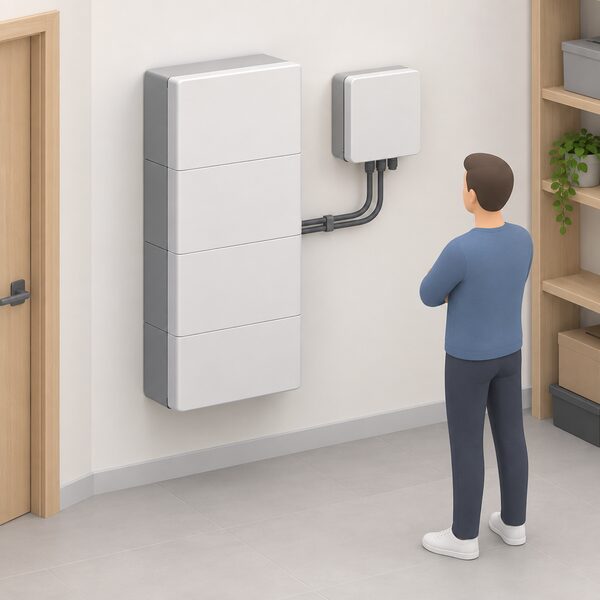
The Battery flex competes on three things: AC coupling, modularity in 2.4 kWh steps, and a 10 year warranty with an 80% retained capacity floor. Its ceiling of 19.2 kWh usable is generous for a residential unit, and the 6.0 kW base rating is high enough to charge and discharge quickly relative to the module count.
Its limits are equally clear. It is a single-phase AC device, so three-phase homes need a different approach. It depends on a Solarwatt Manager for the self-sufficiency figure Solarwatt quotes, and on an internet connection for remote updates. Its warranty excludes individual product components, and its longest cover depends on registration within a tight window. And like every grid-connected battery, it shifts consumption rather than removing the household from the grid or from a supplier.
For households comparing named systems, the wider range is covered at Solarwatt home batteries and at the pillar page on home battery storage. Chemistries and their trade-offs are at home battery chemistries, and the question of adding capacity later at modular and stackable home batteries.
Sources21 cited
- SOLARWATT Battery flex AC-1 1.3 datasheet, Solarwatt, 2026-09-17
- SOLARWATT Battery flex AC-1 datasheet, Solarwatt, 2026-09-17
- Solarwatt develops Battery flex with BMW Group, Flexi-Orb, 2021-06-09
- SOLARWATT Battery flex pack datasheet, Solarwatt, 2026-09-17
- SOLARWATT Battery flex AC-1 warranty conditions, Solarwatt, 2022-03-23
- SOLARWATT Battery flex base AC-1 1.3 (6.0 kW) datasheet, Solarwatt, 2023-07-21
- SOLARWATT AC-Sensor Flex datasheet, Solarwatt, 2026-09-17
- SOLARWATT Manager flex 1.5 datasheet, Solarwatt, 2025-07-10
- SOLARWATT Battery flex pack datasheet, Solarwatt, 2023-07-21
- SOLARWATT Battery vision datasheet, Solarwatt, 2026-05-12
- How to upgrade your Feed-in Tariff solar system, Good Energy, 2026-07-23
- Adding a battery to existing solar panels, Aira, 2026-04-03
- Solarwatt opens three new production facilities, Flexi-Orb, 2021-09-23
- Solarwatt takes its pioneering role further, Flexi-Orb, 2021-06-09
- Solarwatt establishes UK subsidiary, Flexi-Orb, 2021-09-02
- Solar panel battery storage, Which?, 2026-05-14
- Plug-in solar panels vs rooftop systems, Which?, 2026-04-27
- SOLARWATT Manager flex 1.0 datasheet, Solarwatt, 2024-06-08
- SOLARWATT Manager flex 1.0 scope of delivery, Solarwatt, 2024-06-08
- SOLARWATT EnergyManager pro datasheet, Solarwatt, 2024-06-08
- SOLARWATT UK, Solarwatt, 2026-09-17
 SOLARWATT EV chargersSOLARWATT's Charger vision works best with the company's own solar battery and panels, so is it worth buying if you already have a different brand?
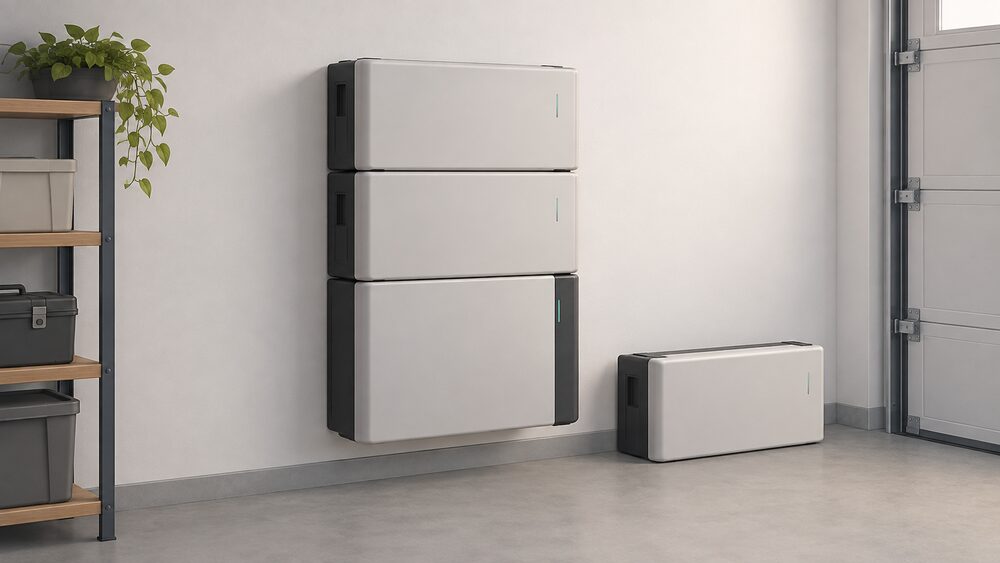 Solarwatt Home BatteriesSolarwatt home batteries suit households wanting to store solar power, including homes with panels already fitted.
 Solarwatt Solar PanelsSolarwatt panels are built with glass on both sides, so what does that mean for how long they last?