
In this guide
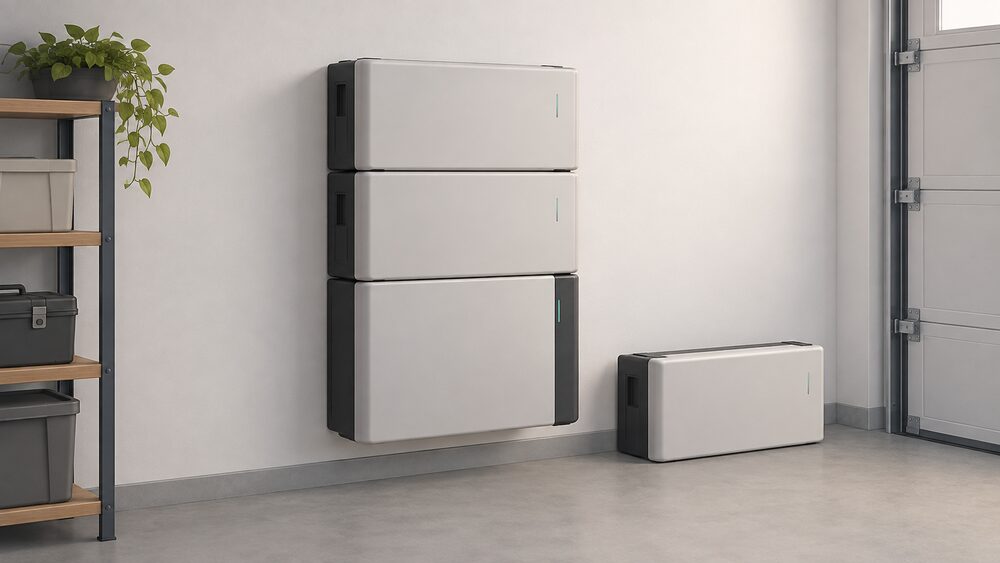
The Solarwatt Battery flex AC-1 is a modular, AC-coupled lithium-ion home battery sold in the UK by a Dresden manufacturer. The system runs from 4.8 to 19.2 kWh of usable energy, built from 2 to 8 battery modules wired in series, and it can be extended in 2.4 kWh steps after installation1. Because it couples on the AC side, it can be added to an existing solar installation as well as a new one2.
The base unit, the Battery flex base AC-1 1.3, is a battery inverter rated at 6.0 kW continuous power with a maximum charge efficiency of 93.6% AC-to-battery1. Each module weighs 25 kg and the base unit 23 kg, which the maker notes allows single person installation1. The product carries a 10-year warranty, conditional on registration within three months of first operation2.
For a household, the appeal is straightforward: a battery that does not care which inverter is already on the wall, expandable in small increments, with a long warranty and an unusual unlimited-cycle term on the modules1. The dependence it creates is equally clear. It is a grid-tied system, it needs a Solarwatt Manager or comparable control layer to do anything clever with tariffs, and its remote features run through the manufacturer's cloud portal and app4.
Battery flex AC-1: a modular AC-coupled battery from 4.8 to 19.2 kWh
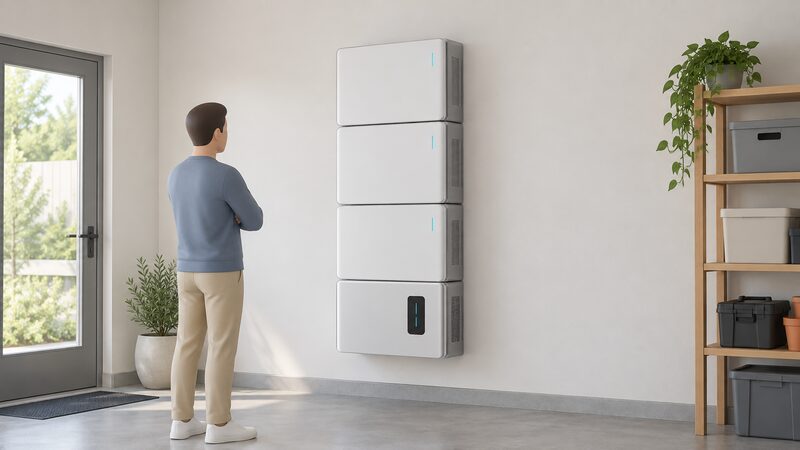
The Battery flex AC-1 1.3 is described by its maker as a modularly expandable lithium-ion battery storage system, with usable energy of 4.8 to 19.2 kWh across the range1. The architecture is unusual in one respect: the base unit is not a passive enclosure but a battery inverter, described in the datasheet as a highly efficient battery inverter with a 6.0 kW continuous rating4. That is what makes the system AC-coupled, and it is why the battery can sit alongside an existing solar array without matching the original inverter.
The base unit connects to the grid at AC single phase, 230 V, 50 Hz, with a rated AC current of 30 A1. On the DC side it works between 25 and 350 V1. Noise emission is listed at a maximum of 30 dB, and internal consumption in operating mode is given as 0 W1. The base unit measures 540 x 248 x 303 mm and carries an IP54 rating2.
The modules themselves are the Battery flex middle pack 1.3 and the Battery flex top pack 1.3, each with 2.4 kWh of usable energy and each weighing 25 kg1. They connect by plug-in connection without any cabling between them, which is what allows the incremental expansion the range is built around2. The module housing is aluminium, and the modules carry an IP54 protection rating and an integrated battery fuse with a 30 A current carrying capacity6.
Specifications of the Battery flex base AC-1 1.3
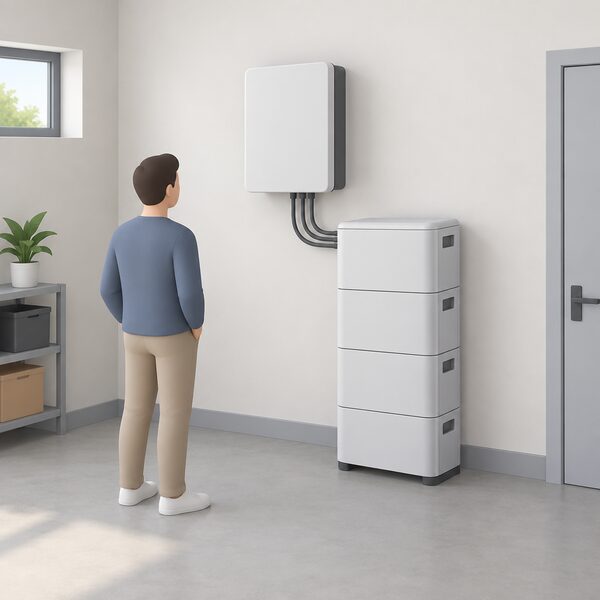
The base unit is the fixed part of any Battery flex installation, and its figures set the ceiling on what the rest of the stack can do. The table below collects the published specification for the 6.0 kW version.
| Specification | Battery flex base AC-1 1.3 |
|---|---|
| Continuous power | 6.0 kW2 |
| Max rated real power | 6.0 kW2 |
| Grid connection | AC single phase, 230 V, 50 Hz1 |
| AC rated current | 30 A1 |
| DC voltage range | 25 to 350 V1 |
| Max charge efficiency (AC to battery) | 93.6%1 |
| Dimensions (W x H x D) | 540 x 248 x 303 mm2 |
| Weight | 23 kg1 |
| Noise emission | max. 30 dB1 |
| IP rating | IP542 |
| Internal consumption, operating mode | 0 W2 |
| Warranty | 10 years2 |
Two of those figures deserve a note. The 93.6% is a maximum charge efficiency measured AC-to-battery, not a round-trip figure, so it does not describe what comes back out; round-trip losses are covered in battery round-trip efficiency. The 6.0 kW continuous rating is the inverter's ceiling, and the power available at any moment also depends on how many modules are fitted: the datasheet gives 1,700 W charging and 1,900 W discharging with two modules, rising to 6,000 W charging and 4,800 W nominal charging with eight4. A small stack therefore cannot use the full inverter rating.
Scalability and installation: extending in 2.4 kWh steps
The Battery flex is designed to be bought small and grown. The maker states it can be extended in 2.4 kWh steps, and the modularity figure is 2 to 8 modules in series1. That gives a floor of 4.8 kWh and a ceiling of 19.2 kWh from a single base unit, with every intermediate step available1. The modules connect by plug-in connection without cabling, which is what makes later expansion practical rather than a rebuild2.
This is a different approach from fixed-capacity batteries, and it sits in a market where expansion increments vary widely between makers. For context on how other systems handle it, see modular and stackable battery systems. The practical consequence for a household is that the initial purchase can be sized to current demand and extended if an electric vehicle or heat pump arrives later, without replacing the inverter.
Installation is wall-mounted as standard, with floor installation listed as an option6. The 25 kg module weight is called out by the maker as allowing single person installation, and the base unit at 23 kg is lighter still1. The IP54 rating on both base and modules means the equipment is protected against dust and water spray, which matters for garage, plant room and outbuilding siting; the general rules on where a battery may go are set out in battery siting and location.

Warranty: 10 years, registration within three months, and what is excluded
The Battery flex carries a 10-year product warranty, and the base unit datasheet repeats the term as 10 years after successful warranty activation2. The modules carry a 10-year performance warranty for at least 80% of the usable energy content, again after successful activation6. The maker's warranty conditions for the Battery flex AC-1 1.3 state that cover depends on the product having been registered at solarwatt.com within three months of the initial operation date3.
"the Product has been registered at www.solarwatt.com within three months of the initial operation date."
Two further terms are worth knowing. The warranty transfers to a new owner of the product to the extent of the remaining warranty period, so a house sale does not automatically end cover3. And the modules are listed with an unlimited number of full cycles during the warranty period, which removes the throughput cap that limits many home batteries1. Cycle life and degradation are explained further in battery cycle life and degradation.
Exclusions follow the pattern common to the industry. Solarwatt's warranty conditions exclude damage from improper storage or transport, improper installation or removal, operation contrary to instructions, improper maintenance, improper modification or manipulation, force majeure, and manipulation or removal of the serial number or type plate7. The last of those is the one to watch: a removed or defaced type plate voids cover regardless of what went wrong.
Separately from the product warranty, the base unit datasheet lists FullCoverage insurance as included for 5 years, with an optional extension to 10 years1. That is an insurance product rather than a warranty term, and it sits alongside the 10-year warranty rather than replacing it. The wider subject of retained capacity and conditions is covered in home battery warranties.
The Solarwatt Manager and the Home app: controlling the system

A Battery flex on its own stores and releases energy; the intelligence sits in the control layer. Solarwatt's EnergyManager is described as monitoring, controlling and regulating all energy flows in the house, with automatic or manual control of consumers, and it creates both an output forecast for the PV system and a demand forecast for connected loads4. With additional devices, an EnergyMeter or Digital Extension, further consumers such as heat pumps or water heaters can be coupled, metered and controlled4.
The Solarwatt Home app brings solar panels, inverter, battery storage, EV charger and heat pump together in one app, with control either automatic or according to the householder's specifications5. Its listed features include real-time visualisation of generation, consumption, feed-in and electricity cost, personalised forecasts, manual control of storage and appliances, automatic control by schedules, and smart control optimised for maximum solar power or dynamic tariffs8. The Manager portal is cloud-based, and firmware and app updates run through an update server9.
The Manager flex 1.0 datasheet sets out three ways to switch appliances and optimise their consumption through the Manager portal: manual, time-optimised and PV-optimised10. The Manager is also listed as compatible with a VARTA battery, so it is not confined to Solarwatt storage9.
This is where the system's dependence is clearest. The battery will charge and discharge without any of it, but forecasting, tariff optimisation, remote monitoring and app control all run through Solarwatt's cloud portal and a home broadband connection. A September 2026 Home app update added improved in-app help, battery health information checks and Bluetooth functionality for connecting to devices to edit settings and run firmware updates, which reduces but does not remove that reliance5. The general picture for app-dependent batteries is set out in battery monitoring and apps.
Who Solarwatt is: a Dresden manufacturer with a UK presence
Solarwatt GmbH is registered at Maria-Reiche-Str. 2a, 01109 Dresden, Germany, and appears as the warrantor in its own warranty documents11. The company states it has over 30 years of experience in research, development and production, began manufacturing solar modules in 1993, and has installed more than 750,000 PV systems across Europe, with more than 13 million individual solar panels sold8. It also states it has more than 1,000 craft installer partners and 130,000 battery systems, heat pumps and EV chargers in the field8.
On UK presence, Solarwatt states it has local offices and warehousing5. Solarwatt Technologies Ltd handles UK enquiries at info.uk@solarwatt.com, and warranty claims for the Battery vision and Inverter vision range use support.uk@solarwatt.com7. The Battery vision datasheet states that it applies only to the UK and Ireland14.
Manufacturing location needs care. The Battery flex datasheets carry the phrase quality Made in Germany, and the module housing is aluminium1. Independent trade reporting from 2021 records final assembly of the Battery flex energy storage system at Dresden, and states that the company is committed to Dresden as a location15. One Solarwatt datasheet dated October 2024 gives the place of production for a different product as China16. The origin claim therefore applies to the Battery flex line specifically, and a householder wanting certainty on a particular unit can ask the installer to confirm the markings on the delivered equipment.

Certification and grid compliance: G98, G99 and G100 documentation
Any grid-tied battery in the UK has to satisfy the network operator, and the paperwork matters as much as the hardware. Solarwatt's Inverter vision max 1.0 is certified to EREC G98-1:2022, G99-1:2022 and G100:202217. The Inverter vision three 1.0 lists EREC G98-1:2022 Amendment 7, G99-1:2022 Amendment and G100:2022 Amendment 214. The Battery vision carries PAS 63100:2024 for the UK14.
G98 is the route for smaller, single-phase generation and is an obligation under the Electricity, Safety, Quality and Continuity Regulations 200218. G99 applies to larger connections, and Northern Ireland operates a fast-track G99 process that requires a compliance certificate with test results as part of the application19. G100 covers export limitation, which is what allows a battery to be installed where the local network cannot accept unlimited export.
The practical point for a householder is that the certification belongs to the inverter, not to the battery modules, and the installer is responsible for notifying the network operator. The full process is set out in battery grid connection G98 and G99, and the standards governing the installation itself are covered in battery installation standards.
Where the Battery flex sits in the market

The Battery flex is one of several modular systems sold in the UK, and the differences between them are mostly about expansion increments and control architecture. The table below sets the published scalability figures side by side; it is a comparison of what each maker states, not a ranking.
| System | Stated scalability |
|---|---|
| Solarwatt Battery flex AC-1 | 2.4 kWh steps, 2 to 8 modules2 |
| RCT Power Battery Premium | 2.5 kWh steps20 |
| RCT Power Battery | 1.9 kWh steps up to 11.5 kWh21 |
| SMA Home Storage battery module | 3.2 kWh to 16.4 kW22 |
| SolarVault 3 Series | up to 15.12 kWh with five expansion batteries23 |
Two things distinguish the Solarwatt approach. The first is the AC coupling, which means the battery does not have to match an existing solar inverter and can be retrofitted to a system of any make; the difference between the two architectures is explained in AC-coupled and DC-coupled battery systems. The second is the unlimited cycle term on the modules, which is unusual in a market where most batteries cap throughput over the warranty period1.
What the Battery flex does not do is provide backup power in a power cut. The datasheets describe a grid-tied AC battery with no emergency power supply function listed, and the Manager flex 1.0 is described as Battery flex ready rather than as a backup interface10. Households weighing independence should treat this as a storage and self-consumption product, not a resilience product; the options for outage cover are set out in battery backup power and EPS.
On price, no published UK figure for the Battery flex appears in the material available, so prices are installer-quoted. The general cost picture for home batteries is covered in how much does a home battery cost.
Sources23 cited
- Battery flex AC-1 1.3 datasheet, Solarwatt, 2026-09-17
- Battery flex AC-1 datasheet, Solarwatt, 2026-09-17
- Battery flex AC-1 1.3 warranty conditions, Solarwatt, 2022-03-23
- Battery flex base AC-1 1.3 (6.0 kW) datasheet, Solarwatt, 2023-07-21
- Solarwatt Home product page, Solarwatt, 2026-09-17
- Battery flex pack datasheet, Solarwatt, 2023-07-21
- Solarwatt warranty conditions, Solarwatt, 2024-02-01
- Solarwatt brochure, Solarwatt, 2026-08
- Solarwatt Manager datasheet, Solarwatt, 2025-07-10
- Manager flex 1.0 datasheet, Solarwatt, 2024-06-08
- Battery vision one backup booster datasheet, Solarwatt, 2026-07-07
- Solarwatt Manager warranty conditions, Solarwatt, 2025-02-25
- Battery vision and Inverter vision warranty conditions, Solarwatt, 2025-02-27
- Battery vision datasheet, Solarwatt, 2026-05-12
- Solarwatt opens three new production facilities, Flexi-Orb, 2021-09-23
- Solarwatt datasheet, Solarwatt, 2024-10-24
- Inverter vision max 1.0 datasheet, Solarwatt, 2026-09-17
- Micro generation and storage connections, Electricity North West, 2026-09-19
- G99 NI fast track installations, NIE Networks, 2026-09-19
- RCT Power Battery Premium, RCT Power, 2026-09-19
- RCT Power FAQ, RCT Power, 2026-09-19
- SMA Home Storage battery module, Wind and Sun, 2026-09-20
- Jackery SolarVault 3 Series, Jackery, 2026-09-20
 SOLARWATT EV chargersSOLARWATT's Charger vision works best with the company's own solar battery and panels, so is it worth buying if you already have a different brand?
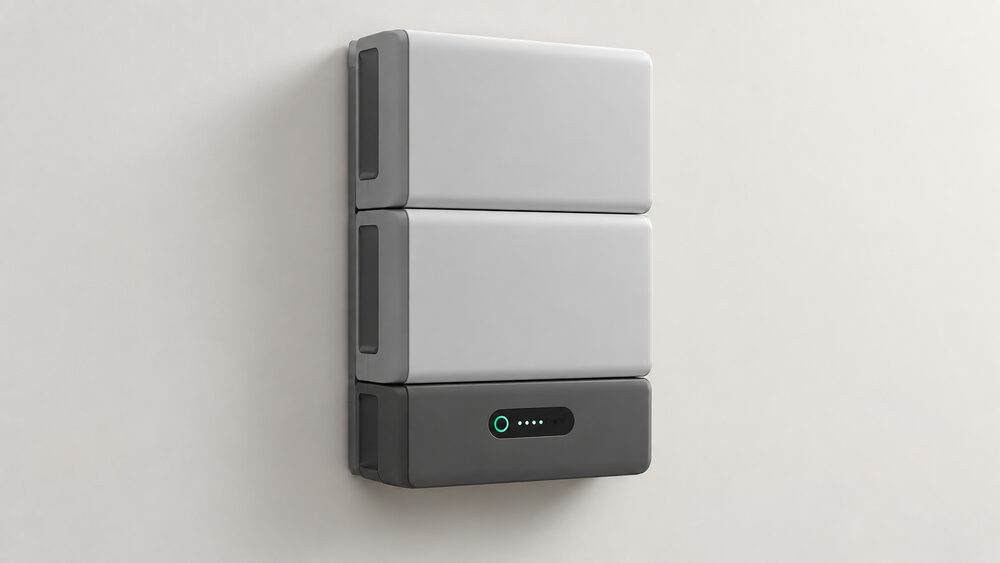 Solarwatt Battery flexThinking about adding a battery to solar panels you already have?
 Solarwatt Solar PanelsSolarwatt panels are built with glass on both sides, so what does that mean for how long they last?