In this guide
Warmcel is a blown cellulose insulation made from recycled newspaper, and it is the main UK product of its kind. Cellulose insulation is made from a mix of recycled newspaper, around 85%, and other organic compounds1. It is supplied as loose fibre and blown into a structure under pressure, rather than sold as rolls or boards, which is why it is tied to an approved installer network rather than to a shelf in a builders' merchant.
Its thermal conductivity is quoted at 0.037 to 0.042 W/m K1. That places it alongside mineral wool and slightly behind the best rigid boards, but the material's advantage is not the number on its own: blown fibre fills the space it is blown into, so it removes the joints and gaps that cut the performance of any insulation that arrives in fixed shapes. Mineral wool's own technical guidance makes the same point, that compression fit minimises gaps at joints in slabs or removes joints completely when blown2.
Warmcel is a timber-frame and dry-construction product. It suits walls, roofs, floors and lofts where there is a cavity to fill, and it does not suit masonry cavity walls, which are built around mineral wool and similar materials. PYC has been the sole approved distributor of Warmcel cellulose fibre insulation in the UK and Ireland since 2014, and installation runs through its approved installers.
What Warmcel is: cellulose fibre from recycled newspaper
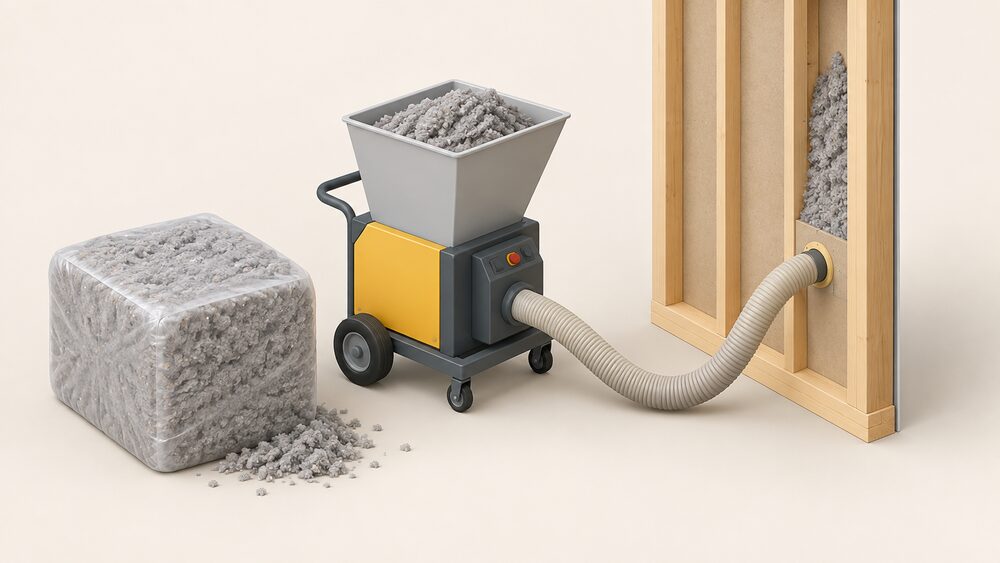
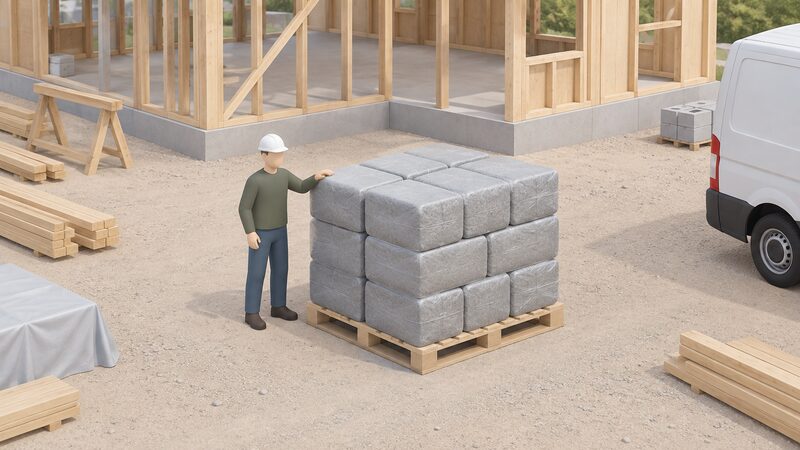
Cellulose insulation is made from a mix of recycled newspaper, around 85%, and other organic compounds1. The newspaper is shredded, then treated with additives, normally borate-based, which give the fibre fire resistance and resistance to mould and insects. The result is a loose, grey fibre that is delivered in bales and blown into the building fabric on site.
The recycled content is the headline environmental fact, and it is not unique to cellulose: mineral wool also uses recycled material6. What distinguishes cellulose is the proportion and the source. Newspaper is a post-consumer waste stream, and the manufacturing process is closer to shredding and treating than to melting rock. That matters for the embodied carbon of the material, though the figure a household should ask for is the product-specific declaration rather than a general claim about the category.
The thermal conductivity of cellulose insulation is 0.037 to 0.042 W/m K1. For comparison, recycled plastic insulation rolls have been measured at 0.040 W/m K1. The two overlap, and both sit above the performance of PIR boards, which are the usual choice where space is tight. Cellulose's case rests on how completely it fills a void, on its recycled content, and on its acoustic behaviour, not on being the thinnest option available.
Warmcel itself is the UK product in this category, distributed by PYC, which has been the sole approved distributor of Warmcel cellulose fibre insulation in the UK and Ireland since 2014. That single-distributor arrangement shapes everything about how the material is bought and fitted: there is no general merchant route, and the installer network is the channel.
| Material | Thermal conductivity | Form | Typical route to site |
|---|---|---|---|
| Cellulose fibre | 0.037 to 0.042 W/m K1 | Loose, blown | Approved installer network |
| Recycled plastic rolls | 0.040 W/m K1 | Roll | Merchant or installer |
| Mineral wool | Compression fit, joints minimised or removed when blown2 | Slab, roll or blown | Merchant or installer |
Where it can be used: timber frame walls, roofs, floors and lofts
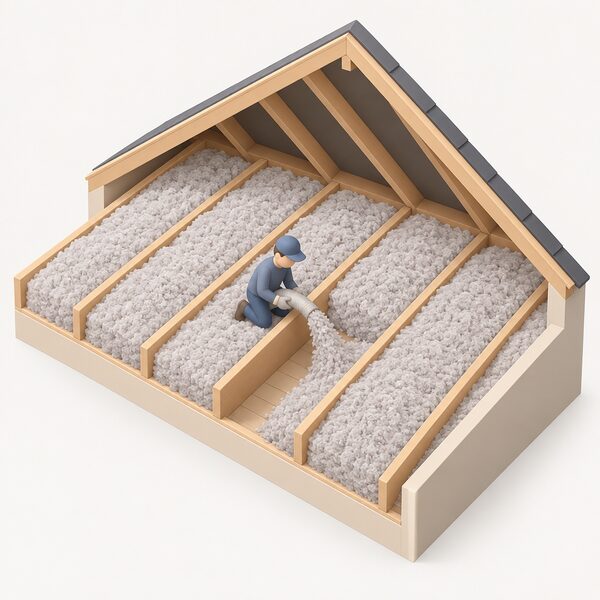
The material suits any construction where there is a cavity to fill and the cavity can be closed after blowing. That covers timber frame walls, pitched and flat roofs, intermediate floors and lofts. The legislation that defines energy-saving materials for VAT purposes describes insulation for walls, floors, ceilings, roofs or lofts or for water tanks, pipes or other plumbing fittings4, which is the broad category cellulose sits in.
In roofs, the placement rules are set by building guidance rather than by the product. For a cold deck pitched roof, the insulation can be placed between the rafters or it can be placed between the ceiling joists7. Where the roof has no ceiling, the insulation can be placed between the rafters, with ventilation maintained and ridge vent tiles installed to allow through ventilation8. A warm deck roof reverses the arrangement: the insulation is placed on top of the rafters or joists with the roof covering placed over the insulation7. For a pitched warm deck, the insulation goes over the rafters, then a felt, then the battening and tiling fixed down over it10.
Between-rafter insulation is used when the depth of the rafters enables the installation of sufficient insulation to meet the required thermal performance6. That is the practical constraint with cellulose in a roof: it needs depth. Blown fibre cannot be compressed into a thin space the way a rigid board can, so a shallow rafter will not take enough of it.
In floors, the method is to fill the void between the beams. Installing mineral wool insulation in the void between the beams provides improved acoustic performance while improving thermal performance without increasing floor depth11. The same principle applies to cellulose, which is well suited to the spaces between timber joists because it can be blown in through a small opening and fills around services and noggings.
| Position | Placement | Constraint |
|---|---|---|
| Cold deck pitched roof | Between rafters or between ceiling joists7 | Ventilation maintained; ridge vents where between rafters8 |
| Warm deck pitched roof | Over the rafters, then felt, battens and tiling10 | Roof build-up depth increases |
| Between rafters | Where rafter depth allows sufficient insulation6 | Needs depth; cannot be compressed thin |
| Intermediate floor | Void between beams filled11 | No increase in floor depth |
For the wider picture of where each material fits, see insulation materials compared and the loft insulation guide.
Where it falls short: masonry cavity walls and moisture limits
Blown cellulose is not a masonry cavity wall product. Where insulation is inserted into a cavity wall, the appropriate requirements will be applied to ensure the insulation material is suitable12. The approved construction details for masonry cavity walls have been developed for a range of partial and fully filled cavity wall constructions5, and those details are built around mineral wool and similar materials with known behaviour in a wet, exposed cavity.
The reason is moisture. A masonry cavity is not a dry, sealed box: it drains and ventilates, and any insulation in it has to tolerate that. Cellulose fibre is absorbent. Where it stays wet it loses thermal performance and can hold moisture against timbers and wall ties. That is why the material is specified for dry, enclosed cavities in timber frame and dry-lined construction, and why masonry cavity walls have their own separate route.
Solid walls are a different problem again. The high standards of thermal insulation needed in buildings mean that it is more difficult to achieve those standards with solid masonry wall construction13, and solid blockwork constructions may meet the requirements if allied with other insulation products and surface finishes14. Internal wall insulation on a solid wall is not a straightforward win: official guidance on converting traditional buildings states that this solution does not represent best practice in building conservation but can be useful where the masonry is unavoidably damp15. An alternative approach is to maintain a cavity between the masonry wall and form a separate insulated layer15.
Where internal wall insulation is proposed, the wall should be assessed to ensure it is suitable for insulating by this method, which should include a moisture risk assessment16. That assessment is the gate: without it, a blown or board insulation scheme on a solid or traditionally built wall risks trapping moisture.
If a wall has already been insulated badly, the symptoms are damp or mould17, and there is a separate route for cavity wall insulation problems and for damp after insulation.
How it is installed: blown under pressure by approved installers
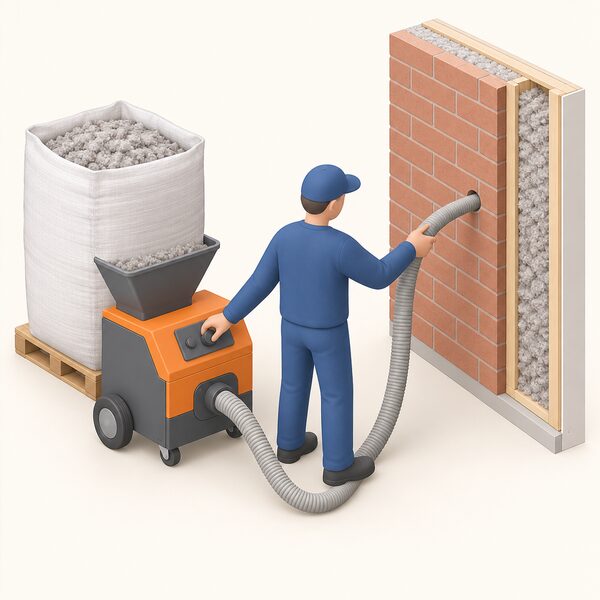
Blown fibre insulation is not suitable for DIY installation unless you are a professional3. The fibre is fed through a machine and blown through a hose into the cavity, and the installer controls the density by regulating the airflow and the rate of feed. Density is the whole job: too little and the material settles, leaving a cold band at the top of the wall or roof; too much and the pressure can distort boards and linings.
The comparison with other materials is instructive. Independent guidance on loft insulation notes that it is not as easy as laying rolls of insulation, so a professional installer is recommended, though it can still be done as a DIY job if you have the skills18. Blown cellulose sits further along that scale than blanket insulation, which is described as an easy-to-fit, simple installation process11. Boards are further still: DIY installation is not recommended3.
The practical sequence on a retrofit is:
- The cavity is opened at intervals.
- The hose is inserted and the fibre is blown in until the space is full.
- The openings are made good.
In a new build or a major renovation, the structure is often left open for the installer and closed afterwards, which gives a more reliable fill. In a loft, the fibre is blown across the joists to a depth set by the target U-value, and the depth should be marked so it can be checked later.
Because the work is done by an approved installer, the paperwork matters as much as the material. Insulation work under grant funding is quality checked by qualified professionals19. On funded schemes, installers are typically required to be registered with TrustMark or an equivalent competent person scheme; the Warm Home Discount regulations, for example, require that the boiler or central heating system is installed by, or under the responsibility of, a person who is registered with TrustMark, with a certificate of lodgement issued by the operator of TrustMark20. The Surrey County Council Warm Homes Local Grant is explicit that to be eligible for the funding, one of the installers on the Surrey County Council network must be used, and those installers are TrustMark registered and MCS accredited for renewable technologies21.
For how to check an installer, see finding an insulation installer.
Thermal and acoustic performance: high-density fill with no gaps
The thermal case for cellulose rests on completeness of fill. Mineral wool's technical guidance states that compression fit minimises gaps at joints in slabs or removes joints completely when blown2. That is the mechanism: a material that arrives in fixed shapes has joints, and joints are where heat leaks. A blown material has no joints at all, and it flows around pipes, cables, noggings and irregular timbers that would otherwise be bridged or left as voids.
The conductivity figure is 0.037 to 0.042 W/m K1. To hit a given U-value, cellulose needs a similar depth to mineral wool and more depth than PIR. That is the trade-off: a thicker build-up in exchange for a continuous fill and a lower embodied impact.
Acoustically, the material performs well. Mineral wool's guidance describes excellent sound absorption and reduced flanking noise through the cavity where the cavity is fully filled2. Cellulose behaves in the same family: dense, fibrous and fully filling, which absorbs sound within the cavity and reduces the flanking path. In timber floors, filling the void between the beams provides improved acoustic performance while improving thermal performance without increasing floor depth11. For a party wall or a floor between flats, that combination is often the reason cellulose is chosen over a board.
The performance in practice depends on the installed density and on the structure being closed and dry. A blown fill that has settled, or that was installed into a cavity with a permanent air path, will not deliver the modelled figure. The material's own conductivity is only half the story; the other half is whether the installer filled the space completely and whether the detailing keeps wind and moisture out.
For the underlying numbers, see U-values and R-values explained and thermal bridging and cold spots.
Fire, vermin and VOCs: what the additives cover
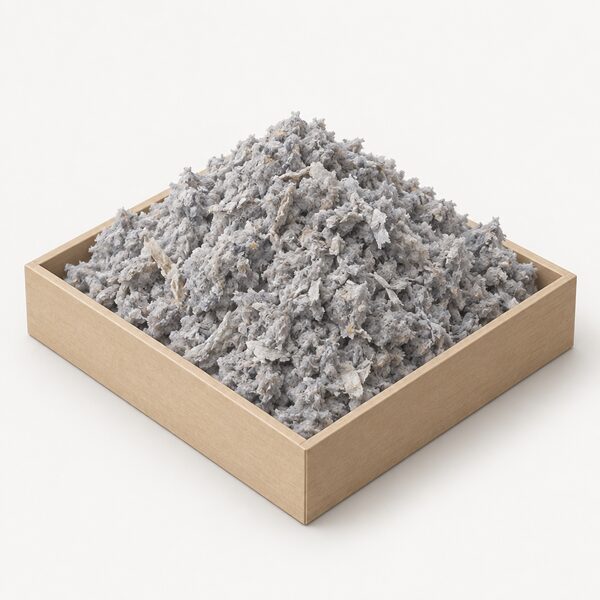
Cellulose fibre is treated with additives, normally borate-based, which give it resistance to fire, mould and insects. The treatment is what turns a pile of shredded paper into a building product, and it is the reason the material can be specified inside a wall or a roof void. The certification position for a specific product, covering reaction to fire and fitness for purpose, is issued by the manufacturer and should be requested before work starts.
Fire performance in a building is set by regulation, not by the product alone. The location of the insulation, the substrate it sits against and the surface it is covered by all form part of the assessment. Where a product is certified for a given application, that certification is the evidence a building control body will look for.
Ventilation is the other half of the indoor air question. Insulating a home tightly changes how moisture and pollutants behave, and mechanical ventilation systems are covered by their own competent person schemes: BESCA, Blue Flame Certification, Certsure and Napit are registered schemes for mechanical ventilation and air conditioning systems in dwellings22. Oil combustion appliances, including liquid biofuels, are covered by a separate list including APHC, BESCA, Blue Flame Certification, Certsure, NAPIT and OFTEC23. The point for a household is that fabric work and ventilation work belong together, and the ventilation side has its own registration and sign-off.
For the wider context, see insulation safety and fire, home ventilation and insulation standards and certification.
Environmental credentials: carbon locked in the fabric and Passivhaus use
The environmental case for cellulose is straightforward: it is made largely from a post-consumer waste stream, and the carbon in that paper stays locked in the fabric for the life of the building. Cellulose insulation is made from a mix of recycled newspaper, around 85%, and other organic compounds1. Mineral wool also uses recycled material6, so the difference is one of degree and of process rather than of kind.
The material has a track record in high-performance buildings. The Chippenham Passivhaus case study describes engineered timber I-beams with primarily Warmcel and Pavatex wood fibre board insulation, alongside Passivhaus certified triple glazed windows and Passivhaus certified MVHR with high airtightness rated metal spiral ductwork24. That is a certified Passivhaus, which means the fabric achieved the airtightness and thermal targets with cellulose as the primary insulation. It is a single case study rather than a general claim, but it is the kind of evidence a householder weighing the material will find useful.
Grant funding recognises insulation as a fabric measure. The Warm Homes Social Housing Fund guidance states that funding is available for insulation, associated ventilation, and communal low carbon heating25. The West Midlands retrofit scheme lists eligible measures for selected households including external wall insulation, cavity wall insulation, underfloor insulation, loft insulation, draught proofing, air source heat pumps, solar PV, double glazing, new doors, floor insulation, heating controls and ventilation26. Cellulose is not named in either, because the schemes fund measures by performance and category rather than by brand.
For the wider picture, see Passivhaus and EnerPHit and insulation and energy independence.
Buying Warmcel in the UK and Ireland: the PYC approved installer route
Warmcel is bought through PYC's approved installer network rather than through a merchant counter. PYC has been the sole approved distributor of Warmcel cellulose fibre insulation in the UK and Ireland since 2014. That means the route to a price is a survey and a quote from an approved installer, not a published list price per bale or per square metre.
The installer requirement is the same as for other funded fabric work. Under the Warm Home Discount regulations, the boiler or central heating system is installed by, or under the responsibility of, a person who is registered with TrustMark, with a certificate of lodgement issued by the operator of TrustMark20. The Surrey County Council Warm Homes Local Grant requires that one of the installers on the Surrey County Council network must be used, and those installers are TrustMark registered and MCS accredited for renewable technologies21. Insulation work is quality checked by qualified professionals19.
Grant availability differs across the UK. The Warm Home Discount is a government scheme in England, Wales and Scotland27. Northern Ireland has its own list of schemes, published by the Utility Regulator28. The Keep Warm Scheme in Northern Ireland lists cavity wall insulation among its measures, alongside LED light bulbs, a low-flow or eco shower head, a hot water tank jacket, reflective radiator panels and draught proofing measures if required28.
| Nation | Scheme position |
|---|---|
| England, Wales and Scotland | Warm Home Discount is a government scheme27 |
| Northern Ireland | Own list of schemes published by the Utility Regulator; Keep Warm Scheme lists cavity wall insulation among its measures28 |
For the detail by nation, see insulation grants England, insulation grants Scotland, insulation grants Wales and insulation grants Northern Ireland.
Where a scheme has failed or a company has gone under, the household's position is different, and there is a separate route for closed insulation schemes and for ECO4 and GBIS insulation failures.
What Warmcel means for a household's energy independence
Blown cellulose insulation changes what a home needs to buy, not where it buys it from. By filling a timber frame, a roof or a floor completely, it reduces the heat the fabric loses, which reduces the fuel the heating system has to burn. That is the independence it offers: a lower standing demand, and a home that holds its temperature for longer after the heating stops.
The dependence that remains is the same as for any fabric measure. The household is still on the grid, still on a supplier, and still buying whatever fuel the heating system uses. Insulation does not generate anything. It also depends on the installer having done the job properly: a blown fill that settles or that was installed into a wet or open cavity will not deliver the modelled performance, and the household has no easy way to inspect it afterwards.
There is a maintenance dependence too. Cellulose is absorbent, so any leak into the structure has to be found and fixed, and the material around it may need to be removed and replaced. The certification and the installer's registration are the household's protection, and they should be checked before work starts rather than after.
For the wider context, see whole-house retrofit planning, insulation and glazing costs and the pillar guide at home insulation and glazing.
Sources28 cited
- Cellulose vs hemp vs cork insulation, Uswitch, 2025-11-21
- Masonry cavity wall insulation, MIMA, 2026-09-20
- Installing blanket insulation, Which?, 2026-05-26
- Energy-saving materials, VAT relief, legislation.gov.uk, 2023-05-01
- Accredited construction details, Part L, Planning Portal, 2026
- Roof insulation applications, MIMA, 2026-09-20
- Roof insulation: thermal resistance, Welsh Government, 2026-09-17
- Roof conversion projects, Welsh Government, 2026-09-17
- Building regulations for roof conversion projects, Planning Portal, 2026
- Building regulations for new roofs: thermal resistance and insulation, Planning Portal, 2026
- Internal floor insulation, MIMA, 2026-09-20
- Building regulations for cavity wall insulation, Planning Portal, 2026
- Building regulations: external walls, Welsh Government, 2026-09-17
- Building regulations for external walls, Planning Portal, 2026
- Guide to the conversion of traditional buildings, Scottish Government, 2026-08-10
- Approved Document L Volume 1 consultation version, Welsh Government, 2025-08
- Get help with faulty solid wall insulation, Citizens Advice, 2026-09-17
- Roof insulation, Which?, 2026-05-05
- What to do if you have poor quality wall insulation, GOV.UK, 2025-01-23
- Warm Home Discount (England and Wales) Regulations 2026, legislation.gov.uk, 2026-03-27
- Warm Homes Local Grant, Surrey County Council, 2026-09-17
- Future Homes and Buildings Standards consultation response, MHCLG, 2026-03
- Competent person scheme current schemes, GOV.UK, 2013-04-04
- Chippenham Passivhaus, Future Homes, 2025-03-04
- Warm Homes Social Housing Fund wave 3 scheme guidance addendum, MHCLG, 2026-06
- West Midlands residents urged to get ready for fuel-reducing technology, West Midlands Combined Authority, 2022-06-08
- Warm Home Discount, StepChange, 2026-09-20
- NISEP list of schemes 2026-27, Utility Regulator Northern Ireland, 2026-04