
In this guide
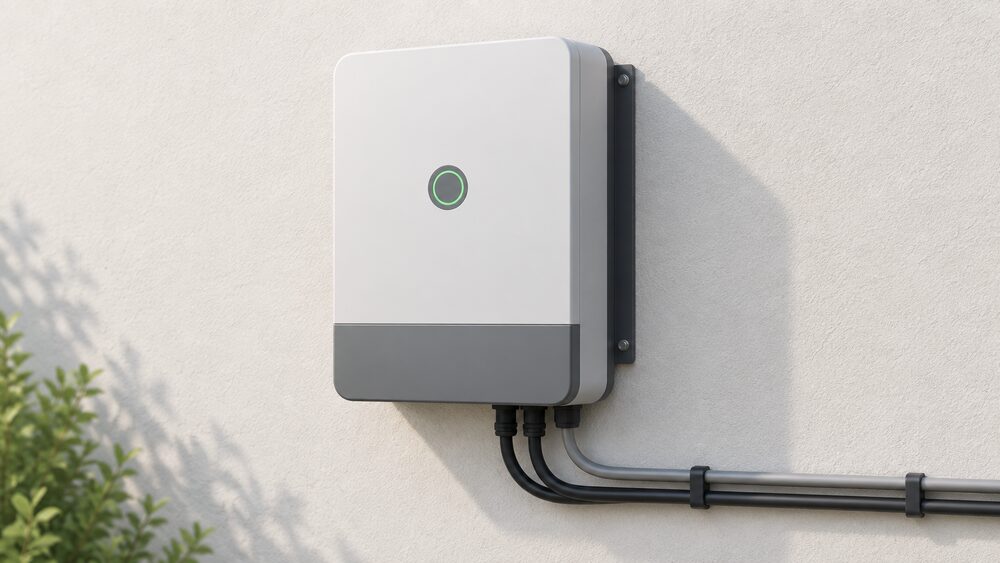
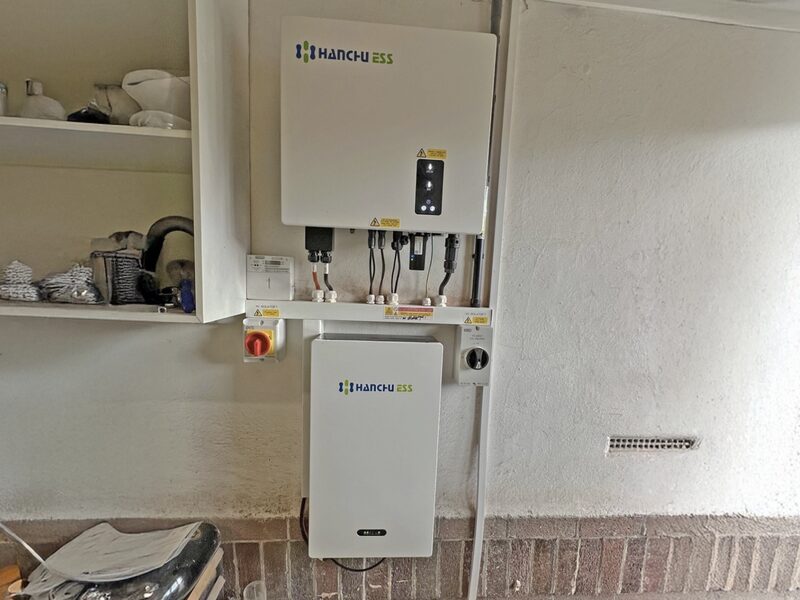
A Hanchu ESS home battery is an all-in-one unit: the inverter and the battery sit in the same enclosure rather than being bought and wired as two separate boxes. The maker describes it as an "All in one hybrid inverter and battery system", and the range is sold in 2.56kWh, 5.12kWh and 9.4kWh configurations1. It is available in both single-phase and 3-phase versions, so it suits an ordinary house as well as a larger property1.
The headline claims are a 95% depth of discharge, a 100A discharge rate, a 12 year manufacturer warranty and a full uninterrupted power supply system that switches the home to battery power during a cut1. The cells are lithium iron phosphate, the unit carries an IP65 rating for indoor or outdoor siting, and it has a built-in aerosol fire suppression system1.
What that buys a household is more of its own solar power used at home, less bought from a supplier, and a limited form of independence during an outage. What it does not buy is disconnection: the battery still works alongside a grid connection, a supplier and, for the app and smart tariff features, a broadband line.
What a Hanchu ESS home battery is: an all-in-one hybrid unit
The all-in-one format is the defining feature. A conventional setup pairs a separate hybrid inverter with a separate battery stack, which takes more wall space and more wiring. Hanchu puts both in one enclosure, which the maker presents as "streamlined efficiency and installation"1. Other makers sell the same idea: Sunsynk's All in One ESS Elite combines "a high-performance hybrid inverter, advanced battery technology and intelligent energy management into a single, wall-mounted enclosure"2, and SAJ's residential range bundles a solar inverter, EV DC charger, battery converter, battery pack, backup system and energy management into one AI-powered unit3.
For a household, the practical difference is space and simplicity rather than performance. One box on a wall is easier to site than two, and there is one set of connections to get right. The trade-off is that the inverter and the battery are tied together: replacing one means dealing with the other, where a separate system lets you change the inverter without touching the batteries.
Hanchu sells the range in three nominal capacities, 2.56kWh, 5.12kWh and 9.4kWh1. The maker's own guidance is that most homes benefit from 5kWh to 15kWh systems, which puts the 5.12kWh and 9.4kWh units in the ordinary domestic range and the 2.56kWh unit at the small end1. Capacity is not the same as usable capacity, and the relationship between the two is set out in battery capacity and usable capacity.
The range has since grown beyond those three sizes. Hanchu launched the POLA-16L-P, a floor-standing battery unit, on 6 July 20264. It delivers 200A rapid charge and discharge, includes built-in auxiliary heating for low-temperature operation, and supports up to 16 units in parallel with intelligent automatic addressing4. Its safety features include a seven-layer battery management system, thermal aerosol fire suppression and a pressure relief valve4. A 16kWh low voltage battery is also on the way, with IP66 protection and a C5-M corrosion rating, shown at Solar & Storage Live Birmingham in September 20265.
Safety and build: LiFePO4 chemistry, IP65 and built-in fire suppression
The cells are lithium iron phosphate, which the maker describes as "known for stability and long lifespan"1. That chemistry is the common choice across the home battery market: SolaX builds its X-ESS G4 around "ultra-safe LiFePO4 batteries" with an IP65 rating6, Pylontech's T-BAT-SYS-HV-R2.5 uses LFP cells7, and GivEnergy's expansion battery uses "safe LiFePO₄ chemistry"8.
The safety argument for the chemistry is consistent across makers. One manufacturer states that LiFePO4 has "extremely high" safety, with high temperature resistance and less prone to thermal runaway9, and another that these cells "generate less heat during charging and discharging, reducing the risk of thermal runaway"10. Puredrive describes lithium iron phosphate as incombustible in the event of mishandling during charging and discharging, and able to withstand conditions from freezing cold to scorching heat11. These are makers' positions rather than independent test results, but they point the same way.
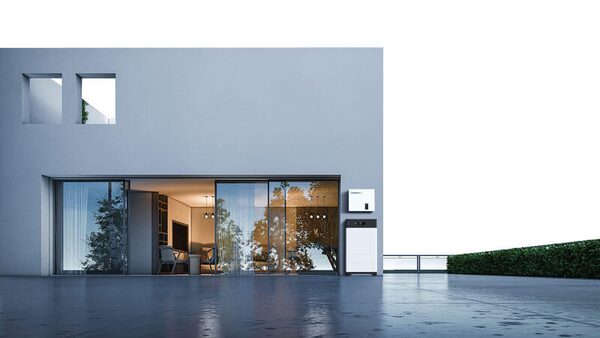
Hanchu adds two things beyond the chemistry. The first is an IP65 rating, which the maker states makes the units suitable for both indoor and outdoor installation1. IP65 is a common rating for outdoor-capable home batteries: myenergi's libbi module carries the same figure12. The second is a built-in aerosol fire suppression system1, which is less common. SolaX describes its X-ESS G4 as fireproof tested13, but that is a test claim rather than an installed suppression device.
Siting is covered in more detail in where a home battery can be installed, and the wider question of chemistry choice in home battery chemistries.
Performance in practice: 95% depth of discharge, 100A discharge and cold-weather heating
Depth of discharge is the share of a battery's nominal capacity that can actually be used before it stops discharging. Hanchu states 95%1, which is at the higher end of what is sold. For comparison, myenergi's libbi module is listed at 90%12, Pylontech's Force H3 at 95% in its 7-module configuration14, and several others at 90%: Livoltek's BHF-E10 to E60 range15, Growatt's APX HV16, SAJ's B2 series17, Livoltek's BHF-S53018 and the Livoltek AES series19. SolaX states that LFP batteries can reach up to 100% depth of discharge20, and GivEnergy lists 100% on its high voltage stackable batteries21.
The gap between 90% and 95% is smaller than it sounds. On a 9.4kWh unit it is a few tenths of a kilowatt hour of usable energy, and the difference between nominal and usable capacity matters more than the headline percentage. The full explanation sits in battery capacity and usable capacity.
The 100A discharge rate is the other performance figure the maker gives1. Discharge rate sets how much power the battery can deliver at once, which decides whether it can run heavy loads such as an oven, a shower or a heat pump without pulling from the grid. The maker presents that rate as supporting "high demand homes"1. The relationship between amps, kilowatts and how long a battery lasts under load is covered in battery power ratings.
Cold weather is the third claim. Hanchu states the system has intelligent thermal management with heating and cooling, and that integrated heating technology ensures consistent performance even in colder temperatures1. That matters in the UK because lithium batteries charge and discharge less willingly when cold, and an unheated garage or an external wall can drop well below the temperatures a battery prefers. Other makers address the same problem: Growatt's BHF-E10 to E60 range has built-in intelligent battery heating for stable charge and discharge in low-temperature environments15. The general principles are in ventilation, temperature and operating conditions.
Backup power: automatic UPS switching during a cut

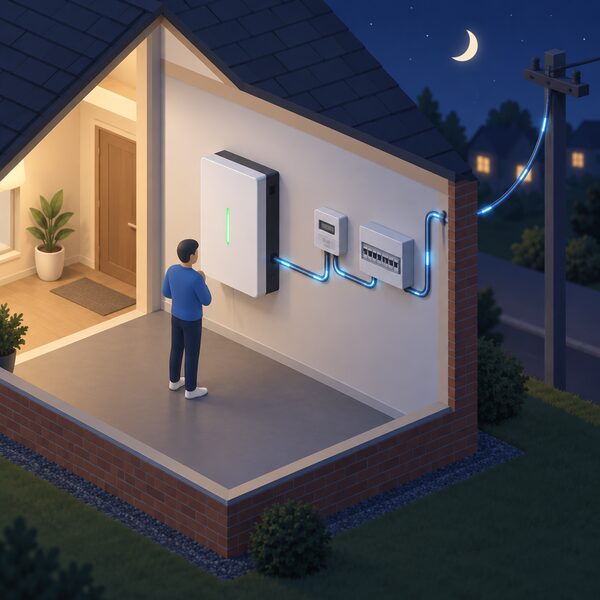
Hanchu states the system features "a full uninterrupted power supply (UPS) system, meaning your home can automatically switch to battery power during a power cut"1. That is the maker's claim, and it is the feature most households ask about first.
It is worth being precise about what backup means in practice. A UPS is designed for instantaneous protection of electronics, with a 0ms switch6. Other makers describe similar arrangements: RCT Power's switch offers automatic switchover during power failure22, Growatt's hybrid system includes a UPS switch for power backup23, and GoodWe's BH Series has a UPS-level switching backup function24.
The independent position is more cautious. Energy Networks Association guidance describes uninterruptible power supplies as providing "a few minutes emergency battery backup if power fails"25, which is a much shorter window than a home battery owner might imagine. Electricity North West states that storage devices "can provide back-up supplies for use in a power cut, but this is not always possible" and advises checking with the installer26. The two positions are not in conflict: a UPS function switches the supply over instantly, but how long it can carry the house depends on the load and the charge left in the battery.
What usually decides whether a home keeps power in an outage is not the battery but the wiring. A battery that only supplies the whole house through a changeover arrangement behaves differently from one wired to a dedicated backup circuit covering a few sockets, the boiler and the broadband. That distinction is set out in battery backup in a power cut and do I need a backup interface.
Smart control: the app, Hi-Agent AI Assistant 360 and 24/7 tracking
Hanchu ESS supports remote monitoring and control through an app, with 24/7 live system tracking1. The maker also describes a Hi-Agent AI Assistant 360 that "optimises when to store, use or export energy"1. In plain terms, the system decides when to hold solar power, when to use it in the house and when to send it to the grid, rather than leaving every decision to the householder.
That pattern is now standard. SolaX describes AI algorithms providing real-time monitoring of battery health and charge, with over-the-air updates20, and app monitoring is listed as a feature across the market27. The value of the AI layer is that it reacts to prices and to solar generation faster than a person would, and the cost is that the logic sits in the manufacturer's software rather than in your hands.
Hanchu supports its installations with the iESS platform, an AI-powered cloud-based energy management system that coordinates generation, consumption and storage across cloud, edge and device layers4. Through iESS, installers and end users get AI-driven energy optimisation strategies and intelligent remote customer service4. The platform connects with Nord Pool, Europe's leading power exchange, covering markets across Central and Western Europe as well as the Nordics and Baltics, so users can optimise energy use based on live electricity price signals4. In the UK, iESS supports a virtual power plant collaboration with Octopus Energy4.
This is where the dependence in an all-in-one system is clearest. Local control at the unit continues without an internet connection, but remote monitoring, remote diagnostics and any tariff-driven optimisation depend on a home broadband connection, the manufacturer's servers and the maker's app. If the company's cloud service changes or ends, the hardware keeps working but the smart layer does not. The wider picture is in monitoring a home battery.
Smart tariffs and Octopus Flux compatibility
The maker states Hanchu ESS "integrates seamlessly with solar PV systems, EV chargers and smart tariffs such as Octopus Flux"1, and that it works with smart tariffs generally, allowing optimised charging and maximised savings1. Octopus lists Hanchu ESS among the battery brands compatible with Intelligent Octopus Flux, alongside AlphaESS, Ecoflow, Enphase, Fox ESS, GivEnergy, Huawei, Sigenergy, SolarEdge, SunPower and Tesla28.
Intelligent Octopus Flux is a two-rate tariff with matching import and export prices, with automated battery management that charges when power is cheapest and exports between 4pm and 7pm29. The supplier describes it as pairing with the battery to optimise charging and discharging28, and states that import rates are lower than standard Flux, with the battery charging when the grid is greenest28. Standard Octopus Flux is also available, offering import and export rates28.
The tariff side of the equation is often worth more than the hardware side. A battery that shifts cheap overnight electricity into an expensive evening peak earns its keep through the tariff, not through the cells. That arithmetic is worked through in stacking a home battery with smart tariffs and home battery savings and payback.
Retrofitting, expansion and phase compatibility
Three practical questions come up before anyone buys. The first is whether the battery can be added to a home that already has solar panels. The maker states Hanchu ESS is "ideal for both new installations and retrofits"1. That is consistent with the wider market: LG states its RESU battery can be installed for both new and existing solar systems30, and GoodWe states its BH Series can upgrade existing on-grid PV systems to storage24. The Energy Saving Trust, responding to a Treasury consultation, states that battery storage retrofitted to a solar panel or other energy saving material should be included in the VAT relief31, which matters to the cost of a retrofit.
The second is expansion. Hanchu states the system is expandable up to 16 batteries per controller1, so a household can start small and add capacity later. The POLA-16L-P also supports up to 16 units in parallel with intelligent automatic addressing4. The practical limits on adding batteries to an existing system are covered in can I add more batteries later and modular and stackable battery systems.
The third is the supply type. Hanchu ESS is available in both single-phase and 3-phase systems, which the maker says makes it suitable for residential homes, larger properties and commercial sites1. Most UK houses are single-phase, so the single-phase version is the usual fit; a 3-phase property needs the matching unit.
On EV charging, the maker states the system integrates with EV chargers1. Durability of that arrangement is a separate question: one maker describes integrating an EV charger with solar and battery to create a home energy ecosystem32, and home chargers vary in whether they can follow surplus solar. The general position is in can a home battery run a heat pump or charge an EV.
Warranty, lifespan and what the maker commits to
Hanchu states a 12 year manufacturer warranty with UK based support1. That is a long term by the standards of the market, and it is a manufacturer warranty rather than an installer one, which matters because the two are often confused. The maker also states the LiFePO4 cells typically offer 10 to 15 plus years of lifespan1.
Both figures are the maker's own. A warranty term is a contractual promise with conditions attached, and a lifespan figure is an expectation rather than a measurement. What actually shortens a battery's life is how hard it is cycled, the temperatures it operates in and whether faults are dealt with early. The general picture is in home battery cycle life and degradation and home battery warranties.
Where a Hanchu ESS system has limits
The limits are the same ones that apply to any grid-connected home battery, and they are worth stating plainly.
- It does not take a home off the grid. The system stores and shifts energy; it does not remove the connection, the standing charge or the supplier.
- Backup depends on wiring, not just the battery. The maker states automatic switching during a cut1, but which circuits stay live is an installation decision, and independent guidance warns that backup in a power cut is not always possible26.
- The smart layer depends on the internet. Remote monitoring, the AI optimisation and tariff integration all rely on broadband and the manufacturer's servers1.
- Tariff compatibility can change. Octopus states that specifications and APIs change regularly and compatibility cannot be guaranteed28.
- Capacity is nominal, not usable. The 95% depth of discharge figure1 means a 9.4kWh unit does not deliver 9.4kWh of usable energy.
- Prices are installer-quoted. No published UK price for a Hanchu ESS installation appears in the material available, so a household should expect a quote after a survey rather than a list price.
For the wider comparison, all-in-one home battery systems covers the format, and home battery storage covers the subject from the beginning.
Sources32 cited
- Introducing Hanchu ESS Battery Systems, Solar Therm UK, 2026-09-17
- All in One ESS Elite, Sunsynk, 2026-09-17
- Residential All-in-One Solution, SAJ Electric, 2026
- HANCHU ESS Receives Top Brand PV Seal in the UK for Both Inverter and Storage, EUPD Group, eupd-group.com
- HANCHU ESS is Making a Splash at Solar & Storage Live Birmingham 2026... - Infinity innovations, infinityinnovations.co.uk
- Emergency Power Supply, SolaX Power, 2026-08-05
- T-BAT-SYS-HV-R2.5, SolaX Power, 2026-09-17
- Products, GivEnergy, 2026-09-17
- Are solar batteries worth it, Jackery UK, 2026-06-04
- Cell introduction, BLUETTI UK, 2026-09-19
- FAQs, Puredrive Energy, 2026-09-17
- libbi Datasheet, myenergi, 2026-09-17
- X-ESS G4, SolaX Power, 2026-09-17
- Force H3, Pylontech, 2026-09-17
- BHF-E10 to E60 High-Voltage Battery System, Livoltek, 2026-09-18
- APX HV Battery datasheet_Datasheet_EN_202405.pdf), Growatt, 2026-09-17
- B2 HV Series, SAJ Electric, 2026-09-19
- BHF-S530 High-Voltage Battery System, Livoltek, 2026-09-10
- AES series battery, Livoltek, 2026-09-10
- Best solar batteries, SolaX Power, 2026-05-12
- High Voltage Stackable Batteries datasheet, GivEnergy, 2026-09-17
- RCT Power Switch, RCT Power, 2026-09-19
- Residential Storage System, Growatt, 2026-09-17
- BH Series, GoodWe, 2026-09-17
- Care and assisted living providers, Energy Networks Association, 2026-09-17
- Renewable energy storage, Electricity North West, 2026-09-19
- APstorage, APsystems, 2026-08-15
- Intelligent Octopus Flux, Octopus Energy, 2026-09-16
- Smart Export Guarantee rates, Which?, 2026-04-24
- RESU FAQ, LG Energy Solution, 2026-09-19
- Response to the Treasury's consultation on VAT relief for energy saving materials, Energy Saving Trust, 2025-10-08
- Maximise energy savings with solar battery storage, Duracell Energy, 2026-09-17