
In this guide
Puredrive Energy is a British battery storage manufacturer, incorporated as PUREDRIVE ENERGY LTD on 19 July 2016, and led by Mark Millar as CEO, described by the company as an official UK expert witness and a trusted voice by trading standards in battery storage technologies1. Its household products sit under the PURASystem banner, which the maker describes as its suite of high-performance and seamlessly integrable energy technologies1.
The headline specification claims are unusually strong for the domestic market. Puredrive states a 1C charge and discharge rating, a 10,000-cycle life, and 46 MWh of guaranteed throughput, which it says is three times more than leading brands1. In its own comparison table against Tesla, it puts lifetime throughput at 138 MWh against 36 MWh, and lifetime cost at £58.59 per MWh against £134.43 per MWh1. Those are maker figures about the maker's own products and a rival, and should be read as such.
The company also holds a licence granted in 2022 to manufacture and sell Duracell Energy battery storage systems across the UK and key European territories, and in June 2026 began a three-month flexibility trial with EDF coordinating around 50 residential Duracell Energy battery systems across England1.
What Puredrive Energy is and who is behind it
Puredrive Energy designs and sells household battery systems in the UK, and its own account of itself is that its manufacturing, design, creative and technological back-end is all created and tested in the UK1. That is a maker's statement about its own operations, not an independently audited figure, and it is the kind of claim that a household weighing a British-made product will want to test against what an installer says on site.
The company is led by Mark Millar, named on its product page as CEO and described there as an official UK expert witness and trusted voice by trading standards in battery storage technologies1. That description is the company's own framing of its chief executive's standing. It is worth separating the two things: the role is a fact about the company, while the "trusted voice" phrasing is a positioning claim.
The corporate history is short and traceable. PUREDRIVE ENERGY LTD was incorporated as a private limited company on 19 July 2016, which places it among the earlier wave of British entrants to domestic storage rather than the later crowd of inverter makers adding a battery to an existing catalogue. The product architecture is branded PURASystem, described as a suite of high-performance and seamlessly integrable energy technologies, and the Puredrive Energy app is stated to connect all of the company's products together1.
For a household, the practical question behind all of this is what the company's identity does for energy independence. A UK-based maker with UK design and testing shortens the supply chain for parts and support, and a domestic repair network matters more than a badge when a system develops a fault in year seven. What it does not change is the underlying dependence: the battery still charges from a grid connection and a supplier, and the app still runs through the maker's software. More on how that trade-off works across the market is at home battery storage.
From Puredrive to Duracell Energy: the licence and what it means for owners
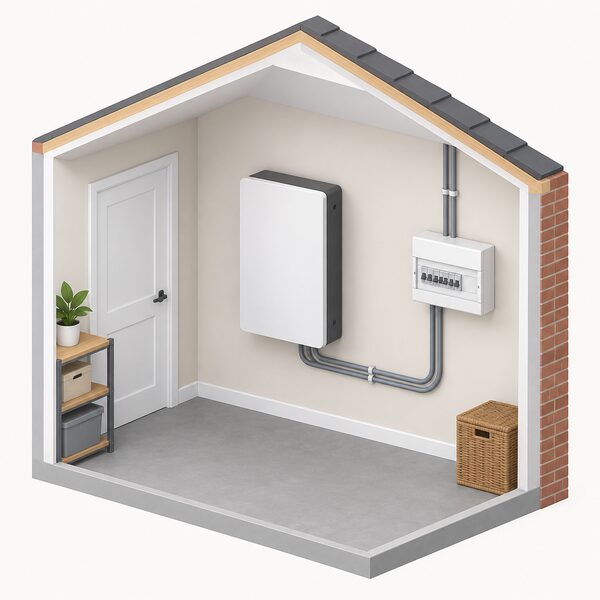
In 2022 Puredrive Energy was granted a licence to manufacture and sell Duracell Energy battery storage systems across the UK and key European territories1. This is a brand licence rather than a change of ownership: the products are made by Puredrive under the Duracell name, and the engineering sits with the British company rather than with the American battery brand.
That distinction matters to a household trying to work out who is actually responsible for the hardware on the wall. A licensed brand can create the impression of a larger parent behind the product than exists. The entity that holds the licence, manufactures the systems and runs the support operation is Puredrive Energy, and the Duracell Energy name is applied to its systems for the territories the licence covers.
The licence has since produced at least one piece of independent validation. On 22 June 2026, EDF and Puredrive Energy announced a three-month trial coordinating around 50 residential Duracell Energy battery systems across England to participate in local flexibility markets from June to August 20261. A trial of that size is small, but it is a network operator and a large supplier working with the hardware in a live flexibility setting rather than a marketing claim.
For owners, the licence has a second implication. Legacy Puredrive-branded systems and newer Duracell Energy-branded systems come from the same maker, so support, spares and the repair network described by the company apply across both. The Duracell Energy home batteries page covers the branded range in more detail.
Specifications: 1C rating, 10,000-cycle warranty and 138 MWh lifetime throughput
The specification claims are where Puredrive's marketing is most specific, and where a household should read carefully. The maker states a 1C rating, described as maximising charging and discharge rates, a 10,000-cycle life described as lasting three times longer than leading brands, and 46 MWh of throughput guaranteed, described as three times more than leading brands1. The 1C figure is a power rating relative to capacity: a battery rated at 1C can in principle charge or discharge its full nominal capacity in one hour, which is a high rate for a domestic unit and matters if the household wants to run heavy loads or charge quickly inside a short off-peak window. The general mechanics are set out at battery power ratings and C-rate.
The comparison table published by the maker puts its own lifetime throughput at 138 MWh against 36 MWh for Tesla, and its lifetime cost at £58.59 per MWh against £134.43 per MWh1. The same table lists Puredrive as supporting both AC and DC coupling while Tesla is listed as AC only, and lists Tesla's charge and discharge power as not applicable1. These are the maker's figures about its own product and a competitor's, published on the maker's own page, and no independent test of either number appears in the material available here.
| Measure | Puredrive Energy | Tesla |
|---|---|---|
| Lifetime throughput | 138 MWh1 | 36 MWh1 |
| Lifetime cost | £58.59 per MWh1 | £134.43 per MWh1 |
| Coupling | AC and DC1 | AC only1 |
| Charge and discharge power | 1C rating1 | Not applicable1 |
Two of those claims are worth separating from the rest. Cycle life and throughput are warranty-shaped numbers: they describe what the maker undertakes to deliver, not what every unit will achieve in every house. The home battery warranties page explains how retained capacity and throughput guarantees are usually written, and the cycle life and degradation page covers what drives the numbers down in practice. The coupling distinction is a real design difference rather than a marketing one, and is explained at AC-coupled and DC-coupled battery systems.
Backup power: what a Puredrive battery can and cannot keep running
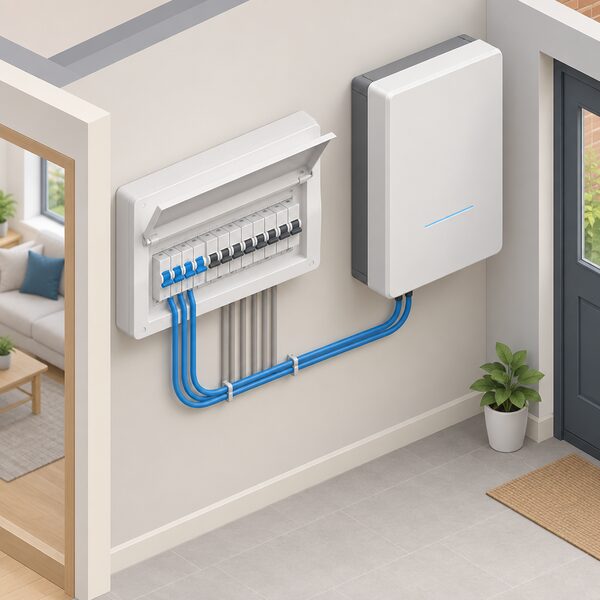
The maker states that its battery technology provides power cut protection with automatic seamless switchover, and adds the condition in the same line: a critical circuit is required1. That condition is the whole story. A backed-up supply in a domestic installation normally feeds a defined set of circuits rather than the whole consumer unit, so what stays live during an outage depends on what the installer wired to it.
Independent guidance is more cautious than the maker's phrasing. Network operator guidance states that in some cases storage devices can provide back-up supplies for use in a power cut, but that this is not always possible and the installer should be checked with2. The same source notes that batteries deliver much more limited electricity than something like pumped storage, which is a reminder that a domestic battery is a small reservoir, not a generator3.
In practice, a household considering backup should establish three things before signing: which circuits are on the backed-up supply, how long the battery can sustain them, and whether the switchover is automatic or manual. The first is a design decision made at installation. The second depends on load and capacity. The third is a property of the specific equipment. Guidance aimed at people who depend on powered equipment makes the same point in plainer terms, advising that the backup battery's duration should be checked4.
The wider subject, including changeover arrangements and what typically stays running, is covered at battery backup power and EPS and at will a battery storage system work during a power cut.
Tariff integration and grid flexibility: charging at the smartest times
A battery earns most of its money by moving cheap electricity into expensive hours, and that is a tariff question as much as a hardware one. The Puredrive Energy app is described by the maker as integrating with all flexible, time-of-use tariffs to optimise battery recharge costs without input from the householder1. That is the maker's claim about its own software.
The underlying mechanism is well established. Independent guidance describes setting a battery to charge when electricity is cheap and discharge when it is expensive5, and notes that a battery can be charged with cheap electricity from a supplier, typically on certain tariffs at night or in the middle of the day6. The same source advises that switching to a time-of-use tariff lets a household charge the battery during off-peak times when electricity is cheap6. Network guidance makes the connection to flexibility explicitly, noting that smart charging can enable the leverage of time-of-use tariffs7.
There is a compatibility trap. Independent guidance warns that some tariffs only work with specific systems, so the tariff has to be checked against the battery before it is signed up to8. A tariff that automates battery management, charging when power is cheapest and exporting in the evening peak, is only useful if the battery is on the supported list9. The same principle appears in the electric vehicle world, where smart charging products schedule charging at the cheapest time based on the household's existing tariff and preferences10.
For energy independence, this is the section where the dependence is most visible. A tariff-integrated battery is more useful and more valuable, but it ties the household to a supplier's tariff design, to a smart meter, and to the maker's app and servers for the automation. The batteries and smart tariffs page sets out how the stacking works, and virtual power plants and flexibility services covers what participation in grid markets involves.
Where Puredrive sits against Tesla on lifetime cost and coupling
The comparison the maker publishes is against Tesla, and it is worth taking apart because it is the clearest statement of how Puredrive positions itself. The table puts Puredrive lifetime throughput at 138 MWh against 36 MWh for Tesla, and lifetime cost at £58.59 per MWh against £134.43 per MWh1. On coupling, Puredrive is listed as AC and DC while Tesla is listed as AC only, and Tesla's charge and discharge power is listed as not applicable1.
Read plainly, the claim is that a Puredrive system will move roughly four times as much energy over its life at roughly half the cost per unit of energy moved. Both halves of that claim come from the same page, published by the company making the comparison, and neither is independently verified in the material available here. A household should treat the direction of the claim as the maker's argument and the specific numbers as the maker's numbers.
The coupling difference is the more concrete of the two. An AC-coupled battery sits alongside an existing solar inverter and can be added to a system that already has panels, while a DC-coupled battery connects on the direct current side and can capture generation that would otherwise be lost in conversion. The trade-offs are set out at AC-coupled and DC-coupled battery systems. A maker offering both is offering a choice of architecture rather than a single fixed design, which matters if the household already has a solar array or expects to add one.
Lifetime cost per MWh is a useful way to compare systems of different sizes, but it depends entirely on the throughput assumption behind it. The battery payback and savings page explains how those calculations are built, and the Tesla Powerwall 3 page covers the competing product on its own terms.
UK design, manufacture and the repair network
Puredrive Energy states that its manufacturing, design, creative and technological back-end is all created and tested in the UK1. It also states that it is the only British manufacturer with an extensive repair network, delivering the best local support across the nation1. Both are maker claims about the maker's own operations, and the second is a superlative that no independent source in the material available here corroborates.
What can be said without qualification is that a domestic repair network is a different proposition from a domestic assembly line. For a household, the question that matters in year eight is who attends when the inverter faults, how long the wait is, and whether a replacement part has to cross a border. A UK-based operation shortens that chain in principle. It does not guarantee a fast response, and it does not remove the dependence on the manufacturer as a company: if the maker's support operation changes, the household's route to a repair changes with it.
The contrast with imported systems is instructive. Independent product information for one large international brand lists manufacturing across Israel, China and the USA11, which is typical of the sector and not a criticism of it, but it does mean spares and service run through international logistics. A UK maker's claim to a local repair network is a claim about that logistics chain being shorter.
"Puredrive Energy is the only British manufacturer with an extensive repair network, delivering the best local support across the nation"
Installation standards apply regardless of where the hardware was made. PAS 63100:2024 covers battery management among the components it addresses for fire protection in domestic battery energy storage12, and the wider framework is set out at the standards governing home battery installation. Siting, ventilation and temperature requirements are covered at ventilation, temperature and operating conditions, and the fire safety picture at home battery fire safety.
Availability: where to buy and who installs
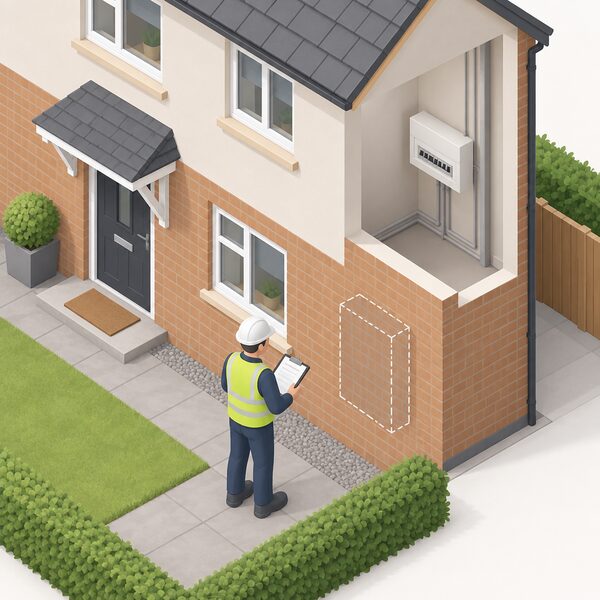
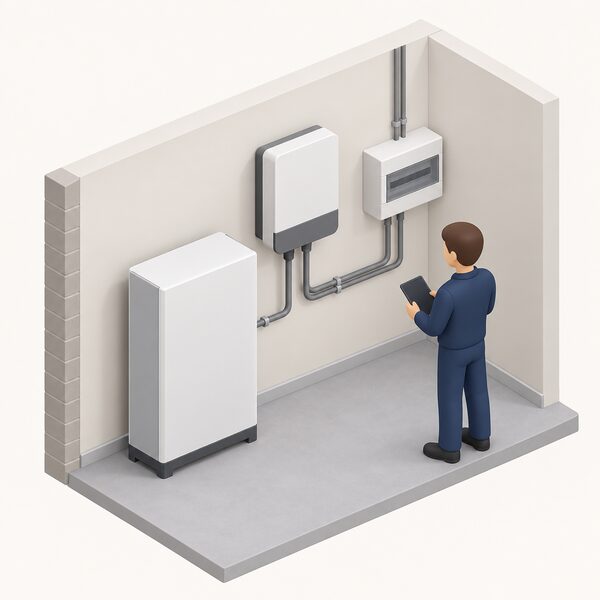
Puredrive systems are sold through UK installers rather than direct to households, which is the normal route for domestic storage and the one that determines what a household actually pays. There is no published manufacturer list price for a Puredrive battery in the material available here, so prices are installer-quoted after a survey. The general cost picture, including what drives a quote up or down, is at how much does a home battery cost in the UK.
The installer route also determines the two things a household cannot easily change later: which circuits are on the backed-up supply, and how the battery is configured against the tariff. Both are decisions made at the survey and handover stage, and both are hard to revisit once the wiring is in. The home battery installation process page walks through survey, fitting and handover, and battery siting and location covers where a unit can physically go.
Two further points bear on availability. First, the Duracell Energy licence covers the UK and key European territories, so the branded range is a UK-market proposition rather than a global one1. Second, the EDF flexibility trial announced in June 2026 drew on around 50 residential Duracell Energy systems across England1, which indicates that the hardware is being installed in volume at least at trial scale, though 50 homes is a small sample against the wider market.
For a household weighing independence, the position is this. A Puredrive battery reduces dependence on imported electricity and on peak-period pricing, and a UK maker with a domestic repair network shortens the service chain. What remains is a dependence on the grid for charging, on a supplier and a tariff for the cheap hours, on the maker's app and servers for the automation, and on the company itself for spares and support over a warranty that runs for years. The home batteries and household energy independence page sets out that balance across the market, and can I have a home battery without solar panels covers the no-solar case.
Sources12 cited
- Puredrive Energy home battery product page, Puredrive Energy, 2026-09-17
- Care and assisted living providers, Energy Networks Association, 2026-09-17
- Storage and renewable energy, Electricity North West
- Tariffs for renewable technology, Energy Saving Trust, 2026-08-12
- Battery storage, Home Energy Scotland, 2026-09-20
- Connecting to the networks: LCT strategy, Energy Networks Association, 2026-09-17
- Time of use tariffs explained, Which?, 2026-04-23
- Smart export guarantee rates, Which?, 2026-04-24
- Zapmap smart charging, Zapmap, 2026
- SolarEdge solar panels review, Which?, 2026-08-12
- Electrical installations: protection against fire of battery energy storage systems for use in dwellings, BSI, 2024-03-20
- What is flexibility, FlexAssure, 2026-09-19