In this guide
A Flow Energy boiler is an orphaned appliance. The company behind it went out of business, and no successor is recorded for its boiler fleet or its warranty obligations. Owners are left with a gas appliance that still heats a home, a Feed-in Tariff accreditation that may still pay, and no manufacturer to call when a part fails.
The technology itself was micro combined heat and power: a gas-fired unit whose primary function is running central heating, with electricity produced as a by-product1. Under the Feed-in Tariff, micro-CHP was eligible up to 2kW of electrical capacity, and the scheme capped the technology at 30,000 eligible installations2. That 2kW ceiling is the honest measure of what a Flow boiler could generate: a small offset against a home's import, not a supply.
What follows sets out what happened to the company, what the appliance was, what owners can still claim, and what the options are now. The wider picture of this technology, including the Stirling engine, internal combustion and fuel cell variants, is covered in micro-CHP types.
Flow Energy entered administration: what happened and what it means for owners
The company is recorded as having gone out of business4. That single fact drives everything else on this page. A failed manufacturer cannot honour a warranty, cannot supply spare parts on commercial terms, and cannot run a service network. The pattern is familiar from other collapses in this lane, and the practical consequence is the same: the household carries the risk.
Where an installer that fitted a faulty installation is no longer trading and the guarantee is missing, fraudulent or cancelled, the National Energy Foundation can consider a complaint8. That is a narrow route and it is not a warranty. It applies to faulty installation work, not to a boiler that has simply reached the end of its life or lost a part.
The wider consumer-protection picture matters here too. Energy market consumer protection has been the subject of parliamentary debate, and the failure of a supplier or installer is exactly the kind of event that leaves households exposed9. For a household, the lesson is structural rather than personal: a heating appliance tied to one company's continued existence carries a dependence that a boiler from a trading manufacturer does not.
What the Flow Energy micro-CHP boiler was and how it worked
A micro-CHP unit resembles a gas-fired boiler and produces electricity from mains gas or LPG10. That description is the clearest short account of the category. The appliance burns gas, drives a generator of some kind, and recovers the waste heat for the heating and hot water circuit. The electricity is a by-product of making heat, not the other way round.
Official guidance is explicit that a CHP unit is gas-fired and that its primary function is to run central heating for the home1. Domestic-sized models are available1. The technology has been in use for some time in Northern Ireland in large scale installations such as hospitals and leisure centres, which is where the economics of combined heat and power have always worked best1. Scaling that principle down to a kitchen wall is what micro-CHP attempts.
The efficiency case rests on the comparison with a conventional boiler. Traditional gas and oil boilers deliver less than one unit of heat per unit of energy, because some energy leaves through the flue11. A micro-CHP unit captures some of that otherwise wasted energy as electricity, so the total useful output per unit of gas rises. That is the whole proposition, and it is a real one.
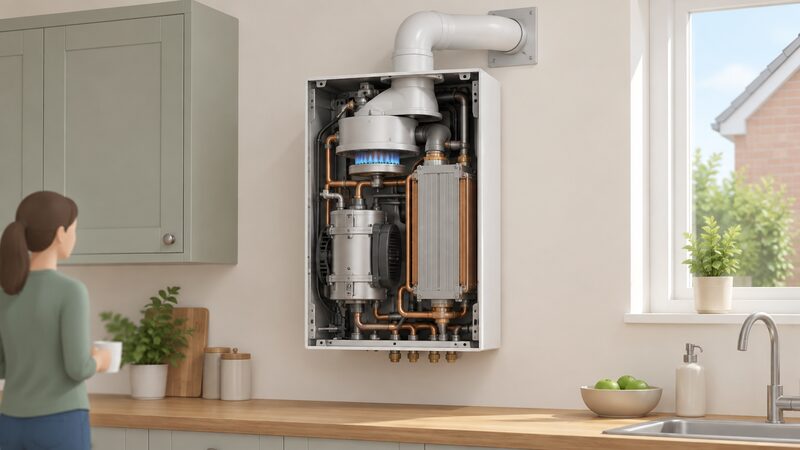
How a micro-CHP boiler differs from a conventional gas boiler
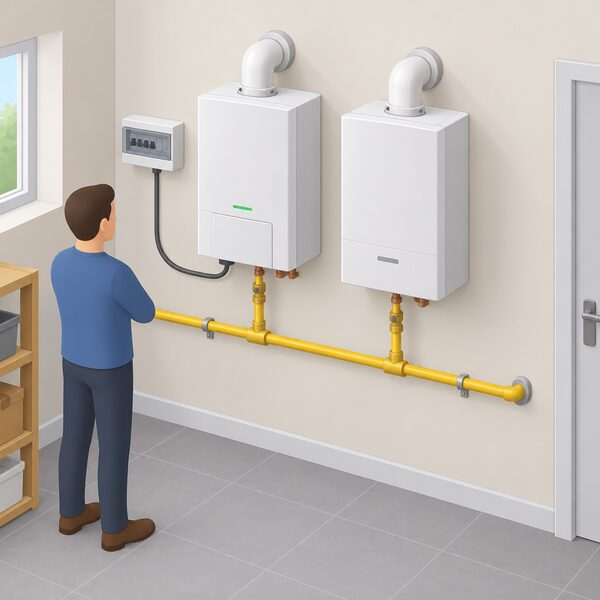
The differences are in what the appliance produces, what it is permitted to emit, and how it is treated by building regulations.
On emissions, the rule is that a micro-CHP unit's heating plant emission rate must be no greater than the emission rate of a regular boiler using the same fuel12. That is a constraint rather than a benefit: the appliance is allowed to be no dirtier than the boiler it replaces, and the electricity is the gain.
On fuel, a micro-CHP unit runs on mains gas or LPG, so it does not change the household's fuel10. A conventional gas boiler also runs on gas. The difference is that the micro-CHP unit displaces some imported electricity, whereas the conventional boiler displaces none.
On regulation, renewable heating measures do not have a separate measure type: the installation of hydronic heat pumps, biomass boilers and fuel cell micro-CHP are included in the boiler measure type13. That matters for grant schemes, because it means a micro-CHP installation is assessed under boiler rules rather than under renewable rules.
| Micro-CHP | Conventional gas boiler | |
|---|---|---|
| Fuel | Mains gas or LPG10 | Mains gas |
| Primary function | Central heating1 | Central heating |
| Electricity output | Yes, as a by-product10 | None |
| Emission constraint | No greater than a regular boiler on the same fuel12 | Baseline |
| Grant treatment | Boiler measure type13 | Boiler measure type |
The practical difference for a household is that a micro-CHP unit keeps every dependence a gas boiler has, and adds a generator that can fail. A comparison of the two approaches is set out in micro-CHP vs a condensing gas boiler.
Specifications and output: heat and electricity generation figures
The published figures for this class of appliance are narrow, and they are the ones that matter.
Under the Feed-in Tariff, fossil fuel-derived combined heat and power was eligible up to 2kW, described in the scheme rules as micro-CHP14. The same 2kW ceiling appears in the scheme's own factsheet15, in the 2013 scheme guidance16, and in the annual report for the scheme's second year, which records micro-CHP with an electrical capacity of 2kW or less, up to a maximum of 30,000 eligible installations3. The 2023 annual report repeats the eligibility statement: generators using solar PV, wind, hydro, anaerobic digestion and fossil fuel-derived combined heat and power were able to apply, subject to eligibility requirements2.
For comparison, the Feed-in Tariff scheme as a whole supported 772 MW of hydro installed capacity by scheme year 132. A single micro-CHP unit at 2kW sits at the opposite end of that scale.
The electrical output is therefore small. A 2kW ceiling is a peak figure for the generator, not a continuous supply, and it is well below the draw of an electric shower or an oven. What the appliance does is reduce the number of units imported from the grid while it is running for heat. The heat output is the appliance's main job, and it is sized like a boiler rather than like a power station.
"Micro combined heat and power (micro-CHP) with an electrical capacity of 2kW or less (up to a maximum of 30,000 eligible installations)"
Cost, installation and the feed-in tariff payments owners relied on
The Feed-in Tariff was introduced on 1 April 2010, and the scheme requires participating licensed electricity suppliers to make payments on electricity generated and exported by accredited installations9. It is funded by a levy paid by electricity suppliers17. That funding structure is why the scheme's closure matters: no new applications are accepted, but installations already accredited continue to receive payments5.
A tariff rate is assigned to an accredited installation based on a number of factors, including technology type, total installed capacity, position in deployment caps, and for solar installations whether the generator is classed as multi-site and whether it meets the Energy Efficiency Requirement18. For a micro-CHP owner, the relevant factors are the technology type and the 2kW capacity.
Two conditions catch owners out. First, payments do not transfer automatically if the FIT licensee paying you has failed6. Second, you cannot receive FIT payments in respect of electricity generated from any additional capacity unless the extension was commissioned before 15 January 20166. A replacement boiler is not additional capacity in the FIT sense, but a household that has had work done should check what was accredited.
The scheme requires participating licensed electricity suppliers to make payments to owners of installations accredited to the scheme for the electricity that their installations generate and export2. The obligation sits with the licensee, not with the manufacturer, which is the one piece of good news for a Flow owner: the collapse of the boiler maker does not by itself end an accreditation.
Servicing, spare parts and repairs after the company ceased trading
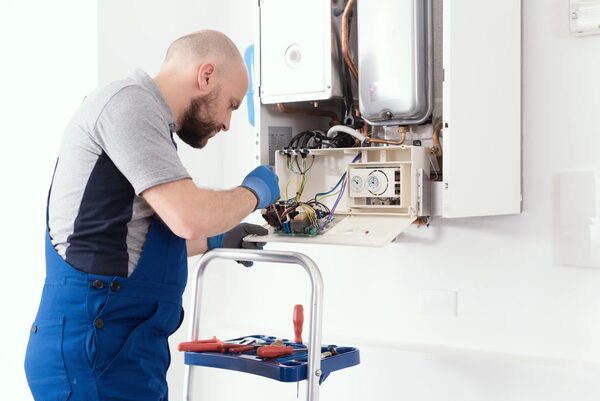
A boiler should be serviced every year by a Gas Safe-registered engineer7. That is independent guidance and it applies regardless of who made the appliance. Annual servicing is also what keeps a warranty valid on appliances that still have one, and it is the main defence against the failures that end an appliance's life early.
The problem for a Flow owner is parts. A manufacturer that has gone out of business does not supply spares, and an independent engineer cannot fit what cannot be bought. Independent boiler repair firms do operate: Boiler Plumbing Installations Ltd, for example, lists boiler repair among its services and states it is fully insured19. Whether any given firm will work on an orphaned micro-CHP appliance is a question for that firm, and the answer will depend on the fault.
The economics are unforgiving. A micro-CHP appliance contains a generator as well as a heat exchanger, so there are more components that can fail than in a conventional boiler, and fewer of them are available. Where a part cannot be sourced, the appliance is beyond economic repair regardless of the condition of the rest of it. Owners should expect that a serious fault will mean replacement rather than repair, and should plan for that cost rather than wait for it.
What existing owners can do now: options for staying warm and independent
The first step is to establish what is actually still claimable. A FIT accreditation is a separate asset from the appliance, and it is worth confirming the accreditation and the payment route directly with Ofgem before assuming either continues6. The second step is to keep the appliance serviced annually by a Gas Safe-registered engineer, because a well-maintained boiler is the cheapest way to defer a replacement7.
When replacement comes, the grant landscape is the thing to check. The Warm Homes: Local Grant permits retrofit hybrids with an existing gas boiler, but only where the existing gas boiler has an energy-related products rating of A or above and is in good working order20. For existing dwellings, at least one of a flue gas heat recovery unit, weather compensation, load compensation, or a smart thermostat with remote access and automation and optimisation is required21. Those conditions are worth reading before any work is specified.
On VAT, the position is uneven. Wood-fuelled boilers qualify for a lower rate of VAT22, and the qualifying energy products list includes central heating and hot water controls, draught stripping, insulation, solar panels, ground-source and air-source heat pumps, micro combined heat and power units, wood-fuelled boilers, and wind and water turbines in Great Britain only23. Energy efficient boilers do not qualify and carry 20% VAT22. A micro-CHP unit appears on the qualifying list, which is a point in its favour at the point of purchase.
For a household whose priority is generating rather than heating, the alternatives are covered in micro-CHP vs an air source heat pump and in the wider microgeneration material on this site.
Micro-CHP in the UK today: is the technology still viable?
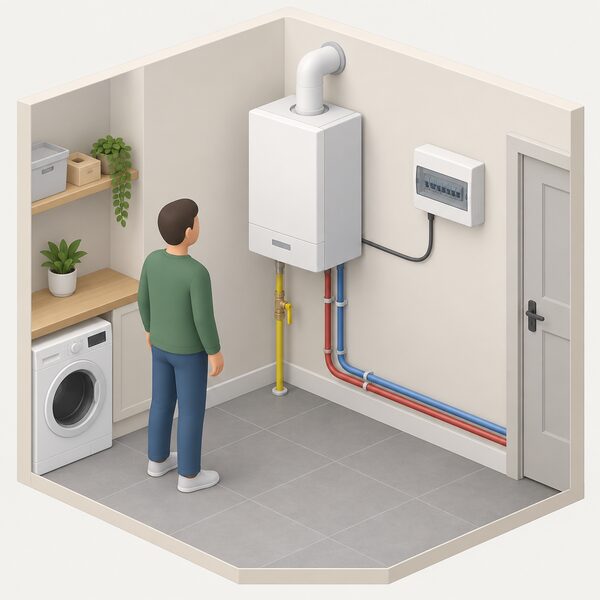
The technology has not been withdrawn from the market in the way some small wind products have. Domestic-sized models are available1, and micro-CHP remains an eligible technology type for the Smart Export Guarantee24. The SEG supports solar photovoltaics, wind, micro-combined heat and power, hydropower and anaerobic digestion, up to 5MW in capacity or up to 50kW for micro-CHP, and installations must be located in Great Britain25. The scheme rules confirm the same ceiling: anyone with an installation of one of the listed technology types up to a capacity of 5MW, or up to 50kW for micro-CHP26.
That 50kW ceiling is a much larger allowance than the 2kW the Feed-in Tariff permitted, which reflects the SEG's different purpose: it pays for exported electricity rather than subsidising generation. Installer certification for micro-CHP, solar PV and wind applies at capacities of 50kW or less27.
The honest assessment for a household is that micro-CHP changes the efficiency of gas use, not the fuel. It keeps the home on mains gas and on a gas supplier, and it adds a dependence on a manufacturer for a more complex appliance. Where that manufacturer fails, as here, the household is left with the appliance and none of the support. Hydrogen boilers are not currently available in the UK28, so the gas appliance route has no near-term fuel change either. Households weighing the trade-offs should look at micro-CHP cost and output and at micro-CHP performance testing and certification before committing.
Sources28 cited
- Micro combined heat and power, nidirect, 2026
- Feed-in Tariffs Annual Report, Scheme Year 13, Ofgem, 2023
- Feed-in Tariffs Annual Report 2011-2012, Ofgem, 2012
- Green Deal and energy company obligation briefing, House of Commons Library, 2026
- Guidance for FIT Generators V18, Ofgem, 2024
- Feed-in Tariffs: FIT generators, Ofgem, 2026
- Getting the best boiler service, Which?, 2025
- Energy Swap, Energy Ombudsman, 2026
- Energy Market Consumer Protection, Hansard, 2026
- Microgeneration planning advice, Scottish Government, 2013
- Ditching costly gas and oil is cheaper thanks to heat pump scheme, GOV.UK, 2022
- Approved Document L, Volume 1: Dwellings, HM Government, 2026
- ECO4 Measures Table v4.0, Ofgem, 2025
- Feed-in Tariffs Guidance for renewable installations V16, Ofgem, 2021
- Feed-in Tariffs factsheet, Ofgem, 2017
- Feed-in Tariff scheme factsheet, Ofgem, 2013
- Feed-in Tariffs scheme, Ofgem, 2026
- Feed-in Tariffs: tariffs and payments, Ofgem, 2026
- Boiler Plumbing Installations Ltd, Which? Trusted Traders, 2026
- Warm Homes: Local Grant policy guidance, HM Government, 2026
- Approved Document L, Volume 1: consultation version, Welsh Government, 2025
- Tax on shopping: energy-saving products, GOV.UK, 2026
- VAT: energy-saving products, HM Revenue and Customs, 2026
- Smart Export Guarantee: generators, Ofgem, 2026
- Smart Export Guarantee, Ofgem, 2026
- Guidance for SEG licensees, Ofgem, 2019
- Sustainable home energy solutions, Planning Portal, 2024
- Public attitudes tracker: heat and energy use in the home, DESNZ, 2026