
In this answer
Short answer
Micro-CHP was eligible for Feed-in Tariff payments, and the rate it received was set in its own technology band rather than borrowed from solar PV. The scheme paid a generation tariff for every kilowatt hour produced and an export tariff for what was sent to the grid, and micro-CHP ran on six monthly tariff periods while solar PV, wind, hydro and anaerobic digestion moved to quarterly periods1.
The scheme itself is closed. It shut to new applications on 1 April 2019, barring some exceptions in response to disruption caused by COVID-19, and no new micro-CHP unit can now be accredited3. What remains is a legacy: installations already accredited continue to receive payments, and micro-CHP carries a maximum eligibility period of 10 years, the shortest support window in the scheme4.
The technology never became a meaningful part of the scheme. Ofgem's quarterly reports exclude micro-CHP from capacity totals because it makes up less than 0.002% of total installed capacity, and the scheme lifetime figure is put at less than 0.01%6. For a household weighing micro-CHP today, the Feed-in Tariff is history rather than an available income stream.
What the Feed-in Tariff was and how it paid generators
The Feed-in Tariff was a government scheme designed to promote the uptake of small-scale renewable and low-carbon electricity generation technologies7. Installations could have a capacity of up to 5 megawatt, or 2 kilowatt for Micro CHP, and generators using solar PV, wind, hydro, anaerobic digestion and fossil fuel-derived combined heat and power were able to apply, subject to eligibility requirements7.
It worked as a levy-funded support mechanism rather than a grant. The scheme was funded by a levy paid by electricity suppliers, and its purpose was to incentivise small-scale production10. For every unit of electricity generated, the supplier paid the generator a certain tariff, which is the mechanism that made the scheme attractive to households: a revenue stream attached to generation rather than a one-off capital payment11.
Payments came in two parts. The generation tariff paid a sum based on the total amount of electricity generated, and the export tariff paid a smaller amount loosely based on how much electricity was exported back to the grid9. The generation tariff was paid for every kilowatt hour produced, whether the owner used it or not, which meant self-consumed electricity earned twice over: once by displacing a purchase and once through the tariff12.
Tariff rates were adjusted each financial year in line with the Consumer Price Index, applying from FIT Year 17, so the value of an accredited installation's payments was indexed rather than fixed in cash terms2. The scheme also had a fuel poverty dimension: the fuel poor who install small scale generation benefit from lower fuel bills as well as a revenue stream from their electricity generation and export13.
Micro-CHP's place in the scheme: less than 0.01% of capacity
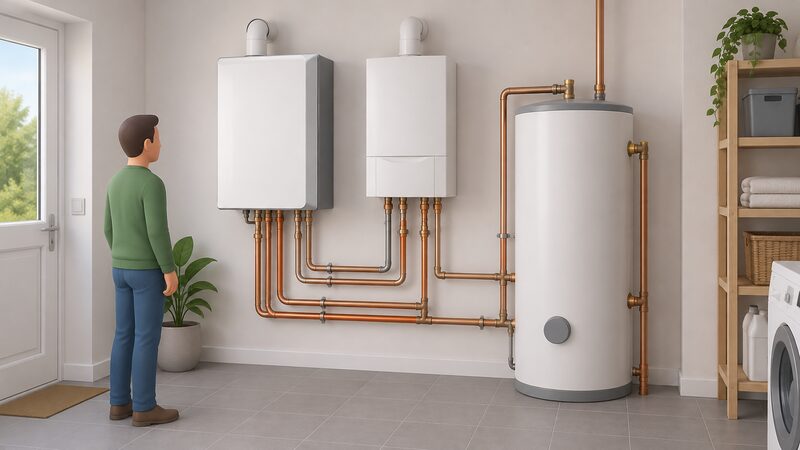
Micro-CHP was a rounding error in a scheme dominated by solar PV. Ofgem's quarterly reporting excludes it from capacity totals because it makes up less than 0.002% of total installed capacity, and the scheme lifetime figure is put at less than 0.01%6. An earlier quarterly report used the same formulation at less than 0.002% of TIC14.
The scale of the scheme overall makes that share stark. Of accredited installations on the scheme, 99.21% are microgenerators, accounting for 53.78% of installed capacity, with the remaining 46.22% coming from larger installations5. Non-domestic commercial installations accounted for only 3.94% of accreditations but contributed 42.52% of capacity5. Micro-CHP sat outside even the microgeneration story: apart from micro-CHP, solar PV installations are on average smaller than installations of other technology types, which is the scheme's own way of noting that micro-CHP units were unusually small relative to other technologies7.
The small share was not for want of budget headroom. Even at full deployment to the previous cap of 30,000 units, mCHP would only occupy 15% of the overall FIT budget, according to a consultation response15. The constraint was deployment, not the cap.
Regional reporting shows the same thinness. For some regions, micro-CHP, anaerobic digestion and hydro figures are not included in the breakdown due to low numbers of the technologies16. Where a technology is too rare to publish by region, it is too rare to shape a national scheme.
How micro-CHP payments were calculated under the tariff
The calculation rested on two components and one unusual timing rule. The generation tariff paid for every kilowatt hour produced, whether used on site or not, and the export tariff paid a smaller amount loosely based on how much electricity was exported back to the grid9. For a micro-CHP unit, which runs when there is heat demand rather than when the sun shines, that generation profile is tied to the heating season.
The timing rule is the distinctive part. Tariff periods for micro-CHP installations are six monthly, against quarterly periods for all solar photovoltaic, wind, hydro and anaerobic digestion installations1. A six monthly period means fewer rate changes across a year and a longer window in which a given rate applies, which matters for a technology whose output is concentrated in winter.
Where capacity changed, the tariff did not follow it down. If generating capacity is reduced, the tariff rate remains as it is and is not recalculated based on the reduction in capacity, for an installation registered on the Central FIT Register17. That protects the rate on a partially decommissioned or derated unit, though the payments themselves fall with output.
The scheme also applied reductions in specific circumstances: the FiT level is reduced by 10 per cent for installations on multiple sites, meaning 25 or more18. That is a multi-site rule rather than a domestic one, but it shows the scheme's rate was not a single flat number applied uniformly.
| Feature | Micro-CHP | Solar PV, wind, hydro, AD |
|---|---|---|
| Tariff period | Six monthly1 | Quarterly2 |
| Capacity limit | 2 kW8 | Up to 5 MW8 |
| Maximum eligibility period | 10 years5 | Varies by technology |
| Payment components | Generation plus export9 | Generation plus export9 |
| Indexation | CPI, from FIT Year 172 | CPI, from FIT Year 172 |
What the FiT legacy means for micro-CHP owners today
For an accredited micro-CHP installation, the scheme still operates. The FIT scheme is now closed to new applications, but still operates for existing arrangements, and closure does not affect installations which are already accredited3. Installations already accredited under the scheme will continue to receive payments, and those who already receive payments under the scheme will continue to do so3.
The support period is the key limit. All micro-CHP installations have a maximum eligibility period of 10 years, shorter than the 20-year period often associated with the scheme5. Ofgem's quarterly reporting has already recorded the consequence: the expired installations are all micro-CHP technology types which are eligible to receive support for 10 years4. Total active accreditations fell slightly in SY12 for the first time due to some micro-CHP installations reaching the end of support7. In other words, micro-CHP units are ageing out of the scheme ahead of the rest of the register.
Switching supplier does not disturb the payments. Your old supplier is required to continue making FiT payments, so the arrangement survives a change of energy supplier21. Payments continue until the end of the initial period, which for micro-CHP is the 10-year maximum eligibility period rather than a 20-year term5.
Accreditation status is checkable. Ofgem's published statistics represent installations that have completed the FIT accreditation process and are on the Central FIT Register, and the installation report is based on installations registered on the Central FIT Register16. A generator can confirm their position through that register and through the supplier administering the payments.
"The expired installations are all micro-CHP technology types which are eligible to receive support for 10 years."
Why micro-CHP was such a small share of the scheme
The short answer is that the technology never reached the deployment the scheme was designed to reward. The Feed-in Tariff was built to incentivise small-scale production, and micro-CHP was eligible from the start, but eligibility is not the same as uptake10.
The numbers show the gap between the two. Micro-CHP is excluded from capacity reporting at less than 0.002% of total installed capacity in the quarterly figures and less than 0.01% across the scheme lifetime6. Even the budget analysis found that at full deployment to the previous cap of 30,000 units, mCHP would only occupy 15% of the overall FIT budget, which suggests the constraint was never money15.
Attrition compounded the thin deployment. In total, 243 micro-CHP installations with a combined capacity of 242.8 kW during SY12 and 83 installations with a combined capacity of 89.1 kW during SY13 became inactive and will no longer be eligible for FIT payments7. Those are small absolute numbers, but they represent a meaningful slice of a technology that never had many accredited units to begin with.
The 10-year support period accelerated the effect. Because all micro-CHP installations have a maximum eligibility period of 10 years, units accredited in the scheme's early years reached the end of support while solar PV installations were still being paid5. Total active accreditations fell slightly in SY12 for the first time due to some micro-CHP installations reaching the end of support7.
For a household considering micro-CHP now, the practical position is that the Feed-in Tariff is not an available route. The scheme closed to new applications on 1 April 2019, barring some exceptions in response to disruption caused by COVID-19, and the successor arrangements for exported electricity sit outside it3. Micro-CHP's economics today rest on the heat and power it produces on site, not on a legacy tariff.
Sources23 cited
- Feed-in Tariffs: deployment caps reports, Ofgem, 2026
- Feed-in Tariffs: scheme closure, Ofgem, 2026
- Guidance for FIT Generators V18, Ofgem, 2024
- Feed-in Tariffs Quarterly Report Issue 64, Ofgem, 2026
- FIT Annual Report Scheme Year 14, Ofgem, 2024
- Feed-in Tariffs FIT Quarterly Report Issue 63, Ofgem, 2026
- Feed-in Tariffs Annual Report Scheme Year 13, Ofgem, 2023
- Feed-in Tariffs FIT generators, Ofgem, 2026
- Can I switch energy supplier if I have solar panels?, Uswitch, 2026
- VAT Fuel and Power VFUP4400, HM Revenue & Customs, 2026
- Renewable Energy Consumer Code: consumers, RECC, 2026
- Helms Home Energy complaints, Citizens Advice Scotland, 2026
- Energy and Climate Change Committee report, UK Parliament, 2011
- Feed-in Tariffs FIT Quarterly Report Issue 59, Ofgem, 2025
- HHIC response on micro-CHP, HHIC, 2026
- Feed-in Tariffs quarterly statistics, Ofgem, 2026
- Guidance for suppliers V14, Ofgem, 2021
- UK Solar PV Strategy Part 2, UK Government, 2014
- Feed-in Tariffs, Ofgem, 2026
- Microgeneration energy guide, Uswitch, 2026
- Feed-in Tariff guide, Uswitch, 2026
- Feed-in Tariff Installation Report 30 June 2026, Ofgem, 2026
- Micro combined heat and power, Energy Saving Trust, 2022
 Solar Export PaymentsIf you have solar panels, how do you actually get paid for the electricity you send back to the grid?
 Micro-CHP TypesWhich type of micro-CHP actually gets fitted in UK homes, and how much electricity does one make while it heats your house?
 The Full Tariffs GuideWhich energy tariff suits how you live, and will switching really save you money?
 Micro-CHP Performance TestingHow well a micro-CHP boiler performs in your home decides what you get paid and what you save.
 Solar and Battery Import TariffsWhat does a special import tariff actually get you when you have solar panels or a home battery?
 Micro-CHP Cost and OutputDomestic micro-CHP costs more than a conventional boiler and produces roughly 1kW of electricity alongside its heat.