
In this guide
The Fox ESS PowerQ is a modular, stackable home battery system sold in seven sizes, from 7.94 kWh at two battery modules to 27.79 kWh at seven1. Continuous power runs from 3.8 kW on the smallest configuration to 11.4 kW on the largest, and the maker's datasheet gives CEC efficiency of 95.5 to 97.5% depending on model1. The stated warranty is 12.5 years1.
It is a high-voltage system rather than a low-voltage one, and it is built to be expanded in place: each stack is made up of one master module and additional slave modules, so capacity can be added later without replacing what is already there2. Fox ESS describes the PowerQ as compatible with its own range of high-voltage batteries, which keeps the household inside one maker's ecosystem for both the battery and the inverter that controls it3.
For a household weighing energy independence, the PowerQ does two things. It shifts when grid electricity is bought, storing cheap or self-generated power for use later, and on the larger configurations it can hold enough to run parts of a home through an outage. What it does not do is remove the grid, the supplier or the manufacturer's cloud platform from the picture, and the sections below set out where each of those dependencies sits.
What the PowerQ is: a modular all-in-one battery system
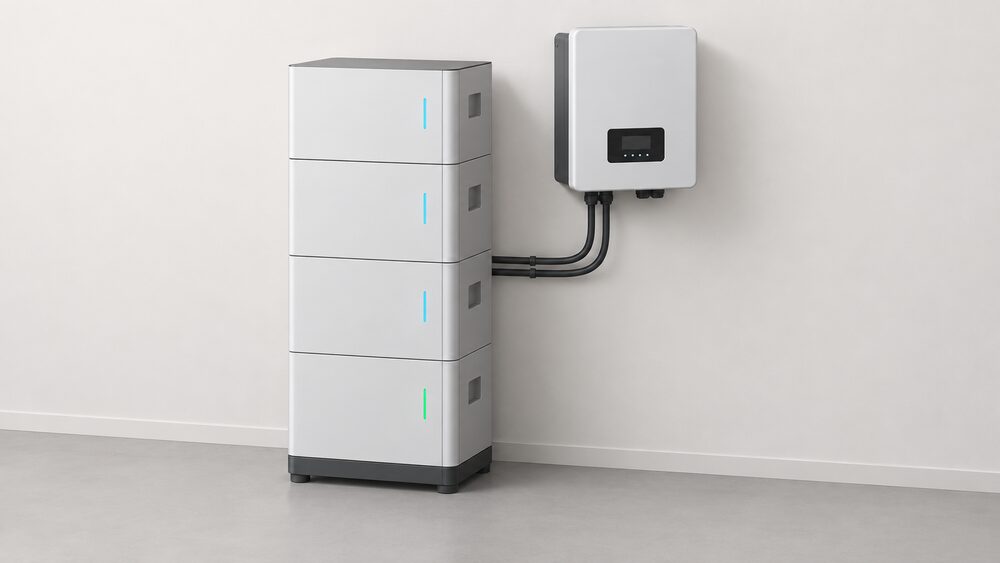
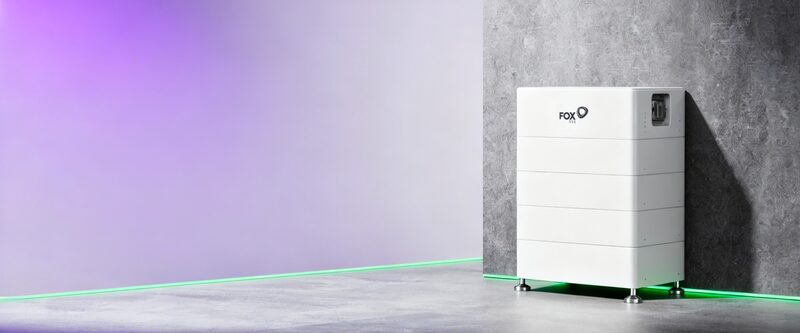
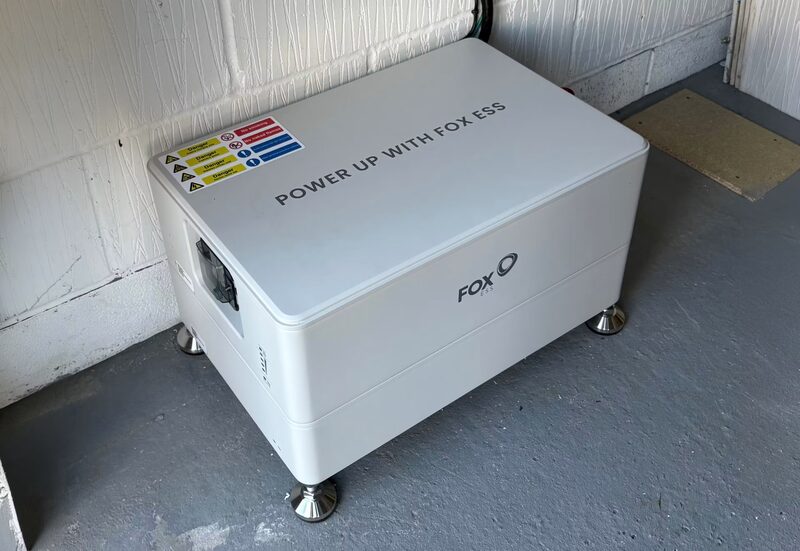
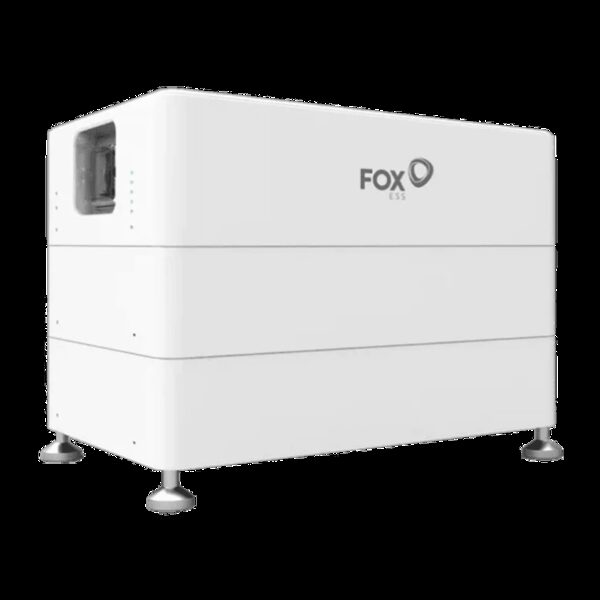
The PowerQ sits in Fox ESS's residential storage line as a floor-standing, modular battery rather than a wall-mounted single box. The maker describes the wider EQ battery range as a modular, high-voltage battery range for residential energy storage systems, using a floor-mounted modular design2. The PowerQ follows that pattern: modules stack vertically on the floor, and the system grows by adding modules rather than by adding separate enclosures.
Fox ESS states that every model in its battery range uses lithium iron phosphate cells, supports modular expansion, and is engineered for straightforward installation4. Lithium iron phosphate, usually shortened to LFP, is the chemistry most home batteries sold in the UK now use, and it is covered in more detail in home battery chemistries. The modular approach is the subject of modular and stackable battery systems, and the PowerQ is a clear example of the type.
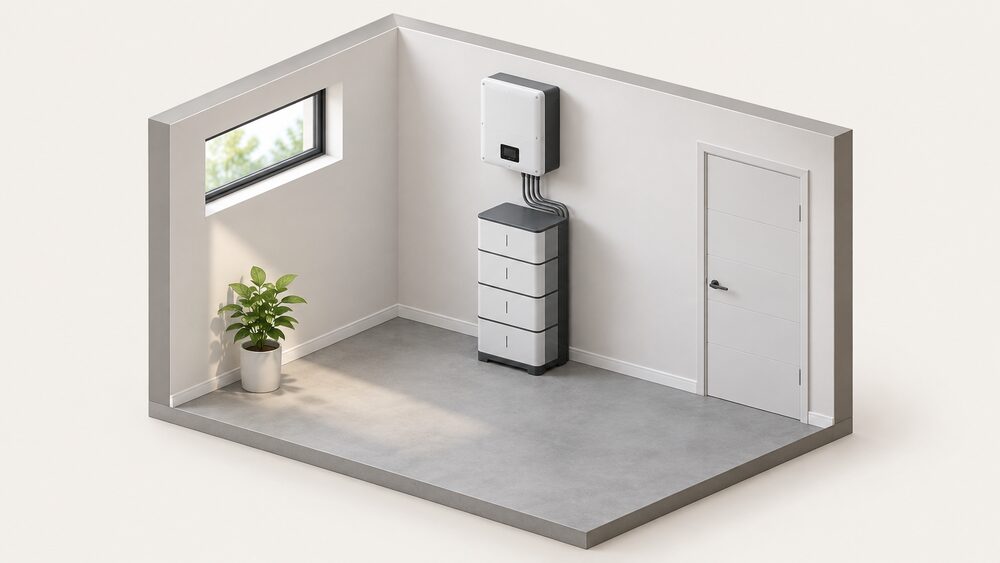
The "all-in-one" label needs care. The PowerQ is a battery system with its own management electronics, not a unit that also contains the solar inverter. In a Fox ESS installation the inverter is a separate box, and the PowerQ pairs with it. Fox ESS hybrid inverters are listed as pairing with Fox ESS high-voltage batteries including the EP, EQ and CQ ranges5. That is a different arrangement from a true all-in-one such as the GoodWe ESA series, where inverter and battery share one enclosure.
The practical consequence is that a PowerQ installation has at least two pieces of equipment to site, and the inverter determines what the battery can do: how much solar it can take in, how fast it can charge, and what backup output is available. The battery's own figures describe the battery, not the finished system.
Modular capacity: 7.94 to 27.79 kWh in seven sizes
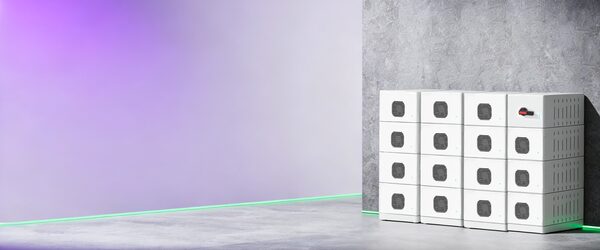
The published PowerQ configurations run in a clear ladder. Two modules give 7.94 kWh, three give 11.91 kWh, four give 15.88 kWh, five give 19.85 kWh, six give 23.82 kWh and seven give 27.79 kWh1. Each stack consists of one master module and additional slave modules, and additional modules can be installed in series, with capacity varying by model and the number of modules used2.
| Modules | Total energy | Weight (total) | Height |
|---|---|---|---|
| 2 | 7.94 kWh | 128.3 kg | 848 mm |
| 3 | 11.91 kWh | 165.2 kg | 986 mm |
| 4 | 15.88 kWh | 202.1 kg | 1124 mm |
| 5 | 19.85 kWh | 239 kg | Not stated |
| 6 | 23.82 kWh | 275.9 kg | Not stated |
| 7 | 27.79 kWh | 312.8 kg | Not stated |
All figures from the maker's PowerQ datasheet1. Width is 570 mm and depth 380 mm across the sizes where dimensions are given1.
Two things are worth separating here. The first is nominal capacity, which is what the datasheet's total energy column states. The difference between the two is explained in battery capacity and usable capacity. The PowerQ datasheet gives nominal totals; a household comparing it with another brand should check that both figures are quoted on the same basis.
For scale, the range spans a small flat's overnight demand at the bottom and a large, high-consumption home at the top. Sizing depends on how much the household uses, when it uses it, and whether there is solar to charge from, which is set out in what size home battery you need.
Continuous power and backup output: 3.8 to 11.4 kW
Continuous power is the figure that decides what the battery can actually run. The PowerQ datasheet gives maximum continuous power of 3.8 kW, 5.7 kW, 7.6 kW, 9.6 kW and 11.4 kW across the model range1. The smallest and largest of those are the ends of the ladder; the middle figures sit between them.
Backup output is a separate and lower number. The datasheet gives maximum output power without PV of 3.8 kW on the 3.8 kW model and 5.76 kW on the 11.4 kW model1. That is the power available when the grid is down and there is no solar coming in, and it is the figure that matters in a power cut rather than the headline continuous rating.
Fox ESS sells a dedicated gateway for this purpose. The EPS-BOX-SP is described as a single-phase whole-home backup gateway designed to provide emergency power during grid outages, and it is listed as working with H1-G2, KH, EVO and PowerQ inverters7. Without a gateway of that kind, a battery may still be able to run a dedicated circuit, but whole-home backup is a wiring decision made at installation. The options are set out in battery backup in a power cut and do I need a backup interface.
The power figures also govern how much can be drawn at once. A 3.8 kW continuous rating will run a typical home's base load and some appliances, but not an electric shower, an oven and a heat pump together. The relationship between kW, capacity and discharge rate is covered in battery power ratings and C-rate.
Efficiency: 95.5 to 97.5% depending on model
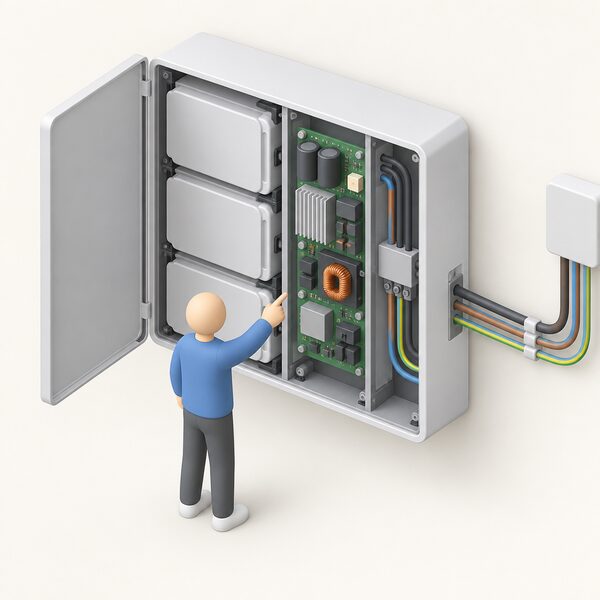
The PowerQ datasheet quotes CEC efficiency of 97.5% on the 11.4 kW model, 97.0% on the 5.7 kW model, 96.5% on the 5.7 kW AC model, 96.0% on the 3.8 kW model and 95.5% on the 3.8 kW AC model1. CEC efficiency is a weighted figure that reflects performance across a range of operating conditions rather than at a single best point, which is why it reads lower than a peak efficiency number.
Those figures describe the conversion electronics, not the round trip through the battery cells. A household's real round-trip efficiency, the share of stored energy that comes back out, is lower than any of these numbers because charging and discharging both lose energy. That distinction is the subject of round-trip efficiency and standby losses.
For context within the same maker's range, Fox ESS quotes maximum efficiency of 97.08% on its H1-3.7, H1-5.0 and H1-6.0 G2 hybrid inverters, with European efficiency of 95.70% on the 3.7 kW unit and 96.33% on the 6.0 kW unit8. The KH/KA hybrid inverter is listed at 97.80% maximum efficiency and 97.40% European efficiency, with MPPT efficiency of 99.90%9. These are inverter figures and are not directly comparable with the PowerQ's CEC numbers, but they show the band the maker works in.
Efficiency is not the main driver of household savings. How the battery is charged and discharged, and against which tariff, matters more, which is covered in stacking a home battery with smart tariffs.
Physical size, weight and where it can go
The PowerQ is a floor-standing unit, and its footprint is fixed while its height grows with the number of modules. Width is 570 mm and depth 380 mm across the sizes where dimensions are published, with height of 848 mm at two modules, 986 mm at three and 1124 mm at four1.
Weight is the constraint that shapes installation. A two-module stack totals 128.3 kg, rising to 165.2 kg at three modules, 202.1 kg at four, 239 kg at five, 275.9 kg at six and 312.8 kg at seven1. A seven-module stack at 312.8 kg is not a unit one person moves, and it needs a floor that can take a concentrated load.
The operating temperature range is -10 to +55 degrees C1. For comparison, the Fox ESS EQ4800 battery module is listed with a discharge range of -10 to 55 degrees C, the CQ7 module carries the same pattern of ratings10, and the KH/KA hybrid inverter is listed at -25 to +60 degrees C with derating at +459. The Q Series is listed at -25 to +60 degrees C11 and the P3 Plus at -30 to 60 degrees C12.
A stated range is not a recommendation to install at its edges. Siting, ventilation and clearance requirements are covered in where a home battery can be installed and ventilation, temperature and operating conditions.
Monitoring and control: app, website, LED and connectivity
The PowerQ datasheet lists its display and control routes as LED, app and website1, and the maker states the system can be monitored remotely via smartphone app or web portal3. Fox Cloud is the platform behind that: Fox ESS describes it as an online platform to monitor real-time performance, review historical data, and adjust settings such as charge and discharge schedule, available via web browser and syncing with the Fox ESS app2. The FoxCloud app is described as putting smart energy management at hand, for monitoring and controlling home energy usage and tracking production and consumption13.
The same pattern runs across the maker's other products. The H1 and AC1 G2 inverters are listed with LCD, app and website display and remote monitoring via smartphone app or web portal14, and the P3-S is listed with remote monitoring via smartphone app or web portal15. The M Series microinverter is listed the same way16.
This is where the clearest dependence in the system sits. Local indication at the unit continues without a network connection, but scheduling from elsewhere, historical data and remote diagnostics run through a home broadband connection, Fox ESS's servers and the maker's app. If the platform changes, or the household's connection drops, remote control goes with it. The wider question of what stays available locally is covered in monitoring a home battery: apps, data and local access.
For households that want control outside the maker's platform, third-party tools exist. EmonEVSE, an open-hardware energy monitoring unit, offers energy monitoring, a web-app interface, real-time solar PV diversion, Emoncms data logging and an HTTP/MQTT developer API17. That is a separate product, not part of the PowerQ, but it illustrates the alternative route.
Warranty: 12.5 years and what it covers
The PowerQ datasheet states a warranty of 12.5 years1. That is longer than the terms Fox ESS publishes for some of its other battery products: the EQ battery range is listed with a 12 year warranty2, and the EQ/CQ range is listed at 12 years with the EQ4800 excluded5. The EP6 is listed at 10 years or 6,000 cycles18.
| Product | Stated warranty |
|---|---|
| PowerQ | 12.5 years1 |
| EQ battery range | 12 years2 |
| EQ/CQ range (excludes EQ4800) | 12 years5 |
| EP6 | 10 years / 6,000 cycles18 |
A warranty term on its own says little. What matters is what it guarantees: whether it covers a retained capacity percentage, a throughput limit in megawatt hours, or simply replacement of failed parts, and what conditions void it. Those distinctions are set out in home battery warranties, and the degradation side is covered in cycle life and degradation.
For comparison across the market, other makers publish different terms. Pylontech lists the Force H3 with a usable capacity of 34.01 kWh in a seven-module configuration19, Growatt describes its ARK system as taking three to ten modules in series to form a 7.68 to 25.6 kWh system20, and GoodWe describes its ESA 3-10K as scalable from 5 to 48 kWh per system with up to six modules per stack21. Warranty terms vary between these products, and the PowerQ's 12.5 years is at the longer end of what is published.
UK availability and price: from around £3,277 + VAT
There is no manufacturer list price for the PowerQ. The figures that exist are distributor prices, and they disagree. One distributor lists the Fox ESS PQ series from £3,277.00 plus VAT, and another lists a supply package from £3,285.00 plus VAT, with a further listing at £3,298.00 plus VAT23. The documents do not resolve which applies, so all three should be read as indicative starting points for a supply-only price rather than as a settled figure.
For scale on what a battery costs in the UK, other distributor listings give a sense of the market. A BLUETTI Apex 300 with B300K is listed at £2,898.0024. These are different products with different capabilities, and the comparison is only about order of magnitude.
The cost of a battery is not the same as its value to a household. Payback depends on the tariff, the household's consumption pattern and whether there is solar to charge from, which is worked out in home battery savings and payback and how much does a home battery cost. The VAT treatment of home battery storage is covered in the VAT rate on home battery storage.
Where the PowerQ sits against other modular systems
The PowerQ is one of several stackable systems sold in the UK, and the differences between them are mostly about capacity range, module size and how the stack is built.
| System | Stated capacity range | Module structure |
|---|---|---|
| Fox ESS PowerQ | 7.94 to 27.79 kWh1 | 2 to 7 modules, one master plus slaves2 |
| Fox ESS EQ range | EQ2900 2.88 kWh, EQ4300 4.32 kWh, EQ4800 4.66 kWh, CQ7 7.02 kWh5 | Stacked floor-mounted modules5 |
| Fox ESS EP6 | 5.76 kWh per unit, modular up to 23.04 kWh in four units18 | Four units maximum18 |
| Fox ESS CQ7 | 7.02 kWh per module10 | Larger stack ceiling10 |
| Pylontech Force H3 | 34.01 kWh usable in seven-module configuration19 | Seven modules19 |
| Growatt ARK | 7.68 to 25.6 kWh from 3 to 10 modules20 | 3 to 10 modules in series20 |
| GoodWe ESA 3-10K | 5 to 48 kWh per system, up to 6 modules per stack21 | Up to 6 modules per stack21 |
The PowerQ's ceiling of 27.79 kWh sits below the CQ7's stated maximum and below the GoodWe ESA's upper figure, and above the EP6's four-unit limit. Within the Fox ESS range, the choice between PowerQ, EQ and CQ7 comes down to how much capacity is wanted and how the stack is configured rather than to a difference in chemistry, since the maker states that every model in its battery range uses lithium iron phosphate cells4.
The wider field of stackable systems is covered in modular and stackable battery systems, and the Fox ESS range as a whole in Fox ESS home batteries and hybrid systems.
What the PowerQ means for household independence
A PowerQ changes when a household buys electricity, and on the larger configurations it can change what happens when the grid fails. It does not change where the electricity comes from. The battery charges from the grid, from solar, or both, and it discharges into the home. The grid connection, the electricity supplier and the meter all remain.
The dependencies that remain are specific. The battery needs an inverter from the same maker's ecosystem to work as designed, since Fox ESS lists its hybrid inverters as pairing with its own high-voltage batteries5. Remote monitoring and scheduling run through Fox Cloud and the Fox ESS app2, so those functions depend on broadband and on the maker's platform continuing. Backup depends on how the installation was wired, and on a gateway such as the EPS-BOX-SP if whole-home backup is wanted7. Independent guidance is clear that backup is not guaranteed by the presence of a battery alone6.
What the household gains is control over timing. Stored energy can be drawn during peak tariff periods, and solar generation can be used in the evening rather than exported at a lower rate. That is a real shift in how a home buys power, and it is the mechanism behind most battery savings. The wider picture, including what full self-sufficiency would require, is covered in home batteries and household energy independence and how much self-sufficiency a solar home battery can achieve.
Sources24 cited
- US PowerQ datasheet V1.1, Fox ESS, 2024-11-12
- EQ battery range, Fox ESS UK, 2026-09-17
- PowerQ hybrid inverter product page, Fox ESS, 2026-09-17
- Energy storage battery buying guide, Fox ESS, 2026-09-17
- KH/KA series hybrid inverter, Fox ESS UK, 2026-05-28
- Renewable energy storage, Electricity North West, 2026-09-19
- Whole home backup gateway, Fox ESS UK, 2026-04-07
- H1 G2 WL datasheet V1.1, Fox ESS, 2025-11-24
- KH/KA datasheet V2.4, Fox ESS, 2026-06-09
- CQ7 datasheet V1.0, Fox ESS, 2026-01-30
- Q4 datasheet V1.0, Fox ESS, 2025-05-15
- P3 Plus datasheet V1.0, Fox ESS, 2025-12-29
- FoxCloud, Fox ESS, 2026-09-17
- H1 G2 datasheet V2.0, Fox ESS, 2025-09-12
- P3-S datasheet V1.0, Fox ESS, 2025-12-29
- M Series microinverter, Fox ESS, 2026-09-17
- EmonEVSE overview, OpenEnergyMonitor, 2026-09-17
- Fox ESS battery range, SO Energy, 2026
- Force H3, Pylontech, 2026-09-17
- Growatt ARK 7.68 kWh battery kit, Growatt, 2026-09-17
- GoodWe 3kW all-in-one ESA hybrid inverter, Alternergy, 2026-09-17
- GoodWe all-in-one ESA 5.12kWh battery module, Alternergy, 2026-09-17
- Fox ESS PQ series supply listings, E.ON Next, 2026-09-19
- Apex 300 price list, BLUETTI UK, 2026-09-19
 Fox ESS Home Batteries and Hybrid SystemsFox ESS is the brand most UK installers now fit, so what do you actually get?
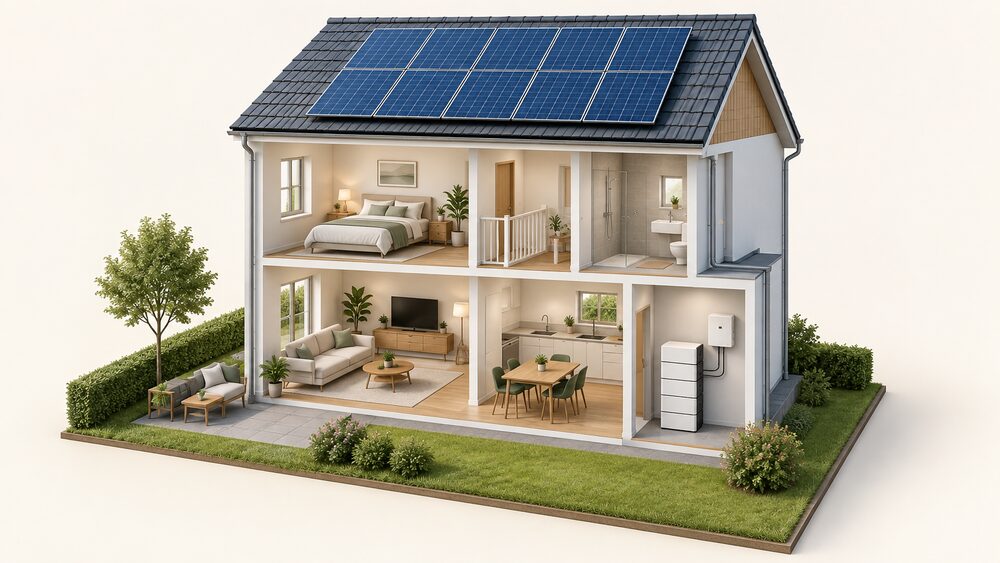 Fox ESS inverters and home batteriesFox ESS is behind more home batteries in the UK than any other brand, so plenty of people want to know if it is any good and what it costs to have fitted.