In this guide
Fox ESS is a Chinese manufacturer of solar inverters, home batteries and EV chargers, and it is now the brand most commonly fitted in UK homes: the company states that it has been ranked number one in the UK among residential energy storage providers for 2025 based on MWh shipments, and that independent verification by SunWiz places it as the UK's number one brand by volume for both inverters and energy storage systems1. It also states that data from S&P Global Insights puts its UK market share at more than 35% of the domestic solar and storage sector2.
For a household, that matters less as a boast than as a practical fact. A brand with a large installed base has more trained installers, more spare parts in circulation and more people who have seen the faults before. What it does not change is the underlying arrangement: a Fox ESS battery stores electricity you have generated or bought cheaply, and it keeps you connected to the grid, to a supplier and, for monitoring and remote control, to the manufacturer's cloud platform.
The range is built around high-voltage batteries paired with hybrid inverters, with capacities from 7.94 kWh up to 27.79 kWh in the PowerQ line and a 12.5 year warranty figure on the PowerQ datasheet3. Prices are installer-quoted, with distributor listings for a PQ Series hybrid inverter and EQ5000 battery package starting at £3,277 plus VAT5.
What Fox ESS makes: batteries, hybrid inverters and EV charging
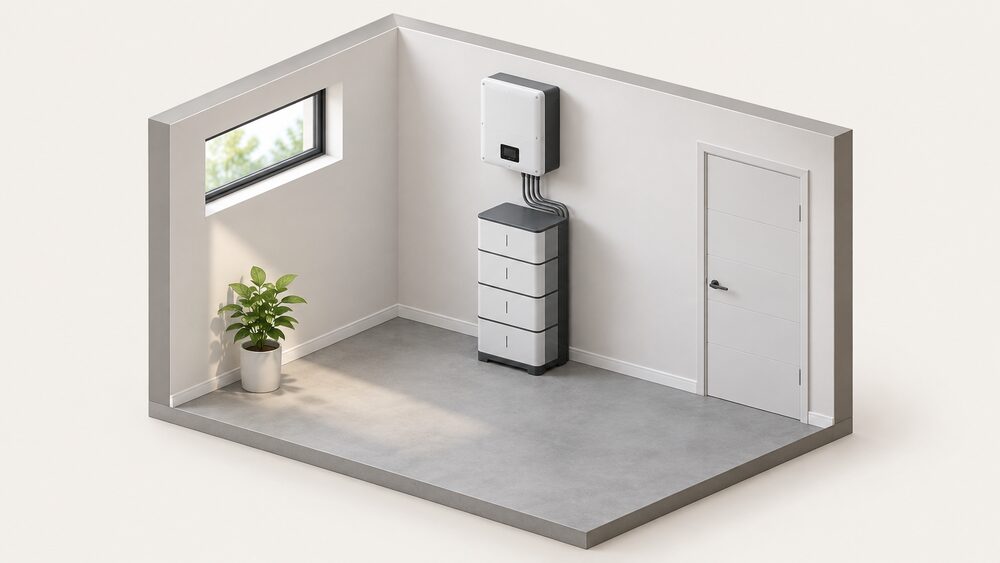
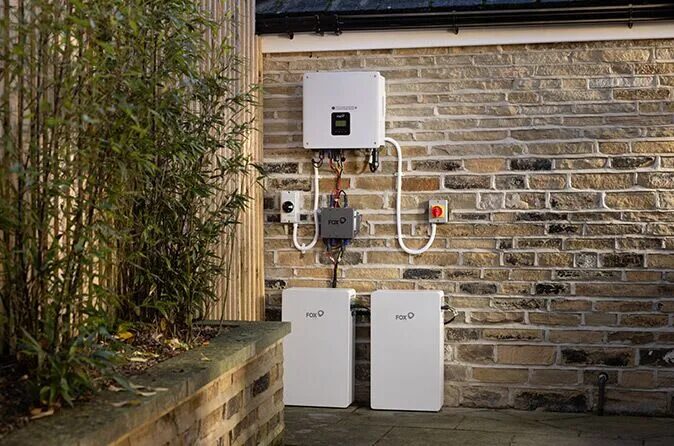
Fox ESS describes itself as a developer of advanced solar inverters, battery storage solutions and EV charging technologies6. In practice the three parts fit together as one system. The inverter converts solar to AC, manages the batteries and powers backup or off-grid circuits, and it is compatible with the company's own range of high-voltage batteries3. The batteries are lithium iron phosphate units for residential solar storage, and every model in the range uses those cells, supports modular expansion and is engineered for straightforward installation7.
The battery families sold in the UK are the EP, EQ and CQ ranges. The EP range comes in two models, the EP6 at 5.76 kWh and the EP12 at 11.52 kWh, and provides a total storage capacity of up to 23.04 kWh or 46.08 kWh depending on configuration5. The EQ and CQ ranges include the EQ2900 at 2.88 kWh, the EQ4300 at 4.32 kWh, the EQ4800 at 4.66 kWh and the CQ7 at 7.02 kWh5. Every model in the range uses lithium iron phosphate cells, supports modular expansion, and is engineered for straightforward installation, so capacity grows by adding modules rather than by replacing the system8.
The hybrid inverters are the KH and KA series, which pair with the EP, EQ and CQ battery ranges and are described as smart tariff compatible5. The PowerQ is a newer hybrid inverter line, compatible with the company's high-voltage batteries9. On the charging side, Fox ESS makes smart, solar-ready chargers for home and workplace use that integrate into the same energy ecosystem2.
The Evo is the all-in-one option, combining the inverter and the battery in a single unit with an integrated 10.24 kWh battery and inverter options of 5, 8 and 10 kW10. It can be installed with or without solar, carries an IP66 rating, a 12 year warranty and a 95% depth of discharge, and it scales to more than 30 kWh across three units10. The first generation expands by installing full Evo units in parallel through an energy management system, while the second generation, due in autumn 2026, adds a battery expansion port for up to two additional Evo units10.
Market position: No.1 in the UK and first globally
The company's own account of its position is unusually specific, and it is worth separating what is independently verified from what is self-reported. Fox ESS states that SunWiz independently verified it as the UK's number one brand by volume for both inverters and energy storage systems, and that it ranks second globally for residential energy storage shipments2. It also states that S&P Global Energy's Residential Energy Storage Market Tracker ranked it number one globally among residential energy storage providers in 2025 based on MWh shipments, and that InfoLink Consulting's 1H26 global ESS shipment rankings placed it first among residential ESS suppliers4.
The UK-specific claim is repeated across the company's pages: number one in the UK among residential energy storage providers for 2025 based on MWh shipments, and number one globally and in Germany on the same basis1. A separate company page describes it as a global brand and the UK market leader11.
Two things are worth holding in mind. First, all of these rankings are the manufacturer's own reporting of third-party trackers, not the trackers themselves. Second, shipment volume measures how much product went out of the door, not how well it performs in a house. The independent context is that residential battery storage in the UK is projected to reach 0.8 GW of annual installation by 2035, so the market this brand leads is still growing12.
"Fox ESS has been independently verified by SunWiz as the UK's No.1 brand by volume for both inverters and energy storage"
PowerQ: capacities from 7.94 to 27.79 kWh and continuous power up to 11.4 kW
The PowerQ is the line with the fullest published specification, and it is modular: capacity is set by how many battery modules are stacked. The datasheet gives total energy of 7.94 kWh with two modules, 11.91 kWh with three, 15.88 kWh with four, 19.85 kWh with five, 23.82 kWh with six and 27.79 kWh with seven4. The same document lists scalability of 4, meaning the system can be expanded in steps rather than replaced4.
Continuous power varies with the model rather than the module count. The US1H-11.4-EQL2 delivers a maximum continuous power of 11.4 kW, while the US1H-7.6-EQL2 delivers 7.6 kW4. Solar input also scales: the US1H-3.8-EQL2 accepts a maximum solar STC power of 7.6 kW, and the US1H-9.6-EQL2 accepts 19.2 kW4.
For a household, the capacity range covers the realistic spread of UK demand. A two-module 7.94 kWh unit suits a flat or a small house with modest evening use; a five to seven module stack at 19.85 to 27.79 kWh suits a larger home with a heat pump or an electric vehicle, where the battery is being asked to carry most of the day's load. The continuous power figure matters separately: a battery with plenty of stored energy but a low power ceiling cannot run an oven, a shower and a car charger at the same time.
| Configuration | Total energy | Max continuous power |
|---|---|---|
| US1H-3.8-EQL2 (2 modules) | 7.94 kWh | 7.6 kW4 |
| US1H-3.8-EQL3 (3 modules) | 11.91 kWh | Not stated4 |
| US1H-3.8-EQL4 (4 modules) | 15.88 kWh | Not stated4 |
| US1H-3.8-EQL5 (5 modules) | 19.85 kWh | Not stated4 |
| US1H-3.8-EQL6 (6 modules) | 23.82 kWh | Not stated4 |
| US1H-3.8-EQL7 (7 modules) | 27.79 kWh | Not stated4 |
| US1H-11.4-EQL2 | Not stated | 11.4 kW4 |
PowerQ specifications: efficiency, weight, IP rating and operating limits
The PowerQ datasheet gives CEC efficiency figures that vary by model: 97.0 for the US1AC-9.6-EQL2, 96.5 for the US1AC-5.7-EQL2 and 95.5 for the US1AC-3.8-EQL2 on the AC side, and 97.5 and 96.0 for the US1H-11.4-EQL2 and US1H-3.8-EQL2 respectively on the PV side4. CEC efficiency is a US test standard, so these are not directly comparable with the European round-trip figures quoted for other brands, but they indicate conversion losses in the low single digits.
The enclosure rating on the PowerQ is Type 4X, a US classification roughly equivalent to a weather-resistant outdoor rating4. The EQ battery range carries IP65, as does the EP range, which means protection against dust and water jets7. The EQ range uses natural convection cooling, so there is no cooling fan to fail or to make noise7. The PowerQ datasheet gives a CEC efficiency of 97.0 for the US1AC-9.6-EQL2, 96.5 for the US1AC-5.7-EQL2 and 95.5 for the US1AC-3.8-EQL2, with PV efficiency of 96.0 on the US1H-3.8-EQL2 and 97.5 on the US1H-11.4-EQL24.
Operating limits are the part households most often overlook. Fox ESS states that the supported capacity, number of battery units, installation method, depth of discharge, ingress-protection rating and compatible inverter combinations vary by model and by regional product portfolio4. In other words, a specification published for one market does not automatically describe the unit sold in the UK. The EQ range also carries a battery warm-up function whose availability varies by model and configuration: it is not available on the EQ4800, and on the EQ2900, EQ4300 and EQ5000 it works only when the system includes both master and slave units, and is disabled when EQ slave batteries are paired with legacy ECS versions7.
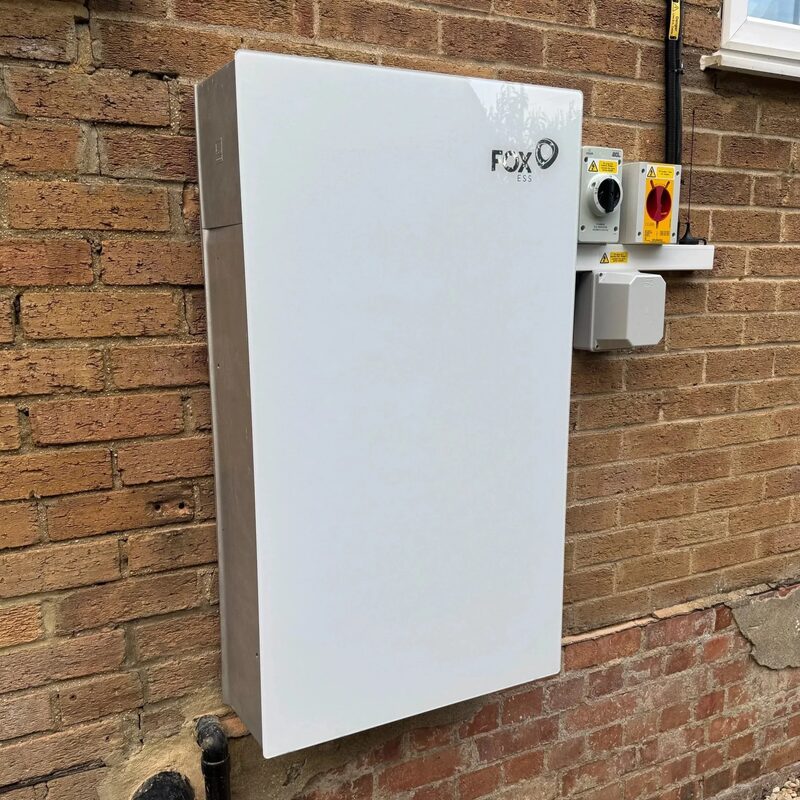
Warranty: 12.5 years, and how service is handled in the UK
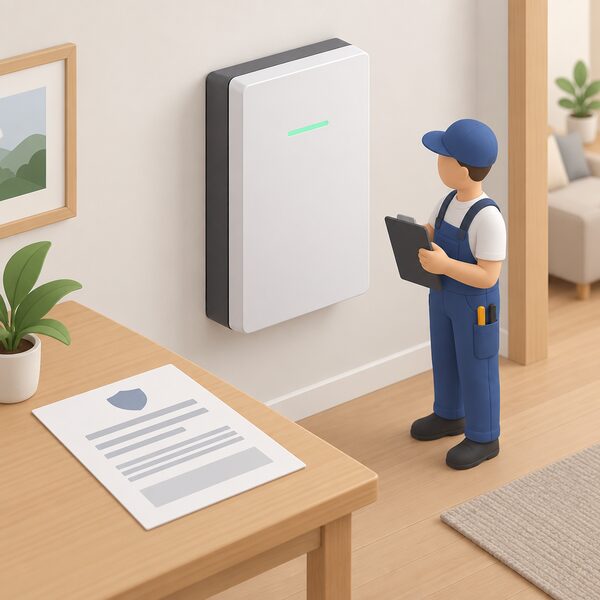
The warranty position is more layered than a single number. The PowerQ datasheet gives a warranty of 12.5 years4. The EQ battery range page states 12 years, and the EQ and CQ range page states 12 years with the EQ4800 excluded7. The EP6 is listed at 10 years or 6,000 cycles13. For comparison, other brands in the UK market sit at 10 to 12 years, so Fox ESS is at the upper end of the range rather than in a class of its own14.
Registration is the condition that catches people out. Fox ESS's battery warranty policy states that warranties should be registered within thirty-six months of installation, but recommends registration no more than six weeks after successful installation and commissioning16. The gap between the deadline and the recommendation is wide, and a household relying on the outer limit is relying on a term the maker itself describes as a backstop rather than good practice.
The claim route is the more important detail. The policy states that the only persons eligible to claim under it are the installer and Fox ESS authorised personnel16. The company describes its structure as one where a household's local installer, rather than a distant call centre, typically handles warranty and service issues7. The installer is also obliged to arrange shipping of a faulty product back to Fox ESS within a maximum of thirty days of receiving the replacement16.
Fox ESS says it runs a dedicated UK service and support operation from a national service centre, with enquiries answered locally by technicians2. The published contact addresses are service@fox-ess.com for service, sales@fox-ess.com for sales and info@fox-ess.com for general enquiries17. The company's registered address is in Wenzhou, China17.
Cost: PQ Series from around £3,277 plus VAT
Fox ESS does not publish a list price for a supplied and fitted system, so the figures that exist are distributor listings for hardware packages. A PQ Series hybrid inverter and EQ5000 battery storage system is listed from £3,277 plus VAT, and the same package appears elsewhere at £3,285 plus VAT5. A fully installed PQ AIO package with two to six EQ5000 batteries is listed from £5,202 plus VAT5. All are quoted plus VAT, and the installed figure is the only one that includes fitting.
That VAT position is worth stating plainly. Domestic battery storage installed alongside solar in a home generally falls within the reduced rate for energy-saving materials, but the distributor listings above are trade prices quoted plus VAT and are not consumer quotes. A household should expect a single installed figure from an installer, covering the inverter, the battery, mounting, cabling, commissioning and notification to the network operator.
What moves the price is the module count, since the PowerQ is priced by how many battery modules are stacked, and whether the installation is a new system or an addition to existing solar. A battery-ready hybrid inverter installed without batteries, with storage added later, spreads the cost but does not reduce the total5. Wider cost context for the category is at home battery cost, and the VAT rules are set out at the VAT rate on home battery storage.
Compatibility: which inverters and smart platforms work with Fox batteries
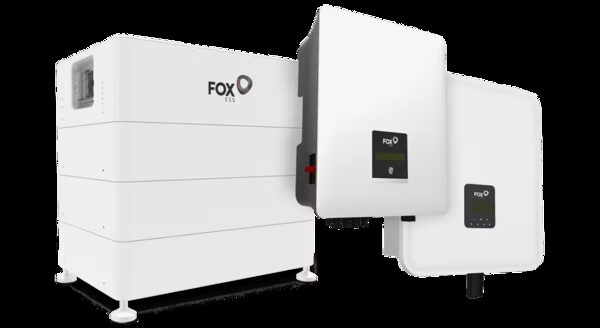
Fox ESS batteries are designed to work with the company's own hybrid inverters rather than as standalone units. The EQ battery range pairs with compatible Fox ESS hybrid inverters including the H1-G2 and K Series, the H3 Smart and the H3 Pro7. The KH and KA series inverters pair with the EP, EQ and CQ battery ranges5. The EPS-BOX-SP backup gateway works with the H1-G2, KH, EVO and PowerQ inverters18. The H1(G2) and AC1(G2) units use CAN communication to talk to the battery and to upgrade the battery management system19.
On smart platforms, the picture is mixed. Fox ESS battery and inverter equipment is listed among the devices that work with the Hive ecosystem and connect to the Hive app20. The KH and KA series are described as smart tariff compatible5. Fox ESS has also partnered with Axle Energy to integrate its systems into an energy flexibility and market participation platform, with owners rewarded for taking part21. For tariff control through a third party, Fox ESS advises opening the time-of-use, schedule or charge and discharge settings and ensuring there are no active charge or discharge periods, turning off any timed charge, timed discharge or export-priority modes22.
The dependence this creates is worth naming. Local control at the inverter continues without an internet connection, but scheduling, monitoring and remote diagnosis run through the Fox ESS cloud, and the company's own guidance refers specifically to Fox ESS cloud v2 for tariff set-up22. A household that wants the battery to respond to a smart tariff is therefore relying on the manufacturer's servers, the installer's configuration and, in the Axle case, a third party's platform.
What owning a Fox ESS system means for energy independence
The honest answer is that a Fox ESS battery increases self-consumption and reduces reliance on the grid, which is what independent guidance says energy storage is for23. It does not remove the grid. The system is designed to be paired with solar PV or installed as a standalone unit that charges from cheap overnight electricity, and in either case it draws from the grid when it needs to12.
The backup capability is real but conditional. The EPS-BOX-SP isolates the property from the grid and, after a short transfer delay, restores power using battery and solar during a grid outage18. That is a gateway product, not a standard feature of every installation, and what keeps running depends on how the backup circuits are wired. The wider subject is covered at battery backup in a power cut.
Expansion is straightforward within the range. Additional battery modules can be installed in series, with capacity varying by model and the number of modules used, and each stack consists of one master module plus additional slave modules7. The EP range allows up to four units in parallel5. The KH and KA inverters can be installed without batteries at all and given storage later with no system redesign5. The second-generation Evo, due in autumn 2026, adds a battery expansion port for up to two additional Evo units10. More on this is at adding more batteries later.
The dependencies that remain are the grid connection, a electricity supplier, the installer for warranty claims, and the manufacturer's cloud platform for monitoring and tariff control. The company is Chinese-owned with a UK service operation, and its products are sold through accredited installers who have completed Fox ESS training and adhere to a code of conduct2. For a household weighing independence, the battery shifts when electricity is bought and how much of it is self-generated; it does not change who supplies it.
Sources23 cited
- Fox ESS ranks No. 1 in the UK for residential energy storage, Fox ESS UK, 2026
- Fox ESS UK, Fox ESS UK, 2026
- Fox ESS products, Fox ESS, 2026
- Modular battery storage for a scalable home energy system, Fox ESS, 2026
- KH and KA Series hybrid inverter, Fox ESS UK, 2026
- Fox ESS battery products, Fox ESS, 2026
- EQ battery range, Fox ESS UK, 2026
- PowerQ datasheet, Fox ESS, 2024
- Fox ESS battery warranty policy UK, Fox ESS, 2025
- Evo All-in-One Solar Battery System | Fox ESS UK, fox-ess.uk
- Energy storage battery buying guide, Fox ESS, 2026
- The simple home tech that can slash electricity bills by a third, Fox ESS UK, 2026
- Works with Hive, Hive, 2026
- Fox ESS and Axle Energy partnership, Fox ESS UK, 2026
- Whole home backup gateway, Fox ESS UK, 2026
- PowerQ hybrid inverter, Fox ESS, 2026
- EP batteries, Fox ESS, 2026
- How do I set up my battery for EcoFlex, Ecotricity, 2026
- H1 G2 WL datasheet, Fox ESS, 2025
- Electrical energy storage systems, Flexi-Orb, 2025
- G-Max warranty, Fox ESS, 2025
- CQ7 datasheet, Fox ESS, 2026
- Q4 datasheet, Fox ESS, 2025
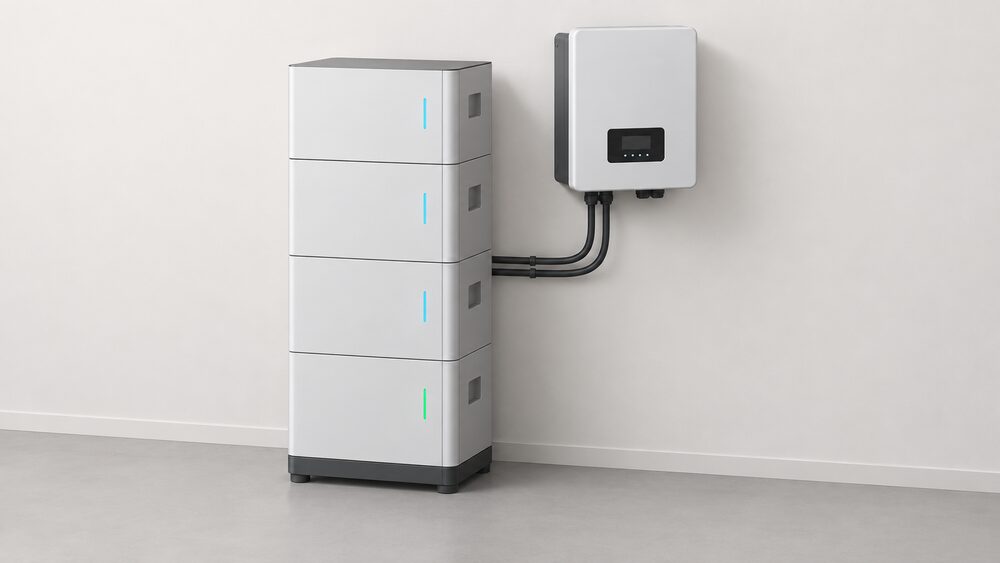 Fox ESS PowerQHow much power does your home need, and can you add more battery later without replacing what you already have?
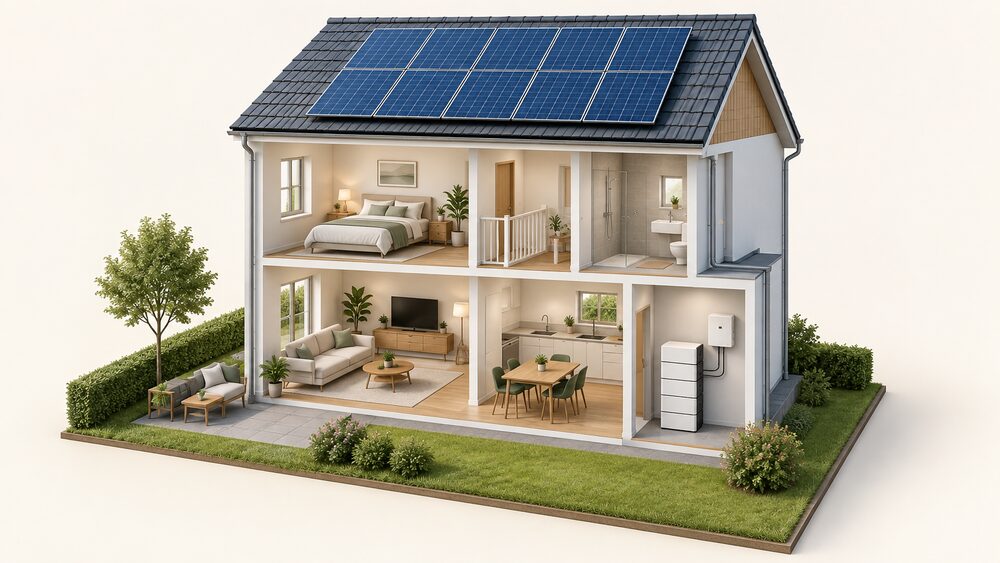 Fox ESS inverters and home batteriesFox ESS is behind more home batteries in the UK than any other brand, so plenty of people want to know if it is any good and what it costs to have fitted.