In this guide
Perlight Solar is a module manufacturer established in Zhejiang, China in 2006, and its panels reach UK householders through distributors and installers rather than through a direct retail channel. The brand is best known in Britain for two things: a warranty structure that is tied to the date modules were dispatched, and a 36-panel installation at Corner Farm in Warwickshire that formed part of a RIBA award-winning project completed by Aspey Energy1.
There is no published UK list price for a Perlight module, and no manufacturer-run consumer warranty desk in the UK. What a householder buys is a panel with a performance warranty running 25 years and a product warranty of five to 10 years, which is the usual structure across the market rather than anything specific to this maker4. The practical questions are therefore about who holds the paperwork, how the modules are matched to an inverter, and what the household still depends on after the panels go up.
Perlight Solar: the company and its background
Perlight Solar was established in Zhejiang, China in 2006, which puts the manufacturer at roughly two decades of trading1. That history matters more than it might appear, because the warranty a householder relies on is a promise made over a quarter of a century. A performance warranty attached to a module installed in 2026 runs to around 2051, well beyond the company's first twenty years. The strength of the manufacturer behind the promise is therefore part of what is being bought, and it is worth reading alongside the general guidance on solar panel warranties and degradation.
The UK route to market is indirect. Perlight modules are supplied through distributors and installed by MCS-registered contractors, and the brand appears in the UK largely through those installers' project work rather than through a national retail presence. One UK distributor, WesTech Solar, has published the case studies and announcements that give the brand most of its British visibility3.
For a householder, the practical consequence is that the first point of contact for anything to do with the panels is the installer or distributor, not the factory. That is normal for the sector, but it means the quality of the commissioning paperwork matters as much as the module itself. The MCS certification held by the installer is what makes the installation eligible for grid connection and for export payments, and it is also the record that a future warranty claim will be traced through.
The UK panel range at a glance
Perlight's UK-facing range is built around n-type and shingled cell designs rather than the older polycrystalline formats. The Spectra PERC-S modules use a shingled cell module design, and the SpectraLite range is described as ultra-lightweight, which matters on roofs where loading is a consideration7. The n-type 435W module is the model most often cited in UK distribution material8.
| Range | Design feature | Where it suits |
|---|---|---|
| Spectra PERC-S | Shingled cell module design7 | Standard pitched roofs |
| SpectraLite | Ultra-lightweight construction7 | Roofs with loading limits |
| N-type 435W | N-type cell format8 | General domestic arrays |
Solar panels are suitable for anywhere in the UK, so the range is not restricted by region in the way that some products are9. About a million households in the UK have solar panels for their home, which gives a sense of how mainstream the technology has become and how much installer experience exists locally6. For a wider view of what different module formats offer, see types of solar panel sold in the UK and solar cell technology.
Panel specifications: what the numbers mean
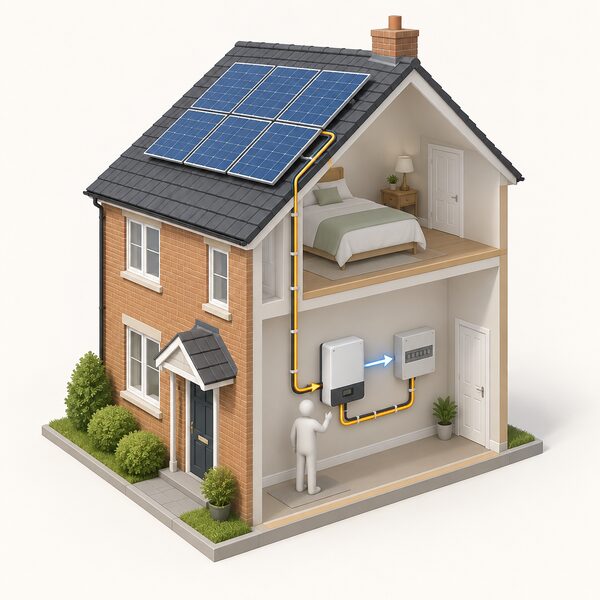
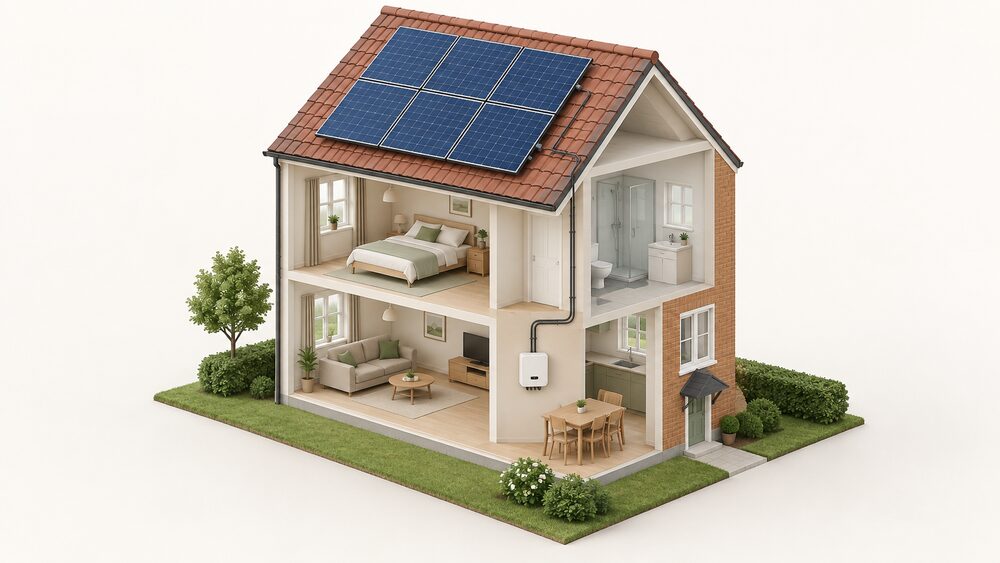
A datasheet is a set of test conditions, not a description of a roof. The figures that matter most for a UK installation are the module's rated output under standard test conditions, its temperature coefficient, and how the array is wired into the inverter. The inverter is not an optional extra: a PV system comprises the panels with cabling, a control panel and an AC/DC inverter, and the inverter is what converts the direct current the modules produce into usable alternating current10.
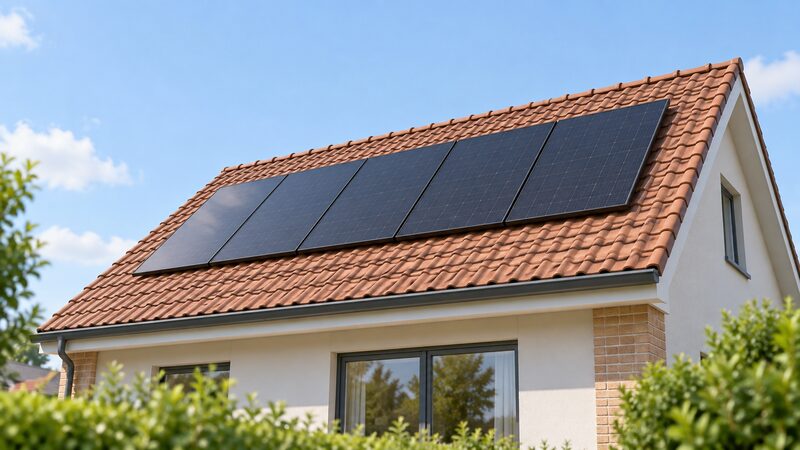
The roof itself sets the ceiling on performance before any module specification is considered. Installers assess roof pitch and orientation and any overshading from trees or other buildings before quoting, because those factors determine how much of the module's rated output is ever reached11. A well-specified panel on a shaded north-facing roof will underperform a modest panel on a clear south-facing one. The detail is set out in roof orientation, pitch and shading and in reading a solar panel datasheet.
One specification point that is often overlooked is glare. Anti-glare coatings are applied where necessary, which matters on roofs close to neighbouring windows or on flat roof arrays angled toward a road12. Solar panels are also included within the definition of energy-saving materials in the relevant legislation, which is the basis on which the reduced VAT treatment for their installation rests13.
Warranty: what is covered and for how long
The warranty position on Perlight modules is documented in an unusual way. The module warranty is stated to apply to modules dispatched from 1 January 2017 up to 31 December 2017, which is a validity window rather than an open-ended term2. That is a specific document covering a specific production period, and it illustrates why the dispatch date and the serial number matter more than the purchase date on an invoice.
Across the market, solar panels usually come with a 25-year performance warranty and a five to 10-year product warranty4. Independent guidance puts the expectation at a 20- to 25-year warranty on performance14. The two warranties cover different things: the product warranty covers manufacturing defects in the module itself, while the performance warranty covers the output the module will still deliver after decades of degradation. The distinction is explained further in solar panel warranties and degradation.
Registration of the installation itself is a separate step. A solar PV installation must be registered with the distribution network operator, usually by the installer, so that the connection is recorded on the network16. Where an installer has failed to do this, or where a company has ceased trading, the Installation Assurance Authority handles consumer concerns and can be contacted at concerns@theiaa.co.uk17.
Efficiency and performance in UK conditions
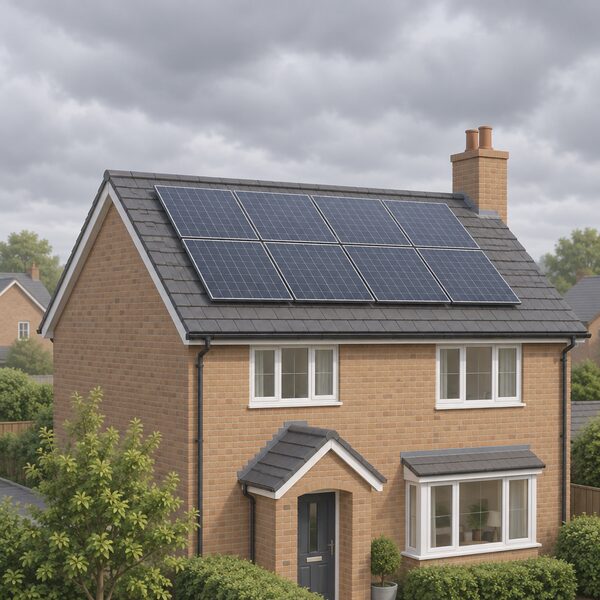
UK conditions are better suited to solar than the climate suggests. Solar panels are designed to capture diffused light, meaning light filtered through cloud cover, as well as direct light, so an overcast day still produces output18. They work best in direct sunlight but generate from daylight, including wavelengths that pass through clouds19. The panels themselves are usually silicon, which is the material that absorbs the light and converts it to current20.
Temperature behaviour is the counter-intuitive part. Cool and windy conditions can be beneficial, because they act as a cooling mechanism for the PV modules and lead to increased efficiency21. A bright, cold, breezy spring day can therefore outperform a hot still afternoon in July, when module temperatures rise and output falls away. This is why UK arrays often perform closer to their rated output than arrays in hotter countries.
Testing programmes reflect this. Where applicable, results are modelled to daylight conditions across a number of UK cities to see how panels would perform in practice, rather than relying on a single laboratory figure22. For a householder, the honest expectation is that annual yield depends far more on roof orientation, pitch and shading than on small differences between module models. The wider picture is covered in solar panel specifications and efficiency and in solar panel sizing.
Sustainability credentials: the EcoVadis Bronze Medal
Perlight Solar achieved an EcoVadis Bronze Medal for sustainability, announced by WesTech Solar in April 2025 and presented as relevant to sustainability and to customers3. EcoVadis is an independent rating platform that assesses companies on environmental, labour, ethics and procurement criteria, so the medal is a third-party assessment of the manufacturer's operations rather than a claim the company makes about itself.
What the medal does not do is change the performance of a module. It speaks to how the panels were made and how the supply chain is managed, which is a legitimate concern for a householder weighing the embodied impact of an installation against the electricity it will generate over 25 years or more. It sits alongside other sustainability questions in the sector, including what happens to modules at the end of their life, covered in solar panel recycling and disposal.
The rating is also a snapshot. A medal awarded in 2025 reflects the assessment period behind it, and ratings are revisited periodically. It is a useful signal about a manufacturer's practices, not a certification of any individual module.
Perlight in real UK projects: the RIBA award-winning Warwickshire installation
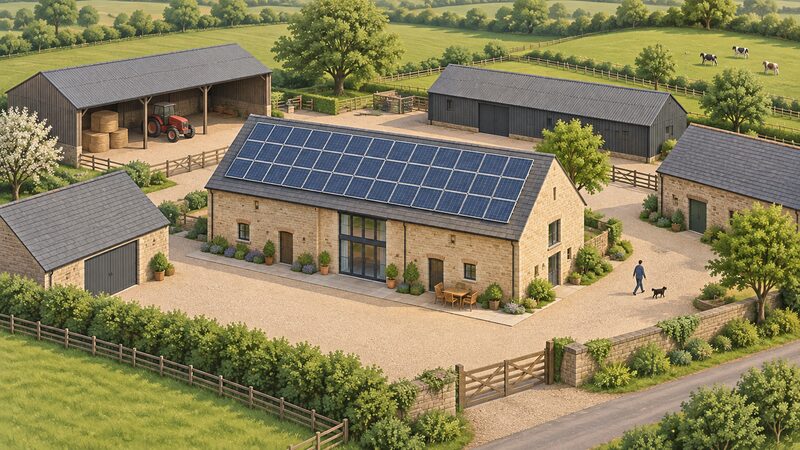
The most concrete UK evidence for the brand is a project rather than a specification sheet. Thirty-six Perlight Solar panels were installed at Corner Farm in Warwickshire, a project designed by Taw Fitzwilliam Architect and completed by Aspey Energy5. The installation formed part of a project that won a RIBA award, which places the modules within a professionally judged building project rather than a marketing photograph3.
A 36-panel array is a substantial domestic or small commercial installation, well beyond the typical 10 to 16 panel domestic system. It indicates the modules are used at scale in UK projects where the specification has been scrutinised by an architect and a contractor. For householders, the value of a reference project is that it demonstrates the modules have been through UK planning, building control and commissioning processes, not just laboratory testing.
What owning Perlight panels means for household energy independence
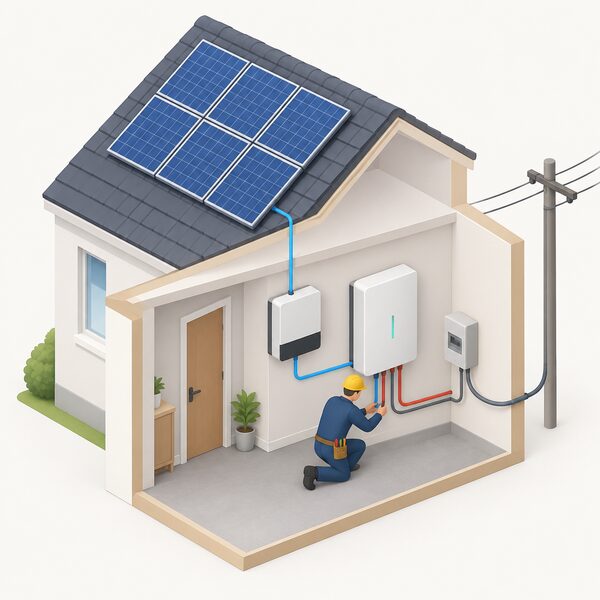
Solar PV panels could power your home, reduce your bills and may earn you money, which is the straightforward case for installing them23. Once the installation is paid for, the electricity the panels generate is completely free to use24. Home solar panels can reduce reliance on the grid, and an Energy Performance Certificate can be improved as a result25.
The dependence that remains is worth stating plainly. A grid-connected array still relies on the network for the times when the panels are not generating, and on a supplier for whatever is imported. Export payments depend on a registered connection and a tariff. If battery storage is added, the household gains more control over when it uses its own generation, since a battery can store excess solar electricity or charge when a tariff is cheap and then be used at night or when prices are high26. Battery storage can be added to existing solar panels to maximise the benefits of the system27, and a PV system can be paired with a battery to store excess electricity for when it is most needed28. Any battery must be permanently wired and installed by a qualified electrician29.
Planning is usually simpler than householders expect. In many cases, even in conservation areas, homes can have solar panels without requiring planning permission from the council under permitted development30. The permitted development rights relating to solar panels are set out as Class A and Class B for domestic premises31. Where the external appearance of an industrial building or warehouse is materially affected, different considerations apply32. The position varies across the four nations, and the detail is set out in the planning guides for England, Scotland, Wales and Northern Ireland.
Maintenance is light. In most cases rain does a good job of keeping solar panels clean, meaning routine cleaning is not essential, though a light clean every 12 to 24 months can help the system operate at its best by removing dirt, dust and other build-up33. Checking panels every 12 to 18 months and cleaning them if there is visible dirt is a reasonable guide, along with checks for wear and tear, damage, water ingress, bird droppings or lichen growth33. Annual checks should also confirm the cables and connectors are still working as they should be18. More detail sits in solar panel maintenance, cleaning and inspection.
For a household weighing independence, the position is this: Perlight panels generate electricity on the roof, reduce what is imported, and can be paired with storage to shift generation into the evening. They do not remove the grid connection, the supplier relationship or the need for a registered installer to hold the paperwork. The wider subject is covered in solar panels and household energy independence.
Sources33 cited
- Perlight brand page, HDM Solar
- Developer Tiled Roof Mount Plug-In Solar Installation Manual, Plug In Solar
- Case study: Perlight in-roof solar installation, WesTech Solar, 16 April 2025
- Buying a house with solar panels, Energy Saving Trust, 13 August 2026
- Perlight Solar panels at Corner Farm, Warwickshire, WesTech Solar, 25 June 2026
- Green energy, Uswitch, 4 September 2026
- SpectraLite and Spectra PERC-S product page, Marlec, 18 September 2026
- Boost your home efficiency with the n-type 435W solar panel, WesTech Solar, 16 April 2025
- UK solar panel hotspots, Energy Saving Trust, 13 August 2026
- VAT energy saving materials manual VENSAV3060, HM Revenue and Customs, 17 September 2026
- Solar PV panels, AgilityEco, 20 September 2026
- Solar panels planning permission checklist, Islington Council
- Energy Act 1994, Schedule 7A, legislation.gov.uk, 17 September 2026
- How to choose a good solar installer, Low Carbon Hub, 20 October 2025
- Barcud Solar Panel Installation Scheme Specification, Sell2Wales, 15 June 2026
- Solar panels, London Borough of Hammersmith and Fulham, 17 September 2026
- Complaints procedure, The Installation Assurance Authority, 20 September 2026
- Do solar panels work in winter?, Uswitch, 15 September 2026
- Solar power facts, Energy Saving Trust, 13 August 2026
- Solar panel installation, maintenance and repair, NICEIC, 17 September 2026
- Solar panel myths debunked, Which?, 9 June 2026
- SolarEdge solar panels review, Which?, 12 August 2026
- Solar photovoltaic panels, London Borough of Bromley, 17 September 2026
- How do solar panels work?, Smart Energy GB, 16 March 2026
- Do solar panels improve the EPC rating, WesTech Solar, 25 June 2026
- Battery storage, Energy Saving Trust, 19 August 2026
- Switch Together Birmingham, Birmingham City Council, 27 January 2026
- Solar photovoltaic (PV), MCS Certified, 30 July 2026
- Plug-in solar panels, Which?, 15 September 2026
- Solar panels and permitted development, London Borough of Richmond upon Thames, 6 July 2026
- Solar panels and planning permission, Cornwall Council, 17 September 2026
- Solar panels, City of York Council, 17 September 2026
- Solar panel cleaning and maintenance, Energy Saving Trust, 25 August 2026