In this guide
STIEBEL ELTRON is a German manufacturer whose UK catalogue covers air source heat pumps and ground source heat pumps, supplied through installers and wholesalers rather than sold direct to householders1. Alongside the heat pumps it sells instantaneous electric water heaters, which heat water at the point of use using bare wire heating elements, a design the maker says suits hard water areas2.
For a household, the split matters more than the brand. A STIEBEL ELTRON heat pump replaces a gas or oil boiler with a system that runs on electricity, so it removes the gas connection and the gas supplier but keeps the home on the electricity grid and on an electricity tariff. An instantaneous water heater removes the cylinder and the stored hot water, but it draws a large electrical load the moment a tap opens, and that load has to be within the property's supply capacity.
The warranty position is the first thing to check. STIEBEL ELTRON's UK terms describe an additional 5 years parts and labour cover on domestic heat pumps, making a total of 7 years, and separately refer to 2 years parts and labour cover3. The two figures sit in the same maker document and are not reconciled, so a buyer is reading a ladder of terms rather than one number.
A German maker with a long heat pump history
STIEBEL ELTRON describes nearly 50 years of experience manufacturing and designing heat pump systems, and its UK catalogue covers both air source and ground source heat pumps1. One of the company's own product pages states over 45 years in operation1. Both figures come from the maker, they are not reconciled, and the difference is small enough that it reads as a rounding of the same history rather than a dispute.
The comparison that gives the figure context is OCHSNER, an independent product listing that describes over 45 years engineering heat pump technology5. On the makers' own statements, STIEBEL ELTRON and OCHSNER are working from a similar vintage, which places both in the first generation of European heat pump manufacturers rather than among the newer entrants.
What that history buys a household is less about the badge and more about the service chain. A long-established maker is more likely to have parts, trained engineers and documentation for older units, which matters at year eight or ten when a repair decision falls due. It does not guarantee individual reliability, and no lifespan figure for STIEBEL ELTRON units is published in the available UK documentation.
The company's UK presence includes a training facility at Bromborough, which is where partner installers are trained and which is a condition of the extended warranty3. That is a manufacturer investing in the installation end of the chain, not just the product, and it is the part of the offer a household actually experiences.
What STIEBEL ELTRON sells in the UK
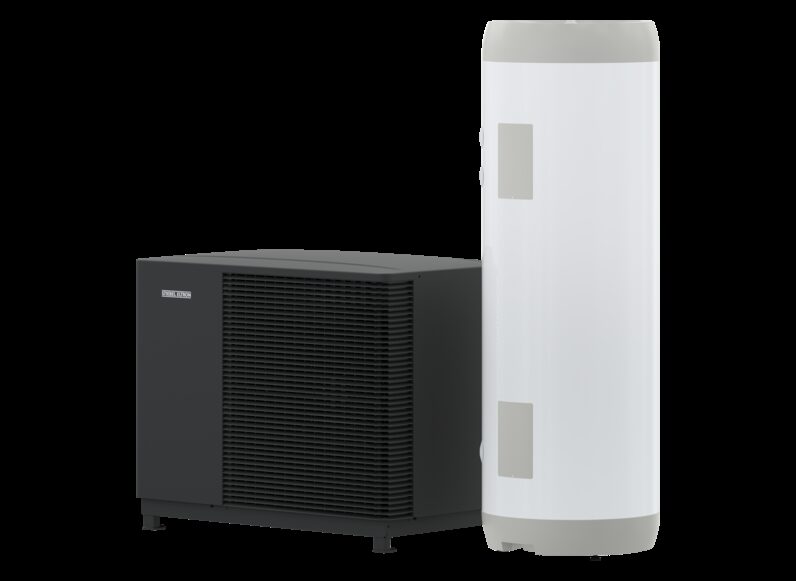
The UK range divides into two quite different propositions. The first is heat pumps: air source and ground source units, supplied through installers and wholesalers rather than through retail1. The second is electric water heating, including instantaneous water heaters that heat water as it is drawn rather than storing it in a cylinder2.
The distribution model shapes the buying experience. Because products go through installers and wholesalers, there is no manufacturer list price for a supplied and fitted system, and no published installed cost in the available documentation. Prices are installer-quoted after a survey. That is the same position as most boiler and heat pump makers in the UK, and it means the quote, not the catalogue, is the price.
STIEBEL ELTRON states that it recommends installers trained on its products1. That recommendation becomes a condition rather than a preference if the household wants the extended warranty, which requires a complete system installed by a partner installer trained at the company's Bromborough facility3.
For a household weighing independence, the two product lines pull in different directions. A heat pump moves space heating and hot water off gas and onto electricity, which removes one fuel supply and one standing charge but concentrates dependence on the electricity grid and the electricity tariff. An instantaneous water heater removes the stored cylinder and the cylinder's standing losses, but it does not reduce dependence on the grid at all: it increases the instantaneous electrical load instead.
Instantaneous water heaters: bare wire elements and 3i control

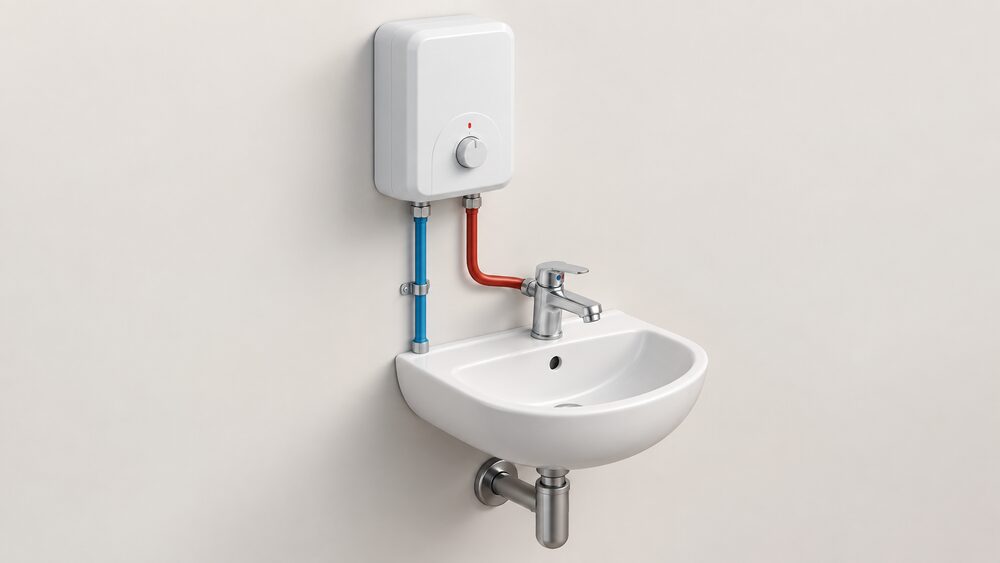
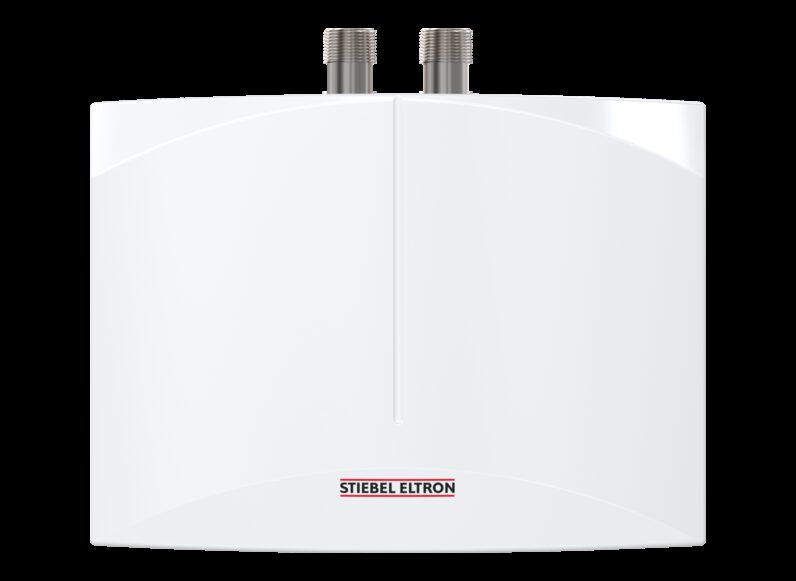
Most STIEBEL ELTRON instantaneous water heaters heat water using bare wire heating elements, and the maker gives two reasons: the design offers a number of advantages, and bare wire elements are especially suitable for use in hard water2. That second point is the practical one for much of England, where hard water scales up immersed elements and shortens their life.
The control side is where the range separates. The DEL and DHB-E models use electronic closed-loop control with 3i technology2. Closed-loop control means the unit measures the outgoing water temperature and adjusts the heating power to hold it, rather than switching a fixed element on and off. The result is a steadier temperature at the tap when the flow rate or the incoming water temperature changes.
The trade-off is electrical. An instantaneous heater has no stored hot water, so it must deliver the entire heating load in the seconds the water is running. That is why these units are sized in kilowatts rather than litres, and why the supply capacity of the property, not the size of the bathroom, sets the limit on what can be installed.
"Most STIEBEL ELTRON instantaneous water heaters heat water using bare wire heating elements because they offer a number of advantages."
Where a household already has a cylinder heated by a gas boiler, an instantaneous heater is usually a point-of-use solution for a single outlet, such as a kitchen or a cloakroom basin, rather than a whole-house replacement. Where the property is all-electric, it removes the cylinder and its standing losses but adds a large load at the moment of use. The wider picture on electric water heating sits alongside the material on hot water cylinders.
Single phase and three phase: what the supply will carry
The electrical supply is the constraint that decides most electric heating installations, and it is worth stating plainly. It is possible to connect up to 17kW maximum to a single phase supply, and above this capacity a three phase supply is required4. That is the ceiling for a domestic single phase connection, and it is a ceiling on the whole property, not on one appliance.
Three phase work is not a like-for-like swap. Installing any three phase electrical equipment, such as water pumps, is listed among the circumstances that require a supply upgrade6. A supply upgrade is a network operator process with its own lead time and cost, and it is the kind of work that has to be planned before an installation date is agreed rather than after.
The three phase route is more common in apartment developments and larger properties, where a single point-of-use system serves each dwelling or each cluster of outlets. Three phase heat pumps exist in the wider market: the Daikin Altherma 3 H HT is listed in both single phase and three phase variants, with different outdoor and indoor model references for each7. Samsung's EHS Mono HT AE120BXYDGG is listed as a three phase unit, described as simple to set up and maintain with easy side panel access8.
For a household, the practical sequence is to establish the existing supply capacity before choosing equipment, because a unit that needs three phase cannot be made to work on a single phase connection by any setting or accessory. The rules and the safety side are covered under electrical safety for electric heating.
| Supply | Maximum capacity | What it means in practice |
|---|---|---|
| Single phase | 17kW maximum4 | Covers most domestic electric heating loads, but not all at once |
| Three phase | Required above 17kW4 | Network upgrade process; needed for three phase equipment6 |
MCS certification and the Boiler Upgrade Scheme

The Boiler Upgrade Scheme is the main grant route for heat pumps in England and Wales, and its rules are built around certification rather than around brands. To be eligible for the Boiler Upgrade Scheme, installers must be MCS certified and meet the MCS standards9. Installers and the low-carbon heating products supported under the scheme must be Microgeneration Certification Scheme certified, and members of an approved consumer code10.
The requirement runs through every stage. A household's chosen installer must be certified by the Microgeneration Certification Scheme, a nationally recognised quality assurance scheme11. Heat pump installations funded by the Boiler Upgrade Scheme need to be carried out by an MCS-certified installer12. All installations under the scheme must be MCS certified, meaning delivered by an MCS installer using MCS certified products13, and all BUS installations must be Microgeneration Certification Scheme certified14.
MCS certification also carries a scope condition that matters for system design. MCS certified means primarily designed to provide the entire property's heating requirements5. That rules out a partial or single-room solution from grant funding, and it is why a whole-property heat loss calculation sits behind a compliant installation.
The audit trail is documented. Evidence expected at audit includes valid ID, proof of address, proof of ownership, MCS certificates, EPCs and EPC site notes, purchase receipts or quotes, total building heat loss calculations, and an emission certificate for biomass boilers15. Copies of the MCS certificate are specifically listed among the documents required16.
Most heat pump retrofit installations with Government funding are required to have MCS certification, and some installations have additional requirements17. The UK has passed 250,000 certified heat pump installations18. Installers operating under the Boiler Upgrade Scheme must be MCS certified19. Satisfaction with the scheme is high: MCS outreach work reports high satisfaction rates for Boiler Upgrade Scheme installations13. The grant structure itself is set out on the Boiler Upgrade Scheme page, and the wider grant landscape differs across the four nations.
ECO4 and the flexibility route
ECO4 is a separate funding route from the Boiler Upgrade Scheme, delivered through obligated energy suppliers rather than through a grant application by the householder. The fourth iteration of ECO was the first to include solar PV, but only if it was installed alongside an electric heating system20. That condition is the one that connects ECO4 to electric heating: the solar measure is available where the home is already electrically heated.
Air source heat pumps are treated differently under ECO4 depending on their type. An air-to-air heat pump is not considered to be a renewable system in ECO421. That excludes air-to-air units from the renewable measures, and it means a household looking at an air-to-air system should not expect it to qualify on that basis.
Smart technologies and flexible heating systems are eligible to apply for a new ECO4 measure type and score, but all smart technologies must provide evidence of space heating cost savings21. That is an evidential requirement rather than a product list, and it applies to the measure rather than to any particular brand.
ECO4 Flex is the local authority route, and its measure list is published. Examples of measures that can be installed under ECO4 Flex include solid wall insulation, cavity wall insulation, room in roof insulation, loft insulation, flat roof insulation, electric storage heater upgrade, first time central heating to air source heat pump, boiler upgrade from oil, LPG and solid fuel to air source heat pump, and solar photovoltaic panels21. The air source heat pump measures on that list are the ones most relevant to a household replacing a fossil fuel system.
No STIEBEL ELTRON product is named in the ECO4 guidance available, and no ECO4 eligibility statement for the brand is published. Eligibility turns on the measure, the property and the supplier's obligation, not on the manufacturer.
Design service, consultation and finding an installer
The route to a STIEBEL ELTRON installation runs through trained installers rather than a direct sales channel. STIEBEL ELTRON recommends installers trained on its products1, and the extended warranty requires a partner installer trained at the company's Bromborough facility3. That makes the installer choice part of the warranty decision, not a separate matter.
Independent guidance on renewable heating is consistent about the quoting process. Get at least three quotes from installers, and make sure they are all certified with the Microgeneration Certification Scheme22. That advice applies to any heat pump purchase, and it is the practical protection against a single quote that has not been tested against the market.
System design sits behind a good quote. Heat loss calculation and radiator sizing software is available to the trade: updated versions are ready to access from the Stelrad professional website23. A whole-property heat loss calculation is also part of the audit evidence expected under the Boiler Upgrade Scheme15, so the design work is not optional on a grant-funded job.
Free and impartial advice is available in Scotland. Home Energy Scotland provides free expert impartial advice on energy efficiency and energy saving technologies24, and can be reached on 0808 808 228225. For households elsewhere in the UK, the government's clean energy campaign and the Energy Saving Trust both publish guidance on renewable heating options26.
Where the installation involves electric underfloor heating rather than a heat pump, the installer requirement is different: a registered electrician certified with a recognised certification body like NICEIC is the appropriate trade28. An installer for underfloor heating systems can be either a registered electrician or a plumbing and heating specialist28. The general installer and registration picture is covered under boiler installation.
Warranty: 7 years on conditions, or 2
The warranty terms are the part of the offer that most needs reading closely, because the maker's own document gives two different figures. STIEBEL ELTRON's UK terms state that an additional 5 years parts and labour warranty is available, making a total of 7 years3. The same document refers to 2 years parts and labour cover3. The two figures are not reconciled in the source, so a household should treat the longer term as conditional and confirm the applicable term for the specific model in writing.
The conditions for the extended term are specific. To access the additional 5 years of warranty, the household must choose a complete heat pump system with all main components from STIEBEL ELTRON and have it installed by one of the company's partner installers who have been trained at its Bromborough training facility3. A mixed-brand system, or one fitted by an untrained installer, does not meet that condition.
There is also a commissioning condition. STIEBEL ELTRON carries out the start up, and the partner installer should be present with the appropriate tools and equipment3. That is a condition of the total 7 year warranty, not a courtesy: the maker attends the first startup and the installer attends alongside.
Registration has a deadline. Within four weeks of the first startup, the partner installer must register the system with STIEBEL ELTRON UK via the online product registration, and commissioning documents must also be uploaded to that area3. Missing the four week window is the kind of administrative failure that can cost the extended term.
The general principles of guarantee registration, including the paperwork that protects a claim, are set out under boiler warranties.
What owning a STIEBEL ELTRON system means for independence
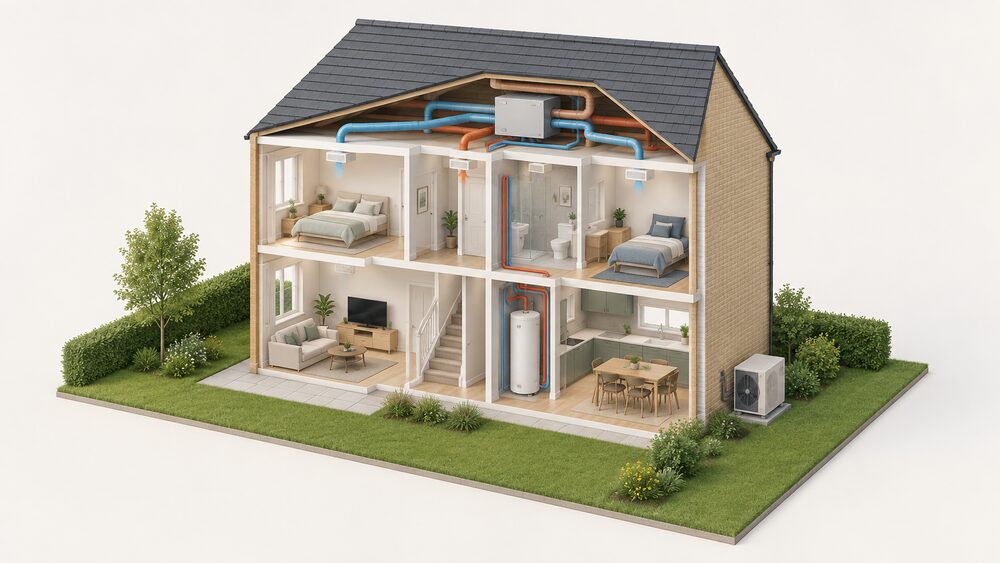
The independence question has a clear answer for each product line, and neither is complete independence. A STIEBEL ELTRON heat pump moves space heating and hot water from gas or oil to electricity. That removes the gas connection, the gas standing charge and the gas supplier from the household's accounts. It does not remove the electricity grid, the electricity supplier or the electricity tariff, and it does not remove the manufacturer from the service chain, since the extended warranty depends on a trained partner installer and on registration with STIEBEL ELTRON UK3.
An instantaneous water heater removes the stored cylinder and the standing losses that go with it, and it heats only the water that is drawn. It does not reduce grid dependence: it increases the instantaneous electrical load, which is why the 17kW single phase ceiling matters4. Where the property is already electrically heated, that trade can still be worthwhile, because the cylinder and its losses disappear.
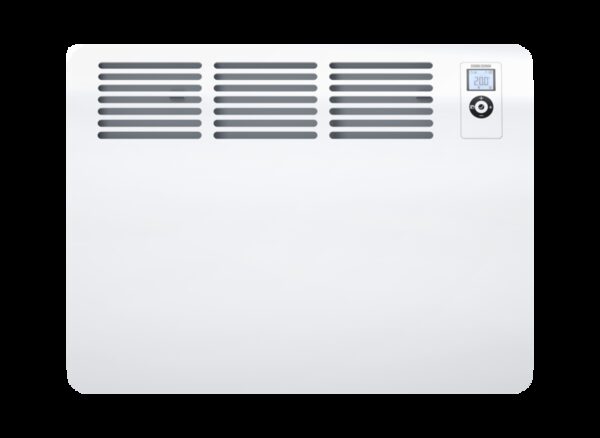
Electric space heating has its own characteristics. Electric space heaters need no regular maintenance29, which removes the annual service visit and the flue inspection that a gas boiler requires. Standalone electric heaters tend to be more energy efficient if they have thermostatic controls that switch off at a set temperature, and a separate plug-in thermostat can be bought as an upgrade28. Heating systems are described as the biggest opportunity to save energy and money27, which is where controls and setpoints matter more than the heat source.
The dependence that remains is worth naming plainly: the electricity grid, an electricity supplier, an electricity tariff, and for the heat pump, a manufacturer's parts and service network. A household that wants to reduce the first three further is looking at generation and storage rather than at the heating appliance, and the wider picture is set out under heating and energy independence.
Sources29 cited
- Buying a STIEBEL ELTRON heat pump, STIEBEL ELTRON, 2026
- What heating systems are used in instantaneous water heaters, STIEBEL ELTRON, 2026
- Terms of warranty, STIEBEL ELTRON, 2026-09-18
- Connections FAQs, NIE Networks, 2026-09-19
- Air to air heat pumps, MCS Certified, 2026-07-24
- What do you need to upgrade, UK Power Networks, 2026-09-17
- Daikin Altherma 3 H HT heat pump, Quiet Mark, 2026-09-17
- Samsung EHS Mono HT AE120BXYDGG three phase heat pump, Quiet Mark, 2026-09-17
- Boiler Upgrade Scheme, Ofgem, 2026-09-17
- BUS Annual Report 2024 to 2025, Ofgem, 2025-07
- Boiler Upgrade Scheme, UK Government, 2026-09-18
- What the Warm Homes Plan and Future Homes Standard mean for installers, NICEIC, 2026-04-23
- MCS outreach reveals high satisfaction rates for Boiler Upgrade Scheme installations, MCS Certified, 2026-02-02
- Boiler Upgrade Scheme statistics, July 2026, Department for Energy Security and Net Zero, 2026-08-27
- BUS PO guidance V2.3, Ofgem, 2023-09-25
- Boiler Upgrade Scheme guidance for installers v2.1, Ofgem, 2023-05-18
- Heat pump deployment tables Q2 2026, Department for Energy Security and Net Zero, 2026-09-10
- UK reaches 250,000 certified heat pump installations, MCS Certified, 2024-08-19
- Heat pumps explained: DESNZ talk to industry experts, MCS Certified, 2024-04-03
- POST note 0771, Parliamentary Office of Science and Technology, 2026-06-25
- ECO4 new measures and products guidance v3.0, Ofgem, 2026-03-26
- Renewable heating: what are the options for your home, Energy Saving Trust, 2024-03-01
- Heat loss calculator and radiator sizing software, CIPHE, 2026-01-21
- Consumer duty, Home Energy Scotland, 2026-09-20
- Keeping your home warm in winter, Met Office, 2026-09-20
- Heat pump, UK Government, 2026-09-10
- Renewable heat: right for your home, Energy Saving Trust, 2026-05-19
- Underfloor heating system, NICEIC, 2026-09-17
- Benefits of electric space and water heating, BEAMA, 2026-09-17
 STIEBEL ELTRON heat pumpsGerman maker of domestic heat pumps and hot water appliances, sold in the UK through a subsidiary of over 25 years, with a 5 year standard warranty and a free system design service.
 Stiebel Eltron heat pumps, water heaters and electric heatingStiebel Eltron is a German maker of heat pumps, hot water cylinders and electric heating sold in the UK through installers.