On this page
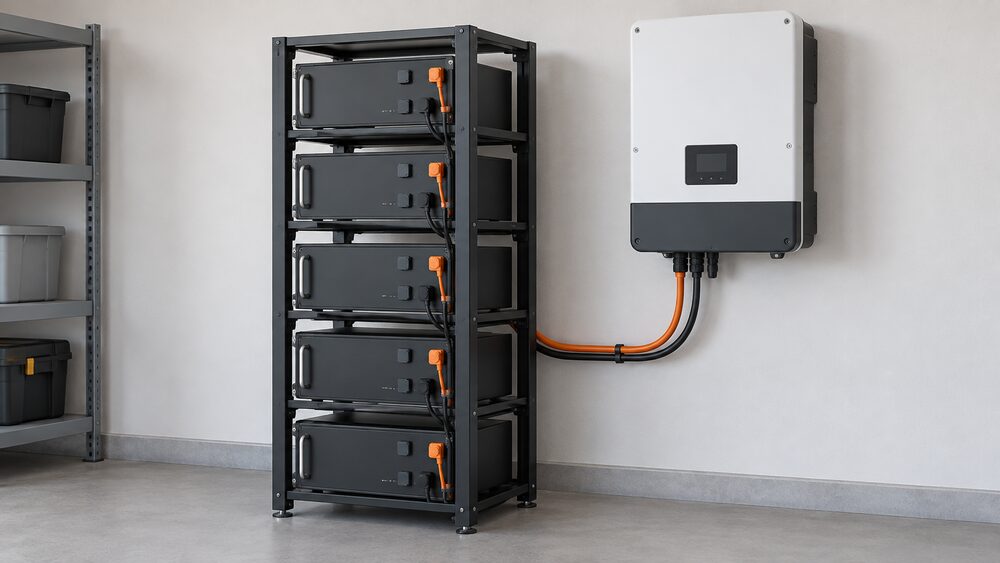
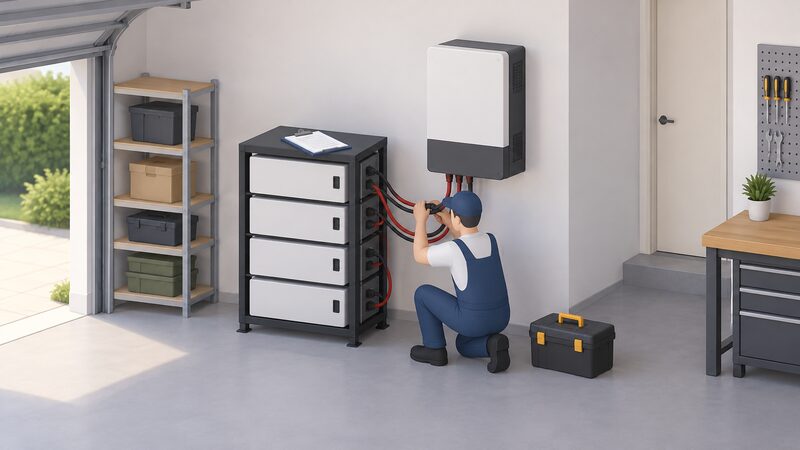
Pytes is a battery manufacturer whose 48 V rack modules sit in the UK's self-build and off-grid market: the segment where a householder or a small installer assembles a system from separate parts rather than buying a sealed all-in-one unit. The modules are lithium iron phosphate (LFP), the chemistry that now dominates home storage, and they are built to be stacked into a rack and paired with an external inverter1.
The headline product with published UK-relevant detail is the V5, a 5.12 kWh module on a 51.2 V, 100 Ah platform, described by Pytes as a building block for reliable energy storage, with modularity as a core feature: capacity is added by fitting more modules rather than replacing the unit1. A UK supplier comparison of Pytes and Pylontech rack batteries, published in June 2025, covers capacity, cold-weather resilience, fire safety and Victron integration, which are the four questions most UK buyers of this class of battery actually ask2.
What this page does not have is a full set of Pytes UK specifications. Pytes does not publish UK warranty terms, prices or a fault code list in the material available, and where that is the case the page says so rather than estimating. What follows is what is published, plus the chemistry and installation facts that apply to any 48 V LFP rack battery of this type.
Who makes Pytes batteries and where they fit
Pytes publishes its product information through Pytes USA, which issued the V5 product overview in June 20261. In the UK the batteries are sold through specialist suppliers rather than through the big energy brands, and the clearest UK-facing treatment of them is a supplier comparison of rack-mounted batteries for solar, off-grid and hybrid systems, published by Callidus in June 20252.
That position in the market matters for what a householder is buying. A Pytes system is not a packaged product with one company answerable for battery, inverter, control and app. It is a component in a system the installer configures: the battery is one purchase, the inverter another, and the monitoring and backup behaviour come from how the two are set up. That gives flexibility, which is why self-builders and off-grid installers like this class of equipment, and it also means the household's dependence is spread across a battery maker, an inverter maker and the installer who configures them. There is more on that trade-off in modular and stackable home batteries and in home batteries and household energy independence.
The V5 module and what is published about the range
The V5 is the module with published figures. It is a 5.12 kWh unit built on a 51.2 V, 100 Ah platform, using LFP cells, and Pytes presents it in terms of discharge capability, cycle life and modularity1. The 51.2 V figure is the nominal voltage that defines the "48 V" class: these are low-voltage batteries, wired to a suitable hybrid or battery inverter rather than the high-voltage stacks used by some wall-mounted rivals. The 5.12 kWh figure is the module's capacity; usable capacity, which is what a household can actually draw, depends on the depth of discharge the battery management system allows, and Pytes does not publish a UK usable-capacity figure in the material available. The distinction matters and is explained in battery capacity: nominal kWh, usable kWh and depth of discharge.
For context on where that sits in the market: a comparable LFP rack product, the BYD Battery-Box Premium HVS, is configured to achieve a usable capacity of 5.1 to 12.8 kWh depending on how many modules are fitted, with the smallest HVS unit at 5.12 kWh4. The V5's per-module figure is therefore in the same territory as the entry point of one of the established brands. Pytes's E-Box and V-Box ranges are sold in the UK, but no verified specification sheets for those ranges were available for this page, so any figures a seller quotes for them should be checked against the maker's own documentation rather than a listing.
LFP chemistry: efficiency and cycle life in practice
Pytes uses lithium iron phosphate chemistry, and the V5 is described as an LFP battery1. The general figures for that chemistry come from maker guidance on battery types, which rates LFP round-trip efficiency as excellent at 90 to 95%, and cycle life as high at 4,000 to 6,000 or more cycles3. Round-trip efficiency is the share of the energy put in that comes back out; the balance is lost as heat in charging, discharging and the battery's own electronics. What that means day to day, and how standby losses add to it, is covered in round-trip efficiency and standby losses in home batteries.
Cycle life needs reading carefully. A cycle is one full charge and discharge, and most UK households with solar will not do a full cycle every day of the year, so a battery's working life is usually longer than a simple cycles-per-year reading suggests. The figures also differ between sources: guidance on LFP chemistry variously gives 4,000 to 6,000 cycles and 4,000 to 10,000 cycles, and the conflict is not resolved, so treat the lower end as the figure to plan around. How degradation actually shows up, and what a warranty's retained-capacity promise covers, is set out in home battery cycle life, degradation and expected lifespan.
For comparison, BYD states a round-trip efficiency of at least 96% for its Battery-Box Premium HVS and HVM, a figure above the general LFP range5. That is a maker's claim for a different product, not a like-for-like test, but it shows the spread of what is claimed across the LFP market.
Compatibility: inverters, PV and off-grid use
Pytes batteries are designed to work with an external inverter; they are not stand-alone units1. That makes inverter compatibility the single most important check before buying. The UK comparison of rack batteries covers Victron integration, which indicates Victron is one of the platforms these batteries are commonly paired with, particularly in off-grid and self-build systems2. Compatibility is not a matter of physical connectors alone: the inverter maker maintains an approved battery list, and communication between inverter and battery management system depends on firmware versions on both sides. The inverter maker's list, not the battery seller's claim, is the authority.
How backup works and what it does and does not cover is explained in battery backup in a power cut and do I need a backup interface.
Off-grid use is a genuine application for this class of battery: the UK comparison covers off-grid systems among the uses it examines2. One thing off-grid households should plan for is replacement: guidance on domestic renewable systems notes that "if your system is off-grid you will also need to replace the batteries"6. With no grid to fall back on, the battery is not a convenience but the supply itself, and sizing and end-of-life planning are correspondingly more serious. See off-grid battery systems.
Cost, warranty and what ownership means
There is no published UK price for Pytes batteries in the material available. Prices for this class of equipment are installer-quoted, and a quote should separate the battery modules, the rack, the inverter and the labour. General UK cost ranges for home batteries, and what moves a quote, are covered in how much does a home battery cost in the UK.
The same gap applies to warranty. Pytes does not publish UK warranty terms in the material available, so the retained-capacity promise, the term in years, the throughput limit and the conditions that void cover all need to be obtained in writing before purchase. What those terms mean, and how to compare them, is set out in home battery warranties. This is a real weakness of buying from a supplier-assembled market rather than a brand with published UK terms, and it should be weighed against the flexibility these systems offer.
For energy independence, a Pytes-based system does what any home battery does: it shifts solar generation or cheap-rate grid electricity to when the household needs it, reducing what must be bought at peak times. What remains is a dependence on the grid for the energy itself unless the system is off-grid, on the inverter maker for the system's intelligence, and on the installer for configuration and support. A battery alone does not make a home self-sustaining; sizing it properly, as in what size home battery do you need, is what determines how much of the household's demand it can carry.
Pytes vs Pylontech: the comparison UK owners ask about
Pylontech is the other name that dominates the 48 V rack market, and the comparison between the two is the question UK buyers ask most. A dedicated UK comparison was published by Callidus in June 2025, covering rack-mounted batteries for solar, off-grid and hybrid systems across four dimensions: capacity, cold-weather resilience, fire safety and Victron integration2. Those four are the right axes, and they are worth explaining.
Capacity is about module size and how many modules a system can usefully take. Cold-weather resilience matters because LFP chemistry charges poorly below freezing: a battery that cannot charge from solar on a cold bright winter day loses real self-consumption, and how a battery handles low-temperature charging is a specification worth reading closely, covered further in ventilation, temperature and operating conditions. Fire safety is about cell chemistry and enclosure design, covered in home battery fire safety. Victron integration matters because in the off-grid and self-build segment, Victron is the inverter platform many systems are built around, and how cleanly a battery communicates with it determines how well the whole system behaves2.
This page does not rank the two brands: no independent test data comparing them was available, and a supplier's comparison is a supplier's view. What a household can do is take the four axes and ask each supplier for the specific figures on each, in writing. Pylontech's own range is covered in Pylontech home batteries.
Buying and installing in the UK: what to check
Pytes batteries are sold in the UK through specialist suppliers, and the route to ownership is through an installer who works with 48 V rack systems. Independent guidance on finding one is consistent: try MCS, TrustMark or Buy With Confidence to search for vetted contractors near you, and it is good practice to get more than one quote7. Before any installation, the Institution of Engineering and Technology has advised homes to get their wiring checked8, which applies with particular force to older properties.
The checks specific to this purchase are:
- The inverter maker's approved battery list, confirming the exact Pytes model and firmware version
- The maximum number of modules the inverter supports, if expansion is planned
- The warranty terms in writing: term, retained capacity, throughput, and what voids cover
- Who registers the battery, and with what serial number
- The low-temperature charging behaviour, if the battery will live in a garage or outbuilding
- The backup arrangement, if supply during a power cut matters to the household
Installation itself is governed by UK standards, covered in the standards governing home battery installation, and the network operator may need to be told about the system, covered in G98 and G99. A fuller walk-through of the process is at home battery installation: survey, fitting and handover, and the questions to ask before signing anything are collected in buying a home battery: the checklist.
Sources8 sources
- Pytes V5 5.12kWh LFP battery product overview, Pytes USA, 2026-06-12
- Pytes vs Pylontech rack battery comparison 2025, Callidus, 2025-06-16
- Types of solar batteries, SolaX Power, 2026-01-29
- BYD Battery-Box product page, BYD, 2026-09-17
- BYD Battery-Box Premium HVS and HVM datasheet, BYD, 2026-09-17
- Wind turbines, Uswitch, 2026-01-06
- Clean energy boost, Low Carbon Hub, 2024-06-25
- How plug-in solar can save UK homes £1,100 on energy bills, Carbon Brief, 2026-04-02