
In this guide
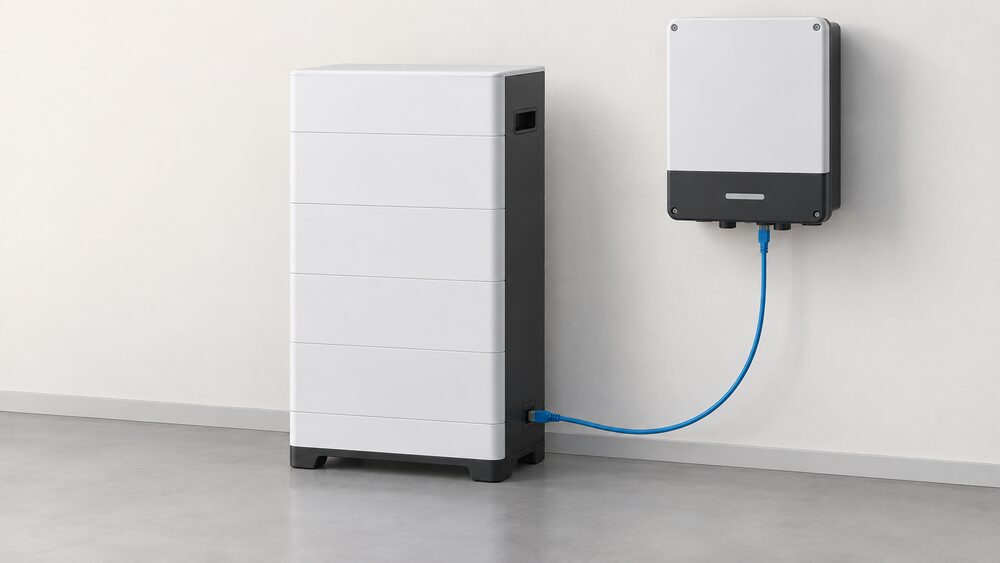
The Dyness PowerBox Pro is a low-voltage home battery with a nominal capacity of 10.24 kWh per module, expandable to 50 units in parallel for a stated energy coverage of 10.24 kWh to 512 kWh1. It is sold as a battery only: an inverter, installation and any backup changeover are separate, and the householder or installer must confirm the inverter is compatible before buying1.
The most important thing a UK buyer needs to know is that the PowerBox Pro is listed as discontinued2. Dyness itself gives the product a global sales area excluding North America, Spain, Germany and Brazil, which includes the UK, but a discontinued listing means new stock cannot be relied on and any remaining units are run-out purchases2.
On price, a UK distributor lists the unit at £1,373.90 ex VAT with a £150 plus VAT delivery charge for up to four identical units, delivered by pallet to the kerbside, usually next working day2. A second distributor figure of £1,648.68 also appears for the same product and the two are not reconciled, so the price should be treated as quoted rather than fixed2.
Discontinued in the UK: what that means for buyers and owners
A UK distributor lists the Dyness PowerBox Pro as discontinued2. That is the single fact that should shape any decision about this model. A discontinued listing does not necessarily mean the product is unsafe or unsupported, but it does mean the supply route that a householder would normally use is closing, and the practical consequences fall in three places: availability, spares and the resale or expansion path.
Availability is the first. Dyness gives the PowerBox Pro a global sales area excluding North America, Spain, Germany and Brazil, which includes the UK, so the maker's own position is that the product is sold here1. The distributor listing and the maker's sales area are not the same statement: one describes what a seller currently offers, the other describes where the product is intended to be sold. Where a product is being run down, remaining stock may be limited to specific sellers and specific quantities, and a householder planning a system around a particular module should confirm that more of the same module can be obtained later if the intention is to expand.
Spares and service are the second. No warranty term, service arrangement or spares position is published for the PowerBox Pro, so nothing can be said about how long support will run or what happens if a module fails. That absence matters more on a discontinued line than on a current one, because the expansion path and the replacement path both depend on the same module being obtainable.
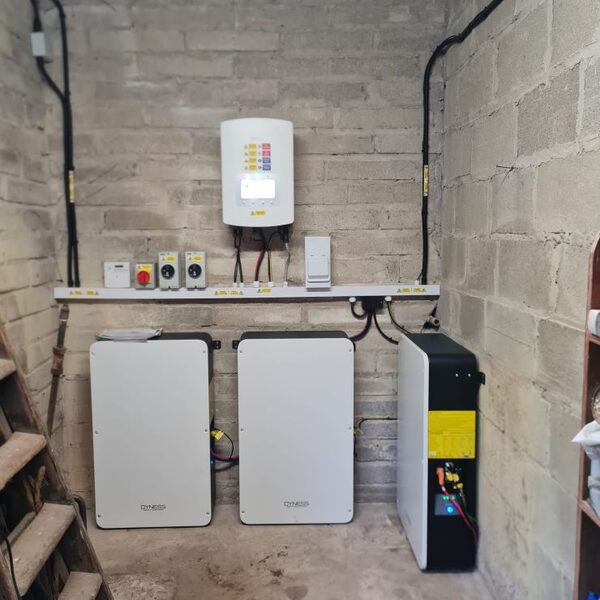
The third is expansion. The PowerBox Pro's main selling point is that it scales to 50 units in parallel1. A household that buys one module intending to add more later is relying on that module still being available when it wants the second and third. A UK project already used three modules in parallel for 30.72 kWh, so multi-module installations are an established pattern rather than a theoretical one3. Anyone weighing a discontinued battery against a current model should read the position on modular and stackable battery systems and on home battery warranties before committing.
What the PowerBox Pro is: an all-in-one low-voltage battery
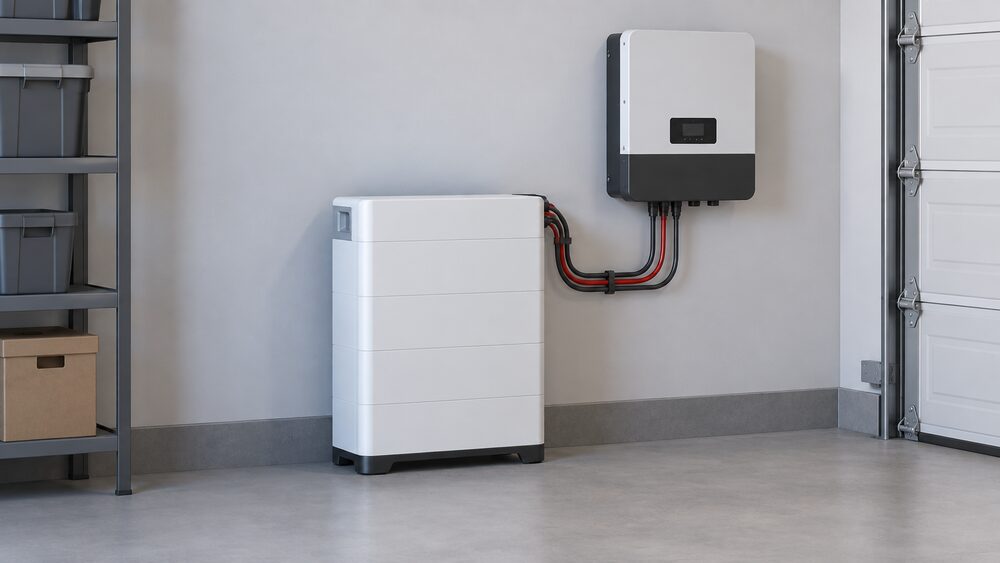
The PowerBox Pro is a low-voltage residential energy storage system, which Dyness lists under its low-voltage residential range4. Low voltage matters because it determines which inverters the battery can talk to and how the system is wired. The battery communicates with compatible inverters through the corresponding CAN or BMS communication protocol, usually over an RJ45 communication cable1. It is not a hybrid inverter and it is not a complete system: it is the storage half of a system, and the inverter, the changeover arrangement and the installation are supplied separately.
Dyness builds in several protective and balancing features. The product page lists short-circuit lockout, surge resistance, and support for mixing modules under different states of charge to protect battery life1. Across the low-voltage range the company states that all low-voltage batteries carry a short-circuit lockout function, that the system allows integration of 0% and 100% power modules, that a pre-discharging function improves voltage balance, and that the range supports up to a 1C charging and discharging ratio5. A current-limiting function allows intelligent charging to self-balance even where parallel modules differ in capacity5.
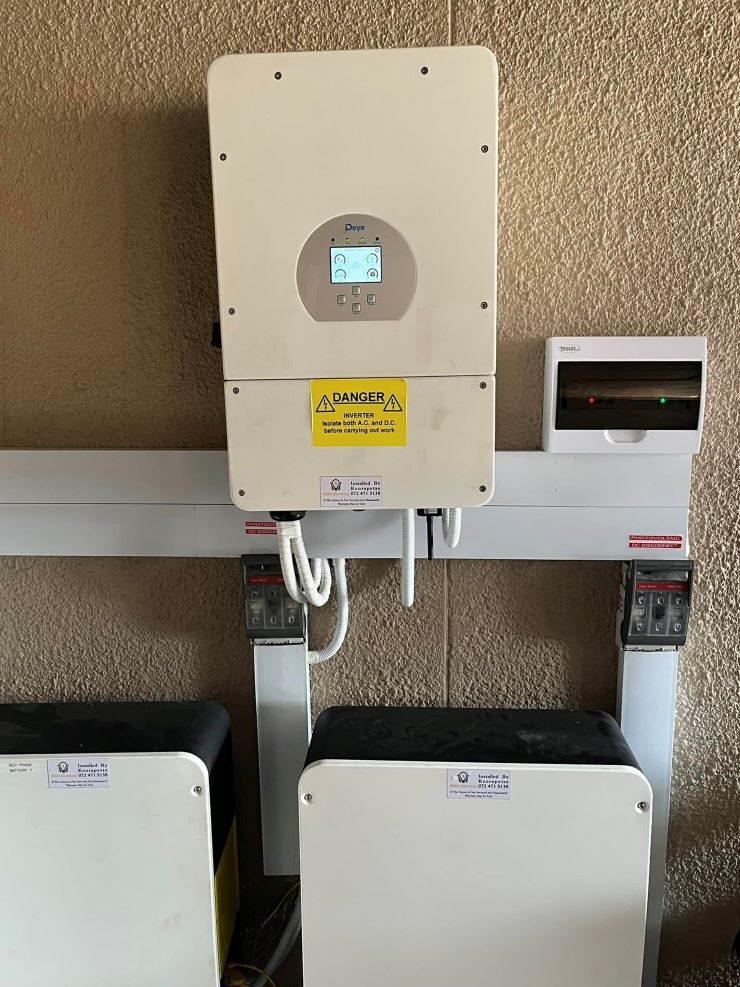
The practical consequence of the low-voltage design is that the battery is a component in a system a householder assembles with an installer, not a plug-in appliance. Dyness states plainly that users should verify the inverter is compatible with the PowerBox Pro and follow the corresponding installation instructions1. The maker publishes a low-voltage compatibility list with inverter brands, dated 27 July 2026, which is the document to check against a proposed inverter6. For the wider picture of how these systems are put together, see all-in-one home battery systems and AC-coupled and DC-coupled home batteries.
Capacity: 10.24 kWh per module, expandable in parallel
One PowerBox Pro module is 10.24 kWh nominal1. That is the nameplate figure, and it is the number a householder will see quoted in a specification. It is not the same as usable capacity: no depth of discharge, no round-trip efficiency and no usable kWh figure is published for this model, so the energy actually delivered to the house will be lower than 10.24 kWh. The distinction between nominal and usable capacity is set out in battery capacity and usable capacity.
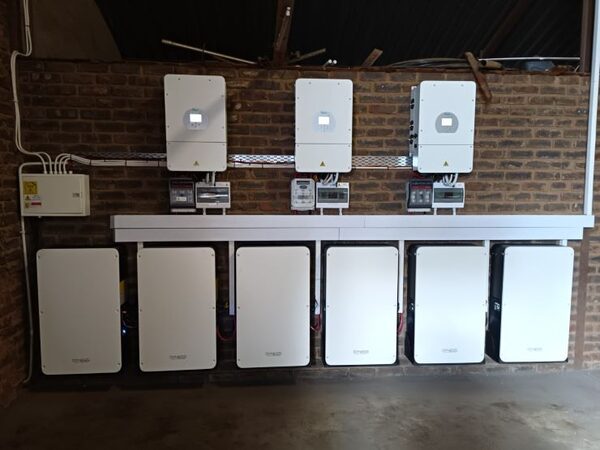
The stated energy coverage across a parallel bank runs from 10.24 kWh to 512 kWh, which is the arithmetic of 50 modules at 10.24 kWh each1. A UK installation used three modules in parallel for 30.72 kWh, which is the same arithmetic at a domestic scale3. Dyness describes that project as three PowerBox Pro modules connected in parallel with a Solis inverter, forming a more powerful supply system than a single module3.
For a household, the useful way to read the capacity figure is against daily consumption rather than against the maximum. A single 10.24 kWh module is a modest battery by current UK standards, and the parallel expansion is what turns it into a larger system. Because the modules can be mixed at different states of charge, adding a module later does not require the existing bank to be at a matched state of charge, which the maker says protects battery life1. Whether adding later is realistic depends on the discontinued status discussed above.
| Configuration | Nominal capacity | Source |
|---|---|---|
| One module | 10.24 kWh | 1 |
| Three modules in parallel (UK project) | 30.72 kWh | 3 |
| Maximum, 50 modules in parallel | 512 kWh | 1 |
Scalability: up to 50 units in parallel
The PowerBox Pro supports up to 50 units in parallel1. That is the headline scalability figure, and it is shared across much of the Dyness low-voltage range: the PowerBox G3, PowerBrick Plus, PowerDepot G2, DL5.0C and DL5.0C Pro are all listed at up to 50 units in parallel, and the PowerBrick SC is listed as supporting 50 parallel units7. The DL5.0C is described as covering energy requirements from 5.12 kWh to 256 kWh across its 50-unit maximum10.
Scaling is not simply a matter of adding modules. Dyness states that a system with multiple PowerBox Pro batteries may require suitable breakers, fuses, busbars, combiner boxes, and correctly sized cables based on the system current and local electrical standards1. That is the point at which a domestic installation stops being a single appliance and becomes a small electrical installation in its own right, with protection and cabling sized for the combined current. The installation surface also has to be stable, level, dry and capable of supporting the weight of the battery1.
Communication is the other constraint. The battery talks to the inverter over CAN or BMS protocol, usually with an RJ45 cable, and Dyness lists the causes of communication failure as an incorrect or damaged communication cable, wrong cable PIN definition, incorrect DIP settings, unsuitable communication ports, missing CAN termination, or incorrect inverter battery settings1. On a multi-module bank those settings matter more, because the inverter has to see the whole bank correctly. The rules that govern notifying the network operator about a battery of this size are covered in battery grid connection: G98 and G99, and the standards that apply to the installation itself in battery installation standards.
Monitoring and remote management
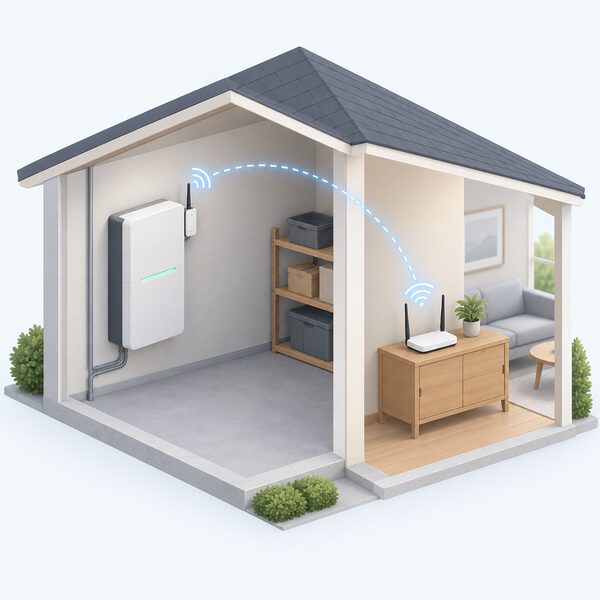
Dyness states that the PowerBox Pro battery modules are equipped with intelligent monitoring and remote management functions, showing working status, power information and fault warnings in real time3. Across its battery range the company uses a WiFi module that enables real-time monitoring of operating data and remote troubleshooting, and a remote over-the-air upgrade function that streamlines system maintenance5. The Dyness Smart app provides real-time monitoring of system running and battery health, and intelligent optimisation of system operation such as state of charge5. The wider product range is marketed on real-time monitoring through app and web7.
What this means for a household is a split between local and remote. The battery and the inverter continue to operate without an internet connection, because the storage and the switching are local. What depends on the network is the visibility: the app, the remote diagnostics and the over-the-air updates all run through the maker's servers and a home broadband connection. If the broadband drops, the system keeps working but the household loses the remote view of it, and the fault warnings that would otherwise appear in the app are not delivered.
The fault information itself is worth understanding, because it is the main thing monitoring surfaces. Dyness lists the causes of abnormal state of charge readings as the battery not reaching a full charge for an extended period, BMS protection, communication failure, incorrect inverter settings, or an abnormal breaker or cable connection1. Those are the same categories an installer would work through on a site visit, which is why the monitoring data is useful to a service call rather than a substitute for one. More on what these systems report is in monitoring a home battery: apps, data and local access, and on the control electronics in battery management systems.
Price: £1,373.90 ex VAT, plus delivery
A UK distributor lists the Dyness PowerBox Pro at £1,373.90 ex VAT2. The same listing applies a delivery charge of £150 plus VAT for up to four identical units2. A second distributor figure of £1,648.68 also appears for the same product, and the two figures are not reconciled, so the price should be read as quoted rather than as a settled market price2.
Three things sit outside that figure. The first is VAT: the listed price is ex VAT, and the VAT treatment that applies to a delivered battery is not stated, so the tax position should be confirmed with the seller. The second is installation: the price is for the unit and its delivery, not for mounting, cabling, protection, inverter or commissioning. The third is the inverter, which is a separate purchase and a separate compatibility question1.
Because the product is listed as discontinued, the price is also a run-out price rather than a current list price2. That cuts both ways for a householder: remaining stock may be discounted, or it may be the last of a line with no route to a matching second module later. For context on what a complete installed system costs rather than a bare module, see how much does a home battery cost in the UK, and for how the numbers are worked through to a payback figure, home battery savings and payback.
| Item | Figure | Notes |
|---|---|---|
| Unit price | £1,373.90 ex VAT | Distributor listing2 |
| Alternative listed price | £1,648.68 | Not reconciled with the figure above2 |
| Delivery | £150 plus VAT | Up to four identical units2 |
| Inverter, installation, mounting | Not stated | Separate purchase and separate quote1 |
Delivery: pallet, kerbside, usually next working day
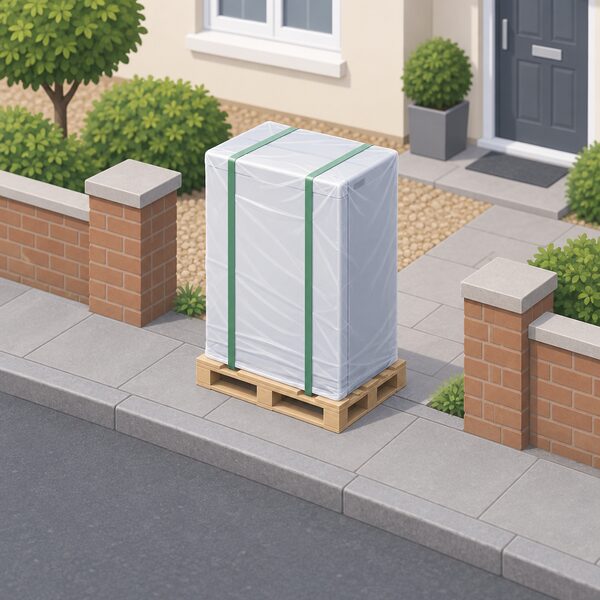
Delivery is by pallet to the kerbside, and the distributor states it can take up to 48 hours but is usually next working day2. Kerbside delivery means the pallet is left at the edge of the property rather than carried to the installation position. For a battery of this size that is a practical consideration rather than a detail: the householder or installer has to move it from the kerbside to the mounting point, and the maker requires the installation surface to be stable, level, dry and capable of supporting the weight of the battery1.
The delivery charge covers up to four identical units at £150 plus VAT, so a multi-module order does not multiply the delivery cost in the way a single-unit order would2. Beyond four units no delivery figure is published, so a larger order should be quoted by the seller.
Timing should be planned around the installation rather than the other way round. A battery arriving on a pallet at the kerbside needs somewhere to go, and the surface it goes on has to be prepared first. The general sequence for a domestic installation, from survey to handover, is set out in home battery installation: survey, fitting and handover, and the question of where a battery can physically be sited in where a home battery can be installed.
Dyness in the UK and beyond: the wider product range
Dyness launched a range of low-voltage energy storage products for the UK market in January 2024, including the DL5.0C9. The company's low-voltage residential range now covers the PowerBox Pro, PowerBox G3, PowerBrick, PowerBrick Plus, PowerBrick SC, PowerDepot G2, PowerDepot H5B, DL5.0C and DL5.0C Pro, most of them supporting up to 50 units in parallel7. The PowerBox G3 is listed with a sales area covering Europe, with the United Kingdom named among the product inquiry countries8.
Alongside the low-voltage line, Dyness sells the high-voltage Tower Pro Series, which supports up to 12 clusters in parallel covering 7.68 kWh to 276.48 kWh, and the STACK100 Pro Series, for which the maker publishes a separate compatibility list dated 27 August 20264. The Tower Pro Series is described as using high-voltage output to maximise energy efficiency4. The company also publishes a low-voltage compatibility list with inverter brands dated 27 July 2026, which is the document that matters when matching a PowerBox Pro to an inverter6.
Dyness products have been installed in the UK and in mainland Europe. A PowerDepot H5B was chosen for a residential installation in a suburban house in the south of England, and the PowerDepot H5B is described as expandable to 51.2 kWh in parallel from 5.12 kWh per unit11. The DL5.0C Pro is listed at 5.12 kWh per unit with up to 50 units in parallel10. On safety, Dyness states that newly launched products such as the PowerBrick support optional aerosol fire extinguishers with detection and sensing elements5. The wider Dyness range is covered in Dyness home batteries: PowerBox and DL range, and the fire safety questions in home battery fire safety.
For a household, the range matters because it determines whether a discontinued module can be substituted. The PowerBox Pro's 10.24 kWh module is one of several Dyness low-voltage products, and the parallel limits and communication method are shared across much of the range, but no statement is published that any other module is a drop-in replacement for the PowerBox Pro. Substitution is a question for the installer and the maker, not an assumption.
What the PowerBox Pro does for household independence
A battery of this kind changes when a household draws from the grid, not whether it is connected to one. The PowerBox Pro stores energy, and the inverter decides when that energy is used: to absorb surplus generation from solar, to shift consumption away from peak tariff periods, or to hold charge for a period when the grid is unavailable. No backup or changeover specification is published for this model, so nothing can be said about what would keep running in a power cut. The general position on backup is set out in battery backup in a power cut: EPS, changeover and what keeps running.
The dependencies that remain are worth stating plainly. The household stays on the grid and on a supplier, because the battery does not generate. It stays dependent on an inverter that is compatible with the battery and correctly configured, on the communication link between the two, and on the protection and cabling sized for the bank1. It stays dependent on the maker's app and servers for remote monitoring and over-the-air updates, though local operation continues without them5. And on a discontinued line it depends on the module still being obtainable if the intention is to expand2.
What the battery does offer is a degree of control over timing. A 10.24 kWh module, or a bank of them, lets a household decide when stored energy is used rather than taking whatever the grid and the tariff dictate at that moment. How far that goes towards self-sufficiency depends on the size of the bank, the generation or tariff feeding it, and the household's daily consumption, which is why the sizing question is covered separately in what size home battery do you need and the wider subject in home batteries and household energy independence.
Sources12 cited
- PowerBox Pro Low Voltage Storage Batteries Household Use, Dyness, 2026-09-17
- Dyness Powerbox Pro 10.24kW Battery, Tradesparky, 2026-09-17
- Powerbox Pro Solis Parallel Home Energy Storage Project in the UK, Dyness, 2023-03
- Tower Pro Powers a Dutch Family's Energy Independence, Dyness, 2025-08
- Joint Compatibility of Victron and Dyness Allows for an Enhanced User Experience, Dyness, 2024-09-19
- Inverter Matching List, Dyness, 2026-07-27
- Energy Storage Products, Dyness, 2026-09-17
- PowerBox G3 Low Voltage Residential Battery, Dyness, 2026-09-17
- Dyness Leads the Way in the UK Energy Storage Market With Innovative Solutions, Dyness, 2024-01-30
- DL 5.0 C Makes It Easy to Integrate Into the Environment of Old Houses, Dyness, 2025-04
- PowerDepot H5B Provides Excellent Safety and Longevity, Dyness, 2025-03
- PowerDepot H5B Powers Resilient Living in the Storm Prone Philippines, Dyness, 2024-12
 Dyness Home BatteriesWhich Dyness battery suits a normal UK home, and can you add more later?