
In this guide
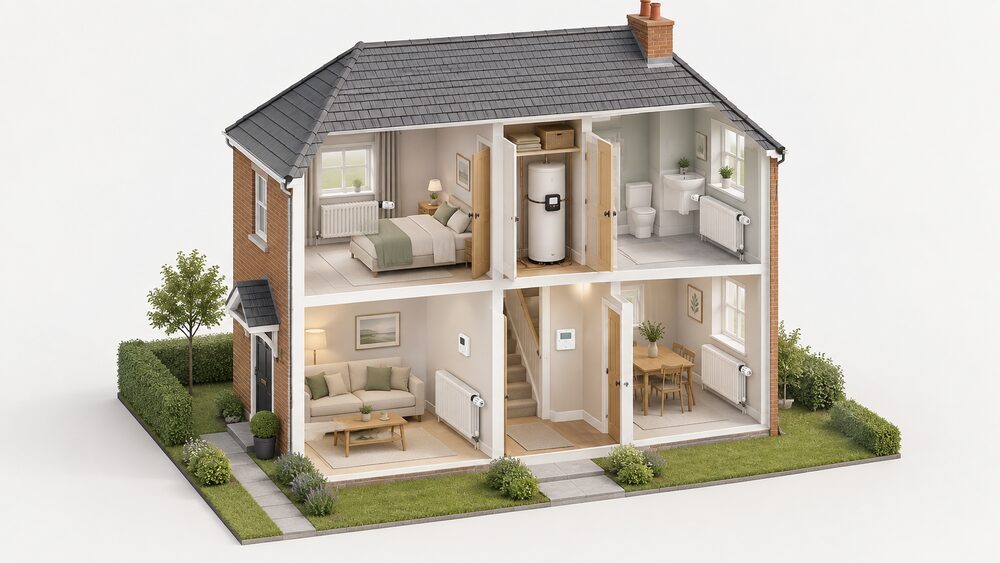
Horstmann is a UK name in domestic heating controls, and a Horstmann thermostat is most often found in a home that was fitted with a programmer and a wall thermostat some years ago and has run on them since. The control does one job: it measures the room temperature and switches the boiler on and off to hold the level the household has chosen1. Around it sits the rest of the control set, a time control, thermostatic radiator valves and, where there is a cylinder, a cylinder thermostat2.
The reason the brand still matters is regulatory as much as commercial. For heating systems in new dwellings, or when a heat generator such as a boiler is replaced in an existing dwelling, each room should be provided with thermostatic room controls able to adapt the heating output in each room served3. A wall thermostat and TRVs are the ordinary way that requirement is met, and a working Horstmann unit already satisfies part of it.
What follows is what the range does, how it wires to a boiler, how it is set up and used, what faults point to, and where a legacy control leaves a household dependent. Prices for Horstmann controls are installer-quoted and no published figure is available.
What a Horstmann control does in a heating system
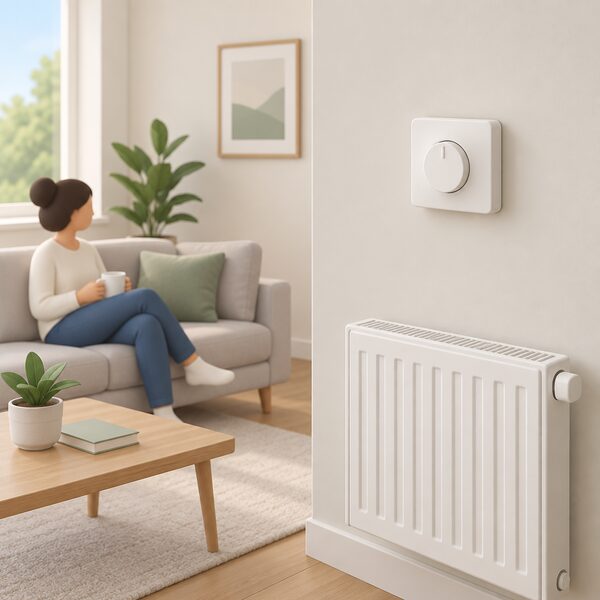
A heating thermostat measures the room temperature in the home and controls the heating system to maintain a set temperature1. A central heating thermostat does this from a single wall position for the whole house, telling the boiler when to turn on and off1. That is the role a Horstmann room thermostat plays, and it is a switching role rather than a modulating one: the thermostat is a temperature-sensitive switch on the boiler's control circuit.
The wider control set is what makes the switch useful. Heating controls help control when the heating system operates and the temperature in each room2, and the recommended set is a time-controlled programmer, at least one room thermostat, thermostatic radiator valves where there are radiators, and a cylinder thermostat where the system has a hot water cylinder2. Cadent describes a full set in the same terms: a programmer, thermostatic radiator valves and a room thermostat7.
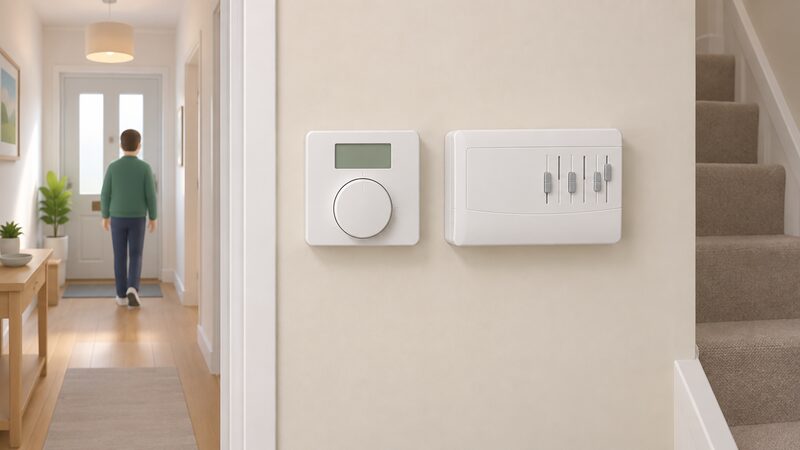
Where a Horstmann programmer sits in that arrangement is as the time control. It decides the hours in which heating and hot water are called for at all; the room thermostat then decides whether the boiler actually fires within those hours. A programmable room thermostat collapses the two into one unit, combining time and temperature controls and allowing different temperatures for different times of day4.
For a household, the significance is that these are local controls. They run on mains wiring and, in the wireless versions, a radio link inside the home. Nothing in the chain depends on a broadband connection, an account or a manufacturer's server, which is the point developed later on this page.
The range: room thermostats, programmers and timers
Horstmann's UK output has historically covered the three control types a gas or oil system needs: the room thermostat, the programmer or time switch, and the cylinder thermostat for stored hot water. The distinctions between them matter more than the badge, because each answers a different question.
A room thermostat answers whether the house is warm enough. A programmer answers when the system is allowed to run. A cylinder thermostat answers how hot the stored water should be, and it stops the cylinder becoming hotter than it needs to be: once the water reaches the set temperature, the heat supply from the boiler is turned off4. That last function is a safety and efficiency control as much as a comfort one, and it is the reason a gravity or fully pumped cylinder system needs one.
Programmers and timers divide further. A simple time switch gives on and off periods only. A programmer adds separate channels for heating and hot water, which is what a household with a cylinder needs if the two are to run on different schedules. A programmable thermostat, as above, merges the time control into the room unit4.
The regulatory backdrop is consistent across the UK nations in substance. Approved Document L Volume 1, in its 2026 Wales edition, requires that each room should be provided with thermostatic room controls3, and the Northern Ireland discussion document on building regulations points the same way, noting that thermostatic control measures typically require both room thermostats and thermostatic radiator valve controls8. The 2025 Wales consultation version of Approved Document L sets out the same requirement for electric warm air systems, where a programmable room thermostat or a time switch and room thermostat is needed on a new system or a replacement component9.
| Control type | What it decides | Where it sits |
|---|---|---|
| Room thermostat | Whether the room is at the set temperature1 | Wall, in a living space |
| Programmer or time switch | When heating and hot water may run2 | Airing cupboard or hallway |
| Programmable thermostat | Time and temperature in one unit4 | Wall, in a living space |
| Cylinder thermostat | How hot the stored water gets4 | On the cylinder |
Which control suits which heating setup
The right Horstmann control follows from the system, not from preference. A combi boiler with no cylinder needs a room thermostat and a time control, and nothing more: there is no stored water to thermostat. A system or regular boiler with a cylinder needs the cylinder thermostat as well, because the stored water has to be held at a set temperature and the boiler has to be told when to stop heating it4.
Zoned homes change the picture again. Where a house has separate heating zones, each zone needs its own room control if the requirement that each room be able to adapt its heating output is to be met in practice3. A single Horstmann wall thermostat in the hallway cannot do that on its own, and the usual answer is TRVs on the radiators plus a zone valve and thermostat per zone.
Underfloor heating is a separate case. In wet systems the thermostat controls motorised valves on the underfloor heating manifold, regulating warm water flow, while in electric systems it controls the electrical supply to heating cables or mats beneath the floor1. A Horstmann room thermostat designed for a radiator circuit is not the same device as a floor probe thermostat, and the two are not interchangeable.
For a household deciding whether to keep an existing Horstmann control or replace it, the useful question is what the system needs rather than what the control is called. The pages on room thermostats and heating programmers and timers set out the types in more detail, and heating controls by home type matches them to property and system.
Wiring and compatibility with boilers and existing controls
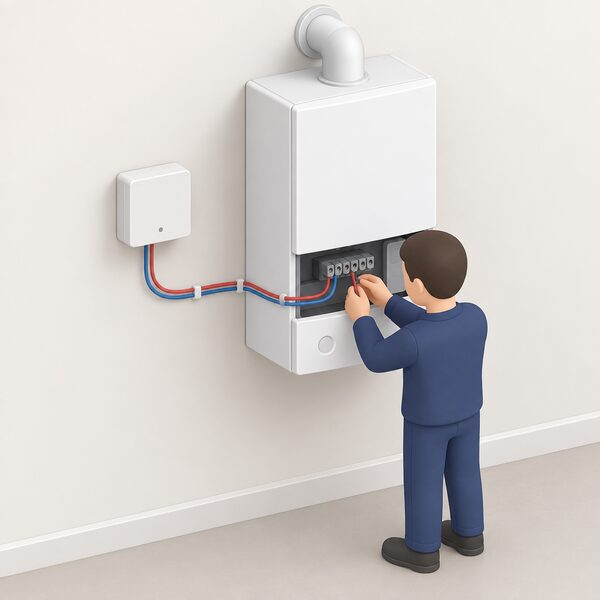
A wired Horstmann thermostat is a switch on the boiler's control circuit, and its compatibility is therefore a question of voltage-free switching and terminal arrangement rather than of brand. A wireless unit works differently: it usually sends a signal to a receiver connected to the boiler, which then tells the boiler when to turn the heating on or off, with no direct wired connection between thermostat and boiler5. That receiver is what the boiler sees, and it is the part that has to match the boiler's control terminals.
Modern controls in the wider market are built to be flexible about this. The tado° Wired Smart Thermostat X is described as replacing the current wall thermostat and being compatible with most boilers and heat pumps on relay or OpenTherm connections, and able to control water-based underfloor heating1. Honeywell Home smart heating controls are described as designed to work with both boiler and heat pump systems10. Vaillant's ecoTEC sustain combi range is listed as compatible with a wide range of Vaillant room thermostats and wired and wireless controls11. The pattern is that a control is matched to a boiler by its switching method, not by its maker.
Two practical points decide most installations. The first is whether a neutral wire is present at the existing thermostat position, which determines whether a mains-powered replacement can go straight in. The second is whether the existing wiring is a simple two-wire switch or part of a zoned arrangement with valves and a wiring centre. The heating control wiring page covers S-plan, Y-plan and wiring centres, and boiler interlock explains why the controls must be arranged so the boiler cannot fire with no demand.
Installing and setting up a Horstmann thermostat
Installation practice in the controls market splits between self-fit and professional. Hive recommends finding a local tradesperson to install its smart thermostat, describing it as a task that can be awkward13. The Nest Learning Thermostat requires professional installation, while the Nest Thermostat E can be installed by the householder14. Bosch's Room Thermostat II is listed as self-installation15, and the Ideal Halo wireless thermostat is described by its maker as wireless, fast and simple to install16.
A Horstmann replacement follows the same logic as any of these. Where the new unit occupies the same backplate and uses the same switching terminals, the work is a swap. Where the system type is changing, or where a wireless receiver has to be wired at the boiler, the work belongs with a competent person, and in the UK that means someone able to work safely on the boiler's control circuit.
Setup is where the household's own choices begin. A programmable thermostat needs its time and temperature periods entered, and a wireless unit needs pairing to its receiver before anything else will work. The Salus HTRP24 programmable thermostat, a comparable product in the same market, offers weekly scheduling with adjustable time slots17, and the Ideal Halo comes with a preset schedule that is altered in the Timed Heating Schedules section of the menu16. The pattern is common: a factory schedule exists, and the household edits it rather than building one from nothing.
Everyday use: settings, schedules and overrides
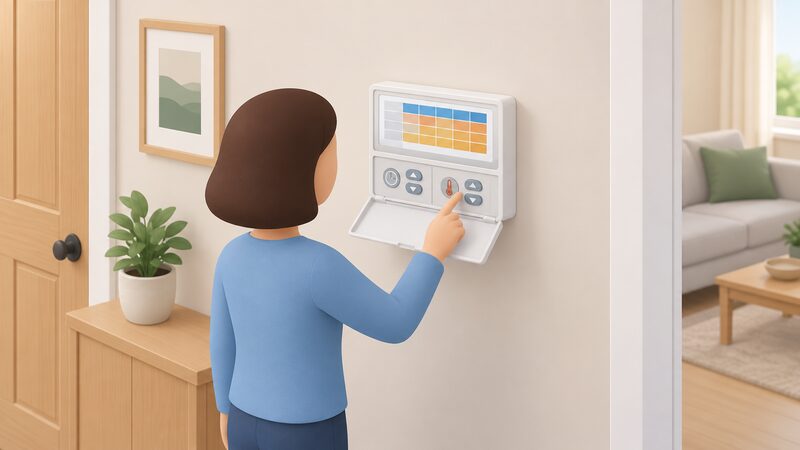
In daily use a Horstmann control is doing two things: holding a temperature and holding a timetable. The temperature side is the thermostat's setpoint, and the timetable side is the programmer's on and off periods. Where the two are combined in a programmable thermostat, the household sets different temperatures for different times of day in one place4.
The reason to bother is straightforward. Room thermostats and heating controls allow a household to set and maintain the temperature in the home, keep it warm for the times of day people are there, and switch it off to save energy when they are not18. A room thermostat turns the boiler on and off automatically when the room reaches the level chosen19, so the setpoint is the single most consequential number in the system.
Overrides matter as much as schedules in practice. A boost button, an advance function or a simple manual override lets a household bring a heating period forward without rewriting the programme. On a programmable unit the override is usually temporary and reverts at the next scheduled change, which is the behaviour to check in the model's own instructions.
Two settings are worth understanding because they are commonly confused. The first is the difference between the thermostat setpoint and the boiler's own flow temperature: the thermostat decides whether there is a demand, the boiler decides how hot the water it sends round the radiators is. The second is the cylinder thermostat, which stops the cylinder becoming hotter than it needs to be and turns the heat supply off once the water reaches the set temperature4. Neither is a comfort preference; both change how much fuel the system uses.
Common problems and what they point to
Most faults reported against heating controls are not boiler faults at all. In one manufacturer's feedback data, over 10% of Viessmann's total feedback comments over a twelve month period related to controls and thermostat issues20, which is a reminder that the control layer is where a large share of household frustration lands.
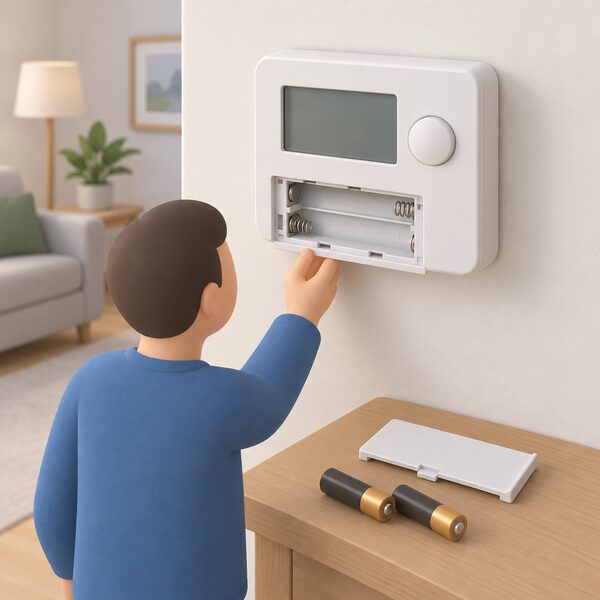
The commonest pattern is a thermostat that never calls for heat. A room thermostat turns the boiler on and off automatically when the room reaches the chosen temperature19, so a system that stays cold usually means the setpoint is already satisfied, a wireless unit has lost its radio link to the receiver, or the batteries in a wireless thermostat have failed. A lost link is a specific and diagnosable fault: the Ideal Halo reports a code indicating that the thermostat has lost connection with the smart interface, with the advice to ensure the interface has power and to follow the distance and location guidance in the user guide16.
Fault codes are not transferable between brands. A code shown on one maker's boiler display means what that maker says it means: the Viessmann fault code checker, for example, explains that an OC fault code on the Vitodens 100-W boiler means there is insufficient power being supplied21. The same letters on a Horstmann control would carry no such meaning. The model's own guide is the only reliable key.
Where a fault persists, the sequence is to check the setpoint and the power supply, then the receiver and its link to the thermostat, then the boiler itself. On heat pump systems the equivalent advice is to check the fault log for recurring fault messages and speak to the installer and manufacturer22. The heating control faults page covers the wider diagnostic order.
Horstmann and household energy independence
The case for a Horstmann control, and for wired local controls generally, is that the whole chain sits inside the house. A room thermostat and a programmer run on mains wiring and a radio link. They do not need a broadband connection, an online account, a manufacturer's server or a subscription, and they keep working through an internet outage. That is a real form of independence, and it is the reason legacy controls survive in so many homes.
The dependence that remains is on the fuel and the boiler. A gas boiler keeps the household on the gas grid and on a gas supplier, and the control only decides when that gas is burned. There is also an electrical dependence for ignition, controls and pumping, so a power cut stops the system regardless of what the thermostat is doing.
Smart controls change the balance rather than removing the dependence. A smart thermostat connects to Wi-Fi, which allows it to form part of a more connected home heating system5, and most smart heating controls link to a phone, with heating controllable by smartphone, tablet, laptop or smart speaker23. The features vary by model and can include app control, voice control, hot water settings, location-based heating, reminders or alerts, open window detection, routine learning and heating-use tracking5. Each of those is useful and each of them is a dependency on a network and a company.
Cost is part of the picture. A household wanting a smart thermostat may have to pay for the device and the installation24, and the independent advice is to look into replacing an old thermostat before it gets too cold, before the autumn gets too chilly25. The heating controls and energy independence page sets out the local-versus-cloud trade-off in full, and smart thermostat subscriptions covers app charges.
For a household with a working Horstmann control, the honest position is that it delivers local, unnetworked control of a gas system, and nothing more. It cannot change the fuel, reduce the standing charge or remove the reliance on a supplier. What it does is keep the decision about when the boiler fires inside the home.
Sources25 cited
- Heating thermostat guide, tado°, 2026
- Thermostats and heating controls, Home Energy Scotland, 2026
- Building Regulations Approved Document L Volume 1 2026, Welsh Government, 2026
- Thermostats and heating controls, Energy Saving Trust, 2026
- What is a smart thermostat, Smart Energy GB, 2026
- Thermostats, Heatrae Sadia, 2026
- Energy efficiency advice, Cadent Gas, 2026
- Building Regulations discussion document and pre-consultation, Northern Ireland Department of Finance, 2023
- Approved Document L Volume 1 consultation version, Welsh Government, 2025
- Smart heating, zoning and training at InstallerSHOW 2026, CIPHE, 2026
- Vaillant ecoTEC sustain combi boilers, Quiet Mark, 2026
- ECO4 New Measures and Products Guidance v3.0, Ofgem, 2026
- tado vs Hive: which smart thermostat is best, Energy Helpline, 2026
- What are smart thermostats, Uswitch, 2026
- How to buy the best smart thermostat, Which?, 2026
- Halo, Ideal Heating, 2026
- HTRP24 programmable thermostat, Salus Controls, 2026
- Make winter feel summer, Home Energy Scotland, 2026
- How to use your heating controls, Age UK, 2026
- Boiler statistics, Uswitch, 2024
- What to do if your boiler breaks down at Christmas, Which?, 2025
- How to ensure a heat pump runs efficiently, Energy Saving Trust, 2026
- Smart homes and lower carbon footprint, Energy Saving Trust, 2026
- Do I already have a smart meter, Smart Energy GB, 2026
- How a smart thermostat can save you money this winter, Ivie, 2025