In this guide
SMA is a German inverter manufacturer whose home storage offer is built around one battery, the SMA Home Storage, sold in 3.2kWh modules that stack from 3.2 kWh to 16.4 kWh1. The battery is designed to work with SMA's own hybrid inverters rather than as a standalone unit, and SMA states it "perfectly complements SMA's hybrid inverters enabling energy solutions of today and tomorrow"2.
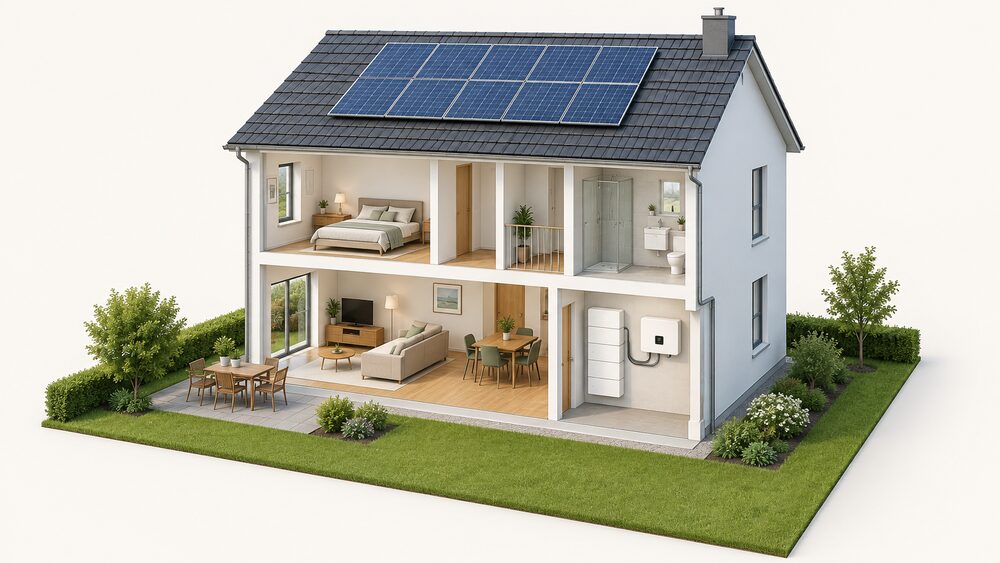
The practical shape of an SMA system is therefore a pair: a hybrid inverter such as the Sunny Tripower Smart Energy or the Sunny Boy Smart Energy, plus a stack of Home Storage modules. The Sunny Tripower Smart Energy is a three-phase, DC-coupled hybrid inverter and charger, available in versions from 5.0kW to 10.0kW, with four models offered in the UK3. The Sunny Boy Smart Energy is a single-phase option, also with four models available5.
Backup is the feature most householders ask about, and it is conditional. SMA lists an integrated black start function for back-up supply on the Home Storage battery, qualified as applying "when combined with the SMA hybrid inverter"1. The Sunny Tripower Smart Energy carries an integrated battery-backup function that safeguards the electricity supply in the event of a grid failure3. Independent guidance is consistent that a battery does not normally provide power in a power cut unless additional equipment and configuration is included7.
What SMA home storage is and how it pairs with SMA hybrid inverters
SMA's storage proposition is a modular battery plus a hybrid inverter, and the two are sold as a matched pair. The Home Storage battery is described by SMA as a modular battery that homeowners can expand at any time, and the company positions it as the storage half of what it calls the SMA Home Storage Solution2. The battery itself is listed as compatible with SMA's hybrid inverters, and the Storage M carries the same compatibility statement1.
The inverter half of the pairing is where the flexibility sits. SMA states that its hybrid inverters can operate both with and without a battery, and that a battery can be added at any time without an additional battery inverter9. That matters for a household starting with solar only: the inverter can be installed first and the battery added later, without a second inverter being bolted on. SMA also notes that when battery and solar inverters are installed together, unused energy from the solar inverters can be stored in the connected battery9.
The Sunny Tripower Smart Energy is the three-phase route, a DC-coupled hybrid inverter and charger with Wi-Fi and Ethernet connectivity and G98 certification3. The Sunny Boy Smart Energy is the single-phase route, compatible with high-voltage batteries from major manufacturers including the SMA Home Storage battery and BYD HVS and HVM batteries5. A packaged example pairs a Sunny Boy Smart Energy inverter with a 6.56 kWh SMA Home Storage battery, an SMA Home Manager and a CT clamp, described as a high efficiency DC-coupled battery solution10.
For a household, the pairing is the point and also the constraint. The system is designed as a set, and the inverter is what turns a battery into something that can run a house. The wider question of how AC-coupled and DC-coupled systems differ is covered in AC-coupled and DC-coupled home batteries.
The battery range: 3.2kWh modules and how they scale
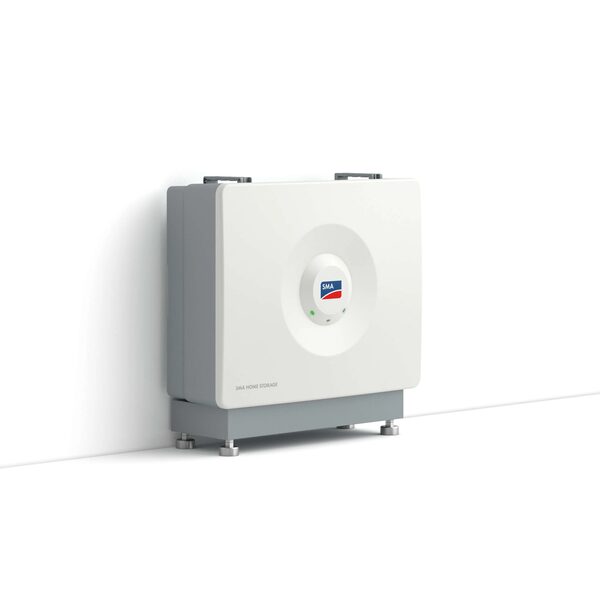
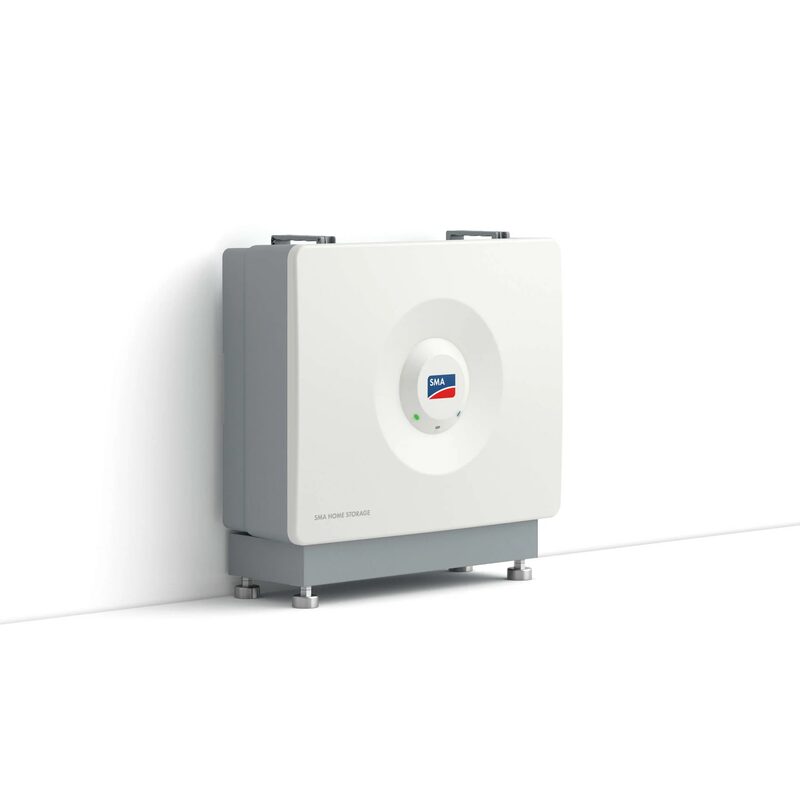
The SMA Home Storage battery is built from modules with a nominal storage capacity of 3.28 kWh each1. SMA describes the design as slim and stackable, scalable from 3.2 kWh to 16.4 kWh, and the Storage M is described in the same terms1. The module is a high-voltage system battery, wall mounted as standard or floor standing with an optional base unit1.
| Specification | SMA Home Storage module |
|---|---|
| Nominal capacity | 3.28 kWh1 |
| Stack range | 3.2 kWh to 16.4 kWh1 |
| Battery voltage | HV system1 |
| Cycle life | around 8000 charging cycles1 |
| Warranty | 10 years1 |
| Dimensions | Height 483mm, width 610mm, depth 214.6mm1 |
| Mounting | Wall mounted as standard, floor standing with optional base unit1 |
| Expansion | Expandable capacity possible within 2 years1 |
Two things stand out for a household planning a system. The first is that expansion is time-limited in the published terms: SMA states that expandable capacity is possible within 2 years1. The second is the installation method, described as a plug and play solution including automatic commissioning, with preassembled cables for an easy installation1. That is a maker's description of the fitting process, and the electrical work itself remains an installer's job.
The cycle life figure is given as around 8000 charging cycles on the Home Storage page, while the Storage M page states 8000 life cycles and 10 years of warranty1. The two documents give the same order of magnitude but phrase it differently, one as an approximation and one as a flat figure. Cycle life is not the same as calendar life, and how the two interact is set out in home battery cycle life and degradation.
SMA also states the battery is ready for future developments such as dynamic tariffs and virtual power plants1. That is a statement of design intent rather than a live service, and it depends on the platform behind it continuing to support those functions.
Compatibility: which inverters work with which batteries
Compatibility is the question that decides whether an SMA battery is even an option, and the answer is narrower than the battery's own specification suggests. SMA states the Home Storage battery is compatible with SMA's hybrid inverters, and the Storage M repeats that wording1. It is not presented as a battery for third-party hybrid inverters.
The Sunny Tripower Smart Energy hybrid inverter is listed as compatible with the SMA Home Storage battery and with BYD HVS and HVM batteries3. The Sunny Boy Smart Energy is compatible with high-voltage batteries from major manufacturers including the SMA Home Storage battery and BYD HVS and HVM batteries, across all models5. So within SMA's own ecosystem there is a genuine choice of battery, and BYD is the named alternative.
The BYD position is worth stating carefully. A separate manufacturer compatibility list shows the BYD Battery-Box HVM+ 8.3 and the HVB 5.9 and HVB 8.9 as not compatible with any listed inverter11. That list is not SMA's, and it does not say those BYD units are incompatible with SMA inverters specifically; it says they are not compatible with any inverter on that particular list. The BYD models SMA names are the HVS and HVM ranges3. Households comparing BYD options should check the exact model against the inverter, not the brand. The BYD range itself is covered in BYD Battery-Box Premium.
Where a household already has a non-SMA solar inverter, SMA offers a partial bridge: an SMA Energy Meter can be added for monitoring of non-SMA solar inverters or older SMA solar inverters without Webconnect10. That is monitoring, not storage. It does not make an SMA battery compatible with a third-party hybrid inverter.
Backup supply: the integrated black start function
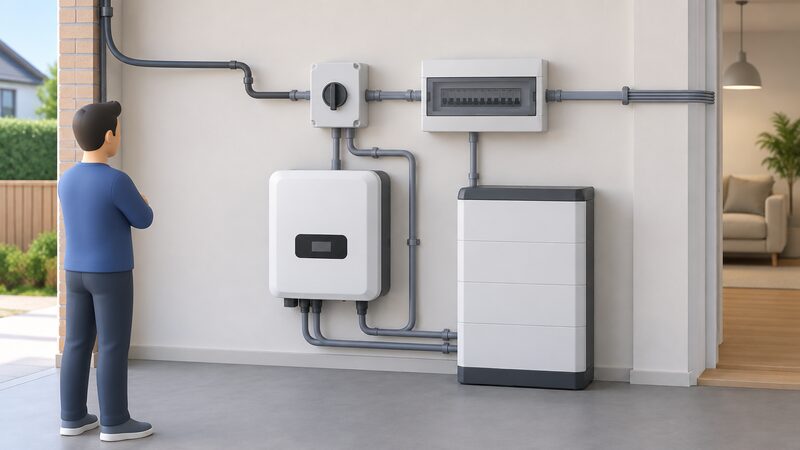
Backup is where the marketing language and the engineering conditions need separating. SMA lists an integrated black start function for back-up supply on the Home Storage battery, with the qualification "when combined with the SMA hybrid inverter"1. The Storage M carries the identical statement8. The function is therefore a property of the pair, not of the battery alone.
The inverter side supports that. SMA states that when paired with a battery storage system, hybrid inverters ensure households have access to electricity in case of a grid failure9. The Sunny Tripower Smart Energy has an integrated battery-backup function that safeguards the electricity supply even in the event of a grid failure, and its backup compatibility is listed as yes3.
Independent guidance is more cautious, and it is worth reading alongside the maker's claim. Which? advises that if a household is looking to protect against power cuts with a home battery, not all systems are suitable, and that the installer should be asked whether the battery will work in an outage and for how long12. The Energy Saving Trust states that a battery storage system does not normally provide power in a power cut unless additional equipment and configuration is included7. Electricity North West notes that in some cases storage devices can provide back-up supplies in a power cut, but that this is not always possible13. The Centre for Sustainable Energy states plainly that not all batteries can deliver electricity during a power cut14.
The reason for the caution is the anti-islanding rule. UK Power Networks explains that distributed generation switches itself off until after the mains supply has been restored, to protect itself15. Backup therefore requires equipment that isolates the home from the grid safely, which is what changeover switchgear does. SMA's own switchgear range includes a single phase automatic switchover switch compatible with the Sunny Boy Smart Energy hybrid inverters, enabling a smooth transition between grid and battery-backup operation16. A three-phase option, the Enwitec switch box, is described as an automatic transfer switch suitable for the SMA Flexible Storage System, allowing operation to continue in case of main power blackouts17.
The wider mechanics of changeover and what stays live are set out in battery backup in a power cut.
Grid connection: on-grid operation and what it means for exports
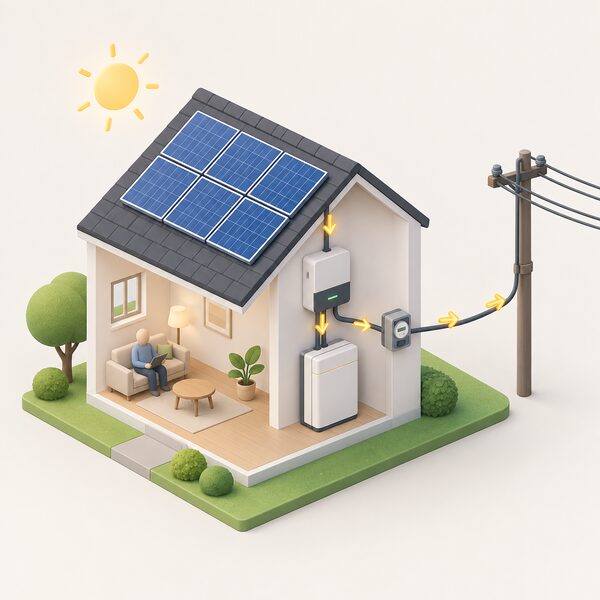
The SMA Home Storage battery is listed as on grid, and the Sunny Tripower Smart Energy is listed as on grid rather than off grid1. That is the design position: the system is built to operate alongside a grid connection, not instead of one.
Welsh Government guidance on behind-the-meter energy systems states that while a grid connection is not mandatory, it enhances the value of such systems by enabling the export of surplus electricity18. That is the trade-off in plain terms. A battery lowers the amount of electricity exported, which reduces export payments, but Home Energy Scotland states that overall savings are greater than relying on export payments19. Which? adds a specific warning: having a storage battery may render a household ineligible for some Smart Export Guarantee tariffs12.
The administrative side matters too. An export MPAN is what allows excess electricity to be exported back to the network, and these are mostly used with solar panel installations20. Solar Energy UK notes that new electricity tariffs mean homeowners can sell power they have produced and stored in a battery back to the grid automatically21. Where a household plans to export, SP Energy Networks states that an Export Limitation Scheme is not required if the network operator confirms there is enough spare capacity to accommodate it22. Home Energy Scotland confirms that households with installed renewables can be paid for electricity exported to the National Grid23.
For an SMA system, the practical sequence is that the battery serves the house first, and whatever is left over can be exported subject to the tariff terms. The battery reduces export volume and therefore export income, while increasing the share of solar generation used on site. The grid connection rules that govern this are covered in telling the network operator about a home battery.
Warranty and registration
SMA's warranty structure runs on registration, and registration is what sets the clock. SMA states that registering a product sets up the start of the device factory warranty at its commissioning date and gives portal access to warranty information24. That is a meaningful detail: the warranty period begins when the system is commissioned, not when it was bought or delivered.
The terms differ by product. The Home Storage battery module carries a 10 year warranty1, and the Storage M is described with 8000 life cycles and 10 years of warranty8. Sunny Boy inverters carry 5 years as standard, rising to 10 years after registration, with options to extend up to 15 years6. The Sunny Tripower Smart Energy hybrid inverter is listed at 5 years, or 10 years with registration in Sunny Portal or Sunny Places3.
Warranty extension plans exist, but SMA states that cover depends on the inverter model and on the warranty terms and conditions applicable in the country24. That qualification is worth reading as written: an extension is not a uniform product.
Registration timing can also be a condition of a scheme rather than of the maker. The Barcud Solar Panel Installation Scheme specification requires inverter product registrations to activate guarantees and warranties to be completed within 48 hours of commissioning25. That is a scheme rule rather than an SMA rule, but it shows how tightly registration deadlines can be drawn on funded installations.
The general principles of retained capacity, throughput limits and conditions are covered in home battery warranties.
What owning SMA storage means for household energy independence
A home battery's contribution to independence is straightforward in principle: it stores electricity for later use, making the energy system more independent from the National Grid12. The Centre for Sustainable Energy describes the mechanism as storing free electricity generated by solar panels during the day so it can be used by the household at night26. The Energy Saving Trust notes that combining solar panels with a home battery allows that stored electricity to power a heat pump, making the household less reliant on grid electricity27.
The scale of that independence is bounded. A battery shifts when electricity is used, not how much is generated, and the household remains connected to the grid for everything the panels and battery cannot cover. Welsh Government guidance on the Active Homes development in Neath states that householder use of solar generated electricity is maximised by battery storage28, which is a statement about self-consumption rather than about disconnection.
For an SMA system specifically, the dependencies are worth naming plainly. The battery works with SMA hybrid inverters, so the household is tied to one manufacturer's ecosystem for the storage half of the system1. Backup depends on switchgear being fitted and configured, not on the battery alone12. Export income depends on the tariff and on network capacity, and a battery may reduce or remove eligibility for some export tariffs12. Warranty cover depends on registration being completed and, for extensions, on the model and the country's terms24.
What remains is a system that raises self-consumption of solar generation, can keep selected circuits live during an outage where the right switchgear is installed, and can be expanded within a defined window after installation1. The wider picture of what a battery can and cannot do for a household's independence is set out in home batteries and household energy independence.
Sources28 cited
- SMA Home Storage battery, Wind & Sun
- SMA product overview, SMA
- SMA Sunny Tripower Smart Energy hybrid inverters, Wind & Sun
- SMA Sunny Tripower inverters, Wind & Sun
- SMA Sunny Boy Smart Energy, Wind & Sun
- SMA Sunny Boy inverters, Wind & Sun
- Solar power facts, Energy Saving Trust
- SMA Storage M battery, Wind & Sun
- Hybrid inverters, SMA
- SMA Sunny Boy storage package, Wind & Sun
- Compatible batteries, Fronius
- Solar panel battery storage, Which?
- Renewable energy storage, Electricity North West
- Battery storage advice, Centre for Sustainable Energy
- What is domestic distributed generation, UK Power Networks
- SMA Backup 1P, Wind & Sun
- SMA backup switchgear, Wind & Sun
- Behind-the-meter energy systems guidance, Welsh Government, 2026-06-29
- Battery storage, Home Energy Scotland
- Export MPAN, UK Power Networks
- Batteries in the home, Solar Energy UK
- Find funding, Home Energy Scotland
- Getting smarter with energy, Centre for Sustainable Energy
- Warranty cover for home, SMA
- Battery storage, Energy Saving Trust
- How to ensure a heat pump runs efficiently, Energy Saving Trust
- Can solar panels charge electric cars, The CPA
- Barcud Solar Panel Installation Scheme specification, Sell2Wales, 2026-06-15
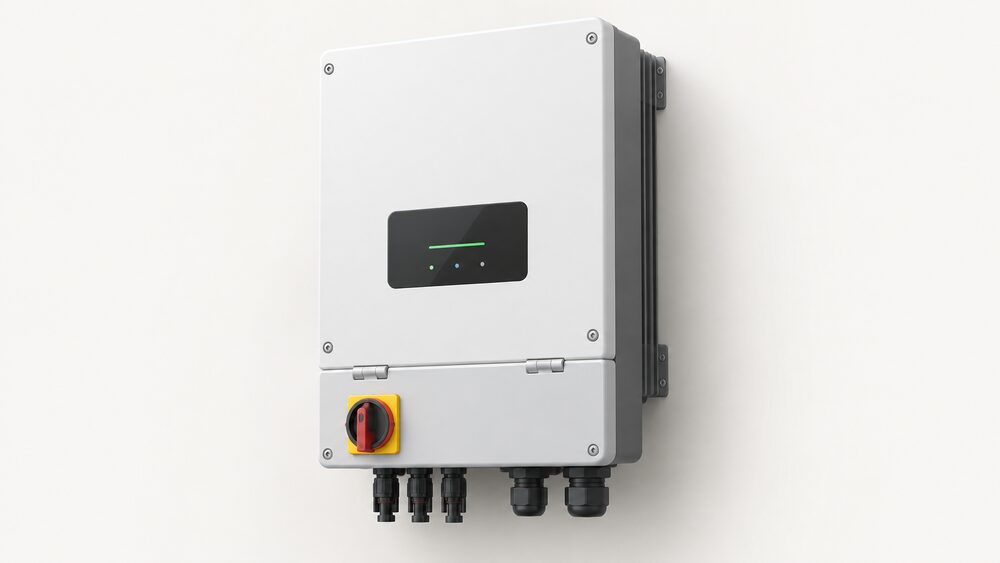 SMA Sunny Boy inverters in the UKLooking at an SMA Sunny Boy for a UK home?
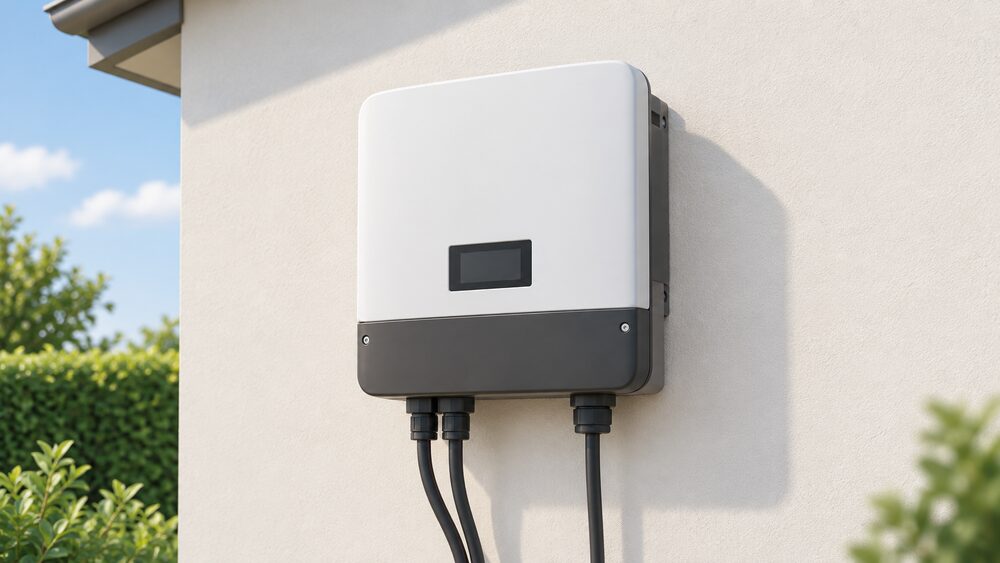 SMA solar invertersSMA is a German brand, and Sunny Boy is the inverter name most UK homes know.