In this guide
Deye hybrid inverters are sold into the UK as the control centre of a home battery system: one box that manages solar panels, a low-voltage battery and the grid connection. The company behind them is Ningbo Deye Inverter Technology Co., Ltd., which publishes its own approved battery lists, warranty terms and declarations of conformity1. The most recent approved battery list for its LV48 inverters, version DY-LV48-0109, was issued on 24 July 2025, replacing version DY-LV48-0076 from 3 January 20242.
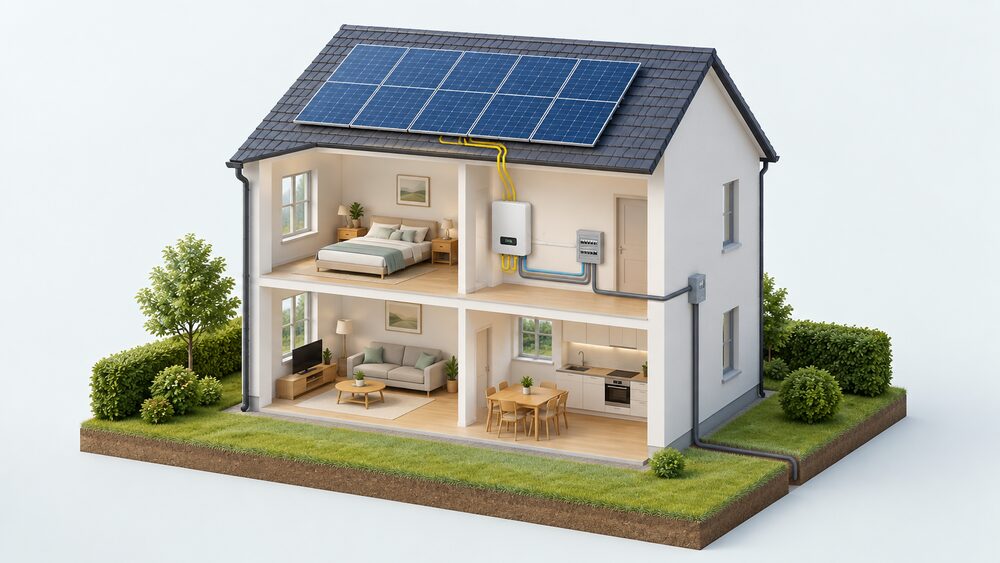
The appeal for a household is straightforward. A hybrid inverter controls both the panels and the battery and converts the DC from both into AC, so a single unit replaces what would otherwise be a solar inverter plus a separate battery inverter5. Deye's own energy storage guidance describes the daily pattern: PV electricity goes to the loads first, excess energy charges the battery through the hybrid inverter, and stored energy is released when loads require it6. The dependence that remains is on the grid as a supplement, on a battery supplier for compatibility, and on the manufacturer for warranty service.
What Deye hybrid inverters are and the main model ranges
A hybrid inverter sits between the solar array, the battery and the house wiring. UK Power Networks describes the general principle: a device called an inverter connects the solar panels or wind turbines to the main wiring in the house7. A hybrid version adds battery management to that role, and Deye's own guidance describes integrated battery management as part of the hybrid function8.
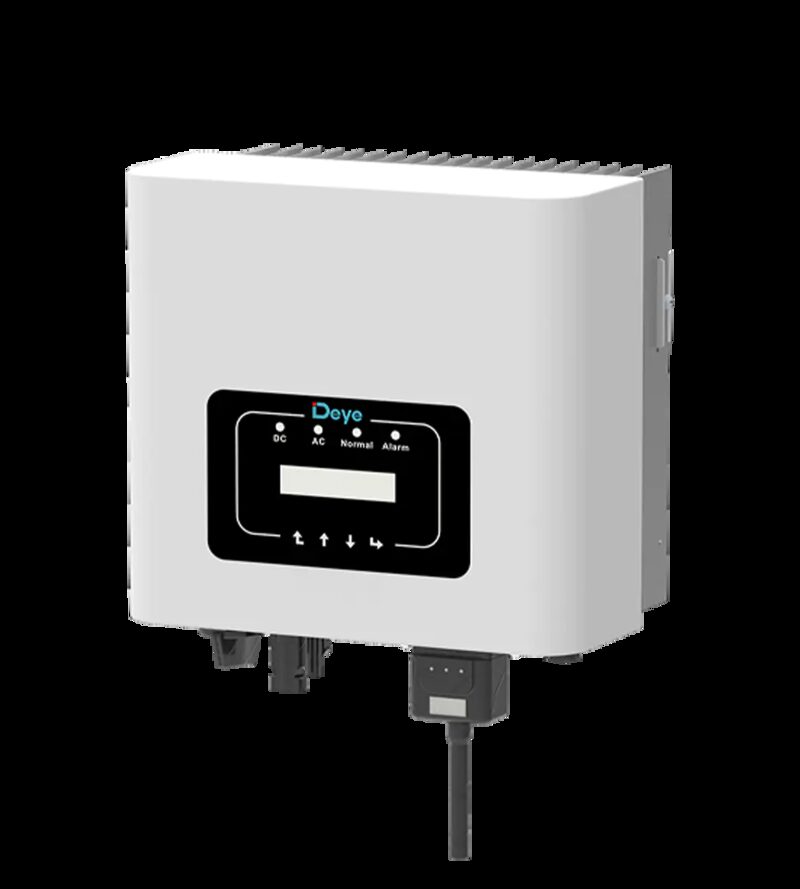
Deye's product range extends well beyond inverters. The company lists solar inverters, variable frequency air conditioner controllers, DC solar water pump controllers and heat pump air conditioners among its products9. For a household, the relevant part is the hybrid inverter line, which spans single-phase and three-phase models. The single-phase SG03LP1-EU hybrid has a published datasheet covering its parallel capability, topology and battery charge windows1. At the larger end, the SG02HP3-EU-GM10 is a three-phase hybrid inverter that also supports multiple batteries in parallel10.
Deye also sells a smart energy management system that all Deye hybrid inverters can be upgraded to support, and a smart EV charger that connects directly to any AC port of the inverter and is controlled over LoRa communication11. Those accessories extend the system's reach into EV charging and load control, but they are additions to the core inverter and battery pairing rather than substitutes for it.
Single-phase or three-phase: which range fits which home
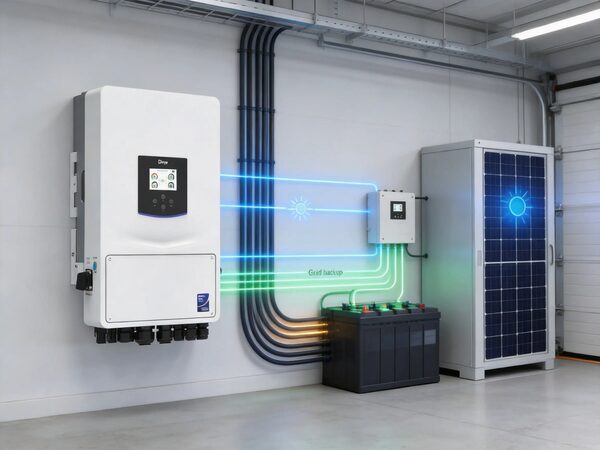
The choice between single-phase and three-phase is set by the property's supply, not by preference. Most UK homes have a single-phase supply, and a single-phase hybrid inverter such as Deye's SG03LP1-EU is built for that arrangement1. Three-phase supplies are more common in larger properties and in some new builds, and Deye's three-phase hybrid range covers those, with the SG02HP3-EU-GM10 listed as a three-phase hybrid inverter supporting multiple batteries in parallel10.
Where a three-phase home has a single-phase battery, the mismatch can cause imbalance across the phases. Guidance on common home battery mistakes suggests choosing a three-phase inverter or a system capable of virtual phase balancing to address this13. Three-phase hybrid inverters from other makers are described as balancing loads across all phases to maximise solar utilisation, with one range covering 8kW to 12kW14. That is the function a three-phase Deye unit performs in a three-phase home.
For a household, the practical consequence is that the inverter must match the supply. A single-phase inverter on a three-phase supply, or the reverse, is not a configuration the equipment supports. The phase arrangement also affects how the installation is notified to the network operator, which is covered below.
Cooling and design across the ranges
Cooling method varies between inverter models and between manufacturers, and it matters for where a unit can be sited and how much noise it makes. The single-phase Deye SG03LP1-EU hybrid uses Intelligent Air Cooling, according to its datasheet1. That means a fan-assisted design rather than a sealed, passively cooled case.
Natural convection cooling appears elsewhere in the market. The SolarEdge single-phase inverter range is listed with natural convection cooling, and the SolarEdge Home Battery uses natural convection as well15. Sunsynk string inverters are listed with Intelligent Air Cooling and an interactive LCD display17. These are different makers' approaches, and the Deye hybrid line follows the air-cooled pattern on the model for which a datasheet is available.
The design question for a household is where the unit will sit. An air-cooled inverter needs clearance for airflow, and the warranty terms make insufficient ventilation of the device an explicit exclusion3. That is a condition worth reading before an installation is planned, because a unit fitted into a tight cupboard without adequate airflow could fall outside warranty cover.
Communications and monitoring: WIFI, RS485 and CAN
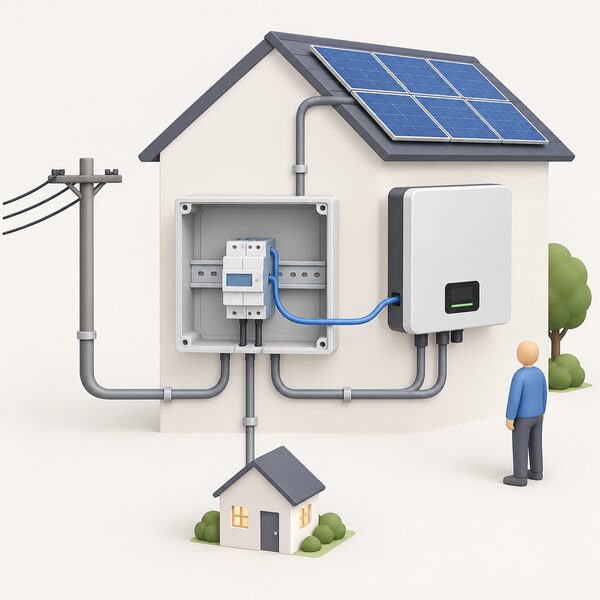
Communication between the parts of a battery system runs over several protocols, and the Deye ecosystem uses more than one. A Deye energy meter datasheet shows the meter connected with RS485 in an arrangement linking the PV array, inverter, energy meter, grid and home load18. The meter itself is DIN rail mounted18.
RS485 and CAN are the two interfaces commonly used between battery modules and the inverter. The SolarEdge Home Battery, for comparison, uses RS485 between modules and a CAN bus to the inverter16. That division of labour is typical: one protocol for the battery stack's internal communication, another for the link to the inverter.
Deye's accessory range adds further communications layers. The smart EV charger uses LoRa communication, described as long-range and low latency, and can be connected directly to any AC port of the inverter12. The smart energy management system supports 100% solar charging with dynamic power adjustment and can be added to any Deye hybrid inverter by upgrade11. The Deye app provides intelligent charging and discharging strategies11.
For a household, the communications chain determines what can be monitored and controlled remotely. Local operation continues without a network connection, but app-based monitoring and any remote adjustment depend on the inverter's connectivity and on the manufacturer's platform.
Battery compatibility: parallel support and the approved battery lists
Deye maintains its own approved battery lists, and they are the starting point for any compatibility question. The current list for LV48 inverters, version DY-LV48-0109, was issued by Ningbo Deye Inverter Technology Co., Ltd. on 24 July 20252. The previous version, DY-LV48-0076, was issued on 3 January 20244. Both carry the same instruction: the purchaser should confirm with the battery supplier if the battery is compatible with the Deye inverter2. The list also instructs that the inverter setup number should be input to lithium mode for the corresponding battery2.
The list names specific brands and models. Wattsonic's Li-LV battery series and ACE's R48100 are both listed as compatible with the Deye inverter models covered2. The list states plainly that these inverter models are compatible with the batteries below2.
Parallel support is a separate question from compatibility. The single-phase SG03LP1-EU supports multiple batteries in parallel, and up to 16 units can be connected in parallel for on-grid and off-grid operation1. The same model provides six time periods for battery charging and discharging, which allows charging and discharging windows to be set across the day1. The three-phase SG02HP3-EU-GM10 also supports multiple batteries in parallel10.
| Feature | Single-phase SG03LP1-EU | Three-phase SG02HP3-EU-GM10 |
|---|---|---|
| Phase | Single-phase | Three-phase |
| Battery parallel support | Yes1 | Yes10 |
| Max parallel units | 16, on-grid and off-grid1 | Not stated |
| Topology | Non-isolated1 | Not stated |
| Charge/discharge periods | 61 | Not stated |
| Cooling | Intelligent Air Cooling1 | Not stated |
Working with third-party batteries: Dyness and other makers
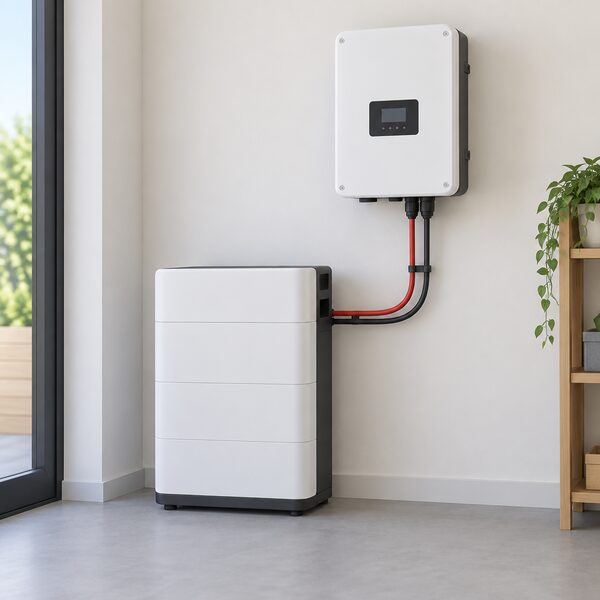
Deye inverters are widely paired with batteries from other manufacturers, and the compatibility check runs both ways. Dyness states that users should verify that the inverter is compatible with its PowerBox Pro and follow the corresponding installation instructions19. The same guidance notes that a system with multiple PowerBox Pro batteries may require suitable breakers, fuses, busbars, combiner boxes and correctly sized cables based on the system current and local electrical standards19.
BYD's Battery-Box LV Flex datasheet lists Deye among its compatible inverters, alongside Victron Energy, MMA, Selectronic, GoodWe and Hoymiles20. That is a maker's own compatibility statement for its own battery, and it sits alongside Deye's approved list rather than replacing it. BYD's Battery-Box Premium HVS and HVM, and the HVS+ and HVM+ versions, are described as for use with an external inverter21.
Dyness has published case studies of Deye pairings in several countries. A PowerBrick with Deye parallel home energy storage project in South Africa used a PV plus AC application, and a four-unit PowerBrick plus Deye parallel project in Limpopo province was deployed to keep household supply stable during grid outages19. A home in Pattaya, Thailand was fitted with a 15kW PV system and three PowerBrick modules paired with Deye inverters during construction19. These are the battery maker's own project reports, and they describe installations outside the UK.
Certification and conformity: what the declarations cover
Grid connection in the UK runs through a notification or application process, and the paperwork depends on the size of the installation. For generation equipment rated less than 3.68kW per phase, EREC G98 requires that manufacturers must always lodge their declarations of full compliance in the ENA Type Test Register22. For G98 notifications, the required documents include approved inverter type test certificates and a G100 declaration23.
In Northern Ireland, the G99 fast track connection application requires a compliance certificate with test results24. The same principle applies across the network operators: the equipment must be certified, and the certificate must be available for the application. Northern Ireland Networks lists the compliance certificate with test results among what is needed to start an application24.
There is also a product safety dimension. The Lithium-ion Battery Safety Bill, dated 29 July 2024, sets out that conformity assessment by a CAB authorised by the Secretary of State, technical documentation and a declaration of conformity by the manufacturer, and CE or UKCA marking are required before placing on the UK market25. That applies to battery products placed on the UK market, and it sits alongside the grid connection requirements rather than replacing them.
For a household, the practical point is that the installer needs the certification documents for the specific inverter model before notifying the network operator. A model without the right certificates cannot be connected lawfully, whatever its specification.
What a Deye inverter means for household energy independence
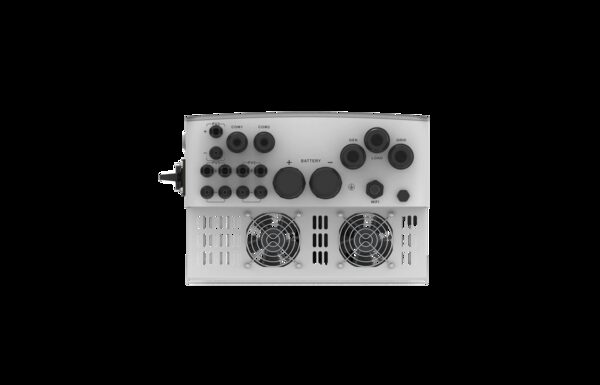
A Deye hybrid inverter changes what a household can do with its own generation, and it also defines the limits of that independence. Deye's own guidance describes several operating modes. In Zero Export To Load, the hybrid inverter provides power only to the connected backup load6. In Zero Export To CT, it provides power to the backup load and the home load, and takes grid energy as a supplement when PV power and battery power are insufficient6. In Selling First, the inverter can sell back excess power produced by the solar panels to the grid, and if time of use is active, battery energy can also be sold into the grid6.
The zero export modes are the ones that matter for a household wanting to avoid exporting. In Zero Export To Load, the hybrid inverter will neither provide power to the home load nor sell power to the grid6. In the CT variant, a built-in CT detects power flowing back to the grid and reduces the inverter's power to supply the local load and charge the battery6. Deye's storage guidance notes that there are independent critical load output ports and grid ports, which is what allows a backed-up circuit to be separated from the grid connection6.
The dependence that remains is real. The system still takes grid energy as a supplement when solar and battery are insufficient6. It depends on a battery supplier for compatibility, on the manufacturer for warranty service, and on an installer for the work, since Deye does not offer an installation service3. Warranty claims require the product model and serial number, system configuration details and a fault description, and the original purchasing invoice or receipt must be presented if required3. Deye takes on the freight cost for products under warranty, but the warranty excludes damage from breaking the product seal, transport damage, incorrect installation, unauthorised modifications, insufficient ventilation and force majeure3. OEM products are not covered by those terms at all3.
For a household weighing independence, the position is that a Deye hybrid inverter can run a home from its own solar and battery for much of the time, with grid backup when those run short. It does not remove the grid connection, and it adds a dependence on the battery maker's compatibility statement and on the inverter maker's warranty process. The wider picture of what a battery can and cannot do for a household is set out in Home Batteries and Household Energy Independence, and the grid connection rules are covered in Telling the Network Operator About a Home Battery: G98 and G99.
Sources25 cited
- SUN-3.6/5/6K-SG03LP1-EU Datasheet, Deye, 2023
- Deye Approved Battery List DY-LV48-0109, Deye, 2025
- Deye Inverter Warranty Terms and Conditions, Deye, 2023
- Deye Approved Battery List DY-LV48-0076, Deye, 2024
- Solar Panels Combined With Home Battery, Homey, 2026
- Deye Solar Energy Storage Solutions, Deye, 2021
- What is Domestic Distributed Generation?, UK Power Networks, 2026
- Hybrid Inverter vs Off-Grid Inverter, LuxPowerTek, 2024
- Deye Hybrid AC/DC Solar Air Conditioner, Deye, 2026
- Deye Inverter Product Range, Deye, 2026
- Deye Smart Energy Management System Datasheet, Deye, 2025
- Deye Smart EV Charger, Deye, 2026
- Common Home Battery Mistakes and How to Avoid Them, Homey, 2026
- Three-Phase Hybrid Inverters, Sunsynk, 2026
- SolarEdge Single Phase Inverter Datasheet, SolarEdge, 2026
- SolarEdge Home Battery 48V Datasheet, SolarEdge, 2026
- Sunsynk String Inverters, Sunsynk, 2026
- Deye Energy Meter Datasheet, Deye, 2022
- Dyness PowerBox Pro, Dyness, 2026
- BYD Battery-Box LV Flex Datasheet, BYD, 2025
- BYD Battery-Box HVE, Wind and Sun, 2026
- Connecting Generation to the Electricity Networks, Energy Networks Association, 2026
- G99 Fast Track Process, Electricity North West, 2026
- G99 NI Fast Track: What You Need to Start Your Application, Northern Ireland Networks, 2026
- [Lithium-ion Battery Safety Bill [HL]](https://bills-api.parliament.uk/api/v1/Publications/56005/Documents/4984/Download), UK Parliament, 2024
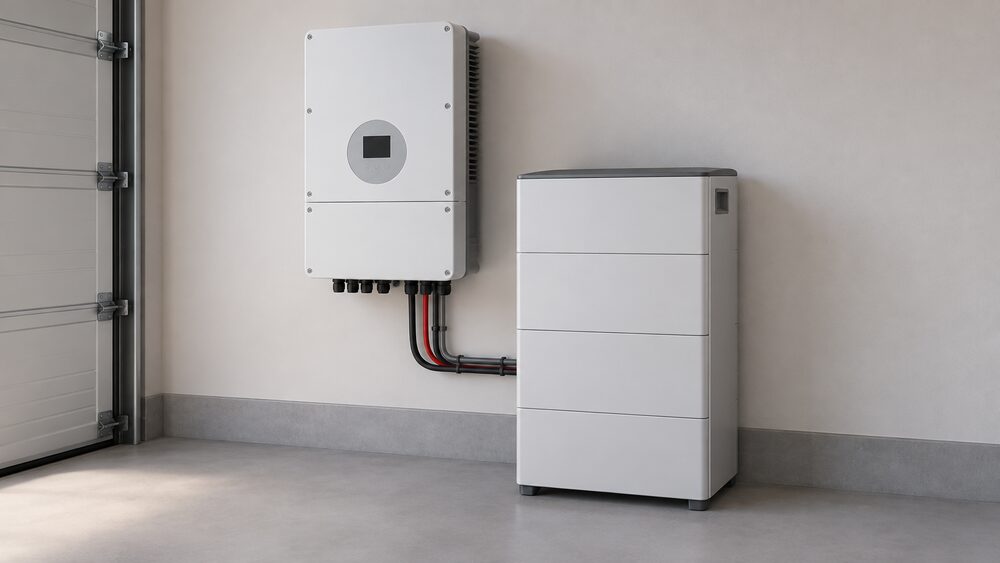 Deye solar invertersDeye hybrid inverters let you store solar power in a battery and use it later, so what do they cost, which models suit a normal UK home, and will they work with your battery and the grid?