In this guide
SoliTek is a European producer of clean technology focused on smart energy storage systems and solar solutions, and its modules reach the UK through specialist distributors rather than a national retail chain1. The range is built around double-glass construction: all panels are double-glass, frameless or framed, built to last up to 50 years, and come with a 30-year product warranty1.
That warranty is the headline. Independent guidance puts the usual product warranty on solar panels at five to 10 years, with a 25-year performance warranty alongside it2. SoliTek's 30-year product term is therefore well above the market norm, and it sits at the top of the 25 to 30 years that the best-known manufacturers offer3. The company also states that its modules are 98.8% recyclable and are produced using 100% green energy1.
For a household, the appeal is a European-made, glass-glass module with an unusually long product guarantee and a documented sustainability position. The dependence that remains is the ordinary one: the panels still need an inverter, an installer, a grid connection and a supplier, and the sustainability claims are the maker's own rather than independently audited national statistics.
Who SoliTek is: a Lithuanian solar and storage maker
SoliTek describes itself as a European producer of innovative clean technology focused on smart energy storage systems and solar solutions1. That framing matters, because the company is not only a panel assembler: storage sits alongside modules in its stated focus, which is why the brand appears in discussions of hybrid and battery-ready systems as well as in panel comparisons.
The product families divide by application rather than by cell technology. The Solid Framed Series Semi-Clear is a bifacial module engineered for a 50-year lifespan1. The Magnus Series is a high-performance bifacial module specifically engineered for solar parks, ground-mount arrays and large-scale commercial installations1. The Solid Framed Series Agro is specifically engineered for agricultural applications, known as agrivoltaics1. The Blackstar Series combines high efficiency with a full-black design1. The Solrif Series is the roof-integrated line, and the Solid Frameless Series Semi-Clear is the building-integrated option.
For a UK householder, the relevant lines are the framed residential modules and, where a roof is being replaced or a conservatory-style structure is involved, the Solrif and frameless variants. The commercial and agricultural families are worth knowing about because they show where the maker's engineering effort goes, but they are not domestic products.
The company's manufacturing is European and its panels are produced using 100% green energy1. That is a supply-chain position rather than a performance claim, and it is the maker's own statement. It does not change how the panel behaves on a roof, but it does bear on the embodied carbon of the installation, which is the part of a solar system's footprint that a household cannot influence after purchase.
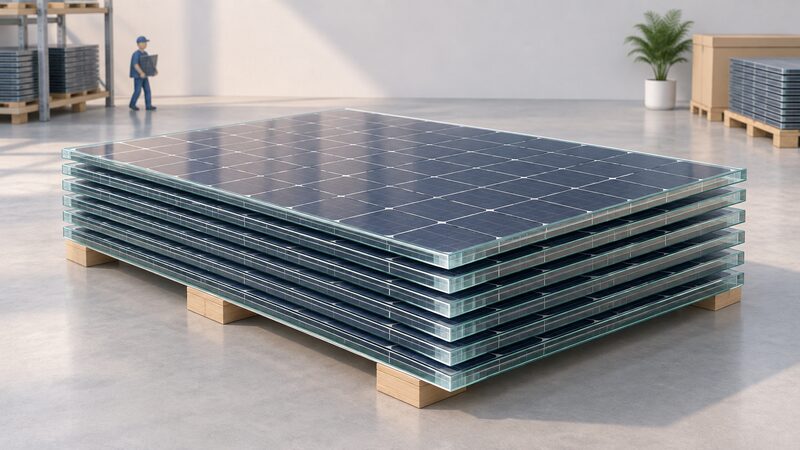
Double-glass construction built to last up to 50 years
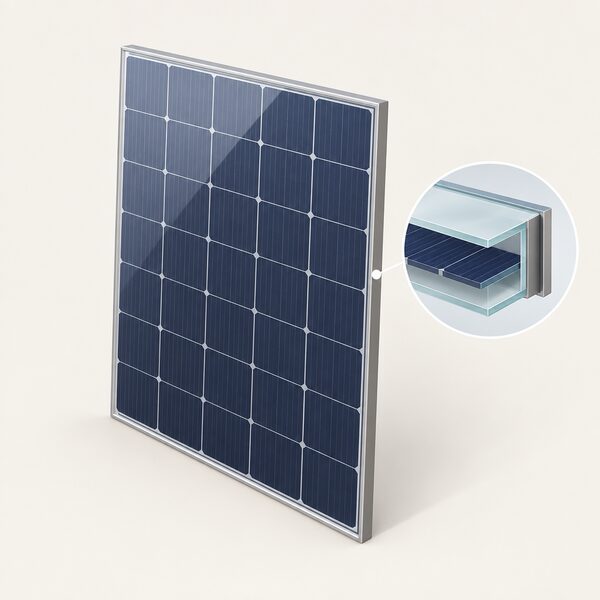
The defining feature of the range is that all panels are double-glass, frameless or framed, built to last up to 50 years1. Glass on both faces replaces the polymer backsheet used on conventional modules, and the maker ties that construction directly to the 50-year design life and the 30-year product warranty1.
Independent expectations for panel life are more conservative. Which? puts current life expectancy for monocrystalline panels at around 50 years, and the same for polycrystalline4. The Energy Saving Trust states that a solar system can be expected to last for 25 years5. A distributor's product page describes panels as made to last for 25+ years and needing very little maintenance6. The documents differ, and the difference is mostly about what is being measured: a module's physical durability against the working life of the whole system, including the inverter, which is the component most likely to need replacing first.
The practical reading is that a glass-glass module is unlikely to be the limiting factor in a system's life. Regular upkeep will keep panels working efficiently for their full lifespan, which independent guidance puts at around 30 years7. For a household, a longer-lived panel shifts the economics: the module cost is spread over more years of generation, and the replacement cycle that matters is the inverter's rather than the panel's.
Glass-glass construction also has a bearing on how the module handles the weather. The absence of a backsheet removes a layer that can degrade, crack or be damaged by rodents and birds, and the frameless variants remove the frame as a point of corrosion and water trapping. The trade-off is weight, which is a roof-loading question rather than a performance one, and one for a structural check before specification.
Warranty: 30-year product cover on all panels
SoliTek states that all its panels come with a 30-year product warranty1. Read against the market, that is a strong term. Independent guidance describes the usual arrangement as a 25-year performance warranty and a five to 10-year product warranty2. The best-known manufacturers offer warranties of 25 to 30 years, which the same guidance reads as a sign of confidence in longevity3. Another independent source advises that panels should come with a 20- to 25-year warranty on performance8.
The distinction between product and performance cover is the one that matters when comparing. A product warranty covers defects in materials and workmanship: delamination, frame failure, junction box faults. A performance warranty covers the module's output over time, guaranteeing that it will still produce a stated percentage of its rated power after 25 or 30 years. SoliTek's 30-year figure as stated is a product warranty1, and a buyer comparing it against a competitor's 25-year performance term is comparing two different things.
Warranty length is also only as good as the company behind it. A 30-year term assumes the manufacturer is still trading and still honouring claims in 2056. That is a real consideration in a sector where panel makers have consolidated, and it is why the maker's corporate position is worth checking alongside the warranty document. SoliTek's European manufacturing base and its published sustainability reporting since January 2023 are indicators of an established operation rather than a start-up1.
Efficiency and specifications: what the datasheets say
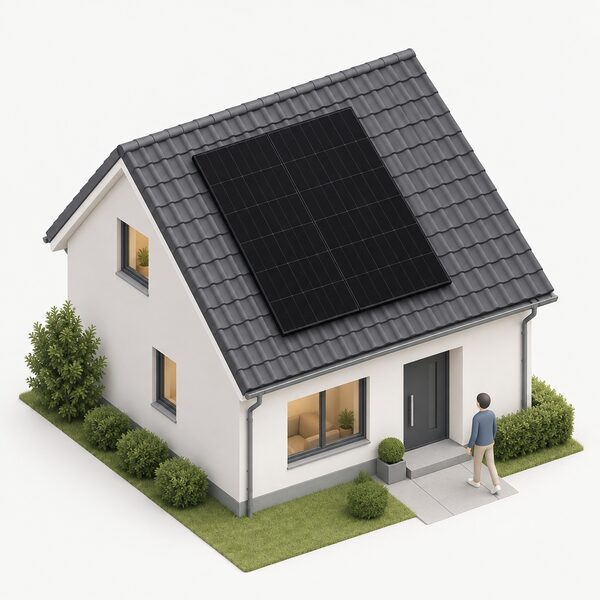
SoliTek's published material describes the range by construction, application and warranty rather than by model-level efficiency percentages. The Blackstar Series is described as combining high efficiency with a full-black design1, and the Magnus Series as high-performance and bifacial1, but the maker's product pages do not give a single efficiency figure for each model in the material available.
What can be said about the technology is general. The current best performance silicon panels are around 25% efficient and are approaching their theoretical performance limit10. Monocrystalline panels, which are made from single-crystal silicon and are black in appearance11, reach up to 25% module efficiency according to independent guidance12. Tandem solar cells have recorded commercial efficiencies above the levels possible with current silicon panels10, but those are not the modules on sale for a UK roof today.
| Family | Type | Stated position |
|---|---|---|
| Solid Framed Series Semi-Clear | Bifacial, framed | Engineered for a 50-year lifespan1 |
| Solid Frameless Series Semi-Clear | Glass-glass, no frame | Building-integrated PV: verandas, carports, canopies1 |
| Solrif Series | Framed, roof-integrated | Patented interlocking frame forming a weather-proof roof covering1 |
| Blackstar Series | Full-black | High efficiency with a full-black design1 |
| Magnus Series | Bifacial | Solar parks, ground-mount, large commercial1 |
| Solid Framed Series Agro | Framed | Agricultural applications (agrivoltaics)1 |
For a household reading a datasheet, the figures that decide the system are the module's rated output, its temperature coefficient and its efficiency at standard test conditions. Those are set out in the manufacturer's own documentation for each model, and the general principles of reading them are covered in reading a solar panel datasheet. The choice between glass-glass and conventional modules is set out in glass-glass vs standard solar panels.
Sustainability: carbon neutral, Cradle to Cradle GOLD and 98.8% recyclable
SoliTek's sustainability position rests on three stated facts: the modules are 98.8% recyclable, they are produced using 100% green energy, and the company holds Cradle to Cradle GOLD certification1. The Solrif Series is named as proudly holding the Cradle-to-Cradle Gold certification1.
Cradle to Cradle is a third-party certification assessing material health, material reuse, renewable energy, water stewardship and social fairness, with GOLD as an achievement level. For a solar panel it means the module's material composition and manufacturing process have been independently assessed rather than self-declared. That is a stronger form of evidence than a maker's own environmental page, though it is a certification of process and materials rather than a measurement of the panel's output or lifespan.
The 98.8% recyclability figure is the maker's own1. It reflects the glass-glass construction, which uses glass on both faces rather than a polymer backsheet, and glass is the easiest fraction of a panel to recover. It is a design claim about material recovery, not a statement that a UK household can put a panel into a normal waste route. End-of-life handling in the UK runs through specialist recyclers, and the general position is covered in solar panel recycling.
"There are small amounts of antimony in solar panels, which is a hazardous substance and may impact recyclability. Some European manufacturers produce panels without antimony."
That caveat applies to panels generally rather than to SoliTek specifically, and it is the reason a high recyclability percentage should be read as a design target rather than a guaranteed outcome. On carbon, solar panels can have a carbon neutral footprint in as little as a year13, which is the point at which the emissions from making the panel are offset by the clean electricity it generates.
Made in Vilnius with 100% renewable energy
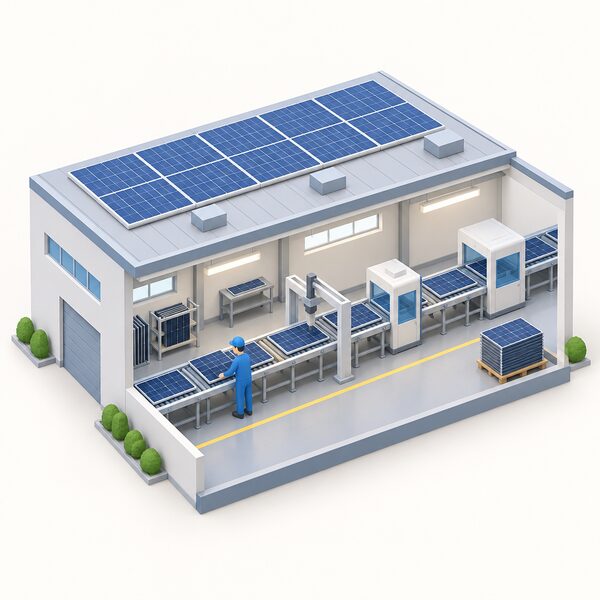
SoliTek's panels are produced using 100% green energy1, and the company describes itself as a European producer1. The manufacturing base is in Lithuania, with the Solrif and Solid families assembled there. That places the brand alongside a small group of European module makers rather than the much larger volume of Chinese-produced panels.
The significance for a household is embodied carbon and supply chain, not performance. A panel made in Europe with renewable electricity has a lower manufacturing footprint than one made on a coal-heavy grid, and the transport distance to a UK installation is shorter. Neither changes the panel's output on a roof.
The wider context is cost. High electricity costs in Europe mean subsequent polysilicon production is double the cost compared to China10. That is the structural reason European module makers compete on construction, warranty and sustainability rather than on price per watt, and it explains why a European glass-glass panel typically carries a higher unit cost than an imported conventional module. Monocrystalline panels are more expensive to install than the alternative14, and that cost position applies across the category.
Solar energy itself is 100% renewable and does not release carbon dioxide or greenhouse gases in generation15, and the electricity generated from the sun is completely free and 100% renewable16. The manufacturing footprint is the part that varies between makers, and it is the part SoliTek addresses directly.
What owning SoliTek panels means for household energy independence
Photovoltaic panels could power a home, reduce bills and may earn money through export17. The electricity they generate is completely free to use once installation is paid for18, and home solar can reduce reliance on the grid while improving an Energy Performance Certificate18.
The economics of self-consumption are the key to independence. Rates for selling electricity to the grid are much lower than tariffs for using electricity from the grid, so using solar electricity yourself is much more cost-effective than exporting it19. A SoliTek array changes nothing about that arithmetic: the panel brand does not affect the export rate or the import tariff. What it affects is how long the modules are expected to keep producing, and therefore how many years of self-consumption the household gets from the same installation cost.
The dependence that remains is substantial and worth stating plainly. The panels need an inverter, which is the component most likely to fail first. They need a grid connection and a supplier for the periods when generation is short, and a meter arrangement to be paid for export. Where a battery is added, the household gains some independence from evening peak tariffs but takes on a second piece of equipment with its own lifespan. Where monitoring is added, it depends on a broadband connection and a manufacturer's app.
For Northern Ireland specifically, homeowners should seek independent advice on solar panels, heat pumps and other energy efficiency measures from organisations such as the NI Energy Advice service20. Support for generating your own electricity differs across the four nations, and the arrangements are set out in solar panels and household energy independence.
How SoliTek compares with other European panel makers
SoliTek sits in the European segment of the market, where the competitive argument is construction and warranty rather than price. The 30-year product warranty is the clearest point of difference against the five to 10-year product terms that independent guidance describes as usual2, and it is at the top of the 25 to 30-year range that the best-known manufacturers offer3.
Against other European makers, the comparison turns on three things: where the module is made, what the warranty covers, and whether the maker publishes environmental data. SoliTek states European production with 100% green energy, a 30-year product warranty and voluntary sustainability reporting since January 20231. Other European brands in the UK market include Solarwatt, BISOL, Eurener and FuturaSun, each with its own construction and warranty position.
The comparison that matters most for a household is not between panel brands at all. Independent guidance is to get various quotes to compare prices of different installers17, and the installer's competence affects the outcome more than the module badge. A well-specified panel fitted badly underperforms a mid-range panel fitted well. The questions to put to an installer are covered in how to choose a good solar installer.
On certification, Solar Keymark covers 27 European countries and provides market surveillance authorities with reliable technical information21. That is the European certification framework a household may see referenced on a datasheet, and it is separate from the MCS certification that governs UK installation standards and access to export payments.
Sources22 cited
- SoliTek collection, Wind and Sun, 2026
- Buying a house with solar panels, Energy Saving Trust, 2026
- How long do solar panels last?, Uswitch, 2026
- Buying advice for solar panels, Which?, 2026
- Solar power facts, Energy Saving Trust, 2026
- Solar PV panels, AgilityEco, 2026
- Solar panel cleaning and maintenance, Energy Saving Trust, 2026
- How to choose a good solar installer, Low Carbon Hub, 2025
- Moving house energy checklist, Energy Saving Trust, 2026
- POST note 771: Solar technologies, Parliamentary Office of Science and Technology, 2026
- Solar panels, NICEIC, 2026
- Are solar panels worth it?, Which?, 2026
- Solar panels: a good investment, CPA, 2023
- A complete guide to solar PV, Centre for Sustainable Energy, 2025
- Could you generate your own energy, Energy Saving Trust, 2024
- Solar panels, Oxfordshire County Council, 2026
- Solar photovoltaic (PV) panels, London Borough of Bromley, 2026
- How do solar panels work, Smart Energy GB, 2026
- Solar panels, London Borough of Hammersmith and Fulham, 2026
- Support to generate your own electricity, nidirect, 2025
- Solar Keymark certification going strong ten years on, Solar Keymark, 2013
- Solar Keymark for public authorities, Solar Keymark, 2026