
In this guide
A Grant solar thermal system is a solar water heating installation: roof-mounted collectors that absorb heat from sunlight and transfer it to a cylinder, working alongside a conventional boiler or immersion heater rather than replacing it1. The collectors carry Solar Keymark certification, the main quality label for solar thermal products in Europe, and a well-designed system can satisfy up to 70% of a home's annual domestic hot water needs2.
The practical numbers a household needs are these. Independent guidance puts collector area at roughly one to two square metres per person in the household, and Building Regulations guidance sets a minimum dedicated storage volume of 25 litres for every 1 square metre of net absorber area3. Planning guidance describes a domestic installation as needing 3 to 4 square metres of southeast to southwest facing roof receiving direct sunlight for the main part of the day5.
What the system does for independence is real but partial. It cuts the gas or electricity a household buys for hot water, and it does so without a supplier, an app or a broadband connection. What remains is the backup heat source, the cylinder, and the fact that solar thermal is not currently supported by national renewable heating payments6.
What a Grant solar thermal kit contains
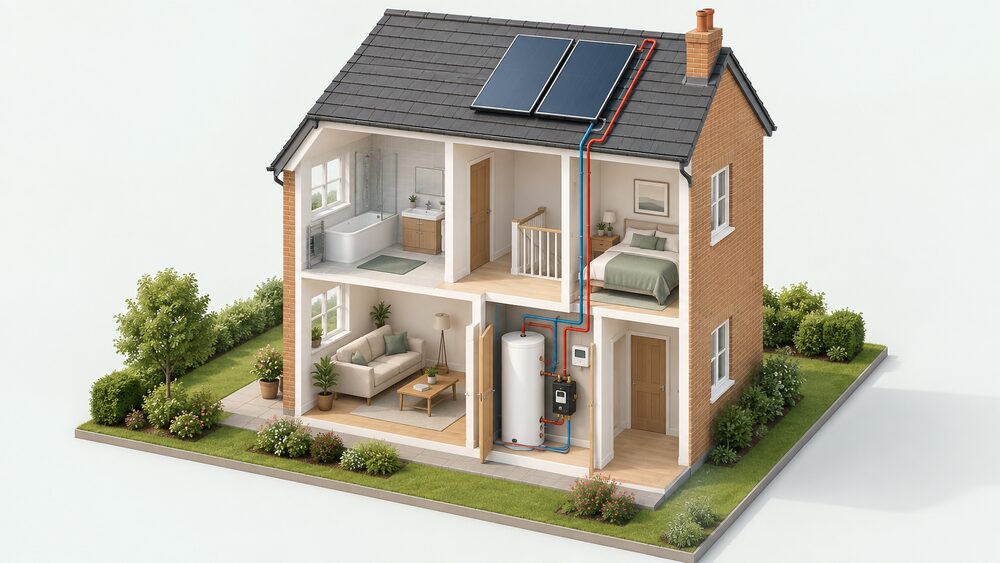
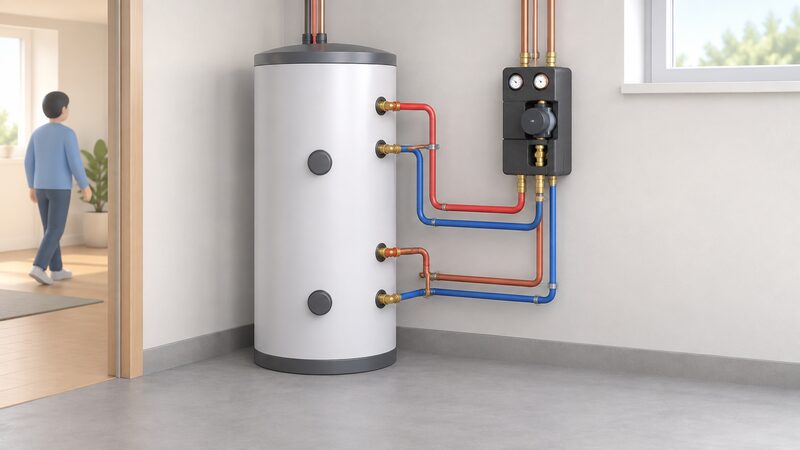
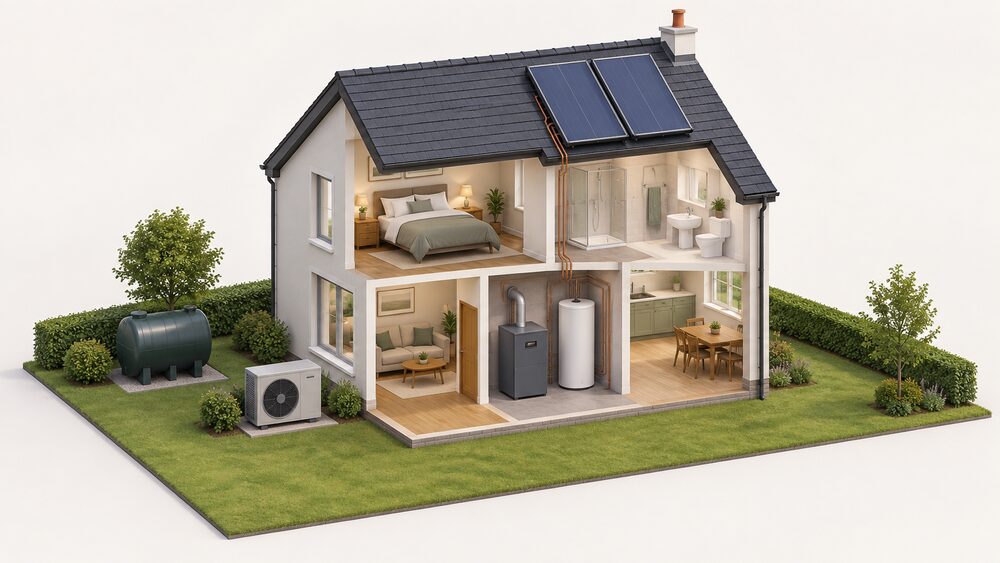
A solar thermal installation is not a single appliance. It is a set of components that have to be matched to each other and to the house: the collectors on the roof, a pump station that circulates the heat transfer fluid, a controller that decides when the pump runs, and a cylinder with a solar coil inside it. The cylinder is the part most households underestimate, because a standard cylinder without a solar coil cannot accept heat from the collectors at all.
The collector is the visible element. Solar heating, also called solar thermal, uses sunlight to produce heat, and the panels are mounted onto the roof and absorb the sun's heat9. Independent guidance describes solar water heating as using energy from the sun to heat water for the home through roof-mounted collectors1.
The controller and pump station are the parts that determine whether the system performs as designed. They decide when the temperature difference between the collector and the cylinder justifies running the pump, and they protect the system when the collector is hotter than the cylinder can usefully absorb. Grant UK's own extended warranty scheme covers cylinders and thermal stores with a 25 year stainless steel shell cover, which indicates the cylinder is treated as a Grant appliance in its own right rather than an accessory8.
For a household, the kit question matters because it determines what is covered by whom. A system assembled from one maker's collectors, pump station, controller and cylinder has a single warranty route. A mixed system does not.
Keymark certification and collector efficiency
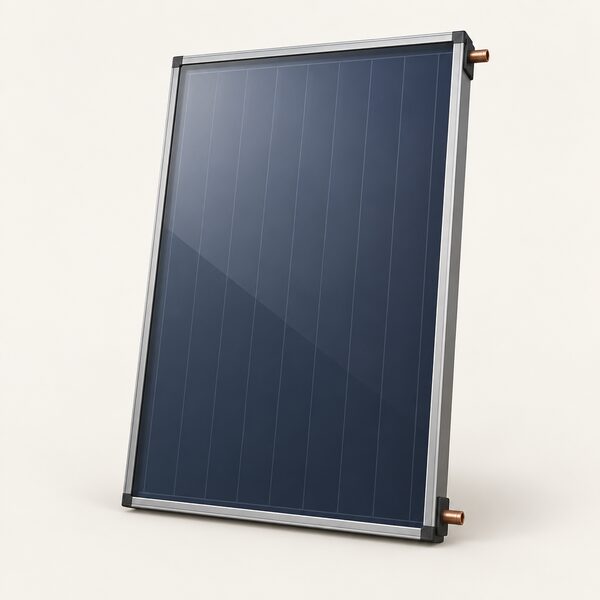
Solar Keymark is the certification scheme that matters for solar thermal products in the UK and across Europe. It is the main quality label for solar thermal products, owned by CEN/CENELEC and developed with the support of the European Commission3. Solar collectors assessed according to EN 12975-1 can currently be granted the Solar Keymark, and the certificate can only be issued by an empowered certification body11.
The scheme exists to give buyers and subsidy administrators a single reference point. Solar Keymark ensures that the certified product will provide a good performance, and it offers a certification scheme that can be used in subsidy schemes11. It is also increasingly recognised worldwide11.
For a household, the practical value is that a Keymark certificate is a test result rather than a marketing claim. It sits alongside MCS certification, which is a requirement for heat pump installations made under the Domestic Renewable Heat Incentive, the Green Homes Grant and the Clean Heat Grant13. Solar thermal sits in a different position: it is not a heat pump technology, and the current national grant schemes do not fund it.
How much hot water it can provide
The headline figure is up to 70% of a home's annual domestic hot water needs for a well-designed solar heating system, a figure given for both the UK and Ireland1. That is an annual average, and the seasonal spread is much wider than the average suggests.
In the summer months a system may satisfy 100% of the domestic hot water need, and in the summer it should provide around 90% of hot water requirements1. In winter that drops to around 25% of hot water requirements1. Across the year, solar water heating systems normally provide roughly half of hot water needs on average7.
Official guidance sits slightly lower than the independent figure. Solar thermal equipment can generate between 55% and 70% of a home's hot water requirements, reducing a home's carbon footprint5. The two ranges overlap, and the difference reflects how the system is sized, how the household uses hot water, and how much of the year the boiler is asked to top up.
| Period | Share of hot water from solar |
|---|---|
| Summer months | up to 100%1 |
| Summer | around 90%7 |
| Annual average | roughly half7 |
| Annual, well-designed system | up to 70%1 |
| Winter | around 25%1 |
| Official range | 55% to 70%5 |
The pattern matters more than the average. A system that covers nearly all hot water in June and a quarter of it in January still leaves the boiler doing most of the work in the coldest months, which is when gas consumption is highest. The saving is real but it is concentrated in the half of the year when heating demand is lowest.
On-roof, in-roof and flat roof mounting options
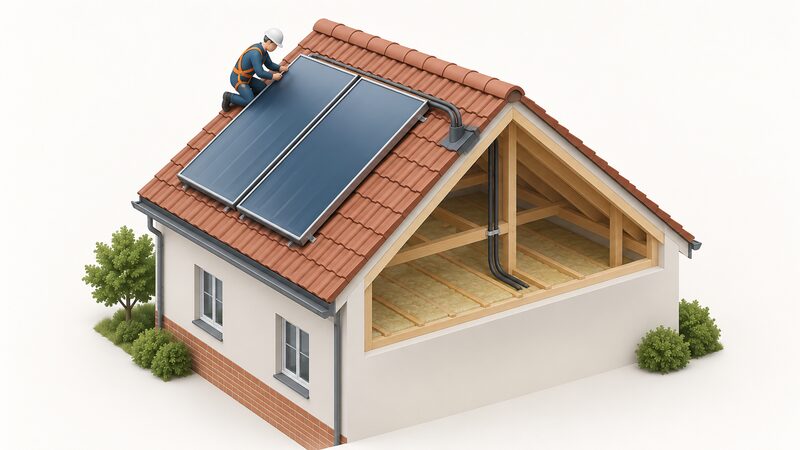
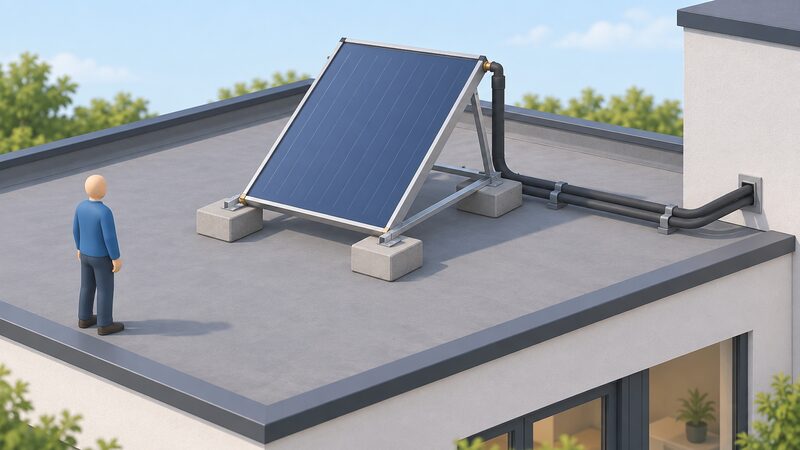
Collectors do not have to go on a pitched roof. Independent guidance describes fixing them to a frame on a flat roof, hanging them from a wall or mounting them on the ground2. A second source gives the same three options: on a roof, fixed to a frame on a flat roof, or hung from a wall14.
The roof remains the usual choice. Planning guidance frames a domestic installation around 3 to 4 square metres of southeast to southwest facing roof receiving direct sunlight for the main part of the day5. Orientation and shading therefore do more to determine output than the mounting method does.
Where a roof is unsuitable, the alternatives carry their own conditions. A ground-mounted array needs space and a route for pipework back into the house. A wall-mounted collector needs a wall that receives direct sun and can take the weight and wind loading. A flat roof frame needs to be ballasted or fixed against wind uplift, and the angle of the frame determines how much of the year the collector faces the sun usefully.
Planning permission is a separate question from mounting. Solar thermal installations on domestic roofs are generally treated as permitted development in England, but the position differs across the four nations and is tighter in conservation areas and on listed buildings. The rules for each nation are set out in the planning permission pages for England, Scotland, Wales and Northern Ireland.
Sizing the system: collector area and cylinder volume
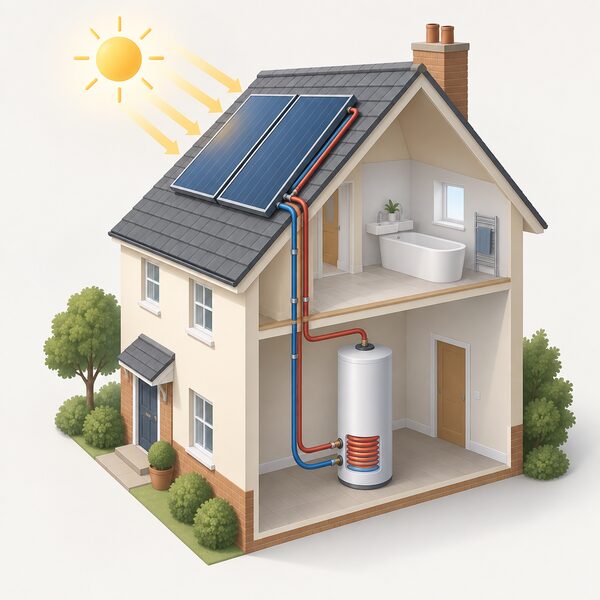
Two numbers drive the design, and they are linked. The first is collector area. Independent guidance puts it at roughly one to two square metres of panel area per person in the household3. A second independent source gives around five square metres for the panels in a sunny location, ideally on a south-facing roof14.
The second number is storage. Building Regulations guidance sets a minimum volume of 25 litres for every 1 square metre of the net absorber area of the solar collector, and the same figure appears in the 2021 edition of Approved Document L and in the Welsh consultation version4. The guidance applies to indirect solar systems supplying domestic hot water with a solar collector area of less than 20m24.
| Household size | Collector area, at 1 to 2 m2 per person | Minimum dedicated solar volume at 25 litres per m2 |
|---|---|---|
| 2 people | 2 to 4 m2 | 50 to 100 litres |
| 3 people | 3 to 6 m2 | 75 to 150 litres |
| 4 people | 4 to 8 m2 | 100 to 200 litres |
The dedicated solar volume is not the whole cylinder. It is the portion of the cylinder that the solar coil can heat, and it sits alongside the general capacity the household needs for daily use. Some solar thermal systems use two cylinders, one dedicated to the solar collectors and another for the immersion heater2. That arrangement separates the solar store from the backup store, which can simplify control but takes more space.
The 20m2 ceiling in the guidance is worth noting: above that, the installation moves outside the scope of the domestic guidance and into a different design and compliance regime. Domestic systems sit well below it.
Working alongside a new or existing central heating system
Solar thermal is a preheat technology. Solar water heating uses energy from the sun to work alongside a conventional water heater, and solar thermal systems are usually used alongside a conventional boiler or immersion heater1. Independent guidance describes coupling a solar collector with an existing gas boiler, and separately coupling a solar collector with a heat pump17.
That means the boiler stays. The solar side heats the cylinder when the collectors are warm enough, and the boiler or immersion heater takes over when they are not. The household keeps its existing heating circuit, its existing controls and its existing fuel supply.
The integration point is the cylinder, not the boiler. A cylinder with a solar coil accepts heat from the collectors; a cylinder without one cannot. Where a household is replacing a cylinder anyway, specifying a solar-ready twin-coil cylinder at that point is cheaper than doing it later. Where the existing cylinder has no solar coil, the cylinder becomes part of the installation cost.
The independence position follows from this. Solar thermal reduces the volume of gas or electricity bought for hot water, and it does so without a supplier, an app or an internet connection. It does not remove the boiler, the gas connection or the electricity supply that runs the pump and controls. A household that wants to change the fuel rather than reduce its use is looking at a different technology, and the comparison is set out in solar thermal vs solar PV and in the wider guide to solar water heating.
Guarantee: twelve months as standard, five years if registered
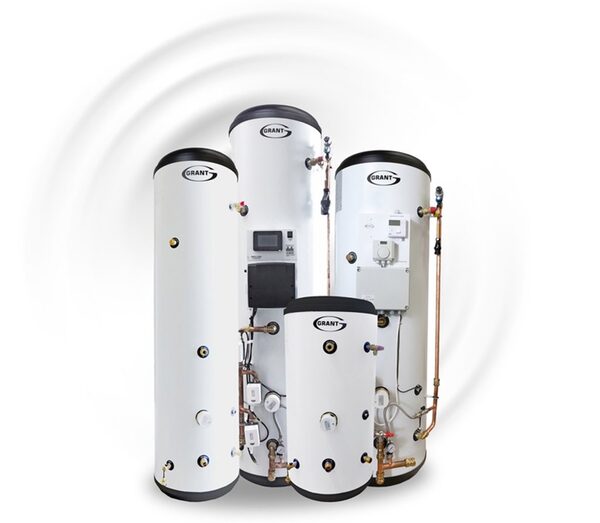
Grant UK's extended warranty scheme requires the appliance to be registered with Grant Engineering (UK) Ltd within 30 days of installation8. Registration is the condition that moves a system from the standard term to the extended term, and the 30 day window is the part that catches households out.
The extended scheme covers cylinders and thermal stores with a 25 year stainless steel shell cover8. That is a long term for a stainless steel vessel, and it reflects the fact that a stainless shell has no coating to degrade.
For context, independent guidance on solar water heating systems generally puts warranties at a five-year or ten-year term for most systems9. Solar panels in the photovoltaic sense usually come with a 25-year performance warranty and a five to 10-year product warranty, which is a different product category with a different failure mode18.
Registration is normally handled by the installer as part of the handover, but the 30 day limit is worth confirming in writing at the point of commissioning. The installation date, the registration date and the warranty certificate should all be in the household's own records, not only the installer's.
Mixed systems: what Grant UK does not cover
A solar thermal system can be assembled from parts made by different manufacturers, and the warranty position changes when it is. Grant UK's extended warranty scheme is built around registering a Grant appliance, and the cylinder cover it offers applies to Grant cylinders and thermal stores8. Where a Grant collector is paired with another maker's cylinder, controller or pump station, the non-Grant components sit under that maker's terms, and there may be no single party accountable for the system as a whole.
The same logic applies to the heat source. Independent guidance describes coupling a solar collector with an existing gas boiler and coupling a solar collector with a heat pump17. Both are legitimate arrangements, but a hybrid system that combines a heat pump with a gas boiler in a single integrated unit is treated differently under current grant rules: integrated and compact hybrids are not eligible measures because they contain a new gas boiler19. Retrofit and packaged hybrid heating systems are eligible for homes currently heated by mains gas only, and where a new gas boiler is fitted only the heat pump component can be funded19.
On grant support, solar thermal is not currently available under the national renewable heating schemes. Home Energy Scotland lists solar thermal as not available, and hybrid solar PV and water heating is also listed as not available6. The Domestic Renewable Heat Incentive, which did support solar thermal, has closed to new applicants, and the Boiler Upgrade Scheme funds ground source heat pumps and air source heat pumps rather than solar thermal20. Solar thermal did generate 5.5 GWh under the Domestic RHI in Scheme Year 9, covering 2022-04-01 to 2023-03-31, which shows the technology was supported historically22.
Local authority schemes are a separate route. Solar thermal for domestic hot water heating only was an eligible measure under the Green Homes Grant Local Authority Delivery Scheme, and solar thermal appears in the eligible measures list for the Green Homes Wales scheme23. The Warm Homes: Local Grant covers England only25.
Sources25 cited
- Your home guide to solar water heating, OFTEC, 2026-09-20
- Solar water heating, Energy Saving Trust, 2026-05-20
- Solar water heating with solar thermal panels, Which?, 2026-05-15
- Approved Document L Volume 1 Dwellings, GOV.UK, 2021
- Solar equipment on residential buildings, Hart District Council, 2025-01
- Home Energy Scotland funding, Home Energy Scotland, 2026-09-17
- Could solar water heating work for you, Energy Saving Trust, 2026-05-20
- Extended warranties, products and prices, Grant UK, 2026-09-20
- Solar heating, MCS Certified, 2026-08-17
- The origin and composition of the Solar Keymark, Solar Keymark, 2026-09-17
- Public authorities, Solar Keymark, 2026-09-17
- Solar Keymark network, Solar Heat Europe, 2026-06-18
- MCS and the Domestic RHI, UK Parliament, 2026-09-20
- Renewable heating: what are the options for your home, Energy Saving Trust, 2024-03-01
- Approved Document L Volume 1 consultation version, Welsh Government, 2025-08
- Solar thermal water heating, Planning Portal, 2026-09-17
- Coupling solar collectors with heat pumps and boilers, Solar Heat Europe, 2026-09-17
- Buying a house with solar panels, Energy Saving Trust, 2026-08-13
- Warm Homes: Local Grant policy guidance, GOV.UK, 2026-07
- Boiler Upgrade Scheme installers, Ofgem, 2026-09-17
- Domestic RHI installers and metering, Ofgem, 2026-09-17
- DRHI annual report Scheme Year 9, Ofgem, 2022-04-01
- Green Homes Grants scheme, Solar Energy UK, 2026-09-17
- Green Homes Wales loan standard terms, Development Bank of Wales, 2026-09-17
- Warm Homes: Local Grant statistics, GOV.UK, 2026-02-26
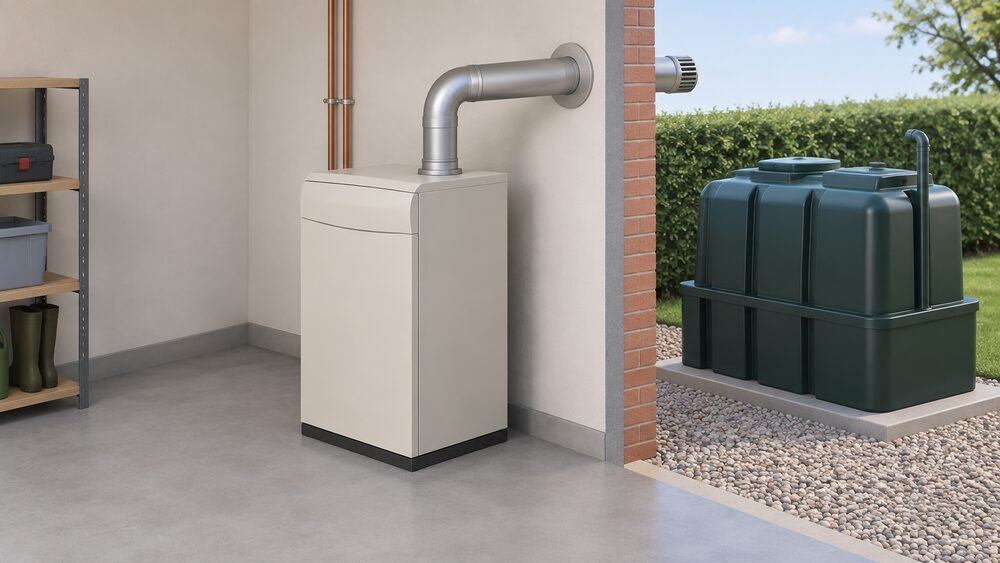 Grant oil boilersGrant oil boilers suit homes with no gas supply, so which Vortex model fits your house, and can it run on greener fuel later?
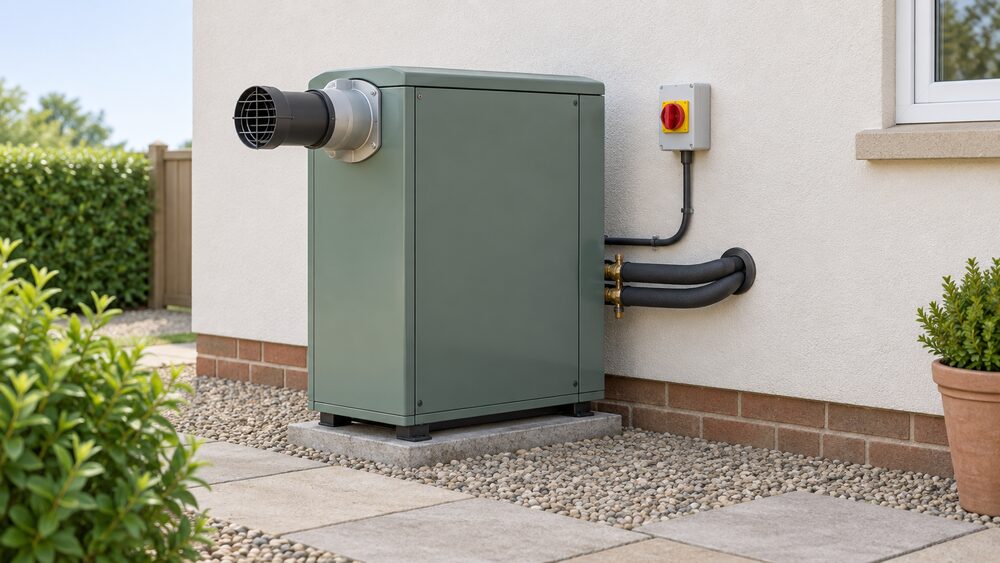 Grant Vortex oil boilerLiving off the gas grid with an oil boiler means you may be comparing a Grant Vortex with a heat pump.
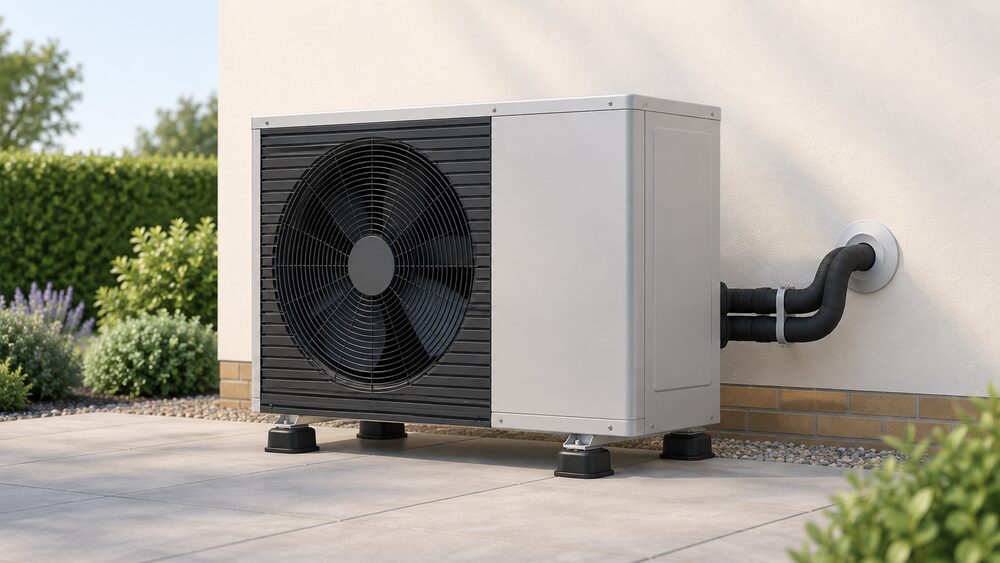 Grant Aerona 290 heat pumpThinking about a Grant Aerona 290?
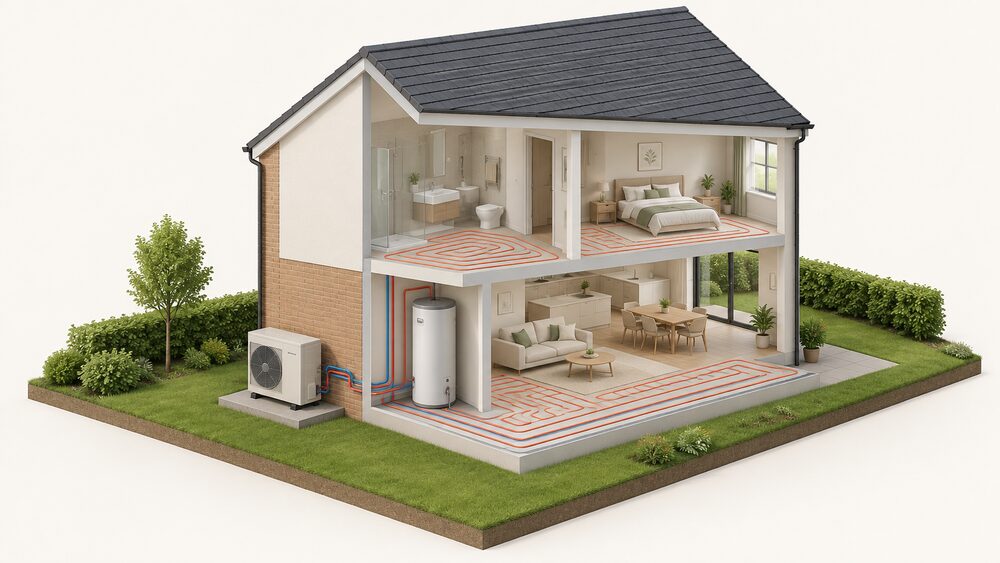 Grant heat pumpsGrant air source heat pumps run on electricity and heat your home through radiators or underfloor heating.
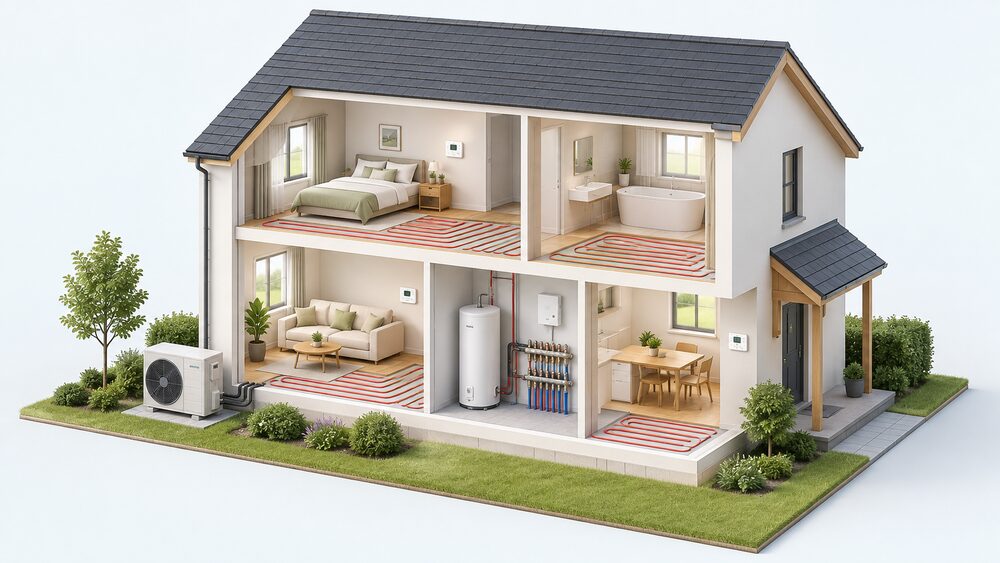 Grant Heating ControlsGrant makes heating controls for its own air source heat pumps, not for boilers.
 Grant UK oil boilers and heat pumpsGrant UK makes oil boilers for homes off the gas grid, and also sells air source heat pumps if you would rather move away from oil.