
In this guide
Wondrwall is a home energy management system rather than a thermostat. It brings heating, hot water, lighting, security and energy monitoring into one app, and the company behind it describes the result as a home that runs its own energy rather than one that waits to be told1. An independent case study describes it as "an intelligent home energy management system which combines multiple technologies with the aim to provide a low carbon home which has low running costs"2.
The headline claims are large. Wondrwall states that its AI-powered controls deliver energy bill savings of over 80% on heating, and that the system reduces the average UK new build home's energy bill by over £1,300 a year1. Those are the maker's figures for a standard three-bedroom new build built to Part L 2021, not an independent measurement, and they sit alongside a much smaller body of independent evidence: a North Devon field trial that installed two Wondrwall systems combining infrared heating panels with solar PV, battery storage and a smart hot water cylinder, compared against a control property2.
What follows sets out how the system works, what it controls, what it depends on, and where the evidence is thinner than the marketing.
What Wondrwall is: a home that controls its own heating, energy and lighting
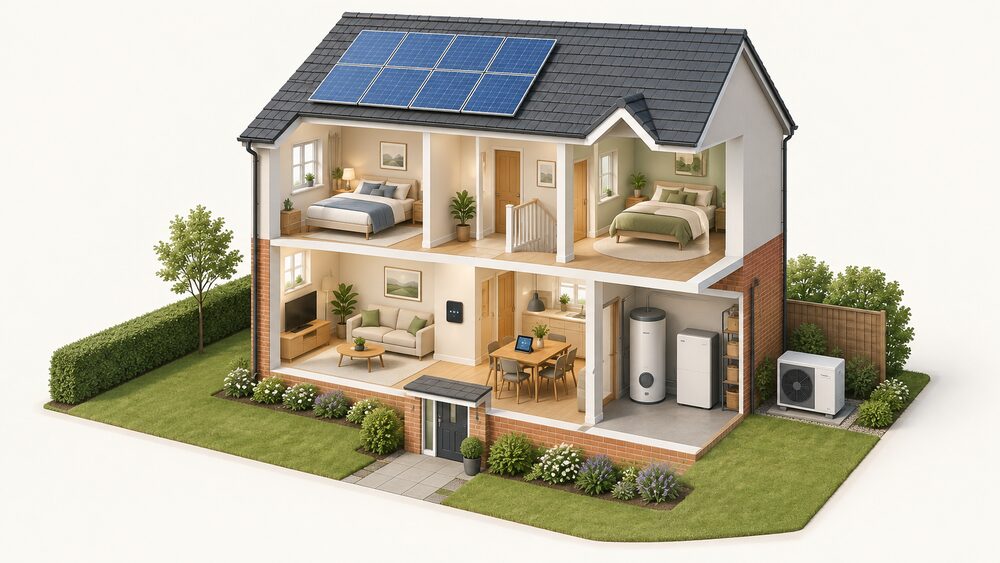
The system is built around a single app that manages "lighting, security, heating, hot water, energy, and entertainment"1. Behind that sits a set of physical components: smart light switches with touch sensors, a tablet computer used for control, infrared heating panels, a smart hot water cylinder, solar PV and a battery2. In the North Devon trial the installed specification was a 5.81kW solar array with a 6kWh battery alongside the heating and hot water equipment2.
The distinction Wondrwall draws is between a smart home and an intelligent one. Its own published explanation is that intelligent homes use machine learning and predictive technology to make decisions, while smart homes rely on timed or triggered events controlled by the householder. The company states that its AI analyses over 20,000 datapoints every day to optimise the energy performance of the home1.
That matters for how the controls behave in practice. A conventional programmer or smart thermostat executes a schedule the householder sets. A system of this kind is designed to decide when to heat, when to charge a battery and when to export, based on occupancy, weather, tariff and learned patterns. Official guidance for self-build homes takes the same line in principle, recommending smart systems that control lighting, heating and cooling based on occupancy and time of day4.
The trade-off is transparency. A system that makes its own decisions is harder to audit than a thermostat showing a setpoint, and the householder's ability to override it becomes the main form of control.
What it saves: over 80% off heating bills and £1,300 a year on a typical new build
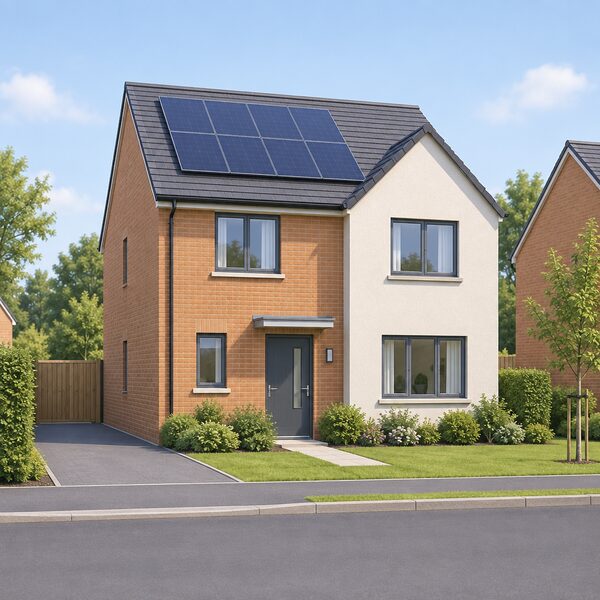
The savings claims come from Wondrwall itself. The company states that its AI-powered controls "can deliver energy bill savings" of over 80% on heating, and that the system reduces the average UK new build home's energy bill by over £1,300 a year1. Both figures are tied to a standard three-bedroom new build built to Part L 2021 with Wondrwall technology installed1.
Those numbers should be read as the maker's modelled or measured results for a specific house type, not as a general expectation. The independent evidence is a field trial rather than a savings claim: the North Devon project installed two Wondrwall systems and compared them with a control property running solar PV and infrared heating panels2. That is a small sample, and the published material does not put a percentage saving on it.
For scale, other published UK figures for home energy measures are far smaller. A local council programme cites improvements such as external wall insulation and heat pumps reducing energy bills by approximately 25%, or £350 a year. Cavity wall insulation is put at around £240 a year for a semi-detached house, and solid wall insulation at up to £280 in Great Britain and £330 in Northern Ireland. A saving above £1,300 a year is therefore an order of magnitude beyond what fabric measures alone deliver, which is why the combination of controls, electric heating, solar and battery matters to the claim.
The honest position is that the size of any saving depends on what the system replaces. A new build with infrared panels and a battery has far more scope for optimisation than a gas-heated Victorian terrace, and the £1,300 figure is explicitly attached to the former.
| Measure | Published annual saving | Basis |
|---|---|---|
| Wondrwall system, new build | over £1,3001 | Maker's figure, Part L 2021 three-bedroom new build |
| External wall insulation and heat pumps | approximately £350, about 25% | Council programme figure |
| Cavity wall insulation | around £240 | Semi-detached house |
| Solid wall insulation | up to £280 (GB), up to £330 (NI) | Published range |
How the system works: sensors, zonal heating and AI energy management
Zonal control is the mechanism. In an independent case study of a luxury home renovation in Edinburgh, underfloor heating and radiators were "zone controlled with individual room temperature controllers integrated into the wall switches"5. That is the same principle Wondrwall applies: rather than one thermostat governing the whole house, each room or zone has its own control point, and the switches themselves carry the temperature sensing.
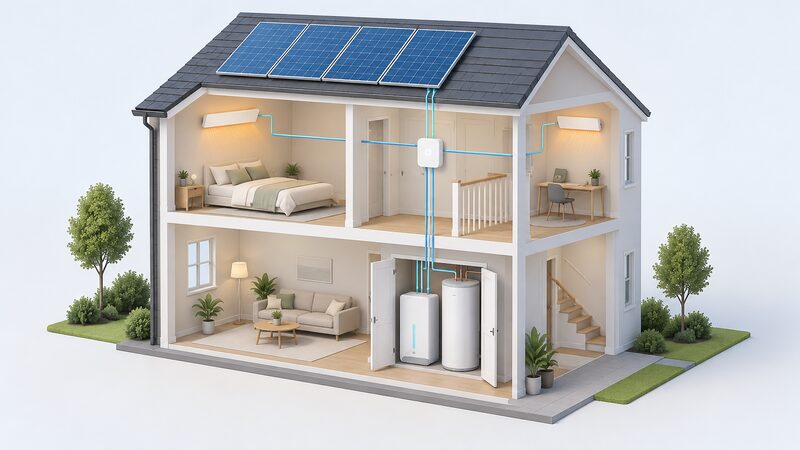
The AI layer sits above the zones. Wondrwall states that its platform analyses over 20,000 datapoints every day1, drawing on occupancy, temperature, energy use and, where fitted, generation and storage. The system then decides which zones to heat, when to run the hot water cylinder and when to charge or discharge the battery.
This is a different architecture from a smart thermostat plus smart TRVs. In that arrangement the householder sets schedules and the TRVs open and close radiators. In a Wondrwall installation the switches, sensors and heating are one system from one supplier, which is what allows the automation but also what ties the household to that supplier for control.
Heating with Wondrwall: infrared panels, heat pumps and dual-zone boiler control
Wondrwall's own heating products are electric. The North Devon trial installed infrared heating panels with a smart hot water cylinder2, and the company launched its own air source heat pump in 6kW and 8kW monobloc options in November 2024, opening its platform to other heat pump manufacturers at the same time.
For homes on a gas boiler, the picture is less clear from the published material. Wondrwall's homeowner pages describe heating, hot water and energy management generally rather than setting out combi boiler compatibility. Independent guidance on boiler flow temperature notes that weather compensation on a combi "can only do this if you have a combi boiler weather compensation kit or load compensator"6, which is the mechanism any third-party control needs in order to modulate a combi rather than simply switch it.
Where a boiler is involved, the practical questions are whether the control can modulate the boiler or only call for heat, and whether the boiler's own manufacturer warranty is affected by third-party controls. Neither is answered in the material available here, and both are matters for the installer surveying the property.
The Edinburgh case study shows the zonal approach working with wet heating: underfloor heating and radiators divided into zones with room controllers built into the wall switches5. That is the pattern a Wondrwall installation follows whether the heat source is a heat pump, a boiler or electric panels.
Solar, battery and selling surplus back to the grid
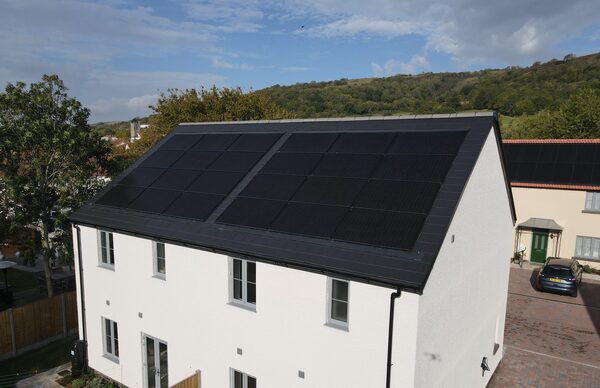
Generation and storage are central to the system rather than add-ons. The North Devon installation paired a 5.81kW solar array with a 6kWh battery2, and Wondrwall states that the system "will even sell surplus energy back to the grid for the highest possible price"1.
The mechanics of exporting are well established. Electricity generated at home can be used in the house, exported to the grid, or stored in a battery for use later. The Smart Export Guarantee obliges licensed suppliers to pay for electricity exported to the grid, and rates vary by supplier.
The scale of what a household can earn is modest. During a heatwave week in June 2026, British households with solar panels sold an average of 4.6kWh of electricity back to the grid per household per day, earning 55p. Rooftop solar paired with battery storage is credited with reducing energy bills by up to 80% when smart tariffs and exports are factored in, which is the same order of claim Wondrwall makes, though for a different combination of equipment.
One household account describes earning money "by selling the surplus electricity generated from our solar panels (and stored through the battery storage) back to the national grid through our supplier". The Home Energy Model used for building compliance has been reworked for solar PV and battery modelling, which affects how new builds are assessed rather than what an existing home earns.
For independence, this is the strongest part of the proposition: a home that generates, stores and exports is buying less and selling more. The dependence that remains is on a supplier to buy the export and on the grid to take it.
Tariffs and suppliers: any provider, optimised for time-of-use rates
Wondrwall states that the system "will work with all energy providers" but recommends a provider offering wholesale price tracking tariffs1. The company is explicit that it is not an energy retailer and only provides energy management services1. No supplier switch is required to use the controls.
Time-of-use tariffs are where the optimisation pays off, and they are entirely optional. Off-peak and time-of-use tariffs are "completely optional"7, and an energy supplier cannot charge based on when energy is used unless the householder specifically chooses such a tariff8. Not all suppliers offer them9, and flexible schemes and tariffs are available to selected customers from selected suppliers, with eligibility and availability varying and consumer action required9.
Smart meter data underpins this. Half-hourly data for any purpose is opt-in only10, so a household can use a time-of-use tariff without granting open access to detailed consumption data.
The independence question here is real but limited. Wondrwall does not lock a household to a supplier, which is a genuine advantage over systems tied to one retailer's tariff. What it does require is a supplier offering a tariff the system can optimise against, and those are not universally available.
Cost, contract and what's maintained: no upfront cost under the Energy Service Contract
Wondrwall does not publish a price list. Its homeowner material describes "energy savings with no upfront cost" and "fully maintained hardware throughout the duration of the Energy Service Contract"1. That is a service model rather than a product sale: the household pays for the system through the energy savings it delivers, and the hardware is maintained by the provider for the length of the contract.
That structure changes what a household is buying. There is no purchase price to compare against a conventional thermostat and TRV installation, and no published figure for the monthly or annual charge. The terms that matter, the contract length, the payment mechanism, what happens if savings fall short, and what happens at the end of the term, are not set out in the material available here.
Support is advertised as 24/7 live chat for all users and website visitors1. For disputes with an energy supplier rather than the controls, the Energy Ombudsman is a free, independent service, and consumers do not pay anything to bring a dispute to it12.
Where it's installed in the UK and who fits it
Wondrwall's route to market has been new build housing rather than retrofit. Installations have included Kier Living's The Vines development in Elburton near Plymouth, where the system was offered as an optional upgrade to buyers, and Avant Homes' Portlands show home near Worksop. A family moved into a Wondrwall-fitted Stonewater home at Mendip View in Axbridge in August 2022, and the company published a case study in August 2025 in which that household reported tracking daily energy usage and cutting bills with the system.
The North Devon field trial is the main independent installation evidence, and it was a research project rather than a customer installation2. The Edinburgh renovation shows the zonal control approach applied in a high-end retrofit5.
On who fits it, the material available here does not name an installer certification scheme for Wondrwall specifically. Where a boiler or central heating system is installed under the Warm Home Discount scheme in England and Wales, the regulations require installation by a person registered with TrustMark, with a certificate of lodgement issued by the scheme operator13. That is a requirement of that scheme rather than of Wondrwall installations, but it illustrates the standard of registration a household should expect to see evidenced for any heating work.
For a household weighing independence, the position is mixed. The system reduces reliance on bought energy by generating, storing and shifting load, and it does not tie the household to one energy supplier. What it does create is a dependence on Wondrwall as a single provider for controls, hardware and maintenance, on an Amazon account for login1, on a working internet connection for scheduling and monitoring, and on the terms of an Energy Service Contract that are not published. Manual control of lights and heating continues without wifi1, which limits but does not remove that dependence.
Sources13 cited
- Wondrwall for homeowners, Wondrwall, 2026-07-01
- Evaluating solar PV with electric heating with North Devon homes, National Energy Action, 2025-07-30
- Solar PV report, National Energy Action, 2025-02-19
- Self-build homes: sustainability, Planning Portal, 2026
- Luxury home renovation, Edinburgh, KNX Association, 2026
- Should I turn my boiler's flow temperature down?, Energy Saving Trust, 2026-05-20
- Time-of-use tariffs: the benefits, Smart Energy GB, 2026-04-24
- Smart Energy GB FAQs, Smart Energy GB, 2025-08-08
- Using energy flexibly, Smart Energy GB, 2026-04-14
- Data protection and smart meter data, Open Energy, 2026-09-20
- Switch your home energy supplier, Ofgem, 2026
- 20 things to know about Energy Ombudsman, Energy Ombudsman, 2026-07-17
- Warm Home Discount (England and Wales) Regulations 2026, legislation.gov.uk, 2026-03-27
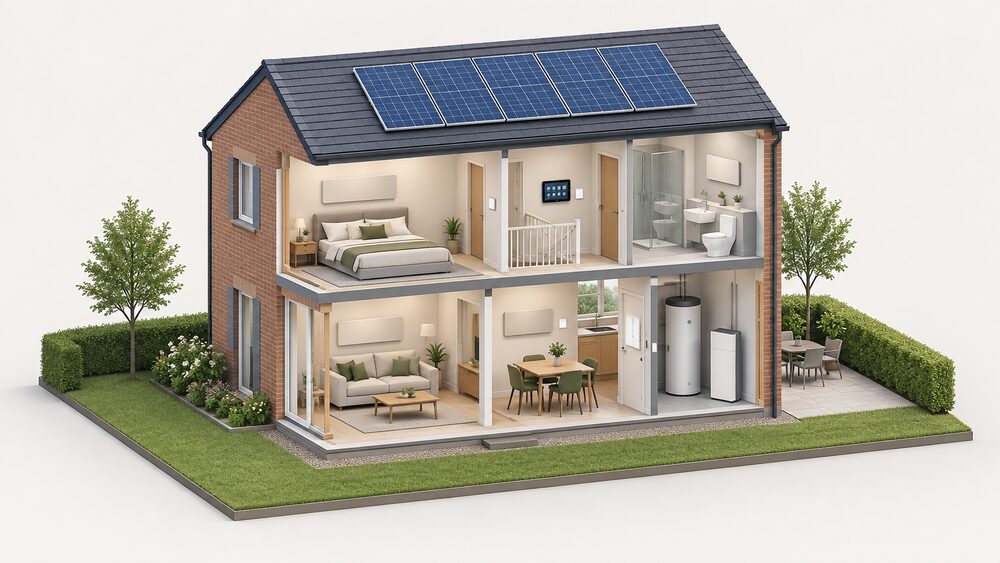 WondrwallWondrwall runs your heating, hot water and lighting from one app, and says it can cut an average new build's energy bill by over a thousand pounds a year.