
In this guide
Wondrwall is a UK maker of an intelligent home energy management system: a combination of hardware and software that controls heating, hot water, lighting, security and energy from a single app. The National Energy Action evaluation of two Wondrwall installations describes it as "an intelligent home energy management system which combines multiple technologies with the aim to provide a low carbon home which has low running costs"1. The company's own figures claim a reduction of over £1,300 a year in the energy bill of an average UK new build home2.
The system is sold as an Energy Service Contract rather than as a box of parts. Wondrwall states that the service charge covers all energy management related costs, maintenance and support for the duration of the contract, and that hardware is fully maintained throughout it2. That structure matters for how a household should read the offer: the household is buying an ongoing service, not just a control panel.
The measured evidence base is narrower than the marketing. An independent trial published by NEA in July 2025 found net energy consumption for the year was 50% lower for the Wondrwall house than for a control property1. Wondrwall's own headline claims run higher, including heating bill savings of over 80%2. Both figures exist, and they are not the same measurement.
What the system controls, and from where
Wondrwall's app is the single interface for the home. The company states that users can "manage lighting, security, heating, hot water, energy, and entertainment from one app"2. That is a wider remit than a smart thermostat or a home energy monitor, and it is the point of the product: rather than several apps for heating, lighting and audio, the system treats the house as one controllable asset.
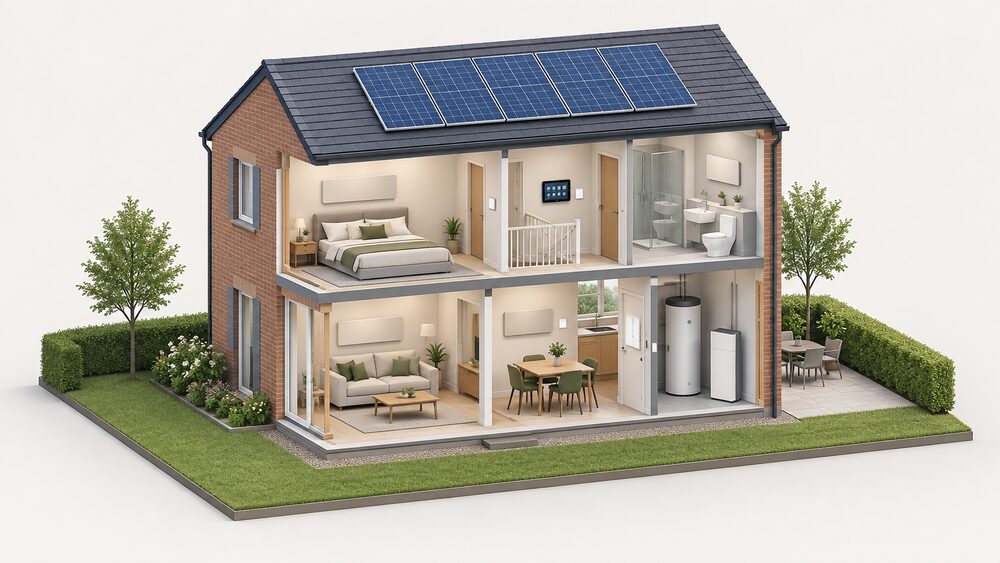
The hardware that does the work is not a single unit. In the two properties evaluated by NEA, the Wondrwall system comprised a 5.81kW solar PV system with a 6kWh battery, a smart hot water cylinder and infrared heating panels, smart light switches and a tablet computer for control1. That is the shape of a full installation: generation, storage, heat, lighting and a fixed control surface on the wall.
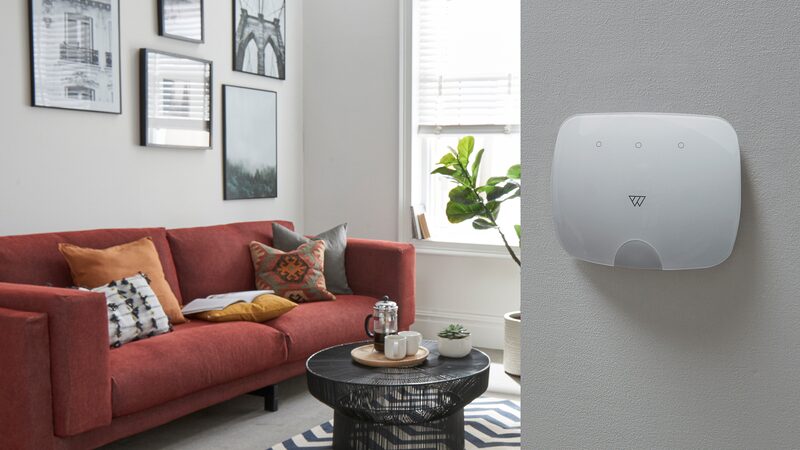
The control surface is also the fallback. Wondrwall states that if wifi goes down, lights can still be controlled manually using the touch sensors on the face of the switch, and heating can be turned on or off manually using the buttons on the relays, which glow red when on2. Basic function therefore survives a lost connection, but scheduling, energy insights and remote control do not.
"You can still manually control the lights as normal using the touch sensors on the face. The heating can be turned on or"
How the AI works: over 20,000 datapoints a day
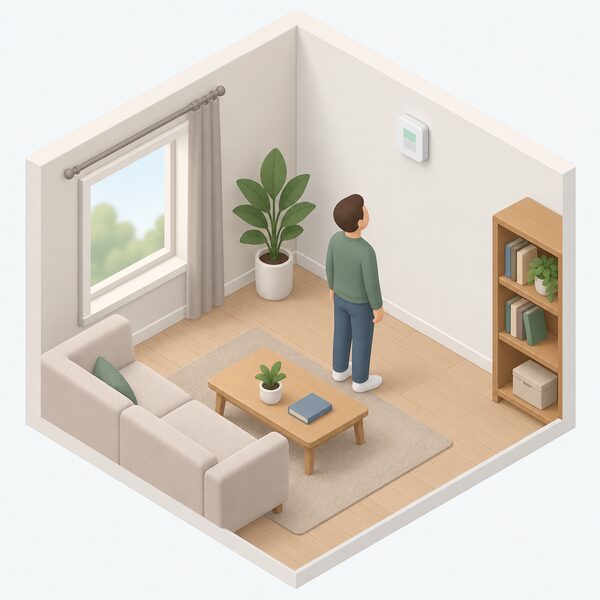
Wondrwall's automation rests on continuous measurement. The company states that "Wondrwall AI analyses over 20,000 datapoints every day to optimise the energy performance of your home"2. Those datapoints come from the sensors and switches distributed through the house, which is why the system is installed rather than retrofitted as a single device.
The distinction the company draws is between smart and intelligent. Wondrwall's own explanation is that intelligent homes employ machine learning and predictive technology to make decisions, whereas smart homes rely on timed or triggered events controlled by the homeowner. The practical difference is who sets the schedule: a smart home follows rules the household wrote, while an intelligent system adjusts them.
That approach is not unique to this product. UK Power Networks' Smart Connect service, for example, "works by using artificial Intelligence to process data about each household installation" to assess whether a supply needs upgrading, referring customers to an expert where it does and otherwise providing automatic assessment and auto approval3. Automated assessment of a household's electrical position is becoming a normal part of connection and upgrade work.
What the AI cannot do is create energy. It shifts and sequences demand, and it decides when a battery charges or a cylinder heats. The savings come from timing and from avoiding waste, not from generating anything.
Measured performance: what the trial found
The strongest independent evidence on Wondrwall comes from the NEA report published on 30 July 2025, which evaluated solar PV with electric heating in North Devon Homes. It compared two Wondrwall properties against a control property with solar PV and infrared heating panels. The finding was that "net energy consumption for the year was 50% lower for the Wonderwall house"1.
Wondrwall's own published claims are larger. The company states that its AI-powered controls "can deliver energy bill savings" of over 80% on heating, and that the system reduces the average UK new build home's energy bill by over £1,300 a year2. The example home behind that figure is described as a standard 3-bedroom new build UK home built to Part L 2021 with Wondrwall technology2.
The two numbers measure different things. The NEA figure is net energy consumption across a year in a specific pair of properties; the Wondrwall figure is a modelled bill reduction for a defined house type. Neither is a guarantee for any individual home, and the gap between them is the reason to read both rather than one.
Comparable results elsewhere in the sector show the same order of magnitude. A separate case study of a Wondrwall-fitted home at Langley Grange found net energy consumption for the year was 50% lower for the Wondrwall house3. Independent work on combined clean technologies reports heating costs falling by up to 80% compared to using gas alone4. The direction of travel is consistent; the exact percentage is not.
Where the savings come from: solar, battery and off-peak charging
The savings mechanism is load shifting plus self-consumption. Battery storage helps a household make the most of renewable electricity from solar panels, wind turbines and hydro turbines5. A home battery can be charged from excess electricity generated by solar panels or other home generation, from the mains electricity supply, or from off-peak grid electricity on a time-of-use tariff6.
That third route is the one that works without any generation at all. If a household has an Economy 7 meter, certain energy storage products can charge from the grid and store cheap off-peak electricity7. Wondrwall's own system in the NEA trial paired a 5.81kW solar array with a 6kWh battery1, so both self-consumption and off-peak charging were available.
Export is the other half. Wondrwall states that the system "will even sell surplus energy back to the grid for the highest possible price, reducing your bills even further"2. The Smart Export Guarantee is the framework that obliges licensed suppliers to pay for electricity exported to the grid8, and some export tariffs carry no fixed end date8.
| Component | Figure | Source basis |
|---|---|---|
| Solar PV capacity | 5.81kW | NEA trial installation1 |
| Battery capacity | 6kWh | NEA trial installation1 |
| Daily datapoints analysed | over 20,000 | Maker statement2 |
| Claimed annual bill reduction | over £1,300 | Maker statement, average UK new build2 |
| Trial net energy reduction | 50% | Independent case study1 |
Cost, payback and the Energy Service Contract

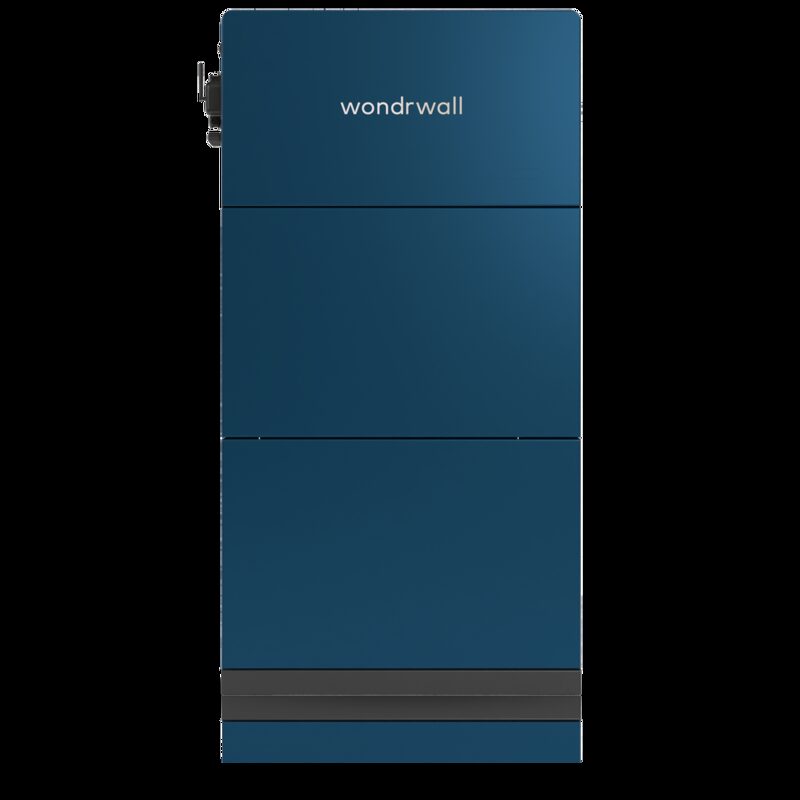
Wondrwall does not publish a hardware price list. The company markets the system as "energy savings with no upfront cost"2, and the commercial mechanism is the Energy Service Contract. Under it, the service charge "covers all energy management related costs, maintenance and support for the duration of the contract"2, and hardware is fully maintained for the same period2.
That is a different proposition from buying a thermostat or a battery outright. The household is not paying for a product and then owning it free of further charge; it is paying a recurring service charge in exchange for maintained hardware and ongoing energy management. What the household owns at the end of the contract, and on what terms it can exit, are not stated in the published material.
For context on what energy costs look like without any of this, Ofgem's cap levels for 1 July to 30 September 2025 put the annual cost of electricity for a Southern Western household at £931.90 on 3,100 kWh a year with single-rate metering, and £1,029.01 on the same consumption under a different payment method9. The documents give different figures for the same region and period, and the disagreement is not resolved. A household comparing a service charge against a bill should use its own consumption, not a cap illustration.
New build availability and the electrical trade
Wondrwall's route to market has been new build. The company's example home is a standard 3-bedroom new build built to Part L 20212, and its installations have been with housebuilders and housing associations rather than through a retail channel. The NEA trial properties were North Devon Homes installations1.
New build electrical work is regulated. The guidance on designing and constructing new builds to enable smart meter installations applies to England, Scotland and Wales10. In Wales, the Building Regulations identify non-notifiable work as including any repair or maintenance work or like-for-like replacement, any addition or alteration to an existing circuit that is not in a kitchen, bathroom or outdoors, installing or upgrading main or supplementary equipotential bonding, and installing extra low voltage cabling outside bathrooms for telephone, fire alarm, burglar alarm and heating systems11.
Connections follow the network operator's process. For one to four properties, Electricity North West asks for postal address and contact details, the site address for the connections, the number of connections needed, the size of incoming supply required, a site plan showing the location of the new supply, and an architect's drawing for new build properties; where planning applications have already been submitted, the reference number can be provided and the operator will source site plans from the local authority12. In Northern Ireland, NIE Networks asks for address and contact details, a site location plan, site layout plan, floor plans and elevations, electrical load details, the planning permission reference number, a feasibility or budget request, a construction sequence for two or more phased properties, and temporary supply needs if required; customers may carry out some excavation and reinstatement work and may appoint their own approved Independent Connection Provider for some connection work13.
Skills are a live constraint. Research into retrofit trades in Wales found that while there may be a shortage of contractors currently delivering energy efficiency measures, there are other suitable trades who could be upskilled to deliver them14. A system that needs electrical work, network connection and commissioning sits squarely in that gap.
Support, tariffs and what owning Wondrwall means day to day
Support is stated as 24/7 live chat available to all users and website visitors2. Hardware maintenance sits inside the Energy Service Contract2, and the company reports being rated "Excellent" by its users on Trustpilot2. Those are the maker's own statements about its own service.
On supply, Wondrwall states that the system "will work with all energy providers" but recommends a provider offering wholesale price tracking tariffs2. The company is explicit that it is not an energy retailer and only provides energy management services2. A household therefore keeps its own supply relationship, its own meter and its own bill.
That relationship has protections. If a supplier goes out of business, the household does not need to do anything: Ofgem states that customers are automatically moved to a new supplier and supply is not interrupted15. Switching supplier is a separate right, and the Green Deal rules note that a household can change electricity supplier as long as the new supplier is taking part in the scheme16. Where a household has its own contract with an energy supplier, it may be able to switch its business energy supplier17.
For unresolved complaints, the Energy Ombudsman service is free and easy to access18, and has provided free, independent support to consumers who have an unresolved energy complaint19. Support with bills also exists outside the supplier relationship: the Welsh government publishes help with home energy bills20, Green Homes Wales requires the home to be owned by the householder21, and Dŵr Cymru and Welsh Water offer payment plans and water rate reductions22.
The dependence that remains is worth stating plainly. Wondrwall keeps a home on the grid and on a supplier, because the system manages energy rather than producing all of it. It adds a dependence on a home broadband connection, on the manufacturer's platform and on an Amazon account for login2. The longest-term commitment is the Energy Service Contract itself, which ties maintenance and support to a continuing service charge.
Sources22 cited
- Evaluating solar PV with electric heating with North Devon Homes: Wondrwall, NEA, 2025-07-30
- Wondrwall for homeowners, Wondrwall, 2026-07-01
- Langley Grange, Future Homes, 2024-07-11
- Clean tech combo could help households beat rising energy bills, Energy Saving Trust, 2026-07-15
- Storing energy, Energy Saving Trust, 2026-07-15
- Solar panel battery storage, Which?, 2026-05-14
- Electrical Energy Storage Systems, Flexi-Orb, 2025-04-22
- Smart Export Guarantee, Solar Energy UK, 2026-05-12
- Energy price cap levels 1 July to 30 September 2025, Ofgem, 2025-07-01
- Design and construct new builds to enable smart meter installations, GOV.UK, 2026-03-24
- Building Regulations: minor works, Planning Portal, 2026
- What to expect when planning your connection, Electricity North West, 2026-09-20
- New electricity supply for 1 to 11 houses, NIE Networks, 2026-09-19
- New Warm Homes Programme integrated impact assessment, Welsh Government, 2024-03-08
- Switch your home energy supplier, Ofgem, 2026
- Green Deal energy saving measures, GOV.UK, 2026-09-17
- Alternative homes energy guidance, Ofgem, 2026
- Can we help? Use this checklist, Energy Ombudsman, 2025-04-15
- One million consumers helped by Energy Ombudsman, Energy Ombudsman, 2026-07-07
- Get help with your energy bills, Ofgem, 2026-09-17
- Green Homes Wales, Development Bank of Wales, 2026-09-17
- Get help with your utility bills, Welsh Government, 2022-11-18
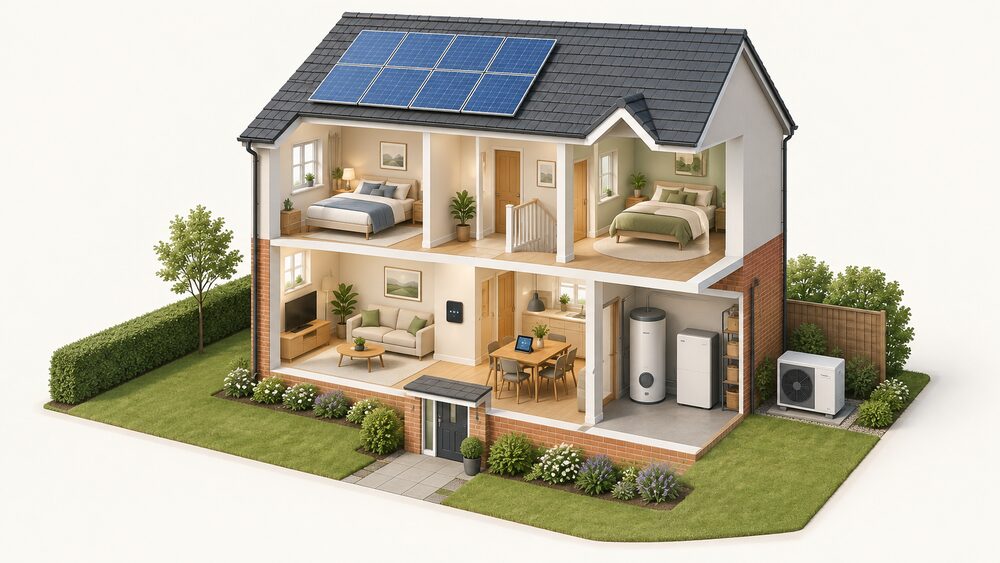 Wondrwall Smart Heating ControlsWondrwall runs the heating, hot water, lighting and solar in one app, and the maker claims over 80% off heating bills and more than £1,300 a year off a typical new build's energy bill.