
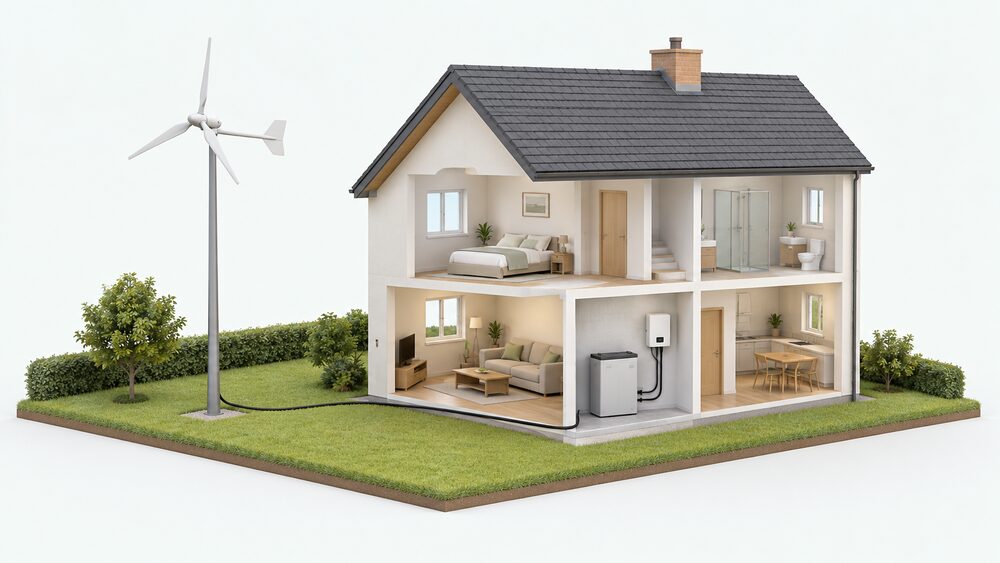
In this guide
Small wind turbines convert wind into electricity, and for a household with the right site they are one of the few microgeneration technologies that can produce power through the night and through the winter1. A typical domestic system is 2.5 to six kilowatts, depending on the location and size of the house, and the Energy Saving Trust's condition for considering one at all is a local annual average wind speed of five metres per second or more2.
FuturEnergy is one of the names a UK householder meets when shopping for a small turbine. This page sets out what the technology does, what it costs to own, where it can be mounted, and what it means for a home's energy independence. It does not carry a verified company address, product list or warranty term for FuturEnergy, and where that detail is missing it is left out rather than guessed at.
The wider context is that small wind is a niche within a large national build-out. Wind accounted for 11.89% of scheme lifetime capacity under the Feed-in Tariff, and offshore wind carries a deployment ambition of up to 50GW by 20303. A domestic turbine is a different proposition: it serves one property, and its output depends almost entirely on the site rather than the machine.
What a small wind turbine does for a home or off-grid site
Wind turbines convert wind into electricity, and that electricity can be used as a clean, renewable power source for a home or small business1. The mechanism is simple and the constraint is not: small-scale turbines generate electricity from wind, and how much they generate depends on wind speed and location6. Two identical machines on two different sites can produce very different annual totals.
For a grid-connected home, any unused or excess electricity can be exported to the grid and sold to the local electricity supply company2. That export route is what turns a turbine from a standalone generator into part of a household's income and accounting. The Smart Export Guarantee requires licensed electricity suppliers to offer export tariffs to onshore wind generators with a total installed capacity up to 5MW, and the scheme's maximum permitted capacity is 5MW for all technology types except micro-CHP5. A domestic turbine sits far below that ceiling.
Off-grid is where small wind is most clearly at home. Independent guidance describes small wind as especially practical for remote areas where connecting to the grid may be costly or challenging, and notes that a turbine can be paired with a battery storage system to store excess electricity for when it is most needed1. In that configuration the turbine is not supplementing a supply, it is the supply, and the battery is what carries the household through calm spells.
The honest limit is that wind is intermittent at the scale of a single site. Official guidance notes that wind-diesel mixed systems are common, running a diesel generator during periods of low wind speeds2. A household that wants independence from the grid should understand that a turbine alone rarely delivers it; a turbine plus storage plus a backup generator is the configuration that does.
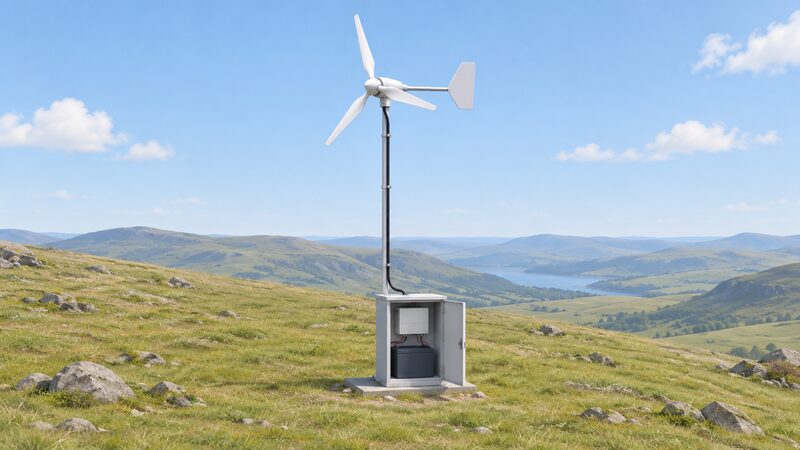
The range at a glance
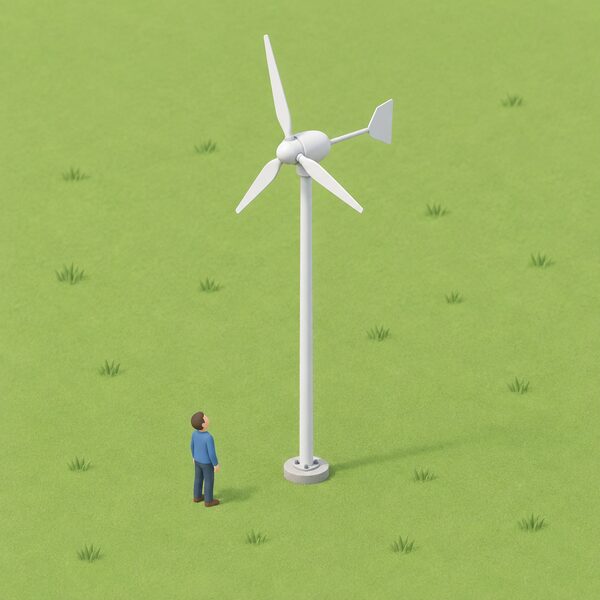
Individual wind turbines vary in size and power output from a few hundred watts to two or three megawatts, where one megawatt equals 1,000 kilowatts2. That is a span of four orders of magnitude, and it is worth being clear that the domestic market occupies only the bottom of it. A typical domestic system for a home is 2.5 to six kilowatts, depending on the location and size of the house2.
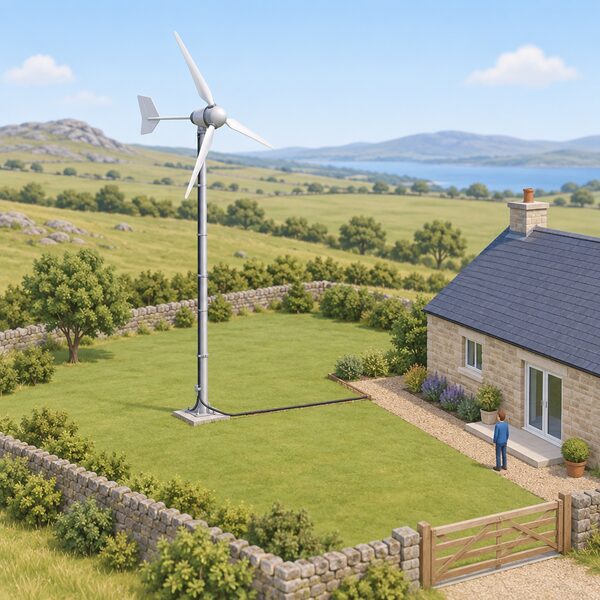
Within that band, the practical split is between pole-mounted and building-mounted machines. Pole-mounted turbines stand on their own pole, usually placed in a clear, open area where there is plenty of wind1. Building-mounted turbines can be installed on rooftops or building sides1. The two are not interchangeable: they suit different sites, attract different planning treatment, and carry different structural implications.
At the larger end of the small-scale market, the technology overlaps with community and public-sector projects. A Scottish island scheme installed three new 60kW class type 1 wind turbines as part of a low carbon electricity storage and generation project8. That is roughly ten times the top of the domestic band, and it illustrates where the boundary sits between a household machine and a small commercial one.
| Scale | Typical capacity | Where it is used |
|---|---|---|
| Micro, off-grid | a few hundred watts2 | Boats, remote cabins, battery charging |
| Domestic | 2.5 to six kilowatts2 | Home or small business1 |
| Small commercial | tens of kilowatts, e.g. three 60kW class turbines8 | Island and community schemes |
| Export scheme ceiling | up to 5MW total installed capacity5 | SEG eligibility limit |
Specifications and what they mean for output
The single figure that governs a small turbine's annual output is the site's annual average wind speed, not the machine's rated capacity. The Energy Saving Trust condition for considering a wind turbine is that the local annual average wind speed is five metres per second or more2. Below that, the arithmetic of wind power works against the household: output rises steeply with wind speed, so a site averaging four metres per second produces far less than one averaging five, and no amount of equipment specification closes the gap.
Rated capacity, by contrast, is a peak figure. A 2.5 to six kilowatt domestic machine is rated at the wind speed at which it reaches its maximum output, and it will spend most of the year below that2. The number that matters for a household's expectations is annual generation in kilowatt hours, which follows from the site's wind resource and the machine's swept area.
There is a second specification question that catches households out: how much of the turbine's output the property can actually use or export. A Welsh scheme illustrates the point sharply. A 900kW turbine at Senghenydd could export only 300kW to the grid, because the connection limited it9. The same principle applies at domestic scale in miniature: the grid connection, the inverter and the household's own demand all cap what a turbine's output is worth.
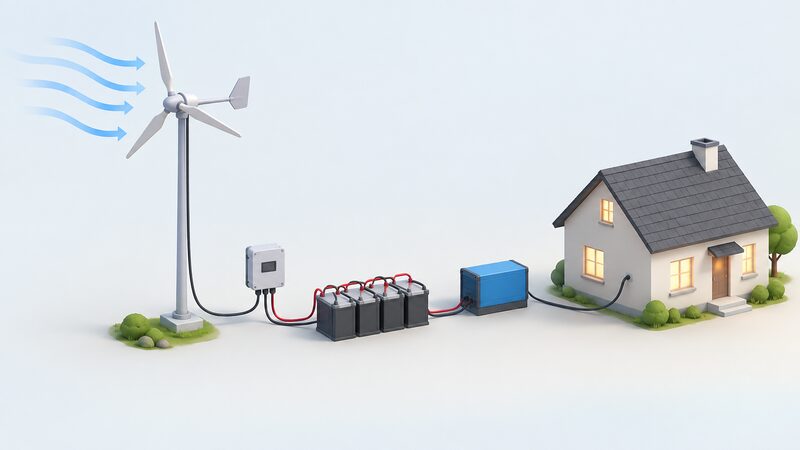
For off-grid systems, the specification that matters is the battery bank and the charge controller rather than the turbine's peak rating. Independent guidance frames the turbine as one half of a pair, with battery storage holding excess electricity for when it is most needed1. Official guidance adds the diesel generator as the common third element for low wind periods2.
Cost and what affects the installed price
No published purchase or installed price exists for a FuturEnergy turbine, and no range is given here. What is documented is the running cost of ownership, which is where small wind differs from solar. Maintenance visits typically cost between £100 and £200, depending on the size of the system1. That is an annual or near-annual figure for a machine that has moving parts exposed to weather.
Component replacement is the larger exposure. For a larger system, replacing the inverter usually costs between £1,000 and £2,0001. An inverter is not a lifetime component, so a household should treat that as a predictable future cost rather than a contingency. On a small off-grid system the equivalent item is the charge controller, which performs the same power-conversion role.
Lifespan sets the frame for both. Wind turbines can have a life of up to 22.5 years, but need service checks every few years to make sure they work efficiently2. Over that period, maintenance at £100 to £200 a visit and one inverter replacement at £1,000 to £2,000 represent the bulk of the non-capital cost.
Three site factors move the installed price before any of that. The first is mounting: a pole-mounted machine needs foundations and a clear area, while a building-mounted one needs structural assessment, and official guidance warns that for turbines attached to the house the size, weight and force exerted on fixed points would be considerable4. The second is the grid connection, where a remote site may face a costly or challenging connection, which is precisely why small wind suits off-grid use1. The third is planning, which can require an application and professional reports. Wider cost context is at how much a domestic wind turbine costs.
Siting and mounting: what a turbine needs to perform
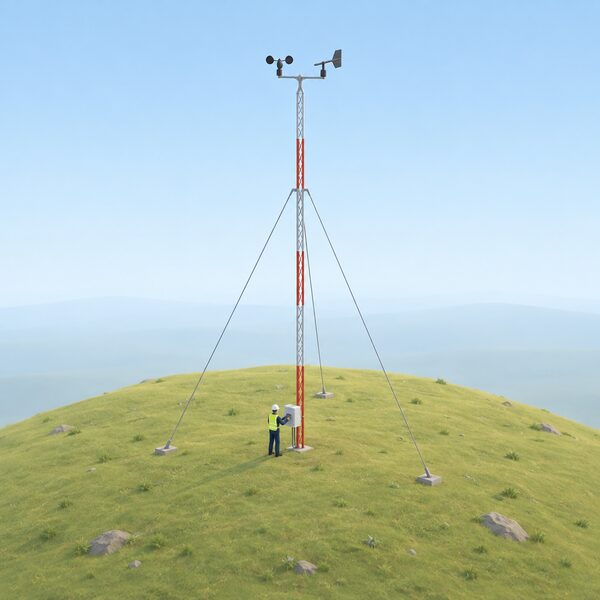
Turbines should ideally be located on a hilltop or raised structure, away from obstructions like trees or other buildings, and higher placements catch stronger, steadier winds1. The Energy Saving Trust's condition is stated as an absence: there are no major obstacles nearby such as buildings, trees or hills that are likely to reduce the wind speed or increase turbulence2. Turbulence matters as much as average speed, because it fatigues the machine and degrades output.
The recommended way to confirm a site is measurement rather than judgement. Ideally, a professional assessment of the local wind speed should be carried out for a full year at the exact location where the turbine is planned, before proceeding2. That is a long lead time, and it is the single most common reason small wind projects stall. More on this is at wind speed and siting for a home wind turbine and how long to measure wind before installing.
Mounting choice follows from the site. Pole-mounted turbines stand on their own pole in a clear, open area1. Building-mounted turbines can go on rooftops or building sides, but the structural loads are considerable1. Building regulations approval may be needed, and the position is set out at wind turbine building regulations.
Planning treatment differs across the UK, and it is where a household's options narrow most. In England, permitted development for a stand-alone wind turbine requires non-reflective blades, must not be sited on safeguarded land, and is not available within the curtilage of a dwellinghouse10. In a conservation area, a stand-alone turbine is not permitted if it would be visible from a highway bounding the curtilage10. In Wales, permitted development for a stand-alone turbine requires non-reflective blades, siting that minimises effect on amenity, and removal when no longer needed for or capable of microgeneration11. In Scotland, a free-standing turbine within a dwelling curtilage must comply with MCS Planning Standards or equivalent, and the developer must apply to the planning authority for a determination on whether prior approval is required as to siting, design and external appearance13. Building-mounted turbines generally require a planning application10. The four nations are covered in detail at England, Scotland, Wales and Northern Ireland.
Wind turbines and household energy independence
Renewable energy technologies help a household meet its own energy requirements and reduce the home's carbon dioxide emissions15. That is the general case, and small wind makes it in a particular way: it generates in darkness and in winter, when solar produces least, and it can do so entirely off the grid.
The dependence that remains is worth stating plainly. A grid-connected turbine still relies on the grid for the periods when wind is low, and on a licensed supplier for the export tariff that pays for what it sends out. The Smart Export Guarantee obliges suppliers to offer export tariffs to onshore wind up to 5MW, but the rate is set by the supplier, not the scheme5. A household that exports is therefore in a commercial relationship with an electricity company, not outside one.
An off-grid turbine removes the supplier and the grid, and replaces them with a battery bank, a charge controller and, commonly, a diesel generator for low wind periods1. That is a real independence, and it is also a real maintenance obligation: fuel, batteries and controllers all need attention, and the household becomes its own network operator.
There is a national dimension too. Wind accounted for 11.89% of scheme lifetime capacity under the Feed-in Tariff, and the British Energy Security Strategy set an ambition of up to 50GW of offshore wind by 2030, with 5GW of floating offshore wind3. Northern Ireland's variable renewables capacity is projected to grow three-fold by 2040 to 5.5GW, combining offshore and onshore wind and solar17. A domestic turbine contributes nothing measurable to those figures, but it does move one property's exposure in the opposite direction. The wider argument is at micro wind, hydro and CHP and energy independence.
How FuturEnergy compares with other small wind options
The UK small wind market is thin, and no verified product specifications for FuturEnergy are available against which a comparison could be built. What is documented is the shape of the market and the standards that apply to every machine in it.
Certification is the first filter. In Scotland, permitted development for a free-standing turbine within a dwelling curtilage requires compliance with MCS Planning Standards for wind turbines or equivalent standards13. In Wales, permitted development for a stand-alone turbine likewise turns on compliance with MCS Planning Standards or equivalent12. A machine that is not certified to those standards may still be installed, but it will generally need a planning application. The standards themselves are covered at small wind turbine standards and certification and MCS certification for wind and hydro.
The second filter is scale and site. A 2.5 to six kilowatt domestic machine suits a property with a clear, exposed site and an annual average wind speed of five metres per second or more2. A building-mounted machine suits a property where a pole is not possible, at the cost of structural work and generally a planning application1. An off-grid machine suits a remote property where a grid connection would be costly or challenging1.
For households weighing small wind against other technologies, the comparison pages set out the trade-offs: micro wind versus solar PV for an off-grid home, micro hydro versus micro wind for a rural home, and pole-mounted versus roof-mounted wind turbines. The pillar page for the whole category is microgeneration beyond solar.
Owning a small turbine: maintenance and practicalities
Ownership is a service relationship. Wind turbines can have a life of up to 22.5 years, but need service checks every few years to make sure they work efficiently2. Maintenance visits typically cost between £100 and £200 depending on system size, and inverter replacement on a larger system usually costs between £1,000 and £2,0001. Those are the figures a household should plan around.
Warranty registration is normally an installer task carried out at commissioning. One official scheme specification requires inverter product registrations to activate guarantees and warranties to be completed within 48 hours of commissioning18. The lesson generalises: registration is time-limited and installer-led, so the paperwork should be confirmed on handover rather than assumed.
Spare parts and controllers are the practical question for a machine expected to run for two decades. No verified parts availability for FuturEnergy is documented. What is clear is that controllers and inverters are serviceable items with a real replacement cost, and that the maintenance regime is periodic rather than continuous1. A household considering any small turbine should establish, before purchase, who services it locally and how long a replacement inverter or controller takes to source.
Two further practical points. First, removal is a condition of permitted development in England and Wales: the turbine must be removed as soon as reasonably practicable when no longer needed for microgeneration10. Second, the export relationship continues for the life of the system. The Smart Export Guarantee requires licensed suppliers to offer export tariffs to onshore wind generators up to 5MW total installed capacity, and the scheme's maximum permitted capacity is 5MW for all technology types except micro-CHP5. A household that installs a turbine is signing up to a long-term commercial arrangement as well as a piece of equipment. More on the practical side is at installing and maintaining a domestic wind turbine and off-grid wind power.
Sources18 cited
- Small wind turbines, MCS Certified, 2026
- Wind, nidirect, 2026
- Feed-in Tariffs Annual Report Scheme Year 13, Ofgem, 2023
- British Energy Security Strategy, UK Government, 2022
- Guidance for SEG licensees, Ofgem, 2019
- Sustainable home energy solutions, Planning Portal, 2024
- Guidance for SEG licensees, Ofgem, 2026
- Low Carbon Infrastructure Transition Programme, Scottish Government, 2024
- Smart Living Initiative Annual Report, Welsh Government, 2019
- Planning permission: stand alone wind turbines, Planning Portal, 2026
- Class H: installation of wind turbine on domestic premises, legislation.gov.uk, 2015
- Planning permission: wind turbines, Welsh Government, 2026
- The Town and Country Planning (General Permitted Development) (Scotland) Amendment Order 2024, legislation.gov.uk, 2024
- The Town and Country Planning (General Permitted Development) (Scotland) Amendment Order 2024: Policy Note, legislation.gov.uk, 2024
- Home energy generation, Planning Portal, 2026
- Major acceleration of homegrown power, UK Government, 2026
- Northern Ireland's Fourth Carbon Budget, Climate Change Committee, 2025
- Barcud Solar Panel Installation Scheme Specification, Sell2Wales, 2026