In this guide
The Amptec is an electric flow boiler: a system boiler that heats water electrically rather than by burning gas, and one of the named options for a home with no gas connection. Baxi describes the Amptec S as "a state-of-the-art electric system boiler to provide an energy-efficient alternative heating and hot water solution to gas"1. It is made by Heatrae Sadia, a UK manufacturer that is part of Baxi UK2.
For a household, the appeal is straightforward. An electric flow boiler removes the gas supply, the gas meter and the gas standing charge from the equation, and it needs no flue, no combustion air and no carbon monoxide risk from a fuel-burning appliance. What it does not remove is dependence on the electricity grid and on an electricity supplier. The Amptec is a high-load appliance, and in Northern Ireland, for example, water heaters and heat pumps are among the equipment that must be declared on a single house connection application3.
This page covers what the Amptec is, who makes and owns it, where it fits in an all-electric home, the standards the range meets, how buying and quoting work, and the support, spares, warranty and disposal arrangements that follow a purchase.
What the Amptec is: an electric flow boiler for homes without gas
An electric flow boiler works on the same principle as a system boiler: it heats water for radiators and, where a cylinder is fitted, for hot water storage. The difference is the heat source. There is no burner, no gas train and no flue, so the appliance can be sited where a gas boiler could not go, and no gas connection is needed at the property.
The Amptec line has a longer history than its current marketing suggests. The National Energy Action charity published details of a project evaluating Amptec C1200 electric boilers from Heatrae Sadia across 10 households in central England, dated 18 June 2015. That is a small sample and an old study, and it should be read as an early field assessment rather than current performance evidence.
The trade press coverage of the newer Amptec S comes from the Chartered Institute of Plumbing and Heating Engineering, which reported the launch as an electric system boiler intended as an energy-efficient alternative for heating and hot water where gas is not available1. That framing matters: the Amptec is not presented as a like-for-like replacement for a gas boiler on running cost, but as a route to a full wet heating system in a property that has no gas main.
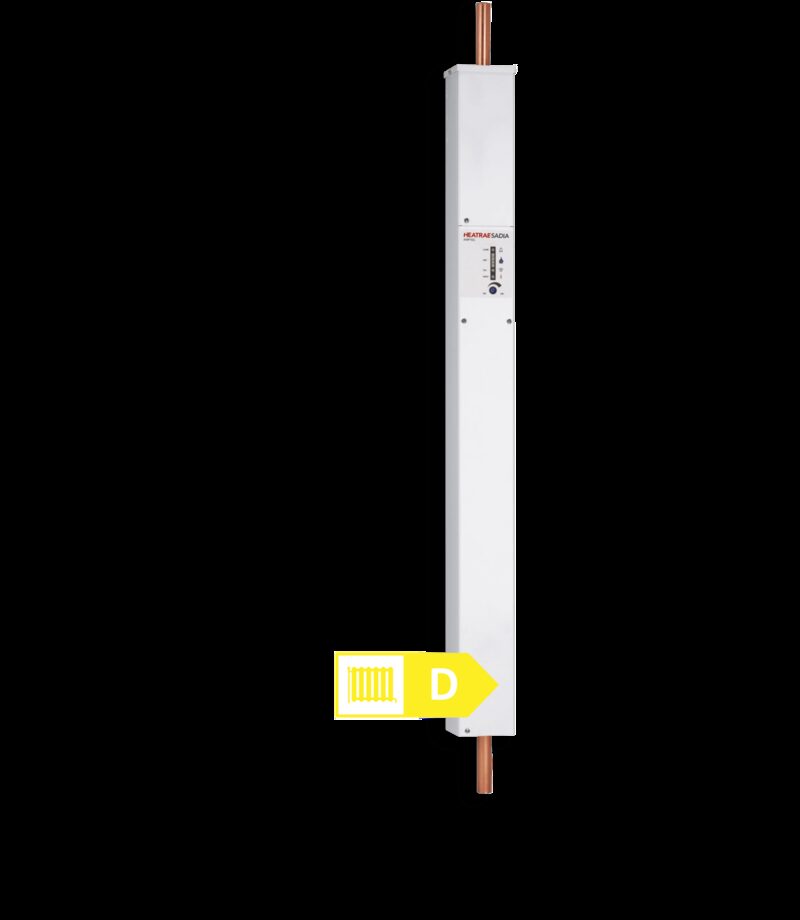
For a household, the practical consequence is that the heating system stays conventional, with radiators and controls, while the fuel changes entirely to electricity. Independence from gas comes at the cost of a larger electrical load and a continuing relationship with an electricity supplier. The wider picture of how electric boilers compare is set out in Electric Boilers Explained, and the supply implications are covered in Electrical Safety and Supply for Electric Heating.
Who Heatrae Sadia are and who owns them
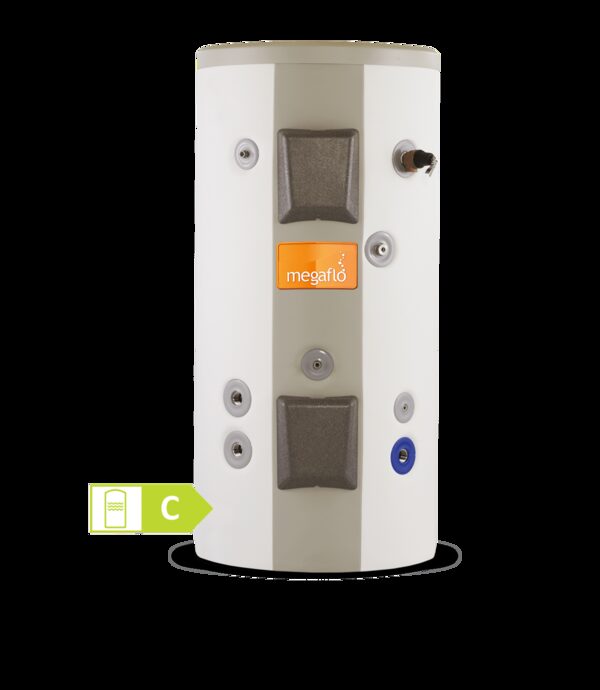
Heatrae Sadia states plainly that it is part of Baxi UK2. That ownership matters to a buyer because it determines who stands behind the warranty, who supplies the spares and which contact centres answer the phone. The company designs, engineers and manufactures in the UK, and its products are made for installation in the UK4.
The brand portfolio is broader than electric boilers. Heatrae Sadia acquired the Megaflo brand in 1993 and introduced the Megaflo Commercial product line in 2011. The Santon brand of water heaters was acquired in 1998, and in 2015 the Santon PremierPlus unvented cylinder moved across to the Heatrae Sadia brand. Those dates show a company that has consolidated several UK hot water names under one roof rather than a single-product maker.
Materials are part of the pitch. Heatrae Sadia states that many of its products are manufactured using marine grade 2205 Duplex stainless steel, which it describes as highly corrosion resistant and twice as strong as an austenitic or ferritic stainless steel2. For a household, corrosion resistance in a hot water vessel is the difference between a long service life and an early replacement, so the material claim is worth noting even though it is the maker's own.
The company also has an international footprint: Doha in Qatar is the location of the Heatrae Sadia representative office for the Middle East region2. That does not affect UK support, but it explains why some corporate material reads as a global operation. For UK buyers, the relevant facts are the UK manufacturing base, the UK contact centres and the UK territorial limit on the warranty. The brand's wider range is covered in Heatrae Sadia: electric boilers and storage heating, and the cylinder side in Megaflo unvented cylinders explained.
Where the Amptec fits in an all-electric home
An electric flow boiler is one part of a system, not a whole heating solution. It needs emitters, controls and, if hot water is to be stored, a cylinder. Heatrae Sadia sells vented tap packages for use with its water heaters, which shows how the components are intended to combine4.
The wider all-electric picture is where the Amptec earns its place. A home off the gas grid has historically run on oil, LPG or solid fuel, each with its own storage, delivery and servicing requirements. Electric heating removes the fuel store and the delivery, and it removes the flue. What it does not remove is the electrical capacity requirement. In Northern Ireland, NIE Networks lists power showers, heat pumps, water heaters, underfloor heating, motors, refrigeration, welders, air conditioning, EV chargers, swimming pools, cranes and lifts among the high-load equipment that must be declared on a single house connection application3. An electric flow boiler sits in that category of load.
There is also a planning dimension in Scotland. Householder permitted development rights guidance states that microgeneration equipment must be removed as soon as reasonably practicable where it is no longer needed for, or capable of, being used for domestic microgeneration or domestic heating or hot water purposes6. That is a condition on permitted development rather than a rule about boilers, but it illustrates how the regulatory framework around home energy equipment increasingly attaches conditions to installation.
For the household, the honest summary is that an Amptec gives independence from gas and from a gas supplier, and from oil or LPG deliveries, while increasing dependence on the electricity network and on whatever tariff is available. The running cost comparison across fuels is set out in Home Heating Running Costs by Fuel and Electric Heating Running Costs, and the tariff structures that can change the arithmetic are covered in Economy 7, Economy 10 and Heating Tariffs.
Certifications and standards the range meets
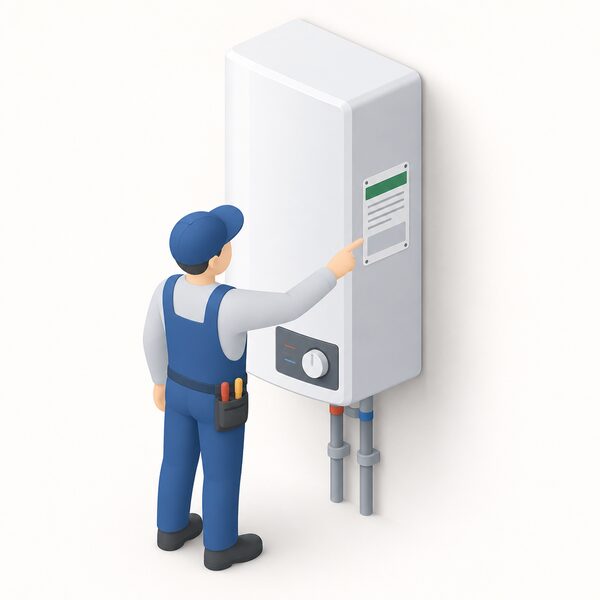
Heatrae Sadia states that many Heatrae Sadia and Megaflo products have been tested and certified by Kiwa2. That is the maker's own statement about third-party testing, and it sits alongside a set of other certifications the company reports holding, including WRAS, the Hot Water Association Charter, BS EN ISO 9001:2015 and Energy related Products (ErP) ratings. Separately, the company states it is one of a select few UK businesses to have achieved the ISO 50001 worldwide standard for managing energy use across its business operations and product portfolio. The two sets of claims are not reconciled in the material available, so both are reported here as the maker's position.
Standards in this sector are not decorative. Heat meters, for example, must comply with Annex I and Annex VI of the 2014 EU Measuring Instruments Directive7, and air source heat pumps must comply with the Microgeneration Certification Scheme Planning Standards (MCS 020) or an equivalent standard8. Heat pumps also have a dedicated standard, MCS 0079. Those are the benchmarks against which heating equipment is assessed, and they show the level of formality involved.
For a household, certification is what makes an appliance acceptable to an installer, to a building control body and, where grants are involved, to a funding scheme. The HETAS Certificate of Compliance, for instance, demonstrates that an installation complies with the relevant Building Regulations10. The general framework is set out in Heating Appliance Standards, Marking and Certification and Building Regulations for Heating Systems.
Buying through merchants and getting quotes
There is no published list price for an Amptec in the material available here, so prices are installer-quoted. That is normal for this category: the appliance, the controls, the cylinder where one is needed, the electrical work and the labour are quoted together after a site visit.
The buying process itself follows the pattern of any wet heating installation. Independent guidance from HETAS is to obtain at least three quotes to ensure the best price for the service required11, and the Energy Saving Trust gives the same recommendation for heat pump systems, asking at least three installers for a quote12. For grant-funded work the route is different: the installer applies for the grant on the household's behalf through Ofgem, and quotes come through the MCS find a heat pump installer tool or the energy supplier12.
Where an appliance is bought through a merchant rather than direct, the HETAS Approved Retailer scheme is relevant. HETAS states that approved retailers can offer advice on purchasing a safe and legal appliance with the appropriate amount of output needed to heat your home13. That is the merchant's role in this market: matching output to the property rather than simply supplying a box.
Sizing is the part households most often get wrong, and it is covered in Boiler Sizing: What Output Do You Need?. The installation process, including who may legally carry out the work, is set out in Boiler Installation: Process, Rules and Who Can Do It.
Support, spares and the UK helpline
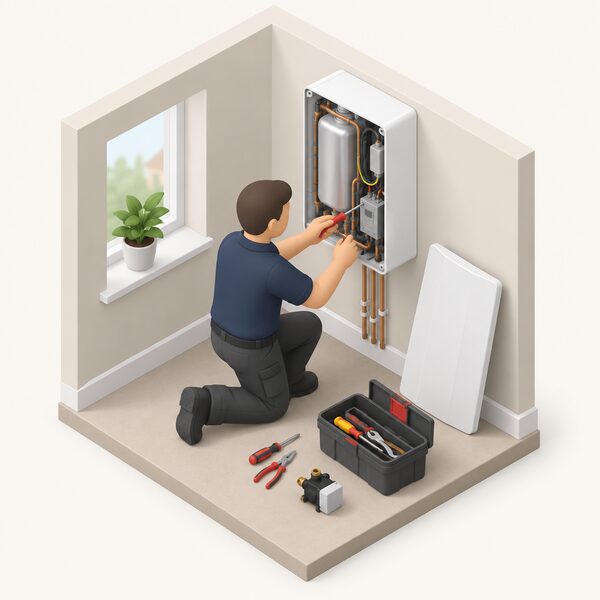
Heatrae Sadia runs UK based customer contact centres in Norwich and Warwick, supported by a nationwide network of highly qualified engineers14. The support function covers specification, sales, genuine parts and aftersales support14. Service and repair booking is available for electric heating products, and the company's product pages list ordering information, service or repair booking, warranty registration and a UK based helpline as the four things a household can do through support4.
The contact numbers are split by department, which is worth knowing before calling.
| Department | Number | Opening hours |
|---|---|---|
| Sales and orders | 0344 871 1535, option 1 then option 1; also 01603 420220 | Mon to Thu 8.30am to 4.30pm; Fri 8.30am to 1pm15 |
| Specification | 0344 871 1535, option 1 then option 2; also 01603 420220 | Mon to Thu 8.30am to 4.30pm; Fri 8.30am to 1pm15 |
| Service and repair | 0344 871 1535 | During opening hours14 |
| Genuine parts | 0344 871 1535, option 5 | Mon to Thu 8.30am to 4.30pm; Fri 8.30am to 4pm15 |
| Technical helpline (engineers) | 0344 871 1535, option 2 | During opening hours15 |
| Customer Relations | 0344 871 1535; customer.relations@baxi.co.uk | During opening hours15 |
All departments are closed on Saturdays, Sundays and bank holidays15. Sales and orders can also be reached at sales.team@baxi.co.uk15.
On spares, the position is unusually strong for a manufacturer with discontinued lines. Heatrae Sadia states that there are over 17,000 parts in stock for current and discontinued product ranges, often with same day availability for the vast majority of spare parts2. Genuine parts are handled by Baxi Genuine Parts, described as the company's specialist genuine parts division2. The company also maintains a literature library of brochures, installation guides and user guides, including an archive for discontinued products4, which is what allows an older appliance to be serviced to its original specification.
"There are over 17,000 parts in stock for current and discontinued product ranges often with same day availability for the vast majority of our spare parts"
In-warranty repairs are free of charge: Heatrae Sadia states that if a product is still in warranty and needs a repair, the household should contact the company to arrange for an engineer to visit14. The cost of calls to the support numbers is not published in the material available here. Where comparable UK helplines publish charges, they are quoted as 7p a minute plus the phone company's access charge16, and households should check with their own provider.
Warranty registration: 30 days from installation
The warranty terms are the part of the purchase most likely to be lost by accident. Heatrae Sadia states that all of its products are supplied with a minimum 2 year manufacturer warranty5. The conditions attached to it are specific.
The product warranty must be registered within 30 days of installation together with proof of purchase5. The same 30 day window appears across the company's support material: households are asked to register their product within 30 days of installation15, and the online form for Heatrae Sadia or Megaflo product warranty registration carries the same deadline14. Registration is not a formality; it is one of the stated conditions.
The other conditions are that the product has been correctly installed as per the instructions contained in the installation manual and all relevant codes of practice and regulations in force at the time of installation, and that it has been installed in the UK5. That last point is a territorial limit: the warranty applies to UK installations.
There is one further term that matters on a house sale. Heatrae Sadia states that the warranty is transferable, but that if ownership is transferred the warranty reverts to a 30 year period5. The wording is unusual and the material does not explain it further, so it is reported here as the maker's stated term rather than interpreted. Households buying or selling a property with a Heatrae Sadia appliance should read the warranty document itself rather than rely on a summary.
The general mechanics of guarantee registration across the industry are covered in Boiler Warranties and Guarantee Registration.
Disposal and WEEE at end of life
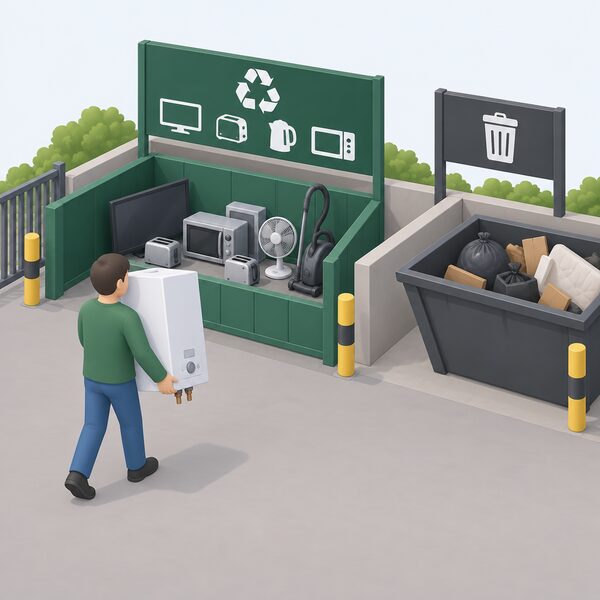
Electrical appliances do not go into general domestic waste. The guidance for old electric blankets is explicit: they should not be disposed of with general domestic waste and should be taken to a recycling facility which accepts electric and electronic appliances, as per the WEEE Directive18. The same principle applies to a boiler-sized electrical appliance, though the material available here does not set out a specific collection route for non-household units.
The safety case for proper disposal is not theoretical. The Electrical Safety First recall notice for a Sorand Water Heater 2000W describes a fault in which, during operation, a live wire inside the product becomes loose and, due to the product being unearthed, the product becomes live19. An appliance that has reached the end of its life, or that has been recalled, should not be passed on or left connected.
For a household, the practical route at end of life is through the installer who removes the appliance, or through the supplier, with the local authority recycling centre as the fallback for a domestic-sized unit. The wider context of electrical safety in the home is covered in Electrical Safety and Supply for Electric Heating.
What the Amptec means for a household's energy independence
The Amptec does one thing that matters for independence: it takes a home off gas, off oil and off LPG, and off the deliveries, storage tanks and flue work that come with them. There is no gas standing charge, no tank inspection and no combustion risk from the heating appliance itself.
What remains is a set of dependencies that should be stated as plainly as the benefits. The home stays on the electricity grid and with an electricity supplier. The appliance is a high-load item, and in Northern Ireland equipment of that kind must be declared on a connection application3. The warranty depends on registration within 30 days and on installation to the manual by someone competent to do it5. Spares and in-warranty repairs run through the manufacturer and its engineer network14. And the longest support relationship a household has with the appliance is with Heatrae Sadia and Baxi UK, not with a local firm alone.
That is the trade. An electric flow boiler is a route to a full wet heating system without a gas main, and it is a route that keeps the household tied to the grid and to a manufacturer's support chain. The alternatives, and how they compare, are set out in Heating a Home Off the Gas Grid, Heat Pumps Compared with Boilers and Home Heating and Energy Independence.
Sources19 cited
- New Baxi Amptec S electric boiler, CIPHE, 2025-09-04
- Heatrae Sadia glossary, Heatrae Sadia, 2026-09-17
- Single house connection application help, NIE Networks, 2026-09-19
- Electric vented storage, Heatrae Sadia, 2026-09-17
- Product warranty, Heatrae Sadia, 2026-09-17
- Householder permitted development rights guidance, Scottish Government, 2021-04-01
- Domestic RHI guide to metering, Ofgem, 2026
- Planning guidance for heat pumps, London Borough of Richmond upon Thames, 2026-04-22
- MCS microgeneration certification, BSI, 2026-09-17
- Moving home, HETAS, 2026
- HETAS consumer FAQs, HETAS, 2026-04-01
- Solar assisted heat pumps, Energy Saving Trust, 2025-06-13
- Rogue traders, logo misuse and imitation businesses, HETAS, 2026
- Customer support, Heatrae Sadia, 2026-09-17
- Contact customer support, Heatrae Sadia, 2026-09-17
- Under your feet, Cadent Gas, 2026-09-20
- The importance of chimney sweeping, HETAS, 2026
- Electric blankets safety advice, Electrical Safety First, 2026-09-19
- Sorand water heater 2000W recall, Electrical Safety First, 2026-09-17
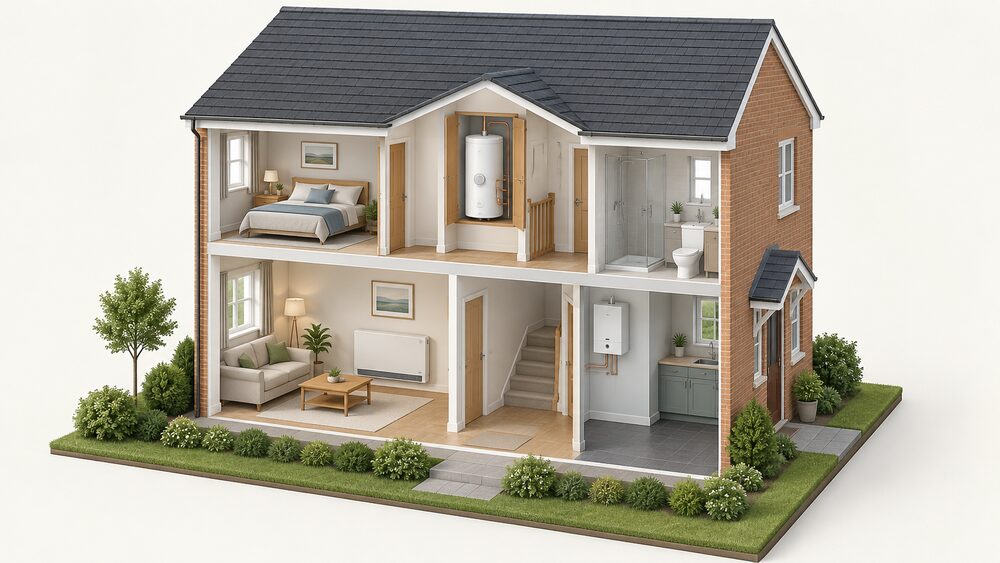 Heatrae SadiaHeatrae Sadia makes electric boilers and storage heaters for homes without gas, including the Amptec boiler and Megaflo hot water cylinder.
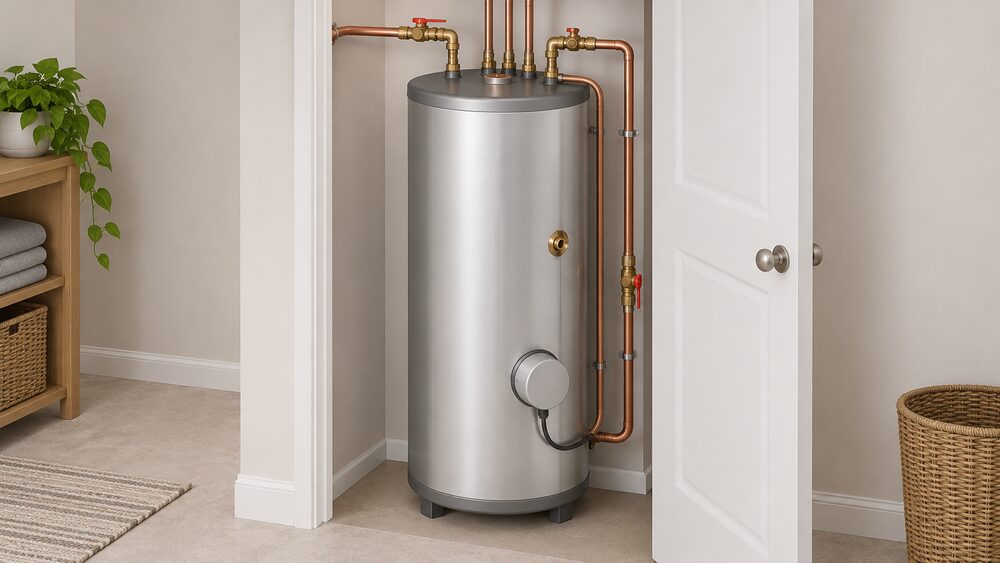 Heatrae Sadia and Megaflo cylinders and water heatersMegaflo is the name most people use for any unvented hot water cylinder, so is yours actually a Megaflo or another make?