
In this guide
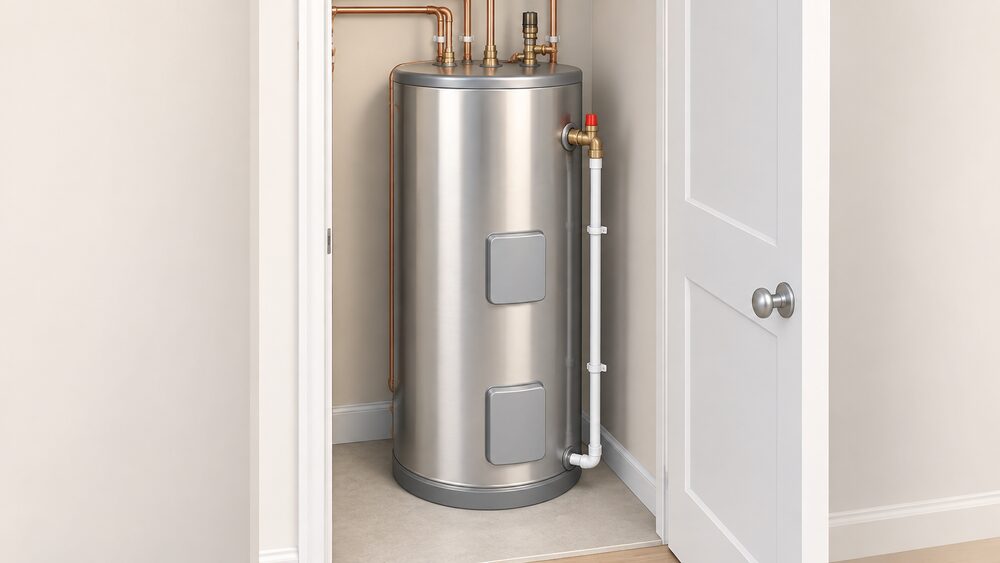
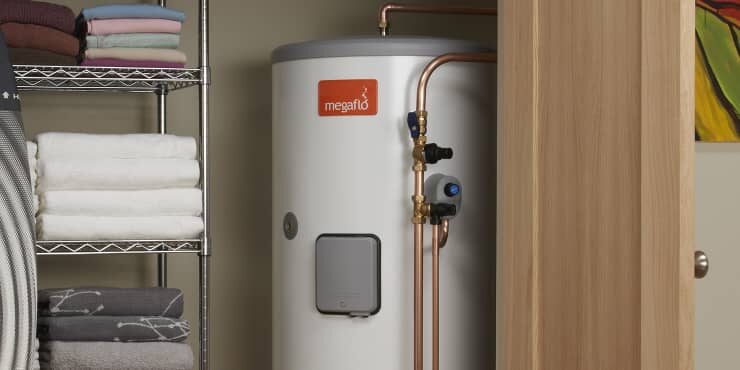
A Megaflo cylinder is an unvented hot water store: it holds hot water at mains pressure and delivers it straight to the taps, with no cold water tank in the loft and no vent pipe over the roof. It is not a boiler and it does not replace one. It works alongside a system boiler, a heat pump, a solar thermal array or an immersion heater, and the water it holds is heated by whichever of those the household has1.
The name has become the category. Heatrae Sadia, which has owned the brand since 1993, states that Megaflo "is seen as the generic term for unvented water heating"1. The first Megaflo unvented cylinder came from Hotflo in 1987, and the maker describes the brand as the market leader in the unvented hot water cylinder sector1.
For a household, the appeal is pressure and space. An unvented cylinder stores hot water and delivers it directly from the mains water supply, so no separate cold water storage tank is needed3. The trade-off is that the cylinder is a pressurised vessel: it must be installed by a qualified person, the work is notifiable under Building Regulations, and it depends on a mains water supply and on whatever heat source is connected to it2.
A short history: from the first Hotflo cylinder in 1987 to the market leader
The Megaflo story starts with Hotflo, the name on the first Megaflo unvented cylinder in 19871. Heatrae Sadia acquired the brand in 1993, and the two names have been linked ever since1. Heatrae Sadia itself is part of Baxi UK, and its product range covers hand dryers, water chillers, immersion heaters and unvented cylinders alongside the Megaflo line2.
The brand marked its 25th anniversary in 2012, the same year the Megaflo Eco Plus model was introduced, and the Megaflo Commercial product line arrived in 20111. The wider unvented cylinder category is younger than many householders assume: unvented hot water cylinders were first introduced to the UK in the 1980s, and their growing popularity since then is tied to the mains-pressure supply they give7.
Hotflo continues as a separate name in the Heatrae Sadia catalogue, aimed at small to medium commercial businesses, with a replaceable heating element and CFC/HCFC free refrigerant content8. The Hotflo 50 to 100 litre range is CE marked, and like the Megaflo products it requires registration within 30 days for the warranty to be active9.
The practical point of the history is continuity of parts and support. A cylinder installed today sits in a line that has been manufactured and supported in the UK for decades, and Heatrae Sadia states that its product range is stocked by all the leading merchants6. That matters more for a cylinder than for many heating components, because a cylinder is a long-lived vessel that will outlast several boilers.
Direct or indirect: how each model heats its water
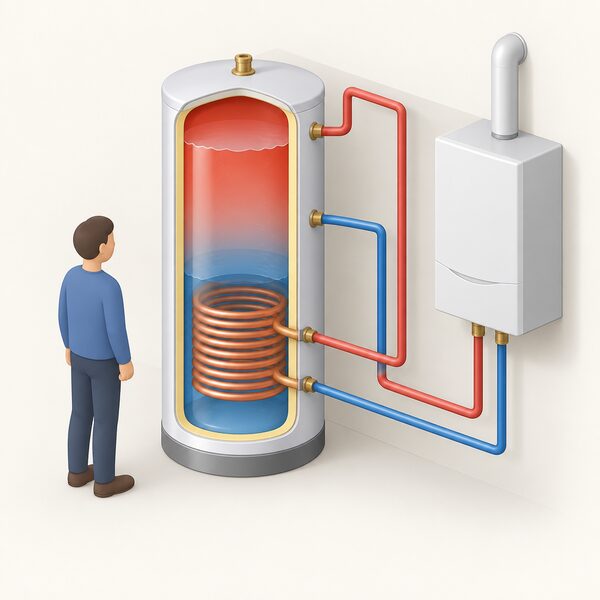
The single most important distinction in the range is how the water gets hot. In an indirect cylinder, hot water from the external heat source circulates through a coil inside the cylinder, transferring heat without the two water supplies mixing3. Newark Cylinders puts it the same way: heat is transferred through a coil or heat exchanger, keeping the heating system water separate from the domestic hot water10. That is the arrangement for a household with a system boiler, a heat pump or a solar thermal array.
In a direct cylinder, heating elements, typically immersion heaters, sit directly in the water that comes out of the taps10. Vaillant's guidance agrees: a direct hot water cylinder heats water through an immersion heater found inside the cylinder7. Megaflo sells both. The Megaflo Eco Direct is described as a direct heated cylinder providing the same high levels of comfort and hot water performance as the indirect range, and it uses a unique 'L' shape immersion heater that maximises the volume of hot water available11.
Megaflo cylinders are available as direct and indirect unvented cylinders, and the maker describes them as easy to install12. The Megaflo Eco range covers both Direct and Indirect cylinders13.
| Type | How it heats | Typical pairing |
|---|---|---|
| Indirect | Coil or heat exchanger, heating water kept separate from domestic hot water10 | System boiler, heat pump, solar thermal |
| Direct | Immersion heater sitting in the water that comes out of the taps10 | No boiler, or an electric-only hot water supply |
For energy independence, the choice decides what the household depends on. An indirect cylinder can be fed by a heat pump or a solar thermal array, so the heat source can change without replacing the cylinder. A direct cylinder depends on electricity and on the immersion element, which is replaceable but is a single point of failure.
Sizes and specifications: 70 to 2,500 litres, storage temperatures and safety devices
Megaflo spans domestic and commercial sizes. The Megaflo Commercial Flexistor range offers 400 to 2,500 litre capacities, with options for 6 or 10 bar operating pressure5. The Megaflo Compact SystemFit 2sf is a 180 litre domestic unit4. Between those two ends sit the standard domestic sizes that most houses use.
The commercial range shows how much the physical size varies with capacity. A 400 litre Flexistor measures 1518 x 872 mm height by width, a 500 litre model 1820 x 100 mm, a 1250 litre model 1957 x 1224 mm, a 1450 litre model 2273 x 304 mm, and a 2000 litre model 2035 x 1470 mm5. The 400 litre model carries an ErP rating of B5.
Sizing guidance for the domestic end comes from the SAP methodology used for energy assessments, which bands cylinder volume as normal (up to 130 litres), medium (131 to 170 litres) and large (over 170 litres), with an indicative size of 110 litres for the normal band14. That is a modelling convention rather than an installation rule, but it shows the range a typical house occupies.
On temperature, UK building regulations advise that water cylinders, but not thermal stores, need to regularly reach temperatures of more than 60°C15. That is the legionella control point, and it is a requirement on the stored water rather than a setting on the cylinder.
Materials and design: Duplex stainless steel and the floating baffle
Megaflo cylinders are made from duplex stainless steel. The Megaflo Commercial Flexistor is manufactured from duplex stainless steel5, and the Megaflo Compact SystemFit is described as proudly made in the UK from the highest quality duplex stainless steel4. The commercial Flexistor is designed, engineered and manufactured in the UK5.
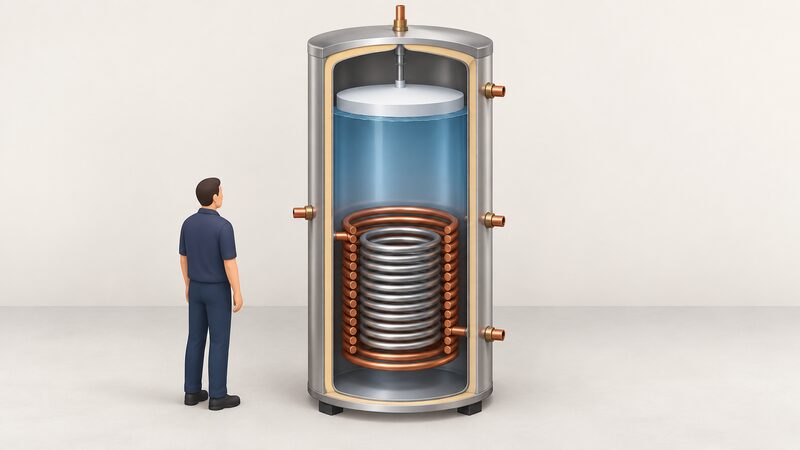
The design feature that distinguishes Megaflo is the expansion arrangement. Heatrae Sadia states that its Megaflo unvented cylinders were the first hot water cylinders to feature an innovative integral floating baffle, which takes up the expansion as water is heated2. The Megaflo range uses this internal floating baffle expansion system12. That is why a Megaflo does not need a separate external expansion vessel on the wall beside it, which is the usual arrangement on other unvented cylinders.
The heat exchanger is the other design point. Heatrae Sadia states that its unvented cylinders such as Megaflo Eco have a high performance coil-in-coil heat exchanger which transfers heat from the sealed primary coil for the central heating system to the coil for water heating2. A coil-in-coil design gives a larger surface area in a given cylinder volume, which affects recovery time rather than standing losses.
The largest units are built differently. Megaflo Commercial and Megaflo Eco Plus unvented calorifiers are manufactured on the maker's 'XL' production line, because they require different manufacturing techniques to the standard unvented cylinders owing to the larger capacities and pressures2.
Cost: £500 to £1,500 plus what VAT and installation add
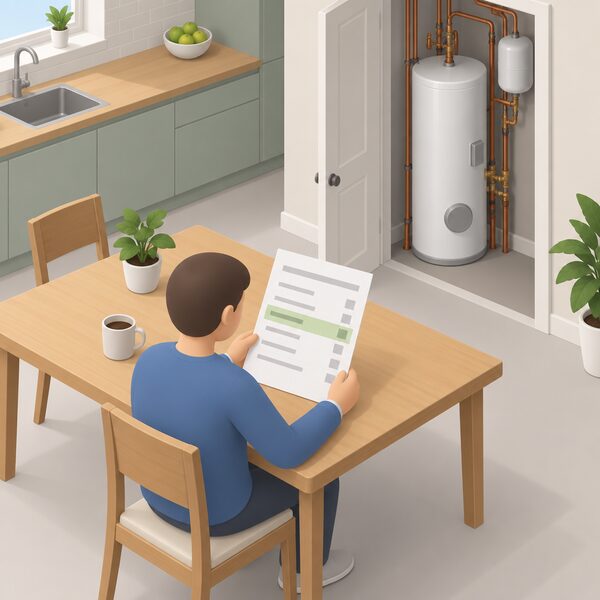
Published prices for Megaflo cylinders vary by source. One set of guidance puts the cylinder at £500 to £1,500, while another puts it at £1,000 to £3,50017. Both figures are indicative, and neither is a manufacturer list price. Where a household is buying a cylinder as part of a heating installation, the cylinder is normally one line in an installer's quote rather than a separately priced item.
For context on what installation adds, independent statistics put a wall-mounted electric boiler with cylinder at £1,750 to £2,000, an average of £1,87518. That is a different product, but it shows the order of magnitude of a cylinder plus heat source package. On VAT, official guidance gives an example of an insulation installation charged at £1,000 excluding VAT19, which illustrates that quoted figures in this sector are often stated net of VAT rather than inclusive.
The honest position on Megaflo pricing is that there is no published manufacturer price for a supplied and fitted cylinder. Prices are installer-quoted, and the quote will reflect the cylinder size, whether the property is changing from a vented to an unvented system, the siting and the pipework runs. A like-for-like replacement of an existing unvented cylinder is a smaller job than a first-time conversion from a loft tank system.
Warranty: 25 years on the cylinder, and what it does not cover
The warranty position is strong on paper and conditional in practice. Heatrae Sadia states that its Megaflo cylinders and calorifiers have an industry-leading lifetime warranty in domestic installations2, and the Megaflo cylinders page describes an industry-leading lifetime transferable cylinder warranty12. The Megaflo Compact SystemFit is backed by a 25 year warranty4, and the Megaflo Eco is backed by a 30 year enhanced warranty13.
The condition attached to all of them is registration. Heatrae Sadia asks householders to use the online form to register a Heatrae Sadia or Megaflo product warranty within 30 days of installation20. The Megaflo Compact SystemFit page repeats the rule: the product must be registered within 30 days for warranty to be active4. The same 30 day deadline appears on the Hotflo pages8.
What the warranty covers is the cylinder itself. It does not cover the heat source, the controls, the immersion element or the labour to remove and refit a cylinder in a tight cupboard. The lifetime term applies to domestic installations, so a cylinder installed in a commercial setting sits under different terms2. The transferable element matters on a house sale: a buyer can inherit the remaining cover, provided the registration is in order.
"Our Megaflo cylinders and calorifiers have an industry-leading lifetime* warranty in domestic installations"
Choosing and installing: installer qualifications, sizing and siting
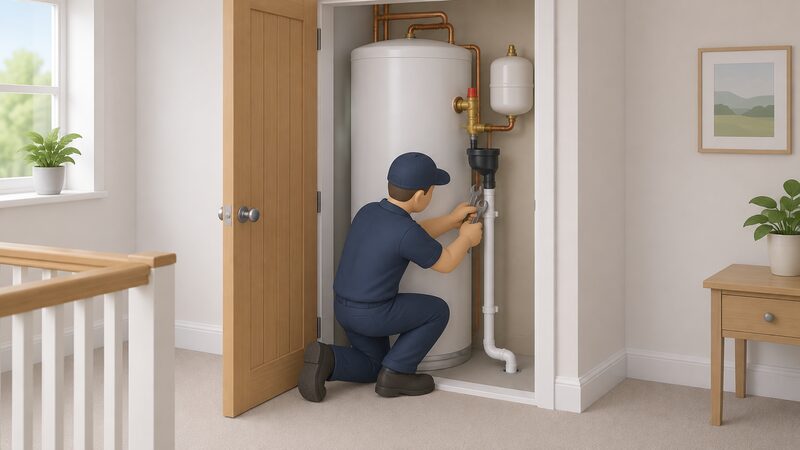
Unvented cylinder installation is regulated work. Installers of unvented cylinders must carry a qualification to install them, and the work is notifiable under Building Regulations2. The specific qualification is G3, also known as the Unvented Hot Water Storage Systems certificate, required under Part G3 of the UK Building Regulations, which requires installation by a competent person holding it3. A G3-qualified installer is certified for unvented systems3.
The wider pattern in heating work is the same. Official guidance in Wales states that gas fittings, appliances and gas storage vessels must be installed only by a person with the required competence21, and that flue installation should be carried out by a suitably qualified installer22. Solid fuel appliances should only be undertaken by competent technicians who have undertaken appropriate training and assessment23. For renewable systems, official guidance recommends that an MCS installer is used for systems up to 50kW24, and independent guidance is to choose an MCS-certified heat pump installer25. A Flexi-Orb certified installer is described as a qualified and experienced professional who has undergone rigorous training and assessment26.
On sizing, the sources give different figures. One suggests a 150 litre cylinder, another suggests 180 to 210 litres17. The right figure depends on the number of bathrooms, the flow rate available and the recovery time of the connected heat source, which is why sizing is an installer's calculation rather than a catalogue choice.
On buying, Heatrae Sadia directs homeowners who are interested in buying a Megaflo product to the Megaflo Find an Installer tool, which finds a local qualified installer6. That installer can purchase the cylinder from a trade merchant6. Megaflo Main cylinders are exclusive to independent merchants13.
Where the range has limits
The dependence a Megaflo creates is on mains water and on a heat source. An unvented cylinder delivers hot water directly from the mains water supply3, which means a loss of mains pressure or an interruption to supply stops hot water regardless of how much heat is available. A vented system with a loft tank buffers that; an unvented one does not.
The heat source dependence is the second limit. An indirect cylinder needs a boiler, a heat pump or a solar thermal array to be running, and a direct cylinder needs electricity for the immersion element. Neither stores energy in a form that can be shifted to another fuel without changing the cylinder or the heat source.
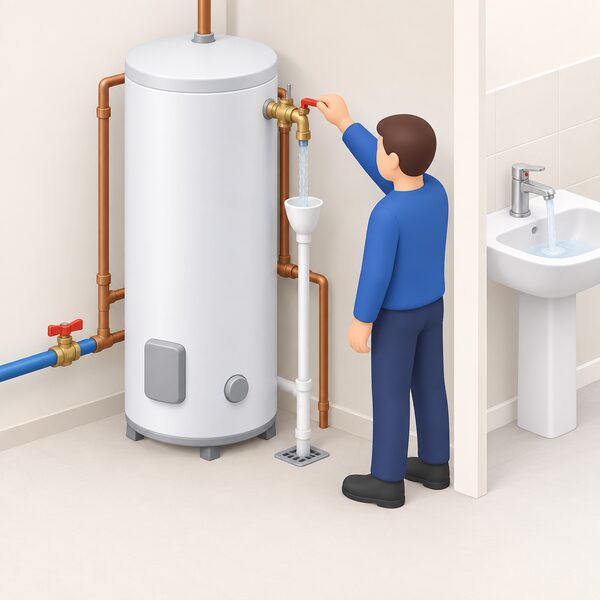
There is also a maintenance dependence. The internal air gap that the floating baffle arrangement relies on can need regeneration, and Heatrae Sadia publishes a procedure for it: turn off the mains cold water supply to the Megaflo, open the lowest hot tap, hold open the temperature and pressure relief valve until gurgling stops, close the valve, reopen the mains supply, and close the tap when water flows16. That is a task for a competent person rather than a householder.
On safety, the record for the category is not unblemished. The electrical safety regulator has published a product recall notice for Glen Dimplex hot water cylinders, where a relay located on the front of the cylinder, used for switching the immersion heater on and off, may be faulty27. That is a different manufacturer, but it shows why the immersion circuit and its controls deserve the same attention as the cylinder itself.
For a household weighing independence, the position is this. A Megaflo cylinder gives mains-pressure hot water, frees the loft of a cold water tank, and can be fed by a heat pump or solar thermal so the heat source is not fixed to gas. It remains dependent on mains water, on a heat source, on electricity for controls and immersion heating, and on a G3-qualified installer for any work on the vessel. The cylinder itself is a long-lived, UK-made component with a lifetime domestic warranty; the system around it is what determines how independent the hot water really is.
Sources27 cited
- Introducing our brands: Megaflo, Heatrae Sadia, 2026
- Glossary, Heatrae Sadia, 2026
- What is an unvented cylinder, Newark Cylinders, 2026
- Megaflo Compact SystemFit, Heatrae Sadia, 2026
- Megaflo Commercial Flexistor, Heatrae Sadia, 2026
- How to buy, Heatrae Sadia, 2026
- What is a hot water cylinder, Vaillant, 2026
- Hotflo 10 and 15, Heatrae Sadia, 2026
- Hotflo 50 to 100, Heatrae Sadia, 2026
- Direct and indirect cylinders, Newark Cylinders, 2026
- RC stainless steel single and twin coil cylinder, Remeha, 2026
- Cylinders and hot water, Heatrae Sadia, 2026
- Cylinders, Baxi, 2026
- SAP 10 specification, BRE Group, 2024
- How to ensure a heat pump runs efficiently, Energy Saving Trust, 2026
- Frequently asked questions, Heatrae Sadia, 2026
- Renewable brochure, McDonald Water Storage, 2020
- Solar PV, Flexi-Orb, 2025
- Draft VAT guidance on changes to energy-saving materials, HM Revenue and Customs, 2019
- Customer support, Heatrae Sadia, 2026
- Building regulations: heat pumps, Welsh Government, 2026
- Building regulations guidance Part J, Welsh Government, 2025
- Building regulations: flue, chimney or soil and vent pipe, Welsh Government, 2026
- Your home guide to solid fuel appliances, OFTEC, 2026
- Heat pump guide: air source vs ground source, The IAA, 2026
- FIT guidance for licensed electricity suppliers, Ofgem, 2024
- Glen Dimplex hot water cylinders recall, Electrical Safety First, 2026