
In this guide
Heatrae Sadia is a UK maker of electric heating and hot water equipment, and the brand behind the Amptec electric flow boiler, the Supreme storage heater and the Megaflo unvented cylinder. It is part of Baxi UK, and Baxi Heating UK Limited sits inside a portfolio that also includes Potterton, Main Heating, Remeha, Andrews Water Heaters and Potterton Commercial1.
For a household, the appeal is straightforward: an electric boiler or a storage heater runs on electricity rather than gas, so it removes the gas connection and the gas supplier from the home. What it does not remove is the grid. Every Heatrae Sadia product depends on a mains electricity supply and a tariff, and the hot water cylinders depend on an installer to commission them and on the maker for parts.
The brand's own support position is unusually long-lived for the sector. Heatrae Sadia holds over 17,000 parts in stock covering current and discontinued product ranges, often with same day availability for the vast majority of spare parts, and states that discontinuing a product does not mean support stops for units already installed in homes and businesses1.
Part of Baxi UK and BDR Thermea: what ownership means for owners
Heatrae Sadia states plainly that it is part of Baxi UK, and that its partner company Baxi Genuine Parts is its specialist genuine parts division1. That matters more than it sounds. Spare parts for an electric boiler or an unvented cylinder are the difference between a repair and a replacement, and a maker with an in-house parts arm and a large stockholding is a different proposition from a brand that has to source components from a third party.
The wider group is set out in written evidence to a parliamentary committee, which lists Baxi Heating UK Limited's brands serving the UK and Ireland markets as Baxi, Potterton, Main Heating, Heatrae Sadia, Megaflo, Remeha, Andrews Water Heaters, Potterton Commercial and Packaged Plant Solutions2. Baxi Heating UK Limited is described in the same document as holding some of the best known and most respected heating brands serving the UK and Ireland markets1.
Ownership of this kind cuts both ways for a household. On the plus side, a group structure supports a national spares network, a technical helpline and a service organisation that a small independent maker could not sustain. On the other side, brand ownership changes over time, and the brand name on the cylinder is not the entity that carries the warranty obligation. The Heatrae Sadia name has already absorbed other brands, which is the subject of the next section.
The Heatrae Sadia name itself is not confined to the UK. The company runs a representative office in Doha, Qatar, covering the Middle East region1, which reflects an export business rather than anything a UK householder deals with. UK support runs through the Warwick contact centres3.
Electric boilers, unvented cylinders and the wider range
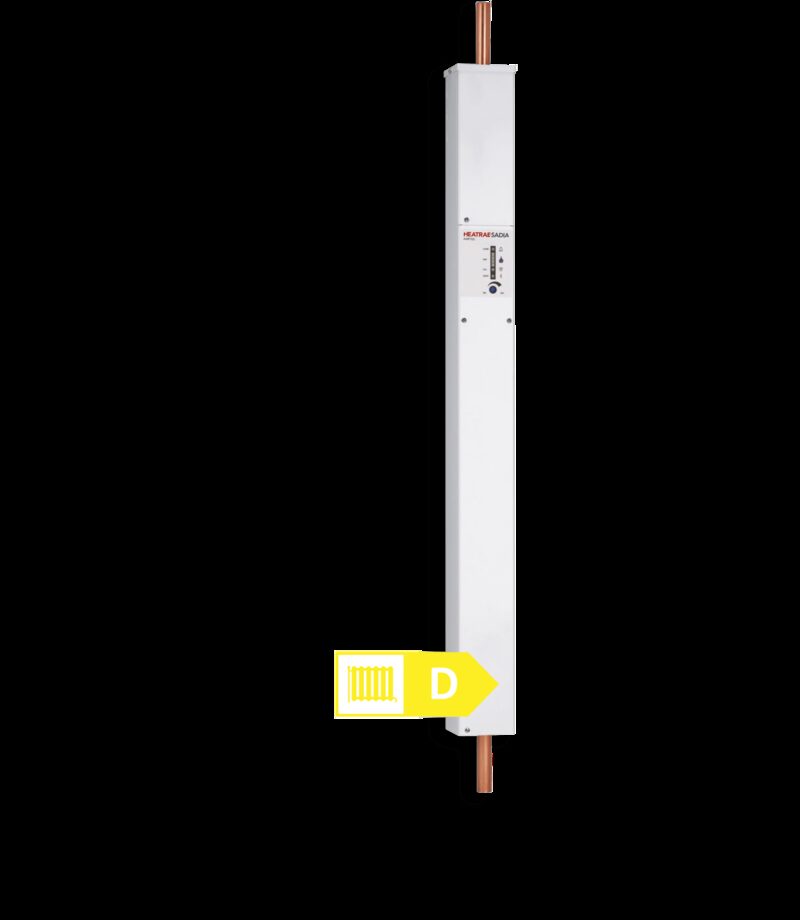
The range splits into three broad groups: electric boilers and instantaneous water heaters, unvented hot water cylinders, and electric space heating. The Amptec electric flow boiler is the best known of the first group, and the instantaneous electric water heaters sit alongside it in the cylinders and hot water catalogue4. The Megaflo and PremierPlus unvented cylinders cover the stored hot water side. The Supreme storage heater covers space heating.
The distinction that matters for a household is between a product that heats water on demand and one that stores it. An instantaneous electric heater takes cold mains water and heats it as it passes, so there is no cylinder and no standing loss, but the electrical load at the point of use is high. A stored cylinder heats a volume of water and holds it, which spreads the load but loses some heat through the cylinder walls and needs the space.
Unvented cylinder work is a specialist trade. One installer listed on a Which? Trusted Traders profile describes its services as unvented cylinder installation and maintenance5, which reflects the fact that unvented cylinders operate under mains pressure and are subject to building regulation requirements on installation and discharge.
For a household weighing independence, the position is this: an electric boiler or instantaneous heater removes the gas supply and the gas standing charge, and it removes the flue, which widens where a unit can be sited. It does not remove the electricity supplier, and it does not remove the grid. A storage heater has the same profile, with the added consideration that its running cost depends heavily on the tariff it is charged on. More on the technology is at electric boilers and storage heaters.
Megaflo and Santon: how the range came together
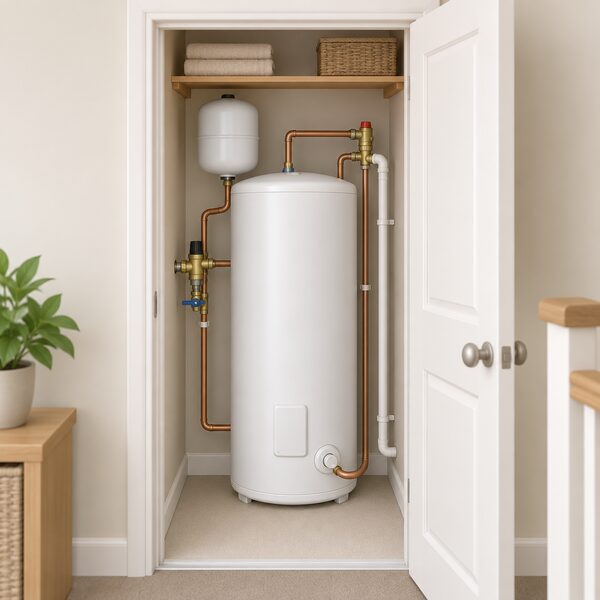
The Heatrae Sadia range is a collection of brands acquired over three decades rather than a single product line. Heatrae Sadia acquired the Megaflo brand in 1993, and the Santon brand of water heaters followed in 19981. Megaflo Commercial was introduced in 20111.
The Santon name has since been folded in. In 2015 the Santon PremierPlus unvented cylinder moved to the Heatrae Sadia brand1. The maker's own replacement listings show the same pattern across the range: the Santon PremierPlus, PremierPlus Solar and PremierPlus SystemFit all map to Heatrae Sadia equivalents, and the Megaflo HE and Megaflo HE SystemFit map to Megaflo Eco3.
| Older name | Current equivalent |
|---|---|
| Santon PremierPlus | Heatrae Sadia PremierPlus3 |
| Santon PremierPlus Solar | Heatrae Sadia PremierPlus Solar3 |
| Santon PremierPlus SystemFit | Heatrae Sadia PremierPlus SystemFit3 |
| Megaflo HE | Megaflo Eco3 |
| Megaflo HE SystemFit | Megaflo Eco SystemFit3 |
That mapping is the practical answer to a common household question. A cylinder installed under the Santon name is not orphaned: it has a current Heatrae Sadia equivalent, and the spares stock covers discontinued ranges1. The Megaflo brand has its own page at Megaflo cylinders.
Where the products are made and what they are built from
Heatrae Sadia states that many of its products are manufactured using marine grade 2205 Duplex stainless steel, which it describes as highly corrosion resistant and twice as strong as an austenitic or ferritic stainless steel1. That is a maker's claim about its own material specification, and it is the kind of detail that shows up in cylinder life rather than in a specification sheet.
The material choice matters because an unvented cylinder is a pressure vessel holding mains-pressure water inside a home. Corrosion resistance determines how long the vessel lasts, and the strength of the steel determines the wall thickness needed for a given pressure rating. A duplex stainless steel allows a thinner wall for the same strength, which affects both the weight of the unit and the heat lost through the cylinder wall.
The company also notes that product details may be modified without notice, a standard reservation in its literature1. For a household, that means the specification of a cylinder or heater bought today may differ in detail from one bought a year earlier, even under the same model name. The installation manual supplied with the unit is the document that governs, not a brochure from an earlier year.
Certifications and standards: Kiwa, WRAS, ISO 9001 and ErP compliance
Heatrae Sadia states that many Heatrae Sadia and Megaflo products have been tested and certified by Kiwa1. Kiwa is a UKAS accredited certification body, holding accreditation number 0217 for MCS product certification6, and it is accredited for testing in accordance with EN155027. Its laboratory work is accredited to ISO 17025 for the relevant EN standards8, and its energy arm holds UKAS accreditation number 06929. Kiwa also carries out ESOS audits10.
The maker's own certification list names Kiwa, WRAS, the Hot Water Association (HWA) Charter, BS EN ISO 9001:2015 and Energy related Products (ErP) compliance, and separately states that Heatrae Sadia is one of a select few UK businesses to have achieved the ISO 50001 worldwide standard for managing energy use across its business operations and product portfolio1. Those two statements are not in conflict, but they are not the same claim either: one is a list of product and management certifications, the other is a specific energy management standard. Both come from the maker.
Independent certification bodies appear in official scheme documentation too. The ECO4 innovation measures list includes a cavity wall insulation product certified under a KIWA BDA certificate number11, which shows the same body operating in the government's energy efficiency framework. For the wider picture on marking and approval, see heating appliance standards and certification.
Buying through merchants and getting quotes from installers
There is no published Heatrae Sadia list price for a supplied-and-fitted installation in the material available, so prices are installer-quoted. What the guidance does cover is how to choose the installer, and it is consistent across sources.
Independent consumer guidance recommends getting at least three quotes and checking that they are like for like, asking family and friends about their satisfaction and whether they received a certificate, checking references, and getting the quote, timeframe and certificate in writing with a written contract and an agreed completion date, along with the warranty and insurance cover12. The same advice appears in condensation guidance aimed at householders appointing installers13.
Where a scheme is involved, the installer usually makes the application. For heat pump grants, the installer applies on the householder's behalf through Ofgem, and the route to a quote is the MCS find an installer tool or the energy supplier14. In Northern Ireland, once an installer has been chosen, the installer submits the connection application on the customer's behalf15. Official guidance for Wales advises contacting an installer who can provide the necessary advice, preferably one belonging to the Microgeneration Certification Scheme or the relevant Competent Person Scheme16.
Independent guidance suggests searching for vetted contractors through MCS, TrustMark or Buy With Confidence, and notes that it is good practice to get more than one quote17. The Energy Saving Trust's position is that quotes should come from at least three installers18.
"Get at least three quotes and check you are being quoted like for like."
If something goes wrong, the first step is direct. HETAS advises that where concerns are raised, consumers are encouraged to first discuss the issues directly with the installer19. For solid fuel work, only persons who are competent should carry out the installation, for example installers registered with HETAS20, and HETAS installers should request a written declaration from the manufacturer confirming the date an appliance was placed on the market if there are concerns about that date21. Certificates of compliance are covered at HETAS certificates of compliance.
Support, spares and the UK helpline
Heatrae Sadia runs UK based customer contact centres in Warwick3. Customer relations is on 0344 871 1535. The same number carries sales and orders on option 1, then option 1, and the technical helpline for plumbing and heating engineers on option 23.
| Line | Number | Hours |
|---|---|---|
| Customer relations | 0344 871 15353 | Not stated |
| Sales and orders | 0344 871 1535, option 1, then option 13 | Mon to Thu 8.30am to 4.30pm; Fri 8.30am to 1pm; closed weekends and bank holidays3 |
| Technical helpline (engineers) | 0344 871 1535, option 23 | Not stated |
Specification enquiries go to specifier@heatraesadia.com, and genuine parts enquiries to baxigenuineparts@baxi.co.uk3. User guides, installation manuals and brochures are downloadable for any Heatrae Sadia, Megaflo or discontinued product3. That last point is worth noting for anyone who has moved into a house with an older unit: the manual carries the commissioning figures and the servicing schedule, and it is available even where the product is no longer sold.
Warranty registration is time-limited. The maker asks that products be registered within 30 days of installation3. Registration is the step that starts the guarantee period running on the maker's records, and it is separate from the installer's own workmanship cover. The general rules on guarantee terms and what registration does and does not cover are set out at boiler warranties.
On disposal, electrical appliances should not go into general domestic waste. The established route is a recycling facility that accepts electrical and electronic appliances, which is the disposal path set out under the WEEE Directive for items such as old electric blankets22. The same principle applies to a redundant electric boiler, cylinder or heater.
Some products have no direct replacement. Heatrae Sadia no longer manufactures the EBW25 boiling water heater, and states there is no replacement for it3. The same applies to its discontinued hair dryers3. Where a product has a current equivalent, the replacement listings give it; where it does not, the household is looking at a different product category rather than a like-for-like swap.
Where the range has limits
The dependence an electric heating product creates is on the electricity supply and the tariff, and that is not a small thing. A household that swaps a gas boiler for an electric one has moved its heating cost from the gas price to the electricity price, and the running cost then depends on the tariff it can access. The pages on electric heating running costs and Economy 7 and time-of-use tariffs set out how that works.
Support for households in fuel poverty exists but is territorially limited. National Energy Action's Warm and Safe Home helpline is a free support service providing advice to householders in England and Wales on their energy bills and keeping warm23. HEAT provides one-to-one mentoring support and advocacy to vulnerable households in England and Wales24. The Energy Advice and Support Service is a free helpline for people living in England and Wales25. In Northern Ireland, the Home Heating Oil Support Scheme runs a helpline on 0800 072 0266, with support and advice available by phone for those who cannot make an online application26. In England, heating oil support money has been routed through the crisis and resilience fund, discretionary for local authorities27.
Support is also available for installers and manufacturers to expand supply chains28, which is a supply-side measure rather than a household one. For the wider context on grants and schemes, see boiler and heating grants England and heating and energy independence.
Sources28 cited
- Heatrae Sadia glossary and company information, Heatrae Sadia, 2026-09-17
- Written evidence to the Business, Energy and Industrial Strategy Committee, UK Parliament, 2026
- Contact customer support, Heatrae Sadia, 2026-09-17
- Instantaneous electric water heating, Heatrae Sadia, 2026-09-17
- BPI Boiler Plumbing Installations, Which? Trusted Traders, 2026-09-17
- MCS product certification, Kiwa, 2026-09-17
- Kiwa 20% hydrogen blend mark, Kiwa, 2026-09-17
- Biomass appliance testing, Kiwa, 2026-09-17
- Biomass MCS certification, Kiwa, 2026-09-17
- Energy monitoring and ESOS audits, Kiwa, 2026-09-17
- ECO4 Innovation Approved Innovation Measures, Ofgem, 2024-11
- Cowboy conundrums, FENSA, 2026-09-20
- Condensation advice, FENSA, 2026-09-20
- Heat pump grant application, UK Government, 2026-09-10
- Apply for an EV or heat pump connection, NIE Networks, 2026-09-19
- Building regulations and heat pumps in Wales, Welsh Government, 2026-09-17
- Clean Energy Boost, Low Carbon Hub, 2024-06-25
- Heat pump fact check, Energy Saving Trust, 2026-07-01
- Complaints and concerns, HETAS, 2026-07-14
- Draft guidance on domestic building services compliance, Scottish Government, 2021-07
- Ecodesign compliance, HETAS, 2023-02-22
- Electric blanket safety, Electrical Safety First, 2026-09-19
- Lived experiences of fuel poverty, National Energy Action, 2026
- Home energy efficiency support, Bridgend County Borough Council, 2026-09-17
- Energy schemes useful resources, Turn2us, 2026-09-20
- Home Heating Oil Support Scheme goes live, Northern Ireland Executive, 2026-09-08
- Heating oil support debate, Hansard, 2026-03-16
- Research briefing on heat pumps, UK Parliament, 2026-09-19
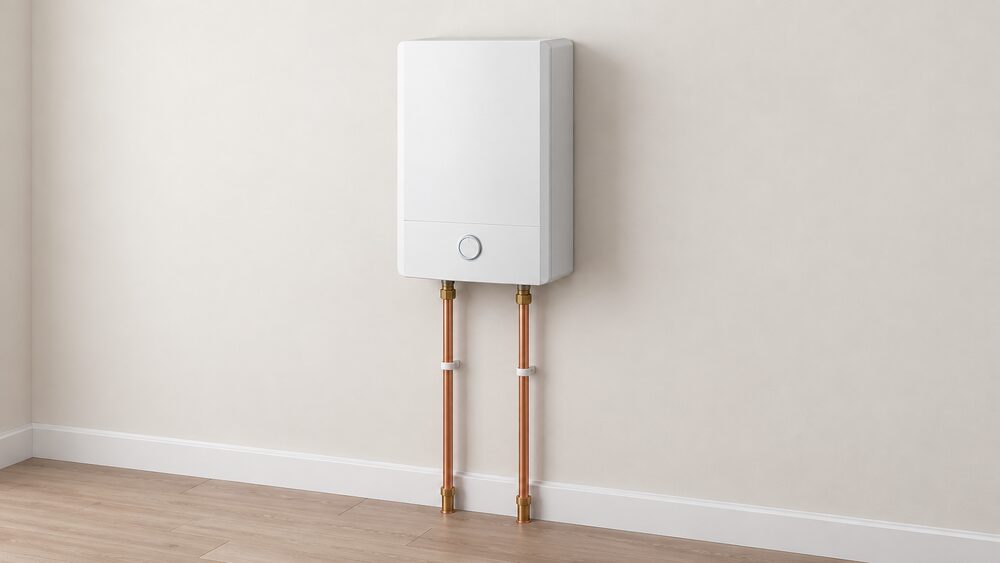 Heatrae Sadia Amptec electric flow boilerThe Amptec is Heatrae Sadia's electric flow boiler for homes with no gas supply, sold through merchants and supported by a UK helpline, with a 30 day warranty registration window.
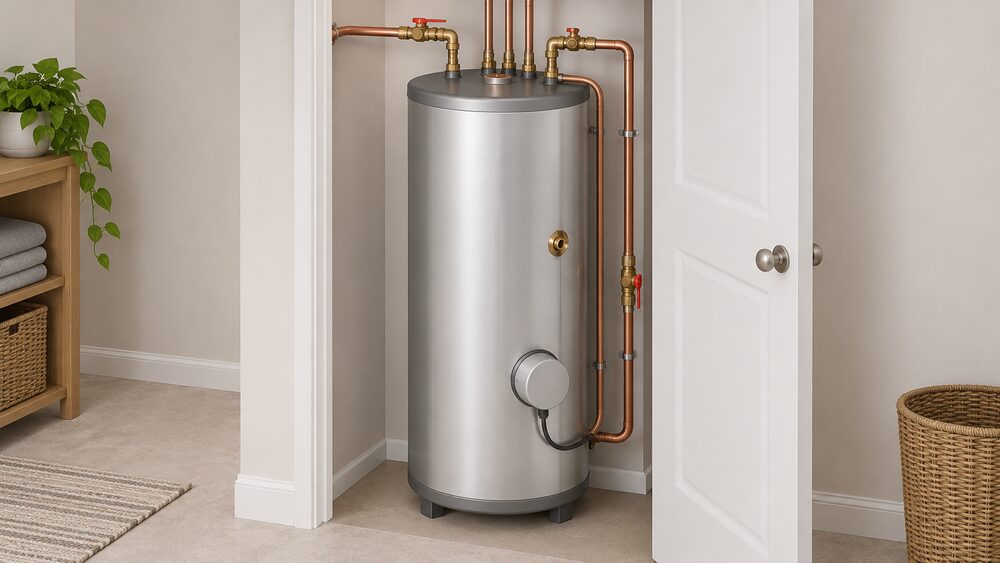 Heatrae Sadia and Megaflo cylinders and water heatersMegaflo is the name most people use for any unvented hot water cylinder, so is yours actually a Megaflo or another make?