
In this guide
Sunwoda is a Chinese battery manufacturer that built its business on cells, then moved into complete energy storage systems. It is listed as a Tier 1 energy storage manufacturer in BloombergNEF's rankings, reaffirmed in the Q4 2025 list, and it began mass production of a 684Ah energy storage cell on 11 October 2025 after showing that cell and a 588Ah version at RE+ 25 the month before1.
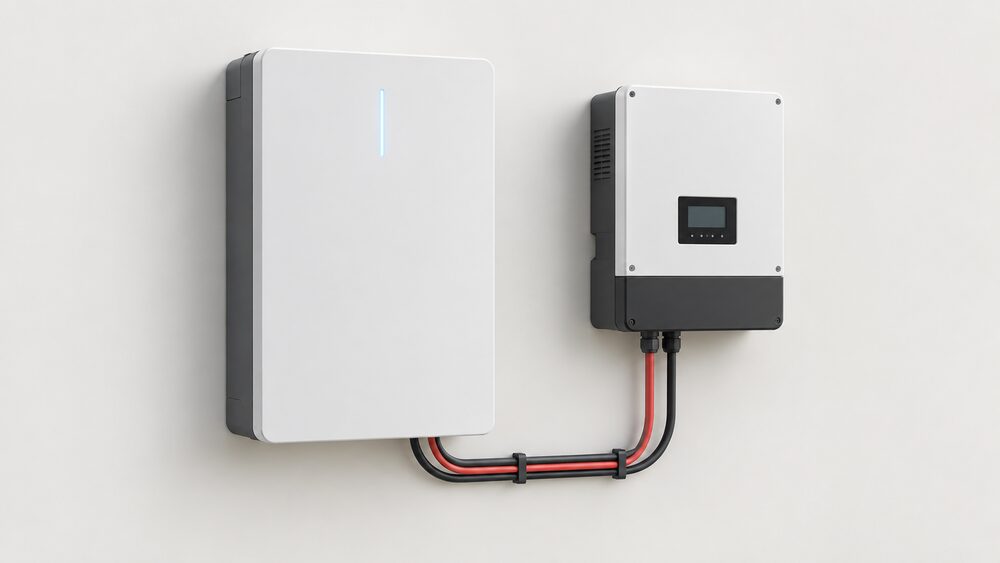
For a UK household the practical question is narrower than the company's scale. Sunwoda does sell a residential product: the MonaWall SE5, a 5kWh low-voltage battery module listed for residential use, compatible with selected low-voltage inverters from GoodWe, Sungrow, SolaX, Solis, Victron and SMA, and supporting backup power applications when paired with a compatible inverter2. That is a module for an existing or new low-voltage system, not a wall-mounted all-in-one with its own inverter and changeover.
The distinction matters for energy independence. A home battery stores electricity for later use and makes a system more independent from the National Grid, but it does not remove the grid connection, the supplier relationship or the metering that sits behind it3. What Sunwoda's rise changes is the supply side: more cell capacity chasing the same household demand, from a maker whose main business is not domestic installation.
Who Sunwoda is and where it stands among storage makers
Sunwoda sits in the group of Chinese manufacturers that supply both cells and finished storage products. Its public positioning is built on two claims: scale in cell manufacturing, and recognition by the ranking bodies that financiers use. BloombergNEF's Tier 1 list is the one that carries weight in project finance, and Sunwoda was reaffirmed on it in the Q4 2025 ranking published on 31 October 20251.
That ranking is a statement about bankability, not about any single product. It tells an installer or a distributor that the company is considered a credible counterparty at project scale. It does not tell a householder anything about how a particular unit will behave in a British garage over fifteen years.
The UK storage market is crowded with makers of this type. Solarwatt, by contrast, has been described as the European market leader in glass-glass solar modules and a leading supplier of electricity storage systems, and it established a UK subsidiary with an office and warehouse to serve installers and customers5. Sunwoda's route into the UK is through distribution rather than a dedicated domestic operation, which is a different kind of presence: the product arrives, but the service infrastructure behind it is thinner.
For a household, the maker's identity matters less than three things: whether the unit is certified for UK installation, whether spares and service exist here, and whether the warranty is enforceable. Sunwoda's Tier 1 status speaks to the first of those only indirectly. Certification and installation standards are covered in battery installation standards, and the wider market context sits in home battery storage.
A cell maker first: what Sunwoda actually manufactures
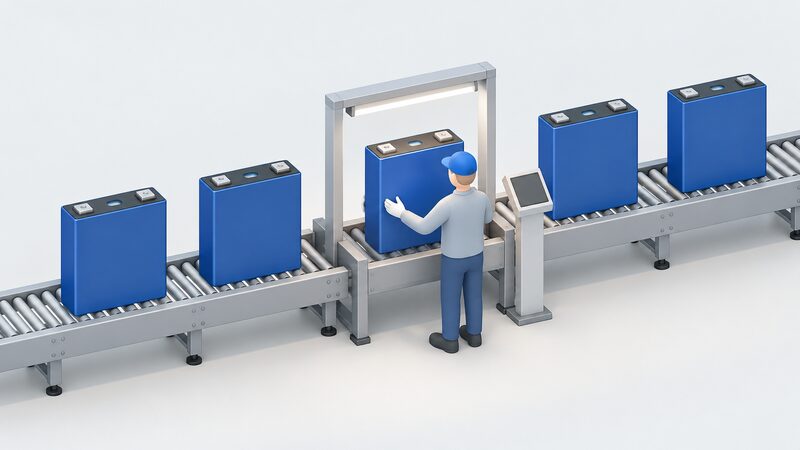
The company's core business is cells, the individual electrochemical units that are assembled into modules and packs. That is a different position in the supply chain from a brand that buys cells and builds a finished home battery around them. Cell manufacture is capital-intensive and scale-driven, which is why the large-format announcements matter more to Sunwoda's business than any single domestic product.
The same layering applies across the industry. A solar panel is made up of small semiconductive cells gridded together to form a larger panel and encased in glass or plastic, and the panel is then only one component of a system that also needs an inverter, mounting and cabling6.
Sunwoda's residential offering reflects that. The MonaWall SE5 is a 5kWh low-voltage module, and the compatibility list is the tell: GoodWe, Sungrow, SolaX, Solis, Victron and SMA2. A module with a compatibility list is a component, not a complete system. The household still needs an inverter from one of those makers, an installer to design and certify the installation, and a route to service.
That is not a criticism of the product. It is the normal shape of the low-voltage segment, and it has advantages: a household already running a compatible inverter can add capacity without replacing the power electronics. The trade-off is that the household's independence now depends on two companies rather than one, and on the compatibility list staying accurate as firmware and models change. Modular approaches are compared in modular and stackable battery systems.
Large-format cells: the 684Ah and 588Ah storage cells
Sunwoda introduced its 684Ah and 588Ah energy storage cells to a global audience at RE+ 25 on 10 September 2025, and began mass production of the 684Ah cell on 11 October 20251. The two events are a month apart, which is the usual sequence: show the cell, then start making it.
Cell capacity in ampere-hours is a measure of how much charge a single cell holds, and the numbers here are large by the standards of a few years ago. Cells of this size are built for containerised and grid-scale projects, where fewer, larger cells reduce the part count and the assembly cost per kilowatt-hour. They are not the cells that go into a wall-mounted household unit, which typically uses smaller prismatic or pouch cells arranged in a module.
The UK context for that scale of storage is growing quickly. Grid-scale battery storage stood at 7.3GW as of June 2026, and long-duration electricity storage at 2.8GW and 23.9GWh in the same month7. Utility-scale battery storage is projected at 33GW in the UK by 20358. Those are the projects that large-format cells serve, and they are the reason a cell maker's announcements are worth reading even by someone who will never buy a grid battery.
The link to a household is indirect but real. Cell manufacturing capacity built for grid projects lowers the cost of cells generally, and the same production lines feed the modules sold into homes. What it does not do is guarantee that a particular residential product will be supported in the UK for its service life. That depends on the distributor and the installer, not on the cell line.
What the recent product launches mean for home systems
Sunwoda's 2025 calendar was a run of trade events. After RE+ 25 in September, it unveiled next-generation energy storage and recycling solutions at All Energy Australia 2025 on 30 October 2025, then announced two SMM Global Tier 1 Supplier awards at NET ZERO EUROPE 2025 on 5 November 20251. Read together, the sequence is a company pushing its storage business into export markets and putting recycling alongside it.
For home systems, the significance is what is not announced. There is no UK-specific residential launch in that sequence, no domestic installation programme and no service network. The residential product that exists, the MonaWall SE5, is sold through distribution and pairs with third-party inverters2.
What a household should take from this is a supply-side story rather than a product story. More cell capacity in the world means more competition among module makers, which is generally good for price. It does not mean a new entrant has the UK support structure that a household needs when a unit faults in year seven.
The wider market is also moving on the demand side. Home batteries have a combined potential to help balance supply and demand across the country by releasing stored power when needed, and that aggregation is what virtual power plants and flexibility services are built on9. A battery that can be reached by a flexibility platform is worth more than one that cannot, and that capability depends on the inverter and the platform, not on the cell inside. The mechanics are set out in batteries and grid services.
Tier 1 status: what the BloombergNEF ranking tells you
Sunwoda was again listed as a Tier 1 energy storage manufacturer in BloombergNEF's Q4 2025 ranking, published on 31 October 20251. It also holds Tier 1 status as a PV module manufacturer, a separate listing covering panels rather than storage10.
Tier 1 in this context is a bankability classification. It is used by project financiers and developers to shortlist suppliers they are willing to lend against, and it is based on criteria such as the scale of projects delivered and the counterparties involved. It is not a quality grade, not a safety certification and not a warranty.
That distinction is worth holding on to, because Tier 1 is often repeated in marketing as though it were a consumer rating. A household buying a battery needs evidence of a different kind: certification to the standards that govern installation, a warranty with stated retained capacity and throughput terms, and an installer who will still be trading when the warranty is called on. Those are covered in home battery warranties and battery installation standards.
The SMM Global Tier 1 Supplier awards announced at NET ZERO EUROPE 2025 on 5 November 2025 are a second, separate recognition, this time from a metals and materials price reporting agency rather than an energy research firm1. Two Tier 1 labels from two different bodies is a stronger signal than one, but both are supply-chain signals. Neither substitutes for product-level evidence.
Does Sunwoda make batteries for home energy storage or only for grid use?
Both, and the split is worth understanding because the two product lines are aimed at different buyers. The large-format cells serve utility and commercial projects. The residential line is represented by the MonaWall SE5, a 5kWh low-voltage battery module listed for residential use2.
| Attribute | MonaWall SE5 |
|---|---|
| Nominal capacity | 5kWh |
| System type | Low-voltage battery module |
| End user | Residential2 |
| Compatible inverters | GoodWe, Sungrow, SolaX, Solis, Victron, SMA2 |
| Backup capability | With a compatible inverter2 |
A 5kWh module is a modest starting point by current UK standards. For comparison, SunPower's modular storage solution runs from 5kWh to 20kWh and is described as compatible with all photovoltaic systems11. Sizing a system is a separate exercise from choosing a module, and the trade-offs are set out in what size home battery do you need.
The compatibility list is the practical constraint. A household with an inverter from one of those six makers can consider the module; a household with anything else cannot, at least not without changing the inverter. That is the normal condition of the low-voltage segment, and it is why the inverter decision often matters more than the battery decision. AC-coupled and DC-coupled arrangements are compared in AC-coupled and DC-coupled battery systems.
Backup capability is stated as available when the module is paired with a compatible inverter2. That phrasing puts the responsibility on the inverter, which is correct: whether a system keeps the lights on in a power cut depends on the inverter's backup output and on whether a changeover arrangement has been installed. The conditions are explained in battery backup in a power cut.
Recycling and end-of-life: the second half of the battery story
Sunwoda presented energy storage and recycling solutions together at All Energy Australia 2025 on 30 October 2025, which places end-of-life handling alongside the products rather than after them1. That is a sensible pairing for a cell maker, because cell chemistry determines how a pack can be dismantled and what can be recovered.
For a UK household, the recycling route is governed by domestic rules rather than by the maker's announcements. Battery storage helps a household make the most of renewable electricity from solar panels, wind turbines and hydro turbines, and the equipment itself becomes waste electrical material at the end of its life12. Removal and disposal should go through a registered route, not general waste. The practical options are set out in home battery recycling, disposal and end of life.
There is a tax dimension that bears on the decision to install at all. The retrofitting of a battery for storing electricity generated by one or more qualifying energy-saving materials, solar panels among them, falls within the relief for energy-saving materials13. The Energy Saving Trust's response to the Treasury consultation stated that battery storage retrofitted to a solar panel or other energy-saving material should be included in the relief14. The VAT position is covered in what is the VAT rate on home battery storage.
Lifespan is the other half of the end-of-life question. A battery's lifespan depends on its type and how often it is charged and discharged fully, and a common modelling assumption is a battery lasting 2,000 full cycles15. Degradation and cycle life are treated in home battery cycle life and degradation.
What Sunwoda's rise means for UK household energy independence
The honest answer is that it changes the supply side more than the household side. A Sunwoda module in a UK home still depends on the grid for import and export, on an energy supplier for billing and tariffs, on a compatible inverter from a third party, and on an installer for design, certification and service2. None of that is removed by the maker's Tier 1 status.
What a battery does change is measurable. Adding a battery to a solar installation increases self-consumption from 30 to 40% to 70 to 80%, according to Great British Energy4. Uswitch data puts the self-consumption rate at 70% with a 10kWh battery for households with solar and battery17. That is the independence a battery actually delivers: more of the generation used on site, less exported at a low rate.
The cost side is real. Adding a battery to a solar PV system considerably increases the upfront cost by around £2,000 to £6,000 for sufficient capacity for typical UK rooftop systems18. Domestic battery systems may save on imported electricity costs but are currently very expensive and do not make financial sense for every household19. Battery storage augmenting the benefits may result in an increase in property value of up to £2,72220.
The wider direction of travel is towards more household flexibility, not less grid dependence. Millions of homes with batteries could release stored power onto the grid when needed to help balance supply and demand across the country9. The Clean Flexibility Roadmap sets out the official view of that shift7. For a household, the realistic position is a home that imports less, exports more intelligently and stays connected. The full picture is in home batteries and household energy independence.
"Home storage batteries store your electricity to use later, making your energy system more independent from the National Grid"
Sources20 cited
- Sunwoda Energy news and product announcements, Sunwoda Energy, 2025
- Sunwoda MonaWall SE5 5kWh low-voltage battery module, Alternergy, 2026
- Solar panel battery storage, Which?, 2026
- POST note on energy storage, Parliamentary Office of Science and Technology, 2026
- Permitted development rights impact assessments, Scottish Government, 2026
- Solarwatt establishes UK subsidiary, Flexi-Orb, 2021
- Clean Flexibility Roadmap, July 2026 update, Department for Energy Security and Net Zero, 2026
- SolarEdge solar panels, Which?, 2026
- Batteries in the home, Solar Energy UK, 2026
- NeoStar module range, AIKO Solar, 2026
- SunPower home battery guide, SunPower, 2026
- Storing energy, Energy Saving Trust, 2026
- VAT on energy saving materials: VENSAV3061, HM Revenue and Customs, 2026
- Response to the Treasury's consultation on VAT relief for energy saving materials, Energy Saving Trust, 2025
- Plug-in solar panels, Energy Saving Trust, 2026
- LG ESS battery division RESU ESS home batteries recall, Electrical Safety First, 2026
- Britain's homes with solar panels reap £40 million during the heatwave, Uswitch, 2026
- Could solar panels save you £500 a year?, Which?, 2026
- Making the most of your solar PV panels, Centre for Sustainable Energy, 2026
- Do solar panels increase home value?, The CPA, 2026