In this guide
The Maxeon 3 is a back contact module sold under the SunPower brand outside the United States, and it is the panel most often searched for by name when a household is weighing the premium end of the UK market. The line spans 405 to 420 W in the DC Black version, 415 to 430 W in the standard DC version and 470 to 485 W in the COM version for commercial roofs1. Maxeon states that its residential modules reach up to 24.1% efficiency at 445 W on current datasheets, and the SunPower-branded IBC range is described as lifting efficiency to around 24%2.
The warranty is the headline: Maxeon panels carry a 40-year warranty covering power, product and service, with 88.3% of the original power rating warranted at year 404. That is a longer term than the 30-year power warranties carried by SolarEdge and Jinko Solar panels, at 89.4% and 87.04% respectively5.
What a household needs to understand before specifying it is the company structure. The panels are manufactured by Maxeon Solar Technologies, a NASDAQ-listed business majority-owned by TCL, and the warranty sits with Maxeon rather than with any installer7. Distribution in the UK runs through approved partners, and TCL SunPower Global announced a UK distribution partnership with Bimble Solar in February 20268.
The SunPower company and who distributes Maxeon 3 in the UK
The brand history matters more here than on most panel pages, because the name on the roof and the company behind the warranty are not the same business. Maxeon IBC panels are marketed outside the United States under the SunPower brand, and the premium SunPower-branded panels are manufactured by Maxeon Solar Technologies, listed on NASDAQ as MAXN and majority-owned by TCL7. The warranty is held with Maxeon, described as a financially stable NASDAQ-listed company7.
That structure is a legacy of a split. Complete Solaria acquired the SunPower name out of bankruptcy and relaunched it in 2025 as a dealer and installation platform rather than a manufacturer, so a SunPower-branded panel sold today is not made by the company that once bore the name7. Separately, SunPower entered a new chapter by joining the TCL Group, the world's leading wafer manufacturer with an annual production capacity of 200 GW10.
For UK buyers the practical question is the route to market. Maxeon states that its IBC solar panels are available exclusively through Maxeon Preferred Partners, which means an approved installer rather than a general merchant11. TCL SunPower Global announced a UK distribution partnership with Bimble Solar in February 2026, and the company has run similar distribution deals in the DACH region and Spain8. Maxeon also notes that ratings may vary based on product availability in specific markets, so the exact model offered can differ from the headline range12.
The dependence this creates is worth stating plainly. A household buying a Maxeon 3 is relying on a manufacturer's warranty for four decades, on a partner network for the sale and installation, and on a parent company structure that has already changed hands once. That is not a reason to avoid the panel, but it is the reason the warranty terms and the named warrantor should be read before signing.
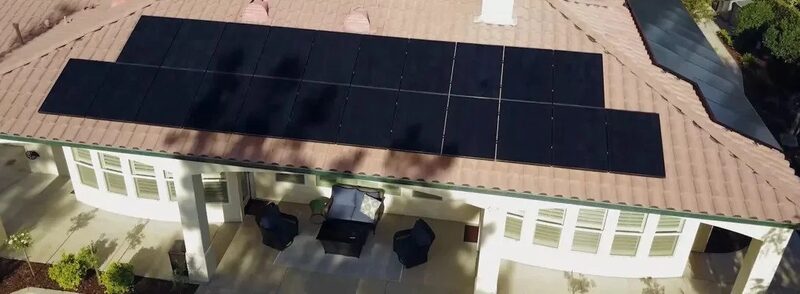
Maxeon 3 at a glance: 405W to 485W across three versions
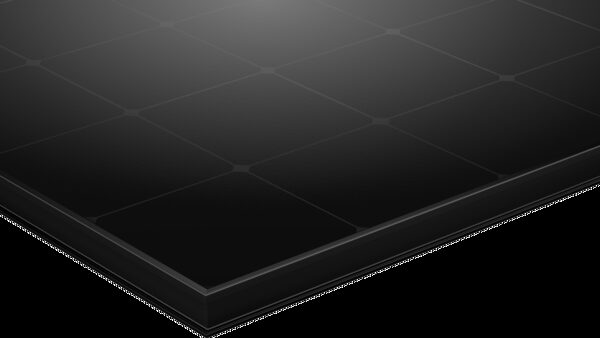
The Maxeon 3 is sold in three power bands rather than one. The DC Black version runs 405 to 420 W and is described as ideal for residential applications. The standard DC version runs 415 to 430 W and is described as ideal for residential and commercial applications. The COM version runs 470 to 485 W and is described as ideal for commercial applications1.
Above the Maxeon 3 sits the Maxeon 6 DC at 410 to 420 W, and the wider Maxeon residential range reaches up to 24.1% efficiency at 445 W on current datasheets1. The SunPower Maxeon 7 is listed at around 24.1% maximum panel efficiency7. Maxeon describes itself as one of the three leading back contact manufacturers alongside LONGi Solar and AIKO3.
| Version | Power | Stated application |
|---|---|---|
| Maxeon 3 DC Black | 405 to 420 W | Residential1 |
| Maxeon 3 DC | 415 to 430 W | Residential and commercial1 |
| Maxeon 3 COM | 470 to 485 W | Commercial1 |
| Maxeon 6 DC | 410 to 420 W | Not stated1 |
The three-band structure is unusual. Most manufacturers sell one module in a power range and let the installer pick the output. Maxeon splits the line by application, which means a domestic roof is normally specified with the DC Black or DC version and the COM version is aimed at larger arrays. For a household, the practical effect is that the highest power figure in the Maxeon 3 family, 485 W, is not the one that will be quoted for a house.
Efficiency and power density: 226W per square metre
Power density is the figure that decides how much a roof can generate, and it is where premium panels earn their price. The REC Alpha Pure-RX is quoted at 226W per square metre and the Viridian Clearline Fusion at 228W per square metre13. The Maxeon 3's own power density is given as 226W per square metre in one figure and as a 209W to 226W range in another, and the two are not reconciled, so the range should be read as the safer statement7.
Efficiency and power density are related but not identical. Efficiency is the share of sunlight falling on the module that becomes electricity; power density is the watts packed into each square metre. A module can be efficient and still low in power density if it is small. What matters on a UK roof is the second figure, because roof area is the constraint. Maxeon's residential modules reach up to 24.1% efficiency at 445 W, and the SunPower-branded IBC range is described as around 24%2.
The comparison that puts this in context is the mainstream market. LONGi's Hi-MO X6 Max is listed at up to 25% module efficiency14. Around 80% of panels available in the UK are made in China, including those from Trina Solar, so the premium tier competes against a large and technically strong mainstream15.
For a household, the honest reading is that a Maxeon 3 buys a small area saving rather than a step change in output. On a roof that fits twelve standard panels, a higher power density might allow eleven or twelve of a higher rating, or the same count at a slightly greater total. Where roof area is tight and generation is the priority, that matters. Where there is space to spare, the premium is harder to justify on density alone. The wider principles are set out in reading a solar panel datasheet.
How it performs in heat: the temperature coefficient
Heat is the quiet killer of solar output in the UK, not because summers are extreme but because a warm, still day on a dark roof pushes cell temperature well above the 25 degrees C at which panels are rated. The temperature coefficient states how much output falls for each degree above that. The LONGi Hi-MO X6 Max is optimised to -0.28% per degree C, and the AIKO Neostar 3 is described as very close at -0.26%14.
The Maxeon 3's own coefficient is not published in the figures available here, so no value can be given for it. What Maxeon does publish is the engineering behind the claim: its panels are built with strain relief to ensure a consistent flow of energy, and are designed without the use of EVA encapsulant, which is the layer that degrades fastest under repeated thermal cycling18. Maxeon describes having researched this across 35 years4.
The company's framing is that its panels are built for temperature swings and for what it calls climate whiplash, the cycle of heat and cold that stresses conventional encapsulants4. That is a durability argument rather than an efficiency one, and it is the maker's own claim about its own product.
"designed its panels without the use of EVA encapsulant"
In practice, a household should read the temperature coefficient from the datasheet of the exact model quoted, because it varies between the DC, DC Black and COM versions. A lower coefficient, meaning a smaller negative number, produces more on hot days. The difference between -0.26% and -0.29% per degree is small on any single day but accumulates across a summer. Roof mounting, ventilation behind the panel and array pitch all affect cell temperature more than the coefficient does.
Specifications: what the published figures cover
The Maxeon 3 datasheet figures available here cover power, application and warranty. Dimensions, weight, cell count and open circuit voltage for the Maxeon 3 are not published in the material available, so no values can be given for them. That is a real gap for anyone sizing a roof or checking a structural load, and it means the installer's survey and the manufacturer's datasheet for the exact model are the only reliable sources.
What is published is the durability specification. Maxeon panels are IEC-certified to withstand hailstones up to 45 mm in diameter, and Maxeon states that its panels achieve the exceptional HW 4 standard3. The company is also explicit about the limit: no solar panel is 100% hail-proof9.
"no solar panel is 100% hail-proof"
That combination, a high certification and a plain statement of its limit, is more useful than a marketing claim. Hail resistance is tested to a standard, and a standard describes a test, not a guarantee against every storm.
For roof loading, the relevant framework is building regulations and roof loading, which governs the structural assessment. Mounting method is covered in solar panel mounting systems. Where a household is comparing module formats, glass-glass versus standard panels sets out the construction difference.
Warranty: 40 years with 88.3% output at year 40

The Maxeon warranty is the longest in the residential market and the main reason the panel commands a premium. Maxeon panels are supported by a 40-year warranty on workmanship and materials, and the comprehensive 40-year warranty includes power, product and service provisions, with 88.3% of the original power rating warranted at year 404. The SunPower-branded IBC range is described as guaranteeing around 88% of rated output at year 407.
The comparison is stark. SolarEdge carries a 30-year power output warranty at 89.4%, and Jinko Solar a 30-year warranty at 87.04%5. AIKO's Neostar 3 carries a 30-year product warranty with 90.6% output at 25 years and 88.9% at 30 years13. So the Maxeon 3 does not win on the percentage retained; it wins on the number of years the guarantee runs.
The terms are not uniform across the range. Maxeon Performance panels carry a comprehensive 30-year warranty covering power, product and service, and earlier generation Performance panels carry 25 years, with the 30-year term not available for them20. The warranty documents list Maxeon at 40/40 years and Performance at 25/25 years19. The latest generation of Performance panels carries a 25-year warranty if registration is not completed20.
Two further points bear on whether the warranty is worth anything. Maxeon states that microinverters attached to panels it produced for SunPower are not covered by its warranty, so a household with that combination has a separate claim to pursue11. And a 40-year warranty is only as good as the company behind it, which is why the TCL ownership and the NASDAQ listing are relevant facts rather than background7. The general framework is in solar panel warranties and degradation.
What Maxeon 3 costs and the premium over standard panels
There is no published Maxeon list price for the Maxeon 3. The figures that exist are indicative and they conflict. SunPower (Maxeon) panels are quoted at £280 to £420 per panel installed in the UK, described as the most expensive residential tier, with a 3.5 kW system of eight panels at £6,500 to £8,500 installed7. A second figure on the same page gives £300 to £420 per panel and £8,500 to £11,500 installed7. The two are not reconciled, so both should be treated as indicative only.
For context, a typical 3 kW solar panel system in the UK is quoted at about £4,500 to £5,500 professionally installed, with installation costs of £1,200 to £1,800 and battery costs of £5,000 to £8,00021. Solar panel prices generally range from around £4,600 to £8,000 depending on panel quality and system size22. E.ON Next offers solar panel and battery packages from £4,995 for a typical 6-panel system17.
| Item | Indicative figure | Source |
|---|---|---|
| Maxeon panel, installed | £280 to £420 per panel | 7 |
| Maxeon panel, installed (second figure) | £300 to £420 per panel | 7 |
| Maxeon 3.5 kW, 8 panels | £6,500 to £8,500 installed | 7 |
| Maxeon 3.5 kW, 8 panels (second figure) | £8,500 to £11,500 installed | 7 |
| Typical 3 kW system, UK | £4,500 to £5,500 installed | 21 |
| General UK range | around £4,600 to £8,000 | 22 |
VAT treatment is not stated in these figures, so they should be read as quoted rather than as confirmed VAT-inclusive prices. The premium over a mainstream panel is therefore real but not precisely quantifiable from published data, and the honest position is that Maxeon 3 prices are installer-quoted. Wider cost context sits in how much do solar panels cost in the UK.
Is Maxeon 3 right for your home: limits and alternatives
Maxeon states that its series is suitable for residential and commercial installations where space is limited and maximum energy generation is desired23. That is the case for the panel: constrained roof area, a long holding period, and a household that values the 40-year warranty over the lowest capital cost.
The limits are equally clear. The Maxeon 3 is not bifacial, so it does not collect reflected light on a rear face. Bifacial modules sold in the UK include the LONGi S10 and the AIKO Neostar 317. On a flush roof mount the rear face sees little light, so the absence costs little; on a raised or ground-mounted array it is a genuine gap. The comparison is set out in bifacial and glass-glass solar panels.
Shading behaviour is a Maxeon strength. On the Performance range, portrait orientation with shade on the short edge re-routes energy flow through the top two thirds of the panel12. Maxeon's back contact architecture is the basis of its shade tolerance claim, and the general principles are in how shade affects solar panel output.
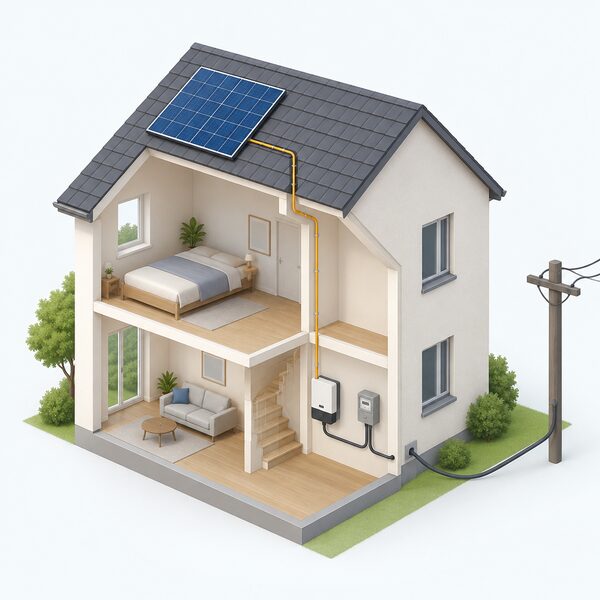
The remaining dependence is structural. A Maxeon 3 array still connects to the grid, still relies on an inverter and a supplier, and still depends on a manufacturer's warranty for four decades. The panel improves the generation side of the equation; it does not change the household's relationship with the network. That distinction is the subject of solar panels and household energy independence. For the wider range, see SunPower and Maxeon panels, and for the market as a whole, types of solar panel sold in the UK.
Sources23 cited
- Maxeon solar panels, Maxeon, 2026-09-17
- What is the best 500 W module on the market, LONGi, 2026-09-17
- Most reliable technology, Maxeon, 2026-09-17
- Maxeon panels: 40-year warranty, Maxeon, 2026-09-17
- SolarEdge solar panels review, Which?, 2026-08-12
- Jinko Solar solar panels review, Which?, 2026-08-12
- SunPower solar panels, Solar Info UK, 2026-09
- TCL SunPower Global UK, TCL SunPower Global, 2026-02-18
- Maxeon panels and hailstorms, Maxeon, 2026-09-17
- SunPower technology and innovation, SunPower, 2025
- Maxeon FAQs, Maxeon, 2026-09-17
- Shade happens, Maxeon, 2026-09-17
- Best solar panels, Spirit Energy, 2026-07
- Hi-MO X6 Max, LONGi, 2026-09-17
- AIKO solar panels review, Which?, 2026-08-12
- Trina Solar solar panels review, Which?, 2026-08-12
- Solar panel for your roof type UK 2026, Spirit Energy, 2026-05-08
- Temperature swings, Maxeon, 2026-09-17
- Maxeon support, Maxeon, 2026-09-17
- Maxeon Performance solar panels, Maxeon, 2026-09-17
- DIY solar panels UK guide, Jackery UK, 2026-04-29
- Solar panels, Uswitch, 2026-09-09
- Maxeon Performance differ, Maxeon, 2026-09-17
 SunPower and MaxeonYour SunPower panels are on the roof, so who honours the warranty now the company has gone bust?
 SunPower and Maxeon panelsSunPower panels sold in the UK now come from a different company than the old American brand, so who actually makes them and does that change the warranty?