
In this guide
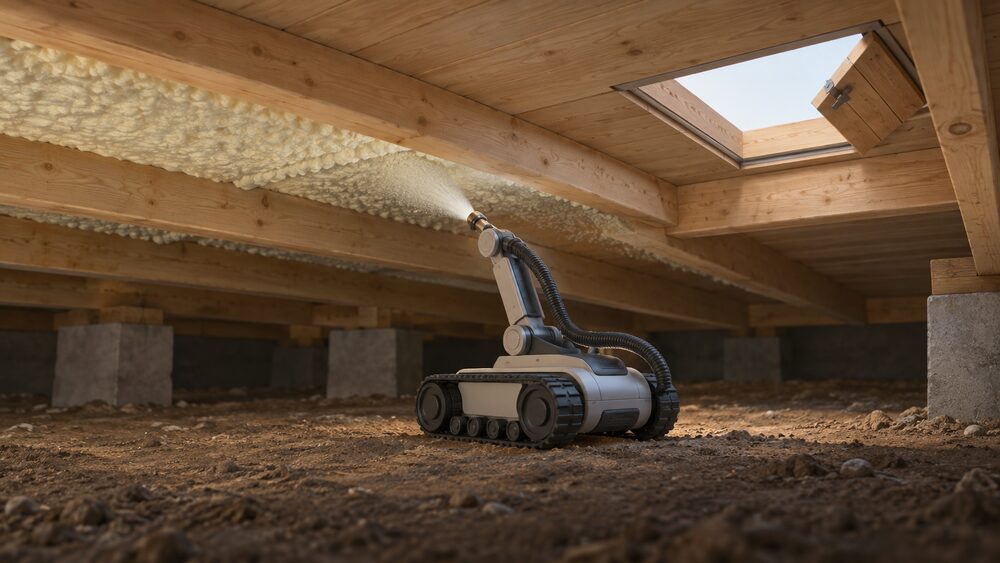
Q-Bot is a British company that insulates suspended timber floors from below, using a remote-controlled robot fed through a small hatch to spray closed-cell polyurethane foam onto the underside of the floorboards. It is a distinct product type rather than a brand of board or blanket, and it is the only widely marketed robotic underfloor insulation system in the UK. The company reports over 5,500 homes insulated since 2012, covering more than 100,000 m² of suspended floors1.
The headline commercial facts are these. A survey is required before Q-Bot will quote, from £99 including VAT, and the fee is credited against the installation if the work proceeds2. Installation starts at £3,250 for a floor up to 25m² on the Premium specification, or £3,762.50 on Premium PLUS, with £126.50 and £150.50 per additional square metre respectively2. Most installations take one to two days, and park home installations are usually completed in one day2.
One official record needs stating plainly at the outset. Ofgem's ECO4 innovation measures list records that the BBA for this product has been withdrawn, and that from 28 January 2025 there were no products meeting the description4. Q-Bot's own pages from 2019 and 2022 describe the system as accredited by the BBA and as having supplied a BBA certificate5. The two positions are not reconciled in the documents, and a householder weighing the product should treat the certification status as unresolved rather than settled.
BBA approval withdrawn: what that means for Q-Bot underfloor insulation
The certification position is the first thing to establish, because it bears on funding, on lender attitudes and on how a building control or retrofit coordinator will treat the measure. Ofgem's list of approved innovation measures under ECO4 states that "the BBA for this product has been withdrawn" and that "From 28/01/25, there are no products that meet the description"4. That is an official document, dated January 2026, and it is the strongest single statement in the record about the product's approval status.
Against that, Q-Bot's own material describes the system as accredited by the BBA, and a 2022 product page refers to certifications supplied including the BBA certificate alongside property data collected on site before and after installation5. What can be said is that the withdrawal is recorded by the scheme administrator, that it took effect from a stated date, and that no subsequent reinstatement appears in the material.
For a householder, the practical consequences are narrower than the phrase "approval withdrawn" might suggest. The product is still sold and installed. What changes is the evidence base a third party will accept: a lender, an energy assessor or a funding body looking for a current certificate will not find one on the Ofgem list. Q-Bot states that it provides an accredited declaration of conformity and verified thermal performance data that are officially recognised by Domestic Energy Assessors, and that its underfloor insulation is recognised by Domestic Energy Assessors1. Those are the maker's statements about its own paperwork, and they are the route by which an installation is meant to be reflected in an EPC.
What Q-Bot is and how the robot installs insulation from below
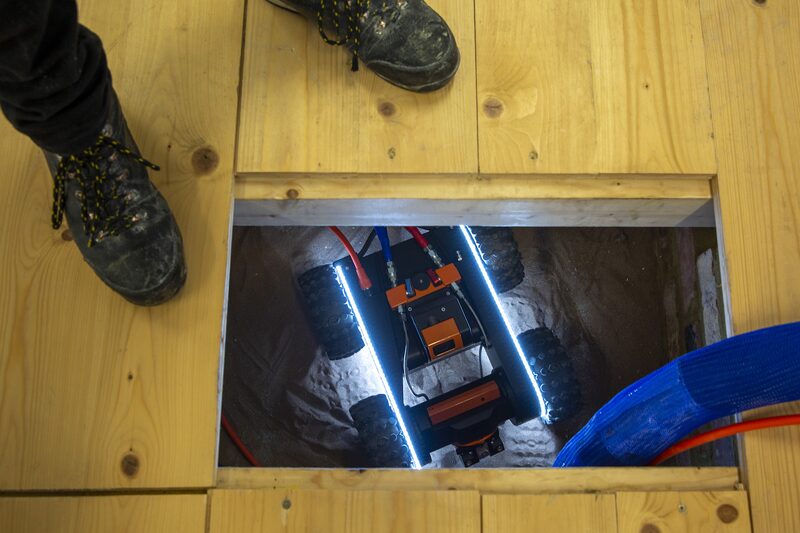
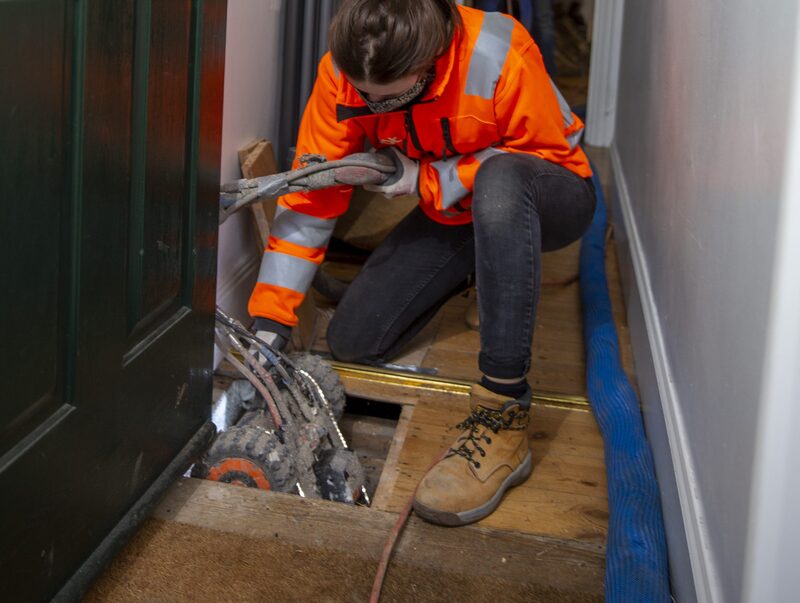
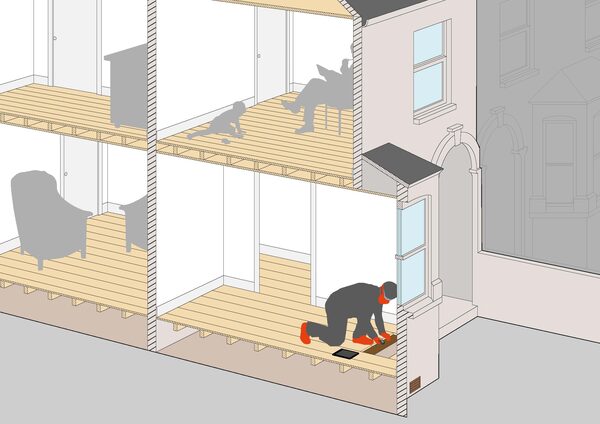
The method is the reason the product exists. Rather than lifting a floor, Q-Bot sends a small remote-controlled robot into the void beneath a suspended timber floor and sprays polyurethane foam onto the underside of the boards, where it expands and sets8. The robot is about the size of a boot box and can be fed in through a small hatch6. Installers make small, discreet openings to the floor, often inside cupboards or under furniture, rather than removing whole floor coverings9.
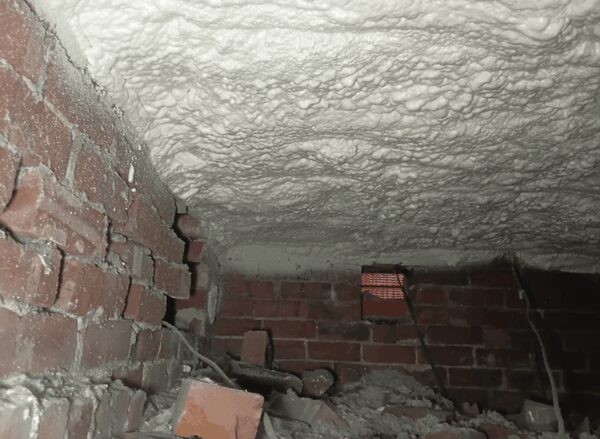
The robot sprays layers of insulation to the underside of the floorboards at a typical thickness of 12cm, and the application is monitored to measure the thickness achieved9. The foam is a closed-cell formulation applied as a continuous layer to the underside of the boards, which Q-Bot states moves the dew point below the insulation10. Because the foam encases the joists, it reduces thermal bridging through exposed timber8. Q-Bot reports high thermal performance with 120mm foam thickness, as low as 0.18 W/m²K in some cases8.
The installation is designed to be non-intrusive. Q-Bot states that the system can fit and retrofit suspended floors without removing furniture or uplifting the entire floor covering and floorboards6. Residents can stay in the home throughout, and the installation takes one to two days11. At the end, the household receives a Declaration of Conformity and a full completion pack9.
The independence question here is straightforward. This is a fabric measure applied inside the home's own structure, so it reduces the energy needed to keep the floor warm regardless of who supplies the gas or electricity. What it does not do is remove the household from the grid or from a supplier. It lowers demand; it does not change the fuel.
Which homes it suits: suspended floors, void height and clearance
Q-Bot is not a universal measure. It applies to suspended timber ground floors with a cavity beneath, and the maker's own suitability statement is specific: suspended floors from 200mm and deeper, where a continuous high-performance insulation layer is required or desired8. The Centre for Sustainable Energy describes the approach as suited to suspended floors with a small cavity below that is hard to access12.
Void height is the binding constraint. A new-generation robot is described as capable of spraying insulation in voids as low as 20cm13. Building Regulations also require 150mm of clearance to remain beneath the floor after insulation is applied, which sets a floor on how much foam can go in and therefore how deep the void must be3. A shallow void may fail on clearance even where the robot can physically enter.
The scale of the potential market is large. Q-Bot states that the solution is needed for over 8 million homes in the UK11. The company has installed in over 1,000 properties in Scotland, including places as far north as Orkney7. Its installation partners have included Camden Council, Hexagon Housing Association, Castlehill Housing Association, Argyll Community Housing Association and Langstane Housing Association5.
| Requirement | Figure | Source |
|---|---|---|
| Floor type | Suspended timber ground floor | 12 |
| Minimum void depth for suitability | 200mm and deeper | 8 |
| Minimum void the robot can work in | 20cm | 13 |
| Clearance to remain after insulation | 150mm | 3 |
| Typical foam thickness applied | 12cm | 9 |
Where a floor is solid rather than suspended, or where the void is too shallow, the measure does not apply and the alternatives are covered in floor insulation. For homes with a suspended timber floor and adequate clearance, the appeal is that the work happens without disturbing the floor finish.
Survey and pre-installation checks: ventilation, moisture and access
A survey is mandatory before Q-Bot will quote, and it is not a formality. The surveyor visits to survey the floors, ventilation and access, and to determine suitability for underfloor insulation, and may lift a board or make a small hatch and take moisture readings9. The survey also measures the surface area to produce an accurate quote14.
The checks fall into a recognisable pattern. Subfloor height is recorded to ensure accessibility for the installation, and the surveyor determines how and where access points should be made, communicated in person and via a floorplan created on the day14. Existing underfloor ventilation is inspected to ensure adequate airflow14. Internal checks identify visible signs of damp or mould alongside a visual assessment of ventilation, with all information logged digitally14. External perimeter checks look for defects that could now or one day lead to moisture ingress, including ground levels, bridging, gullies, downpipes, drains and gutters14.
Moisture is the decisive test. Elevated moisture levels can indicate leaks or condensation issues that should be resolved before insulation is installed, to prevent rot and mould growth14. Q-Bot states that if floorboard moisture levels are above 20%, the installation will be paused until the underlying issue has been resolved3. After installation, timber moisture levels are reported at 11 to 14%, described as well within safe limits10.
Ventilation is maintained rather than sealed. Air vents under the home are checked and, if needed, improved to maintain airflow, and the installation allows for a ventilation gap between the insulation and the ground beneath to protect from damp and mould10. Where necessary, Q-Bot may be required to fit additional background ventilation to meet building regulations as part of an installation14. The void under the floor stays ventilated, allowing the ground to breathe14.
Cost: survey fees, installation prices and VAT

Q-Bot publishes a price list, which is unusual in this market. A survey is required before a quote, from £99 including VAT, and the fee is credited against the installation if the work goes ahead, bringing the net cost of the survey to £57.50, £132.33 or £232.33 for the Standard, Premium and Premium PLUS surveys respectively2. The Standard survey confirms whether the property is suitable, and a survey report can be purchased for an additional fee2.
Installation pricing runs on two tiers. Premium installation starts at £3,250 for homes up to 25m², with £126.50 per additional m² above that2. Premium PLUS starts at £3,762.50 for a home up to 25m², with £150.50 per additional m²3. Q-Bot's support material gives the same figures, describing installations ranging from £126.50 to £150.50 per square metre3. A worked example on the price list puts the total for survey and installation together at £3,307.50 for a floor up to 25m² with a Standard survey and Premium installation2; a second figure of £3,382.33 for the same combination appears in the same document, and the two are not reconciled.
Independent guidance gives a slightly different shape to the cost. Which? reports that, according to Q-Bot, costs start at around £3,000 to £4,500 for a typically sized 2 or 3-bedroom terrace, and notes that a householder may be required to pay for a survey in advance to establish whether the floor is suitable16.
VAT is zero-rated on the installation: Q-Bot states there is no VAT on installation, and that installing underfloor insulation in a home is zero-rated for VAT2. The survey fee, by contrast, is quoted including VAT. Cost drivers are the location and size of the installation, with larger installations more cost-effective per square metre, and the most expensive part of the process described as bringing specialist equipment and trained personnel to site10.
| Item | Premium | Premium PLUS |
|---|---|---|
| Survey fee | from £99 inc. VAT, credited against installation | from £99 inc. VAT, credited against installation |
| Installation, up to 25m² | from £3,250 | from £3,762.50 |
| Each additional m² | £126.50 | £150.50 |
| Warranty | 10-year product warranty | 25-year insurance-backed guarantee |
Savings, EPC improvement and payback
The savings figures come from several directions and do not all agree, which is worth understanding before treating any single number as the expected outcome. Q-Bot states that insulating a floor with its system can reduce energy bills by an average of 16%, an average reduction of £150 per year17. A separate Q-Bot page gives a payback of 8 to 15 years based on energy savings alone18, while another gives less than 15 years10, and a third describes a life expectancy of 30 to 80 years10.
The Energy Saving Trust verified figures are the ones Q-Bot leans on most heavily. For a 2-bedroom ground floor flat in a gas heated home, insulating a floor with Q-Bot could typically save on average £270 a year6. Q-Bot states that the Energy Saving Trust used the energy modelling system BREDEM SAP and the Dynamic Engine to verify and certify its energy saving claims19. The company also reports a case study of 100 homes in which some tenants saved up to £665 per year3.
On thermal performance, Q-Bot states that its spray foam improves thermal performance by 77%, reduces heat loss through the floor by 77%, and reduces cold draughts by a third for the entire house18. It reports that underfloor insulation alone warms feet by 3°C without putting fuel bills up3. On carbon, it states that installing the insulation saves around 700 kilograms of CO₂ every year, roughly one fifth of a typical home's emissions, based on independent SAP assessments3.
For the EPC, Q-Bot states that its underfloor insulation can improve an EPC score by up to 5 points, and describes an average EPC improvement of 5 SAP points across the board, based on a study of 180 homes3. It also states that the insulation is recognised by Domestic Energy Assessors, and that it provides an accredited declaration of conformity and verified thermal performance data that are officially recognised by assessors1. The mechanism matters: unverified insulation improvements are excluded from EPC ratings, and accredited evidence is what allows the EPC to be updated7.
Warranty: 10-year product warranty or 25-year insurance-backed guarantee

The warranty depends on which specification is bought, and the difference is substantial. The Premium installation carries a 10-year product warranty2. The Premium PLUS installation carries a 25-year insurance-backed guarantee on product and workmanship, with discounted future health checks and remediation, subject to eligibility2.
The guarantee structure is worth setting out because it is the part that protects a householder if the installer ceases trading. Q-Bot states that installations carrying the 25-year guarantee sit within a monitored framework with audit and compliance powers external to Q-Bot, that the guarantee runs for 25 years and survives installer insolvency, and that where an installer fails, insurance protection remains21. The guarantee is provided by the Insulation Assurance Authority and TrustMark, and the installation is lodged under the IAA structure3. Q-Bot is registered with TrustMark under reference TMRN4393.
The Premium PLUS route also brings a different quality regime. Properties are assessed for suitability and risks identified before installation proceeds, design must align with documented standards, and an external oversight framework applies to quality control rather than the installer marking its own work21. Q-Bot states that every job is reviewed before certification, and that photos, videos and data are stored as a permanent verifiable record reviewable by homeowners, surveyors and retrofit coordinators10.
"Insurance-backed protection: the guarantee runs for 25 years and survives installer insolvency."
The independence point is that the guarantee is the household's protection against the installer, not against the manufacturer's own continuity. An insurance-backed guarantee lodged with a third party is a different instrument from a maker's warranty, and the documents describe the two as distinct tiers rather than as one product with an option.
Funding and availability: England, Wales and Scotland
Funding availability differs by nation, and the position in England and Wales is less settled than in Scotland. Q-Bot has described its underfloor insulation as eligible for funding such as ECO5, and has written about an ECO3 funding boost intended to scale up installations11. Against that, Ofgem's ECO4 innovation measures list records the BBA withdrawal and states that from 28 January 2025 there were no products meeting the description4. Those two positions sit awkwardly together, and the Ofgem entry is the more recent official statement.
In Scotland, the route is clearer. Through Changeworks, Scottish homeowners can access government-backed funding support for Q-Bot underfloor insulation, with eligibility confirmed via Home Energy Scotland, and eligible residents may receive up to £1,500 grant funding towards the installation22. Q-Bot has installed in over 1,000 properties in Scotland, including as far north as Orkney7. The Scottish Government's own programme record notes that a new form of underfloor insulation was to be added to the scheme in the 2019/20 operating year, describing Q-Bot as installing underfloor insulation using a robot and increasing the RdSAP rating of the property23.
On the Warm Homes Plan, Q-Bot's own position is that most private homeowners in England and Wales should not wait for funding. Its Chief Operating Officer argues that waiting for grant support rarely pays off for typical working homeowners7. That is a commercial argument from the company, not an official statement of scheme rules, and it should be read as such.
The funding landscape for each nation is set out in more detail in insulation grants in England, insulation grants in Scotland and insulation grants in Wales.
Park homes, floorboards and the practical experience
Park homes are a distinct case and Q-Bot markets to them directly. Installations on park homes are usually completed in one day3. A published case study describes a park home where failed underfloor insulation was removed and Q-Bot's system installed in one day, working entirely from outside the property, with the new underfloor insulation seamlessly connected to existing external wall insulation to create a continuous thermal and airtight seal24. The outcome reported was improved air quality, reduced humidity levels, smoothed temperature fluctuations, lowered energy consumption and reduced carbon emissions24. The system includes removal of old insulation, labour, disposal, pipe lagging and full documentation24.
On disruption, the design intent is minimal. The robot is fed through a small hatch, and openings are made discreetly, often inside cupboards or under furniture9. Furniture does not need to be removed and the whole floor covering does not need to be lifted6. The foam bonds to the underside of the floor, which Q-Bot states helps protect timber from moisture and decay25.
On the condition of the floor itself, the survey is the gate. Q-Bot does not offer dampness, rotting or floor timber repair works, but provides advice and guidance on what is needed10. Where moisture is elevated, work pauses until the underlying issue is resolved3. The company states that its method has been shown to reduce the risk of damp and mould when compared to both an uninsulated floor and alternative insulation materials, and that humidity under the floor reduces after the insulation is installed3.
What the system does for a household's energy independence
The honest summary is that Q-Bot is a demand-reduction measure, not a supply measure. It insulates the floor of a home that already has a suspended timber floor, which lowers the heat the home loses downwards and therefore the fuel it must buy. Q-Bot states that insulating the floor stops heat escaping downwards, so a heat pump does not have to run as hot and uses less electricity to keep the home just as warm1. That is a real reduction in the energy a household must purchase, and it applies whatever the fuel.
What it does not change is where that energy comes from. A gas-heated home remains on the gas grid and on a gas supplier. An electrically heated home remains on the grid. The measure reduces the size of the bill and the carbon attributable to the home; it does not make the home self-sustaining, and it does not generate anything.
There are also dependencies specific to this product. The installation is carried out by Q-Bot or its trained installers, so the household depends on a single company's continued operation for the work itself, and on the guarantee structure for protection if that company or its installer fails. The 25-year insurance-backed guarantee is the instrument designed for that risk, and it is available only on the Premium PLUS specification2. The 10-year product warranty on the Premium tier is a maker's warranty and does not carry the same insolvency protection.
The certification position adds a further dependency. Where a lender, assessor or funding body requires a current approval, the Ofgem record of the BBA withdrawal is the document they will find4. Q-Bot's own accredited declaration of conformity and verified thermal performance data are the route by which the installation is meant to be recognised7. A householder weighing the measure should establish, before work starts, which paperwork will be issued and whether the intended recipient will accept it.
For the wider picture of how fabric measures fit with fuel choice, insulation and energy independence and what insulation a heat pump needs set out the relationships. The comparison with other underfloor approaches is covered in floor insulation, and the risks specific to foam in roofs, which are different from this application, are set out in spray foam insulation.
Sources25 cited
- Q-Bot underfloor insulation for your home, Q-Bot, 27 August 2026
- Q-Bot insulation costs, Q-Bot, 14 September 2026
- Q-Bot FAQs, Q-Bot, 14 September 2026
- ECO4 Innovation Approved Innovation Measures v1.17, Ofgem, January 2026
- Benefits of installing Q-Bot's robotic underfloor insulation, Q-Bot, 4 June 2019
- Q-Bot: the only insulation company to be verified by EST, Q-Bot, 15 July 2022
- Is your EPC rating undervaluing your home?, Q-Bot, 11 May 2026
- Compare underfloor insulation methods, Q-Bot, 27 August 2026
- The Q-Bot insulation process, Q-Bot, 14 September 2026
- Is underfloor spray foam the same as loft insulation?, Q-Bot, 11 May 2026
- ECO3 funding boost to scale underfloor insulation installations, Q-Bot, 25 April 2019
- Floor insulation, Centre for Sustainable Energy
- Testimonial: Q-Bot's first ever private customer, Q-Bot, 7 December 2021
- What does a Q-Bot survey entail?, Q-Bot, 13 April 2026
- Why a pre-installation survey is essential for underfloor insulation, Q-Bot, 4 February 2026
- Floor insulation, Which?, 26 May 2026
- Floor insulation, Q-Bot, 27 August 2026
- How to make my home warmer, Q-Bot, 17 October 2024
- Energy Saving Trust updated energy saving claims, Q-Bot, 23 August 2022
- Floor insulation: trusted for reducing energy bills and carbon emissions, Q-Bot, 9 May 2023
- What the IAA guarantee means for property owners, Q-Bot, 25 March 2026
- Scottish homeowners can now access funding for Q-Bot underfloor insulation, Q-Bot, 4 June 2026
- Warmer Homes Scotland programme annual review 2018-19, Scottish Government, 2019
- Park home case study, Q-Bot, 28 January 2026
- Park homes, Q-Bot, 14 September 2026