
In this guide
Gilkes is the UK hydro turbine manufacturer that householders and community energy schemes meet first when they start looking at water power. The company's name is attached to Pelton turbines, the type suited to high-head sites where water falls a long way through a narrow pipe rather than flowing in a wide, slow river. For a home with a steep stream, a Pelton is often the practical choice: independent guidance describes these turbines as comparatively cheap, easy to install and well suited to fluctuating flow1.
The case for water power rests on constancy. For houses with no mains connection but with access to a micro hydro site, a good hydro system can generate a steady, more reliable electricity supply than other renewable technologies at a lower cost2. That reliability is the whole appeal: a stream that runs year round produces power day and night, in a way that solar and wind cannot match. Once installed, most hydroelectricity systems last 40 to 50 years or longer if well maintained3.
What follows sets out what a Gilkes Pelton turbine does, why the design suits a steep drop, how it copes when the stream runs low, what installation and maintenance involve, and what owning one means for a household's energy independence. It also states the limits plainly: a Pelton needs a head of over 10 metres to be viable, and the civil works, licensing and grid connection usually matter more to the outcome than the turbine badge1.
What Gilkes makes: Pelton turbines for high-head sites
Gilkes is a UK hydro turbine manufacturer whose name is most closely associated with Pelton wheels, the impulse turbine used on high-head sites. The Pelton design is one of a small family of turbine types, and the choice between them is driven almost entirely by the site. For low head sites, options include Crossflow and Archimedes Screw turbines, which tend to be much bigger for the same power output1. A Pelton, by contrast, is compact for the power it produces because it works from pressure rather than from volume.
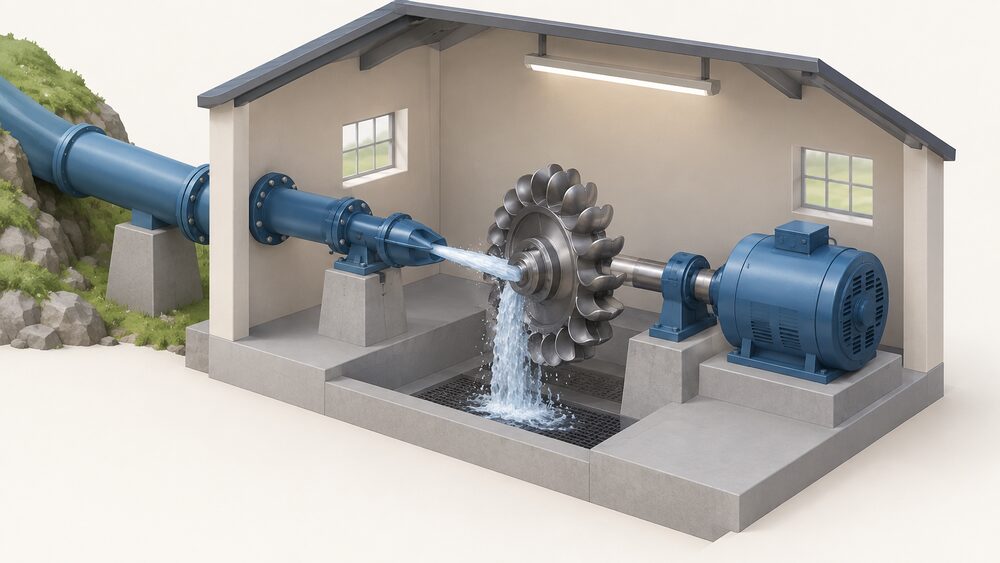
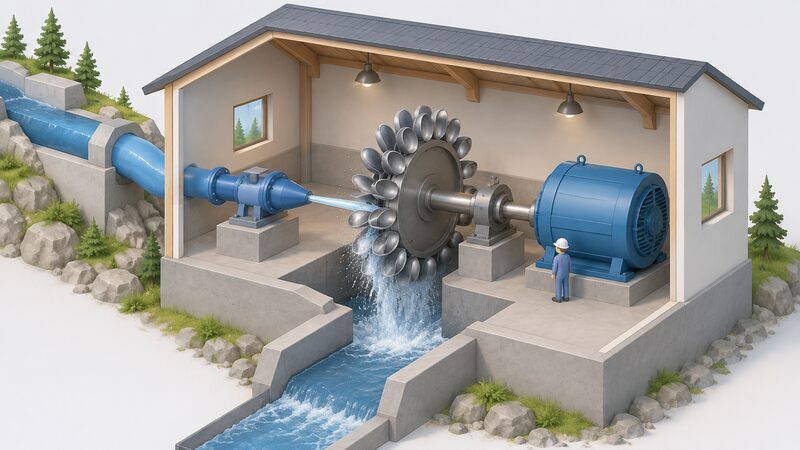
The distinction matters for a household because it determines what kind of stream is worth pursuing. A Pelton takes water from a height, directs it through a nozzle as a high-speed jet, and aims that jet at buckets around the rim of a wheel. The wheel spins, the shaft turns a generator, and the water drops away below. Nothing about the machine requires a large river; it requires a fall. That is why the same turbine type appears on upland streams in Wales, Scotland and the Pennines, and on estate and community schemes where a steep drop is available.
Gilkes has been making this kind of machine for well over a century, and its turbines have been installed on sites ranging from small domestic schemes to large public infrastructure. The company's track record is the reason its name comes up first in UK hydro enquiries, and it is also why second-hand and refurbished Gilkes machines circulate among community groups. For a householder, the practical point is that the maker is UK-based, which shortens the supply chain for parts and service compared with an imported machine.
Why a Pelton turbine suits a high-head site
The Pelton's advantage is that it converts a small volume of water falling a long way into useful power. Independent guidance is specific about the threshold: you usually need a drop of over 10 metres for a higher head turbine to be viable1. Below that, the physics works against an impulse turbine, and a low-head design such as a crossflow or Archimedes screw becomes the sensible option, at the cost of a much larger machine for the same output.
Head and flow together decide what a site can produce. The viability of the installation will depend on whether there is enough water flowing per second and the height or 'head' that it falls from5. A Pelton can work with a modest flow if the head is generous, because the energy comes from the fall. A site with a large flow and almost no head is the opposite case, and it is the one where a Pelton is the wrong tool.
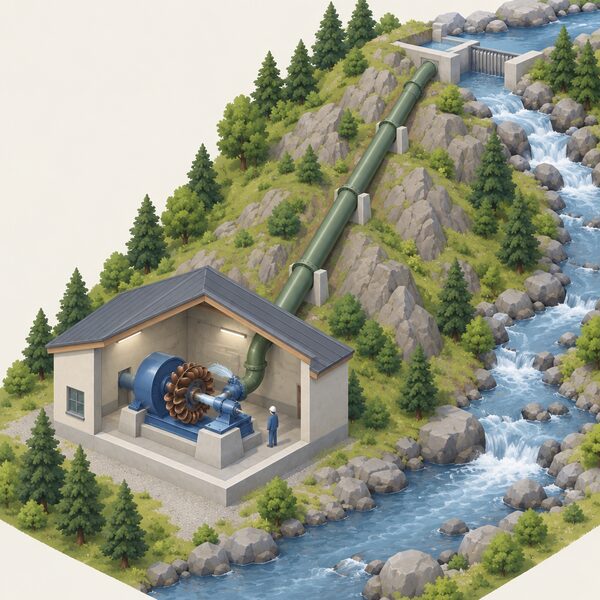
There is a second reason the design suits upland sites. A Pelton turbine sits in a powerhouse at the bottom of the fall, fed by a penstock pipe, rather than being exposed in the stream itself. That keeps the working parts out of the weather and out of the watercourse, which simplifies screening and fish protection and reduces wear. The environmental and licensing requirements still apply, and they are covered in more detail on hydro environmental requirements and water abstraction licences.
For a household weighing up a site, the head is the first thing to establish, because it decides whether a Pelton is even in the running. The companion page on head and flow sets out how the two are measured and combined.
How a Pelton turbine handles fluctuating flow
Streams are not constant. A upland burn can run at several times its summer flow after rain, then drop to a trickle in a dry spell. This is where the Pelton design earns its place: Pelton and Turgo turbines are described as working well in fluctuating flow1. The jet can be adjusted as the available water changes, so the machine keeps turning across a wide range of conditions rather than stalling when the stream drops.
That tolerance is not the same as indifference. A scheme is sized around a design flow, and the turbine produces its rated output only when at least that much water is available. Above the design flow, excess water is spilled or diverted; below it, output falls away. The practical consequence for a household is that annual generation depends on how often the stream runs at or above the design figure, not on the peak. The companion page on run-of-river load factor explains how much of the year a scheme typically runs at full power.
There is a wider point about reliability. For houses with no mains connection but with access to a micro hydro site, a good hydro system can generate a steady, more reliable electricity supply than other renewable technologies at a lower cost2. That steadiness comes precisely from the fact that a stream, unlike wind or sun, is always doing something. A Pelton that can follow the flow captures more of that than a fixed-geometry turbine would.
Where a site has both a stream and wind potential, the two can complement each other, and the comparison is set out on micro hydro vs micro wind. For a stream whose flow varies sharply, the alternative turbine types are compared on Pelton vs crossflow.
Cost and installation: comparatively cheap and easy to install
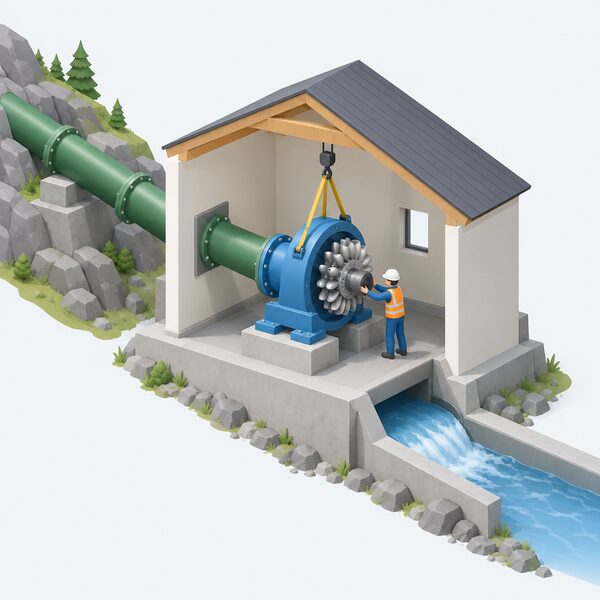
The headline cost figure for micro hydro is high, and it is worth stating plainly. Independent guidance puts the total cost at between £5,000 and £10,000 per kilowatt if professionally installed1. A typical domestic scheme of a few kilowatts therefore runs into tens of thousands of pounds, and the turbine itself is only part of that. The civil works, the penstock, the intake, the powerhouse and the grid connection usually account for the majority.
Within that, the Pelton design is the cheaper end of the turbine market. Pelton and Turgo turbines are described as comparatively cheap, easy to install and well suited to fluctuating flow1. The reason is partly mechanical: an impulse turbine is a relatively simple machine with few moving parts, and it does not need the large civil structure that a low-head screw or crossflow installation demands.
Running costs are modest. Running and maintenance costs are low for hydroelectricity systems3, and maintenance checks are necessary every few years6. That is a different profile from wind, where servicing is a recurring annual item. The long life of a hydro scheme, 40 to 50 years or longer if well maintained3, spreads the capital cost over a period that no other domestic renewable technology matches.
On tax, water turbines qualify for a lower rate of VAT, in Great Britain only4. The same relief is written into the energy-saving materials legislation, which lists water turbines among the qualifying materials7. Northern Ireland sits outside that particular VAT treatment, so a household there should expect the standard rate. Wider funding routes are covered on grants for wind, hydro and micro-CHP, and the full cost picture is on micro hydro cost.
| Item | Figure | Source basis |
|---|---|---|
| Installed cost | £5,000 to £10,000 per kW | Independent guidance1 |
| Turbine type cost | Comparatively cheap, easy to install | Independent guidance1 |
| Running and maintenance | Low | Independent guidance3 |
| Lifespan | 40 to 50 years or longer | Independent guidance3 |
| VAT | Lower rate, Great Britain only | Official guidance4 |
Gilkes in the UK: a long track record, from Balmoral in 1927
Gilkes has been installing turbines in the UK for more than a century, and one of the earliest surviving examples is at the highest level of the British establishment. Gilkes installed a turbine on Balmoral Estate in 1927. That installation is still cited as a case study, and it illustrates the durability that hydro schemes are known for: a machine fitted in the 1920s is still part of the conversation about the technology today.
The company's longevity matters for a household in a practical way. A turbine is a long-lived asset, and the maker's continued existence is part of what makes it serviceable. Hydro systems have few moving parts and low running costs3, but parts still wear, and a UK manufacturer with a century of records is a different proposition from a firm that has come and gone. The contrast with the domestic wind sector, where several makers have failed, is covered on Proven Energy and Evance.
Hydro's place in the national picture is small but established. Hydro accounted for 1.75% of UK electricity generation in 1990, the earliest year in the published series8. That figure covers all hydro, from large stations to micro schemes, and it shows the technology has been a steady if modest contributor for decades rather than a new arrival.
For community groups, the Gilkes name carries particular weight, because a scheme that will run for half a century needs a machine with a service history behind it. The wider context for shared schemes is on community wind and hydro schemes.
What owning a Gilkes turbine means for household energy independence
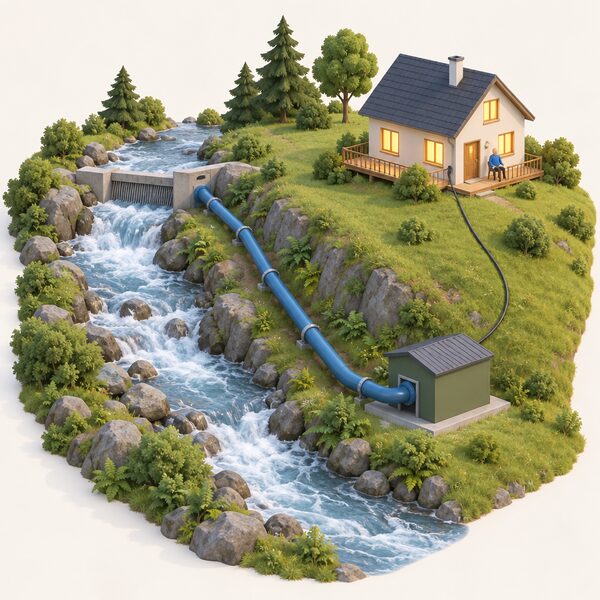
A hydro turbine changes a household's relationship with energy more completely than almost any other domestic technology. For houses with no mains connection but with access to a micro hydro site, a good hydro system can generate a steady, more reliable electricity supply than other renewable technologies at a lower cost2. That is the strongest form of independence available: a property that generates its own power continuously, day and night, through the seasons.
Even for a grid-connected home, the effect is substantial. Renewable energy technologies help you to meet your own energy requirements and reduce your home's carbon dioxide emissions9. They also reduce your reliance on fossil fuels such as gas and oil and therefore reduce your fuel bills and carbon emissions10. A hydro scheme does this with a fuel that arrives free and does not need to be bought, stored or delivered.
The dependence that remains is worth stating as clearly as the benefit. A grid-connected hydro scheme still relies on the network for backup and for export, and on a supplier for the periods when generation falls short. The connection itself is a regulated process, covered on G98 and G99, and in Northern Ireland on grid connection in Northern Ireland. Export payments depend on a supplier and a meter, and the routes are set out on exporting electricity.
There is also a dependence on the water itself, and on the permissions to use it. A scheme needs an abstraction licence and, in most cases, environmental checks, both of which are covered on water abstraction licences and hydro environmental requirements. Those permissions can be varied or reviewed, so the household's independence is bounded by a regulatory relationship as well as by the stream. The broader picture is on microgeneration and energy independence.
"For houses with no mains connection but with access to a micro hydro site, a good hydro system can generate a steady, more reliable electricity supply than other renewable technologies at a lower cost."
Is a Gilkes turbine right for your site: what to check
The first check is the head. You usually need a drop of over 10 metres for a higher head turbine to be viable1, so a site with less fall than that is not a Pelton site, whatever the flow. The second is the flow: the viability of the installation will depend on whether there is enough water flowing per second and the height or 'head' that it falls from5. Both figures need measuring rather than estimating, and the companion page on head and flow explains how.
The third check is permission. Always check with your Local Planning Authority about planning issues before you have a system installed11. Planning guidance for England notes that policy in Wales may differ11, so a household in Wales, Scotland or Northern Ireland should confirm the position with the relevant authority rather than assume the English route applies. Building regulations also apply to other aspects of the work such as electrical installation12, and the electrical side is covered on microgeneration electrical safety.
The fourth check is the connection. A generator that will run in parallel with the grid needs to be notified or approved by the network operator, and the process differs by area. Electricity North West, for example, asks for notification by a completed ENA form sent to G98Notifications@enwl.co.uk for the connect and notify route, or an application to domesticlct@enwl.co.uk for the apply to connect route13. The full process is on G98 and G99.
Finally, the practicalities of the site itself. A hydro scheme needs a route for the penstock, a place for the powerhouse, and access for the machinery that will dig and lay the pipe. Those civil works, not the turbine, usually decide whether a scheme is feasible and what it costs. The installation and maintenance picture is set out on micro hydro installation and maintenance, and the project timeline on micro hydro project timeline.
Sources13 cited
- Micro hydro, Centre for Alternative Technology, 2025-07-01
- Hydroelectricity, Planning Portal, 2026
- Hydroelectricity, Home Energy Scotland, 2026-09-20
- Tax on shopping: energy-saving products, GOV.UK, 2026-09-17
- Hydropower, nidirect, 2026-09-17
- Wind turbines, Home Energy Scotland, 2026-09-20
- Energy-saving materials legislation, legislation.gov.uk, 2026-09-17
- Energy statistics, Uswitch, 2025-12-17
- Home energy generation, Planning Portal, 2026
- Renewable energy, Carmarthenshire County Council, 2025-07-01
- Wind turbines: planning permission, Planning Portal, 2026-09-17
- Wind turbines: building regulations, Planning Portal, 2026
- Heat pump connections, Electricity North West, 2026-09-19