
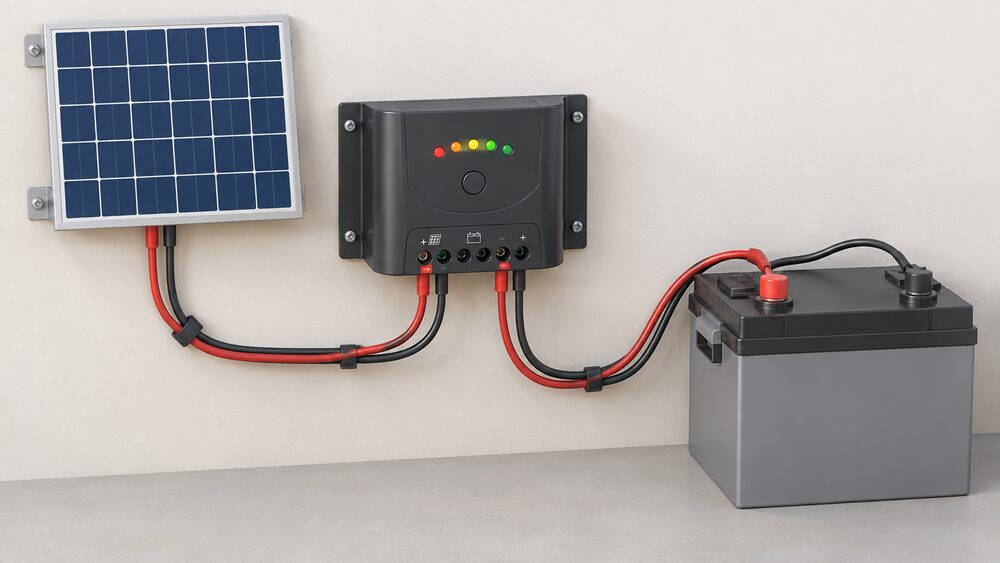
In this guide
Steca is a German electronics manufacturer whose solar products reach UK households mainly as charge controllers and solar thermal control gear, rather than as panels or inverters. The best documented unit in the UK supply chain is the Steca Solarix PRS, a solar charge controller with automatic 12/24 V battery voltage detection, a 5 year warranty and a state-of-charge display made up of several LEDs in various colours1.
That combination matters for a household because a charge controller is the component that decides how much of a panel's output reaches a battery and when. It regulates power from the panels into the battery and blocks reverse current at night, so the battery is not drained back through the array after dark2. On a solar thermal system, the equivalent role is played by a control panel that sits alongside the collectors, circulation pump, storage cylinder and heat exchangers as part of the associated equipment of the installation3.
Steca therefore occupies a narrow but load-bearing position in a home energy setup: it is the electronics layer, not the generation layer. A household that owns a Steca controller is dependent on the panel and battery it is matched to, on the installer or distributor who supplied it, and on a German manufacturer's documentation for settings and fault interpretation. What it does not create is a dependence on a cloud service or an app, because the Solarix PRS reports through local LEDs rather than a network connection1.
What Steca makes for solar systems
Steca's solar output divides into two families that serve different jobs. The first is charge regulation for battery-based systems, where the Solarix PRS is the model documented for UK sale. It is a solar charge controller in the ordinary sense: it manages the flow of power from an array into a battery bank, and it carries a 5 year warranty1.
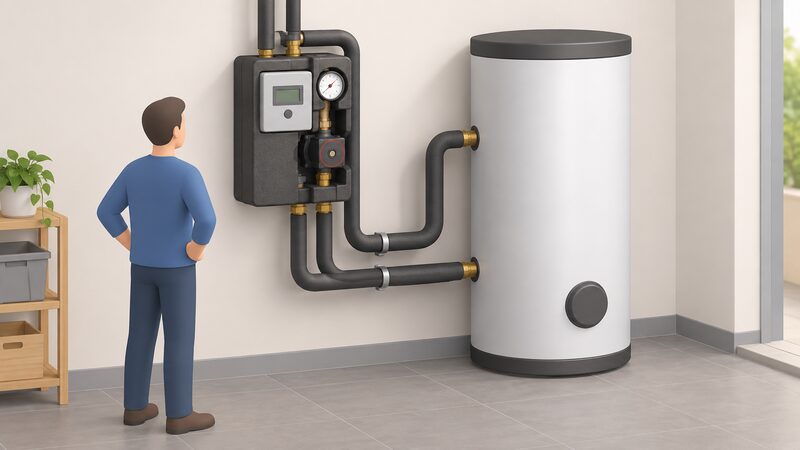
The second is control electronics for solar thermal installations. A solar thermal system is not just collectors. Official guidance describes solar collectors, such as evacuated tube or flat plate systems, together with associated pipework and equipment, such as circulation systems, pump, storage cylinder, control panel and heat exchangers3. The control panel in that list is the part that decides when the pump runs, comparing collector temperature with cylinder temperature. That is the role Steca's thermal controllers fill, and it is a different product from a battery charge controller even where the two share a maker.
Monitoring sits between the two. The Solarix PRS reports battery state through several LEDs in various colours rather than through a screen or an app1. On the wider system, the modern pattern is solar panels on the roof, a battery, and intelligent controls to manage the system4, and a charge controller is the piece of that architecture that sits closest to the battery.
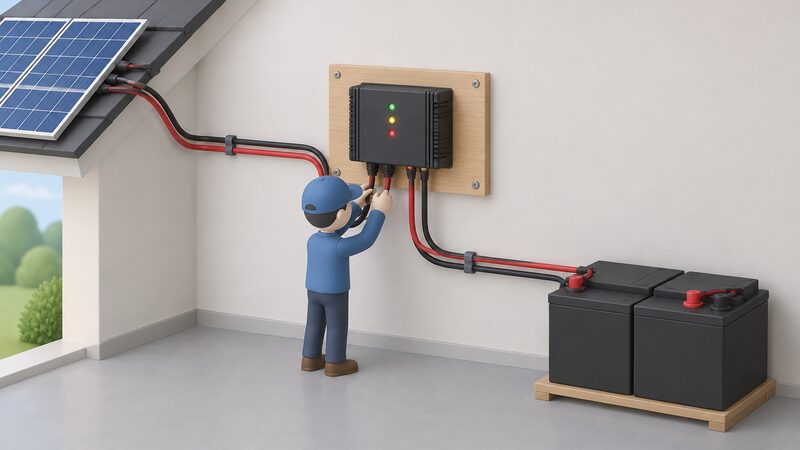
Where a Steca controller sits in a home solar setup
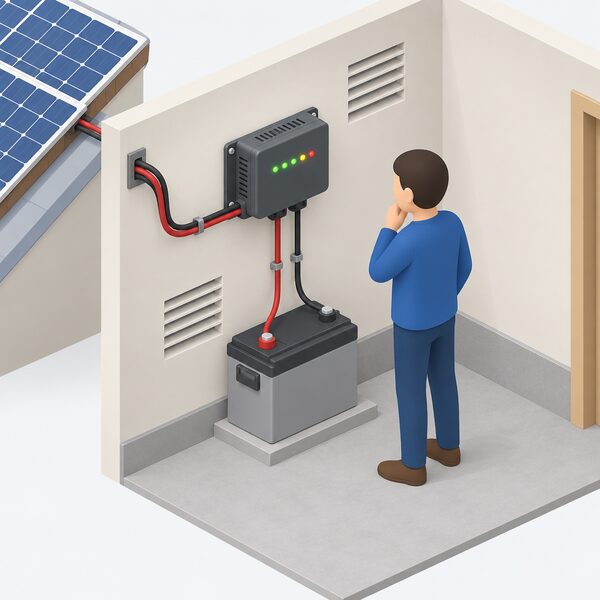
In a battery-based system the controller sits between the array and the battery, and everything downstream depends on it. Its two jobs are to regulate how much power goes from the solar panels into the battery and to block reverse current at night2. A controller that fails open leaves a battery exposed to overcharge; one that fails closed leaves the household without charging.
The position of the controller also determines what the household can and cannot see. Because the Solarix PRS signals through LEDs, the information available at the unit is a state-of-charge indication rather than a logged history1. Households wanting consumption and generation records generally get those from an inverter or a monitoring platform instead, which is a separate layer of the system.
For solar thermal, the controller's position is in the pump station rather than the battery circuit. The control panel forms part of the associated equipment of the collector installation, alongside the circulation system, pump, storage cylinder and heat exchangers3. It is mains-powered control gear, not a DC device, and it does not interact with a PV charge controller at all.
Siting matters in both cases. Guidance for plug-in solar kits includes a section on where to put the kit5, and the same logic applies to a controller: it needs ventilation, accessible terminals and a position where the LED indications can actually be read. A controller mounted out of sight behind a battery bank is functionally harder to diagnose.
Steca and battery storage: the MyReserve Matrix declaration
Steca's involvement in battery storage is documented through a compatibility declaration rather than a product of its own. In November 2018 Steca Elektronik GmbH confirmed that specified Steca coolcept and coolcept fleX inverter series may be used with the SOLARWATT MyReserve Matrix storage system. That is a manufacturer declaration of interoperability between two companies' products, and it applies to those named inverter series, not to the Solarix charge controller range.
The wider point for a household is that compatibility is not automatic. Independent guidance is to make sure to check that your chosen battery storage is compatible with your existing or potential solar panel setup6. Battery storage can be added to existing solar panels to maximise the benefits of your system7, and storage systems can store energy generated by renewable technology like solar panels8. A solar PV system can be paired with a battery storage system to store excess electricity for when you most need it9.
Where a battery is retrofitted, the tax position is settled. Electrical storage batteries are included within the list of energy-saving materials10, and the relief covers the retrofitting of a battery for storing electricity generated by one or more qualifying energy-saving materials11. Battery storage retrofitted to a solar panel or other energy-saving materials should be included in the relief12. Battery storage installations are also covered by added guidance under ECO413.
What a controller actually regulates
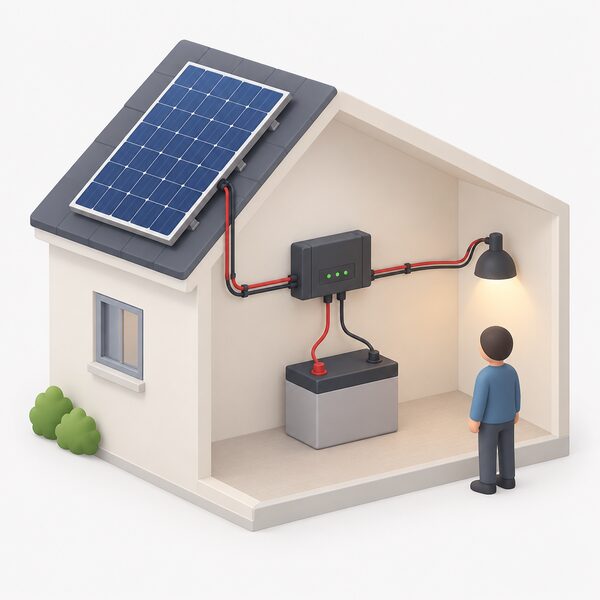
A charge controller's core function is regulation of current into the battery, and the way it does that depends on its type. A PWM controller regulates the flow of electricity by sending short, rapid pulses from the solar panel to the battery, shortening the pulses as the battery nears full charge2. An MPPT controller constantly adjusts the voltage and current coming from the solar panel to find the combination that delivers the most power, converting excess panel voltage into extra charging current2.
The charging sequence is common to both. As the battery fills, the controller transitions from bulk to absorption mode, tapering current as the battery voltage plateaus, and then to a float or trickle-charge stage to counteract self-discharge2. That final stage is what keeps a battery healthy through long periods of low generation.
Protection is the other half of the job. Blocking reverse current at night stops the battery discharging back through the panels2. The Solarix PRS adds automatic load reconnection, meaning the load output is restored automatically once conditions allow rather than needing a manual intervention1. That matters on a remote or unattended installation where nobody is present to reset a latched output.
The comparison with other control electronics is instructive. A modern storage heater's automatic charge control works out how much electricity it needs to store to meet that programme and only uses the amount of electrical charge it needs14. A solar charge controller is doing the same kind of calculation, but against an unpredictable generation profile rather than a fixed off-peak window.
Sizing and matching a controller to panel and battery
The sizing rule is the single most useful number for anyone specifying a controller. Check your panel's short-circuit current (Isc) and choose a controller with at least 25% more capacity. For example, if a panel has an 8A Isc, the controller needs to be rated for at least 10A2. The margin exists because short-circuit current rises above its rated value in cold, bright conditions.
Voltage matching is the second constraint. The Solarix PRS handles this itself through automatic 12/24 V battery voltage detection1, so a household moving from a 12 V to a 24 V bank does not need to reconfigure the controller. What still has to be checked is that the array's open-circuit voltage stays within the controller's maximum input, and that the total array current stays within the rating derived from the 25% rule.
The published figures for one Steca model disagree. The Steca Solsum 10.10F is listed with a maximum solar panel rating of 120W or 10A on one maker product page and 240W or 10A on another, both dated 2026-08-26. For that model the rating should be confirmed with the supplier before it is matched to an array.
| Parameter | What to check | Basis |
|---|---|---|
| Controller current rating | At least 25% above panel Isc | 8A Isc needs at least 10A2 |
| Battery bank voltage | Automatic 12/24 V detection on Solarix PRS | No manual setting needed1 |
| Array open-circuit voltage | Within controller maximum input | Confirm against model datasheet |
| Load output behaviour | Automatic load reconnection | Restores load without manual reset1 |
| Warranty term | 5 years on Solarix PRS | Maker product page1 |
Steca in the UK: availability, support and documentation
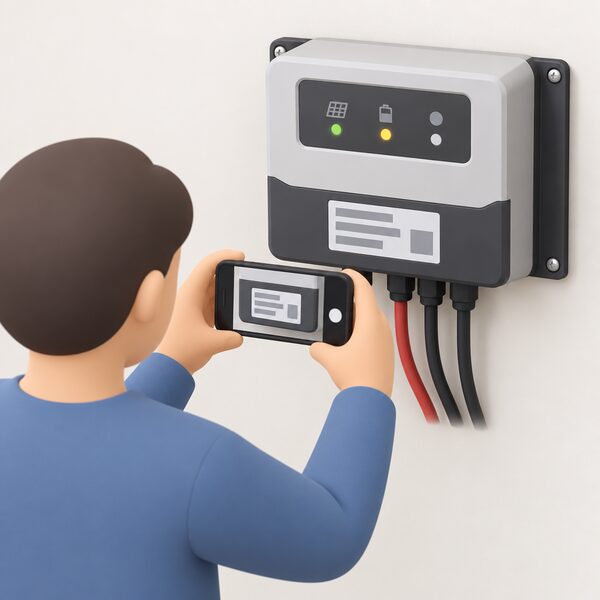
Steca equipment reaches UK households through specialist distributors and installers rather than a direct consumer channel. The Solarix PRS is listed by a UK distributor with its warranty term, voltage detection and LED indication set out on the product page1. There is no UK consumer support line documented for Steca in the material reviewed here, so the practical route for warranty and technical queries runs through whoever supplied the unit.
That pattern is normal for component-level solar electronics. Comparable UK schemes require inverter product registrations to activate guarantees and warranties to be completed within 48 hours of commissioning15, which shows how tightly registration is tied to the installer rather than the householder. For plug-in solar products, some UK sellers provide a customer query contact form as the support route5.
Documentation is the other half of availability. UK product rules for plug-in solar devices require a serial number, a code or other marking to ensure that the user can clearly identify the device16. The Solarix PRS carries a product marking and an HS code of 90328900 on its listing1. Keeping a photograph of that marking, and of the commissioning date, is what makes a later warranty claim possible.
The wider UK context is one of rapid growth in small-scale solar. Monthly deployment of solar photovoltaic capacity in the United Kingdom is tracked in official statistics17, and plug-in solar panels are available to buy in the UK18. UKSOL plug-in solar kits are also available online at Argos19, and plug-in solar panels are expected to be available in shops within months20. All plug-in solar equipment supplied for use in the UK would be required to comply with the specifications set out in the interim product specification21.
What owning a Steca controller means for household energy independence
A charge controller is one of the few components in a home solar system that increases independence rather than reducing it. It has no cloud dependency, no app requirement and no subscription. The Solarix PRS reports through local LEDs1, so the household can read battery state without a broadband connection, a manufacturer's server or a third-party platform being available.
What dependence remains is physical and commercial. The controller is matched to a specific array and battery, so replacing either means re-checking the 25% current margin and the voltage window2. The 5 year warranty runs through the supplier1, and there is no documented direct UK support route. Spare parts and replacements come through the same distribution channel.
For solar thermal, the controller is part of a system that also includes collectors, a pump, a cylinder and heat exchangers3, and it is mains-powered. That means a thermal controller keeps a household tied to the electricity grid for pumping, even though the heat itself is collected on the roof. Coupling a solar collector with a heat pump is one route that changes the balance, but it does not remove the electrical demand of the circulation.
The comparison with grid-tied PV is worth stating plainly. A grid-connected system requires registration with the distribution network operator, usually done by the installer22, and inverter faults are commonly traced to grid voltage mismatch23. A battery-based system with a Steca controller sits outside that arrangement entirely: it charges a battery, serves a load, and does not export. That is a genuine independence gain, and it comes with the loss of export payments and the loss of grid backup for the loads it serves.
Sources23 cited
- Steca Solarix PRS charge controller, Wind & Sun, 2026-09-20
- Solar charge controller guide, EcoFlow, 2025-05-07
- VAT on energy saving materials: solar collectors, HM Revenue & Customs, 2026-09-17
- Batteries in the home, Solar Energy UK, 2026-09-17
- UKSOL customer guide, UKSOL, 2026-09-17
- Battery storage, MCS Certified, 2026-09-17
- Switch Together Birmingham: buying solar panels and battery storage, Birmingham City Council, 2026-01-27
- Storing energy, Energy Saving Trust, 2026-07-15
- Solar photovoltaic (PV), MCS Certified, 2026-07-30
- VAT Act 1994, Schedule 7A, Part 2, Chapter 2, legislation.gov.uk, 2026-09-17
- VAT on energy saving materials: batteries, HM Revenue & Customs, 2026-09-17
- Response to the Treasury's consultation on VAT relief for energy saving materials, Energy Saving Trust, 2025-10-08
- Summary of updates to ECO4 delivery guidance and measures table, Ofgem, 2025-08-07
- Electric storage heaters, Energy Saving Trust, 2026-05-20
- Barcud Solar Panel Installation Scheme Specification, Sell2Wales, 2026-06-15
- Plug-in solar interim product specification (withdrawn), Department for Energy Security and Net Zero, 2026-06
- Solar PV deployment: December 2026, Department for Energy Security and Net Zero, 2026-01-06
- Plug-in solar panels, Electrical Safety First, 2026-09-17
- Plug-in solar panels review, Which?, 2026-09-15
- Britain continues to break clean power records, Department for Energy Security and Net Zero, 2026-05-28
- Plug-in solar consultation document, Department for Energy Security and Net Zero, 2026-06-16
- Solar panels, London Borough of Hammersmith & Fulham, 2026-09-17
- Managing voltage changes in your property, Electricity North West, 2026-09-19