
In this guide
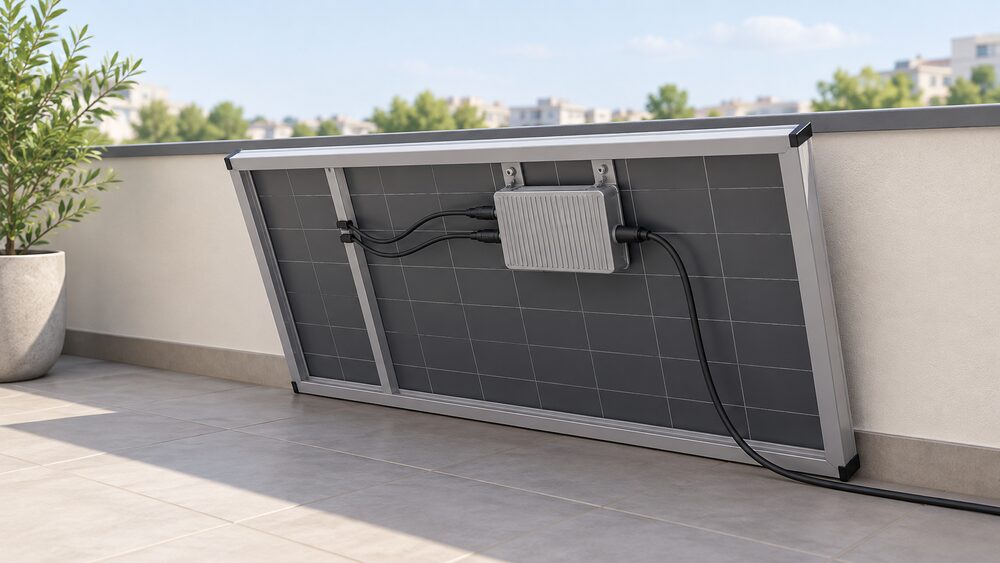
A Marstek microinverter is a small box that mounts with a solar panel and converts that panel's direct current into the alternating current a UK home uses. The M2-800 is the unit most often sold into balcony and plug-in kits: 800 W of AC output, two panel inputs, integrated WiFi and a 10 year manufacturer warranty1. It is bought directly, usually as part of a kit, rather than specified by an installer.
That places it in a different category from a rooftop string inverter. A microinverter works at panel level, so each panel has its own conversion electronics and its own maximum power point tracking. The trade body guidance is that microinverters and power optimisers separate panels so that a single panel failure does not affect the whole system, at the cost of a higher price3. For a two-panel balcony that trade is small; for a large roof it is not.
The independence question is straightforward and worth stating at the outset. An M2-800 keeps a household on the grid and on a supplier. It is grid-tied, so it shuts down when the grid goes down, and it has no battery of its own. What it does offer is generation without an installer, without a roof survey and without a contract, plus panel-level visibility of what each panel is producing.
What a microinverter does, and why it matters for balcony solar
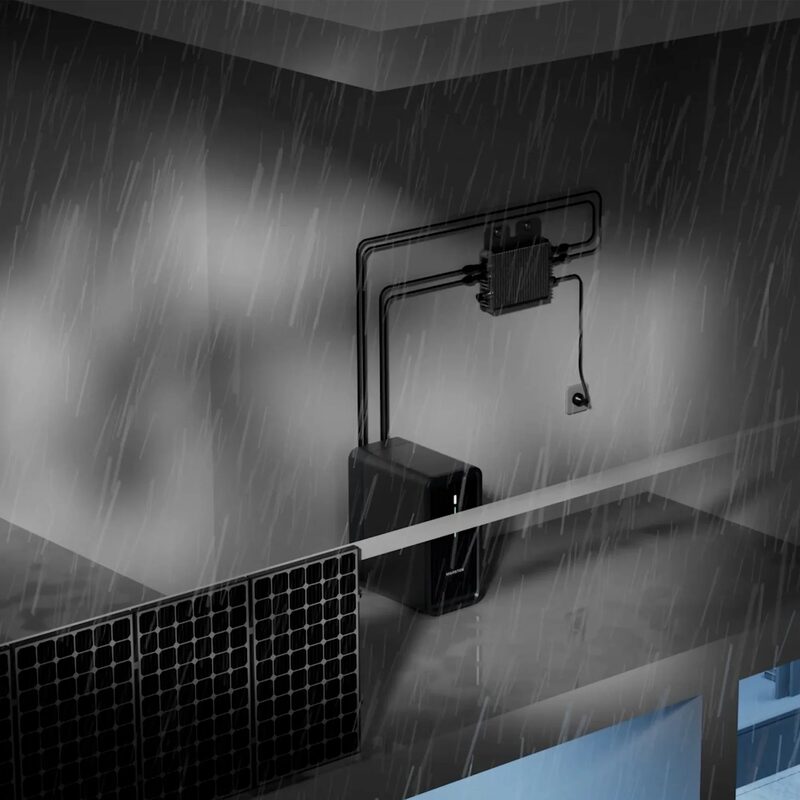
A microinverter converts the electricity generated by the solar panels into the type of electricity used in UK homes6. It does this at the panel rather than at a central box on a wall, converting an individual panel's DC electricity into AC on the roof7. The practical consequence is that the high-voltage DC wiring that runs across a roof in a string system is largely absent, because conversion happens at module level8.
For a balcony installation this matters more than it does on a roof. A balcony array is typically two panels at most, often at a shallow angle, often against a wall, and frequently shaded for part of the day by the building itself or by the balcony above. A string inverter would take the weakest panel's output as the benchmark for both. A microinverter tracks each panel separately using Maximum Power Point Tracking, commonly called MPPT8. The maker guidance is explicit that microinverters are not necessarily better in terms of peak DC-to-AC conversion efficiency, but can produce more usable energy over time when panels experience different shading, orientations or operating conditions9.
The conditions where microinverters are worth considering are listed as multiple roof orientations, partial shading, mixed panels, small installations, phased expansion, panel-level monitoring or module-level AC conversion8. A balcony setup usually meets three or four of those at once. The same guidance notes the disadvantages: higher upfront cost, a larger number of rooftop electronic components, and the labour required to reach a failed unit beneath a panel9. On a balcony at waist height, that last point is far less serious than it is on a pitched roof.
The M2-800: output and specifications
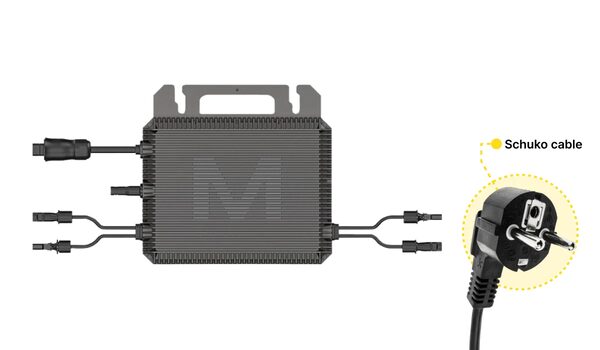
The headline figure is 800 W of AC output, repeated across the maker's product listings for the unit and for the kits built around it1. That output is the ceiling the unit will deliver to the home, and it is the number that determines how the installation sits against the connection rules discussed below.
| Specification | M2-800 |
|---|---|
| AC output | 800 W1 |
| Recommended panel power | 400 to 500 W per panel4 |
| Panel inputs | Two panels2 |
| Monitoring | Integrated WiFi, real-time via app4 |
| Warranty | 10 years, manufacturer1 |
The recommended panel power of 400 to 500 W per input is the figure that matters when matching modules. Two 450 W panels sit inside that band. The maker states the M2-800 can be connected to two solar panels2, and the larger Marstek M4-2000 is listed as accepting up to four panels10. For a household wanting more than two panels on one unit, the M4-2000 is the maker's own answer rather than a second M2-800.
For comparison, an 800 W smart microinverter from another maker is listed with a maximum continuous output of 799 VA, two independent MPPT channels and a 230 V AC output voltage11. The 800 W class is a common size, and the M2-800 sits within it rather than above it.
Efficiency: 96 to 97% across the class
The wider class sits in a narrow band. Modern microinverters achieve efficiency ratings of 96 to 97%12, and one maker's guidance puts microinverter efficiency slightly lower at 95 to 97%13. A single-phase string inverter from the same stable is quoted at 98.3% peak and 97.8% European efficiency13, which is the honest comparison: a string inverter is usually a little more efficient at peak, and a microinverter can recover more over a year when panels are shaded or facing different ways9.
What that means in a UK balcony setting is that the conversion loss is not the limiting factor. Orientation, tilt, shading and the number of daylight hours are. A balcony panel at a shallow angle against a wall will lose far more to geometry than the inverter loses in conversion. The efficiency figure is worth knowing, but it is not where the output goes.
Compatibility: which panels and setups it works with
The M2-800 takes two panels at 400 to 500 W each4. That is the compatibility envelope, and it is narrow enough to check before buying modules. Panels outside that band are not covered by the maker's recommendation, whatever their physical fit.
The wider Marstek ecosystem is built around the same connection point. The Saturn C battery is described as connecting to the microinverter14, and the Venus A is listed as including a microinverter in the main unit15. The Venus A expansion battery is a separate unit16. The Smart Meter is described as helping the battery decide when to store or release energy, and as monitoring consumption in real time17. The Smart Box is listed as preventing surplus energy from being injected into the grid18.
That last function is the one that changes the compliance picture. A grid-tied microinverter exports surplus automatically unless something prevents it19, and a zero-export device is what prevents it. For a household that wants to avoid export entirely, the Smart Box is the component that does it.
Microinverters are generally paired with AC-coupled storage rather than DC-coupled batteries, which limits battery architecture choices9. The Marstek range follows that pattern: the battery sits on the AC side, and the microinverter does not manage it directly.
Warranty and registration
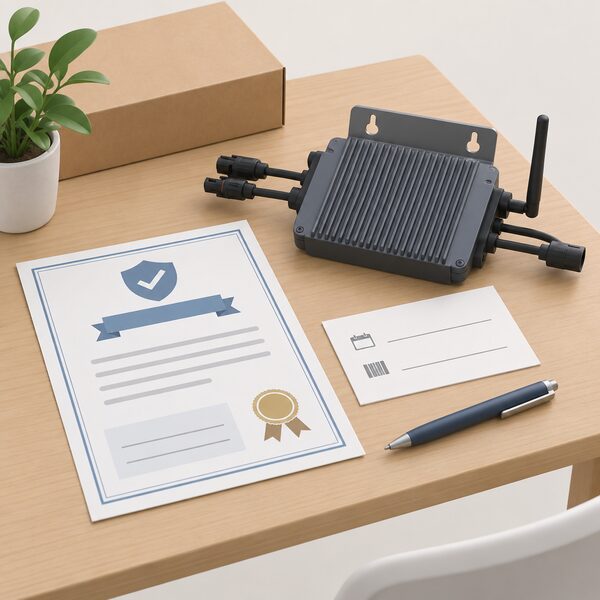
The M2-800 carries a 10 year manufacturer warranty1. That is a mid-range term for the category. Microinverters often have longer product warranties than string inverters9, and the industry standard is quoted at 15 to 25 years12, with one maker offering up to 25 years20 and another a 25 year limited period running from the date of the bill of lading21. Against those, 10 years is at the shorter end.
Registration practice varies by maker. One microinverter series requires users to register their system online via WiFi to be eligible for the product warranty22. The M2-800 is supplied with integrated WiFi and monitoring4, so the connection needed for registration is present in the unit. Where a scheme sets a deadline, it can be tight: one official scheme specification requires inverter product registrations to activate guarantees and warranties to be completed within 48 hours of commissioning23.
Cost and what you get in the box
There is no published UK list price for the M2-800 on its own. It is sold as a component of kits, and the maker's kit listings describe the contents rather than a standalone price. The Performance Basic kit includes one Marstek M2-800 microinverter with integrated WiFi and real-time monitoring24, and the Performance 800 Wall kit lists the same single microinverter2. The Performance kit lists one M2-800 with integrated WiFi and real-time monitoring among its contents25.
For a sense of what microinverter hardware costs in the UK, distributor listings for a competing brand run from £105.32 ex VAT for one model to £141.78 inc VAT for another, with several models out of stock at the time of listing26. Those are component prices for a different maker and a different output class, not a Marstek price, and they should be read as an indication of the hardware's order of magnitude only.
What comes in the box for the M2-800 itself is the inverter with integrated WiFi. The wider Marstek accessory range is bought separately: the Smart Meter, the Smart Box, the Saturn C battery and the Venus A expansion battery are all distinct products14. A household pricing a full setup should price the inverter, the panels, the mounting and any of those accessories separately.
Installation on a balcony or flat roof: what is involved
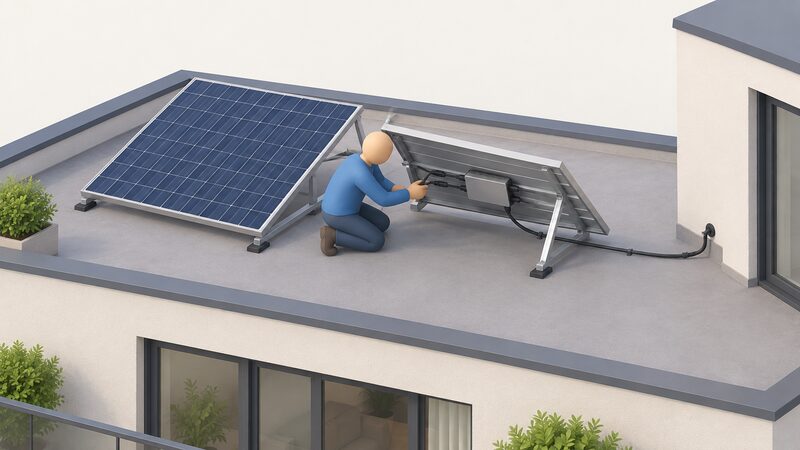
A microinverter is panel-level equipment, installed on the roof or, in this case, at the panel5. The maker's Smart Box is listed as supporting roof, balcony or garden solar kit types18, which reflects where these systems actually go.
The installation itself is a mounting job rather than a wiring job. The inverter fixes to the panel frame or the mounting rail, the panel leads plug into it, and the AC output goes to the property's supply. One maker describes a comparable balcony system as plugging into a socket with easy installation27, and another lists plug-and-play compatibility for 99% of market solar panels28. The M2-800's own kit listings describe it as supplied with the kit rather than as a separate installation task2.
The maintenance consideration is the one to weigh. Repairing a microinverter may require roof access and panel removal9, and roof access is listed among the requirements for microinverter maintenance5. On a balcony or a flat roof at accessible height, that is a modest matter. On a pitched roof it is not, and it is the main reason microinverters are less common on large UK roofs than string inverters.
Grid connection: G98 and the 16 A threshold
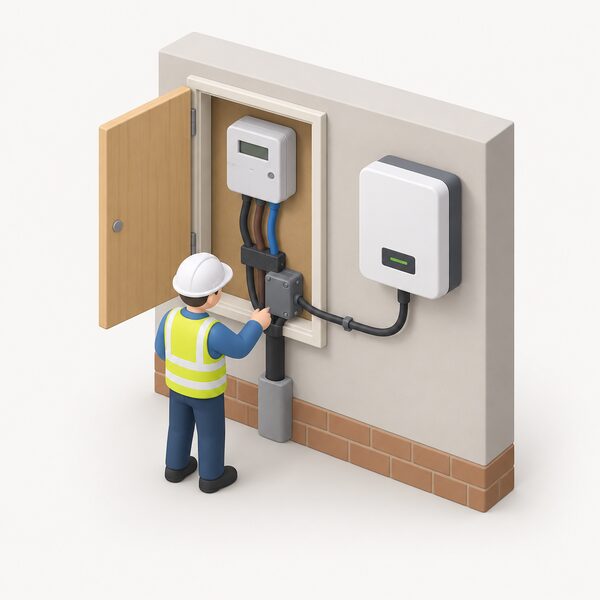
G98 is the connection procedure for fully type tested micro-generation installations under 16 A per phase, installed on a fit and notify basis23. The full title is Requirements for the connection of Fully Type Tested Micro-generators (up to and including 16 A per phase) in parallel with public Low Voltage Distribution Networks29. An 800 W inverter sits well inside that threshold.
In Northern Ireland the position is stated separately: the equipment must comply with the requirements of the G98/NI recommendations28. Above the threshold the rules change, and connections likely to exceed 16 A per phase fall under G99 instead29.
The M2-800's kit listing states that no smart plug is needed4. That is a statement about the kit's own requirements, not a statement that the installation is exempt from connection rules. The two are different questions, and the second is answered by the network operator.
Monitoring, faults and what the app depends on
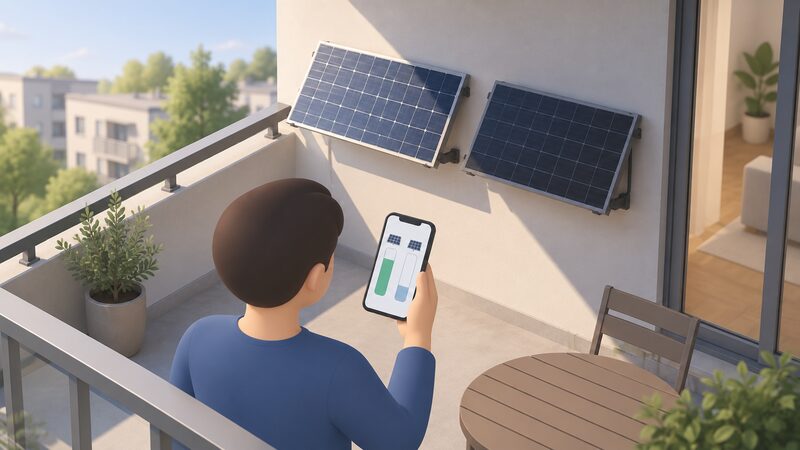
The M2-800 is supplied with integrated WiFi and the maker describes real-time production monitoring through its app4. Microinverters usually provide panel-level monitoring, which makes underperforming panels easier to identify9. The Venus A listing describes supervising production, consumption, storage and savings from the Marstek mobile app15, and the M4-2000 lists real-time production monitoring10.
That monitoring is a cloud service. It depends on a working home broadband connection, the maker's servers and the maker's app. Local generation continues without any of them, but the visibility does not. This is the clearest dependence the product creates beyond the grid itself.
On faults, the behaviour to understand is anti-islanding. Grid-tied microinverters shut down when the grid fails20, and most do so as a matter of course20. One maker states that for safety reasons the microinverter stops power output immediately upon detecting a grid outage and does not supply power during an outage19. Some systems use micro-inverters or power-optimisers to limit power generation when a fault develops3. If the app goes quiet while the property still has power, the fault is more likely in the WiFi link or the service than in the panel.
What owning a Marstek microinverter means for household energy independence
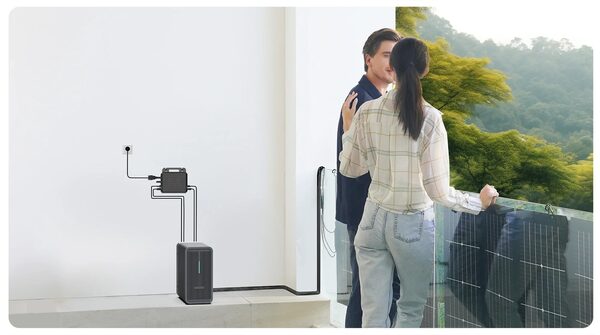
The honest position is that an M2-800 delivers partial independence and leaves most dependence intact. It removes the installer, the roof survey and the contract from the process of generating electricity. It does not remove the grid, the supplier or the meter.
The unit is grid-tied. Surplus is exported automatically unless a device prevents it19, and the Marstek Smart Box is listed as preventing exactly that18. It has no battery of its own: microinverter systems are generally paired with AC-coupled storage9, and the Marstek batteries are separate products14. During a grid outage the unit shuts down for anti-islanding protection19, so it provides no backup power at all.
What remains is a set of dependencies worth naming plainly. The grid, for import when the panels are not producing and for the reference the inverter needs to run. A supplier, for the import that remains. A broadband connection and the maker's app, for monitoring. The manufacturer, for the warranty and for any replacement part. And the connection rules, which decide how the system may be wired in the first place.
Against that, the household gains generation it controls, at a scale it can expand, with panel-level visibility and no ongoing contract. For a flat or a rented property where a roof installation is not available, that is a meaningful shift in where the electricity comes from, even though the meter still runs both ways.
Sources29 cited
- Marstek M2-800 micro inverter, Robinsun, 2026
- Robinsun Performance Wall, Robinsun, 2026
- Solar panels safety advice, Electrical Safety First, 2026
- Plug-in solar kit Eco 800, Robinsun, 2026
- Microinverter vs hybrid inverter, SolaX Power, 2026
- How do plug-in solar panels work?, Good Energy, 2026
- Is a solar panel optimiser worth it?, E.ON Next, 2026
- A comprehensive guide to micro inverter solar systems, SolaX Power, 2025
- Microinverter vs string inverter, SolaX Power, 2026
- Marstek M4-2000 micro inverter, Robinsun, 2026
- 1030W HYM datasheet, UKSOL, 2026
- Types of solar inverters, SolaX Power, 2025
- High efficiency solar inverter, SolaX Power, 2026
- Marstek Saturn C B2500, Robinsun, 2026
- Marstek Venus A, Robinsun, 2026
- Marstek Venus A expansion battery, Robinsun, 2026
- Marstek Smart Meter, Robinsun, 2026
- Marstek Smart Box, Robinsun, 2026
- Plug-in solar guide, Jackery UK, 2026
- Best microinverters for solar panels, SolaX Power, 2026
- ReneSola Replus microinverter warranty, Plug In Solar, 2026
- EZ1 microinverter series, APsystems EMEA, 2026
- Barcud Solar Panel Installation Scheme specification, Sell2Wales, 2026
- Robinsun Performance Basic, Robinsun, 2026
- Robinsun Performance, Robinsun, 2026
- Micro-inverters, Plug In Solar, 2026
- SigenMicro inverter, Sigenergy, 2026
- Generation connection FAQs, NIE Networks, 2026
- G98 Single Premises, Energy Networks Association, 2026
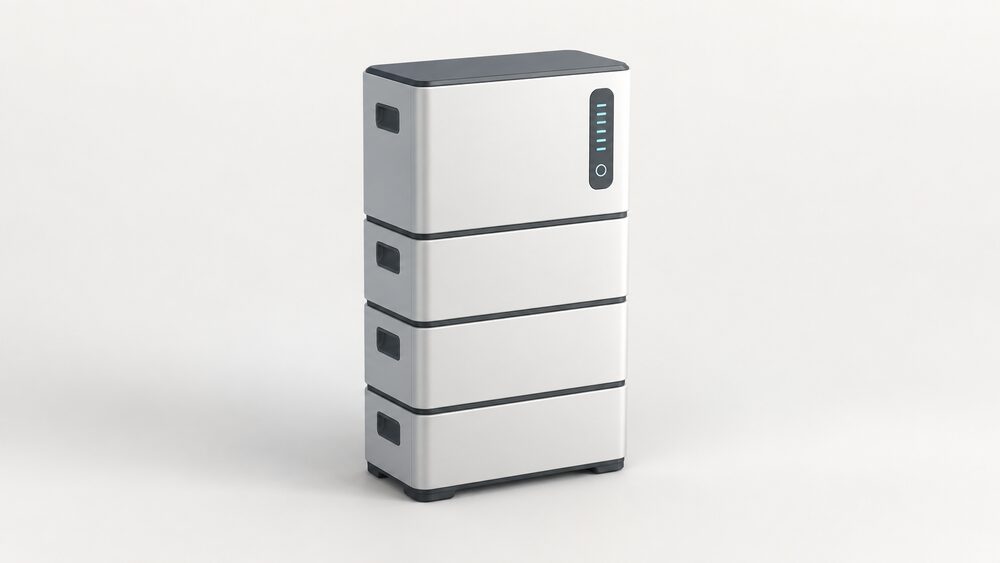 Marstek Home Batteries and Smart StorageMarstek home batteries store the extra electricity your solar panels make so you can use it in the evening instead of buying it back.