

In this guide
Havenwise is a maker of app-based optimisation controls for heat pumps. It is software rather than a box on the wall: there is no extra hardware to buy, and the optimisation runs against a heat pump that is already installed and commissioned. The company's public profile in the UK comes largely from a partnership with OVO, announced on 17 October 2025, which put Havenwise smart controls on Vaillant and Mitsubishi heat pumps for selected OVO customers over the winter of 2025 into March 20261.
The proposition is tariff-aware control. Rather than holding a fixed flow temperature, the software makes a stream of small decisions from the electricity tariff, the home and the weather, shifting and trimming heat pump operation to suit when power is cheap. That places it in the same territory as time-of-use tariffs, which the Energy Saving Trust has researched across over a million tariff and technology combinations2.
What follows sets out what the product does, what it is reported to save, how it is set up, what it costs, and where the dependence on a supplier, a network connection and a young company sits. Households weighing control options more broadly can start with heating controls.
What Havenwise is: software controls for a heat pump
Havenwise is a control layer, not a heating appliance. It sits above an existing heat pump and changes how that heat pump is run, using the tariff, the property and the weather as inputs. Because it is software, it does not replace the manufacturer's own controller, the cylinder thermostat or the room controls; it works alongside them.
That distinction matters for a household thinking about independence. A physical smart thermostat usually means wiring, a replacement programmer and a decision about whether the existing controls stay in place. A software layer means none of that, but it also means the household is adding a second control authority on top of the first, and the two have to agree. The heat pump itself still has to be installed and commissioned to the manufacturer's instructions and the appropriate system design parameters, which is a requirement that applies to the appliance regardless of what controls are added later3.
The trial pairing is the clearest evidence of how brand-agnostic the approach is. Running the same optimisation across Vaillant and Mitsubishi heat pumps indicates the software is written to the heat pump's interface rather than to one maker's ecosystem1. For a household that already owns a heat pump, that is the relevant question: whether the control can be added to what is there, rather than whether the heat pump has to be replaced to get it.
Heat pumps themselves are not a single technology. Air source units are the common domestic form, and the Energy Saving Trust's guidance on them covers the general case5. Monobloc systems, where the refrigerant circuit stays outside, tend to be more common because they are cheaper and quicker to install6. A software control has to work with whatever hydraulic arrangement is present, which is one reason the optimisation is described in terms of decisions rather than in terms of specific hardware.
| Feature | Havenwise position |
|---|---|
| Form | Software control layer, no hardware1 |
| Heat pump brands in the OVO trial | Vaillant and Mitsubishi1 |
| Retrofit to an existing heat pump | Yes, trial open to existing owners7 |
| Setup | Self-installed, three stages1 |
| Reported saving | £276 a year, one early user1 |
| Ongoing price | Not published1 |

What it does: thousands of micro-decisions based on tariff, home and weather
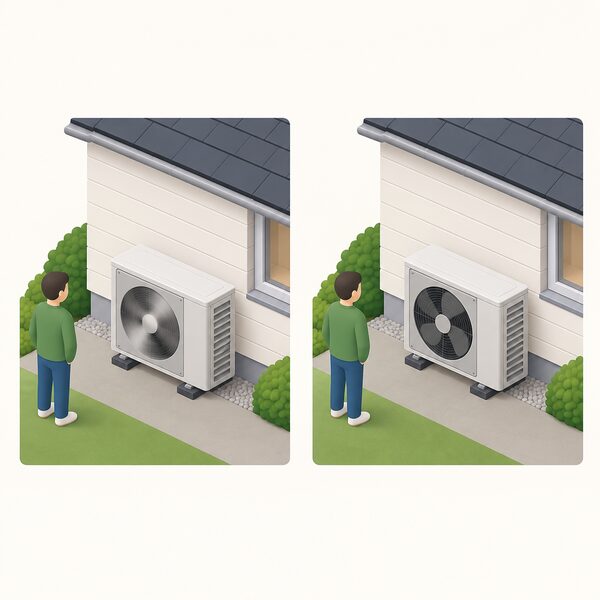
The mechanism Havenwise describes is continuous small adjustment. Instead of one schedule set at installation, the software makes thousands of micro-decisions across a day, weighing the electricity tariff against the home's thermal behaviour and the forecast weather. The effect is to run the heat pump harder when power is cheap and to ease off when it is expensive, within the comfort band the household has set.
This is the same principle that sits behind time-of-use tariffs generally. The Energy Saving Trust has researched over a million tariff and technology combinations to work out which pairings suit which households, which indicates both the scale of the possible combinations and the difficulty of picking one by hand2. A control that automates the matching is doing work a household would otherwise do manually, and badly.
The tariff side is where the market is moving. 100Green sells three multi-rate tariffs designed for different lifestyles, an example of the tiered pricing that rewards load shifting8. Citizens Advice supports standardising tariff pricing data as an important step in enabling consumer-led flexibility, which is the precondition for third-party software to read a tariff reliably and act on it9. Without that standardisation, a control layer depends on whatever data access each supplier chooses to provide.
Export matters too. Outgoing Agile is a variable export tariff with no fixed end date, and it requires a compatible import tariff6. A heat pump control that understands both import and export prices can decide not only when to run the heat pump but when to avoid running it against a good export rate. That is a more sophisticated decision than a simple cheap-hours schedule, and it is the kind of decision the software is described as making.
Where the limits sit is in what the software can see. It can act on the tariff, the home and the weather. It cannot change the fabric of the building, the size of the radiators or the heat pump's rated output. If a system is undersized or the radiators are too small for a low flow temperature, no amount of scheduling fixes that. The control optimises within the system it is given.
What it can save: one early user reports £276 a year
The saving figure attached to Havenwise is a single early user report of £276 a year1. That is one household's outcome, not a modelled average and not a guarantee, and it should be read as an indication of what is possible rather than a prediction for any particular home. The size of any saving depends on the tariff, the heat pump, the fabric of the house and how the system was being run before.
Wider evidence on control savings gives a sense of the range:
- Home energy monitor users have typically saved five to 15 per cent in the first year of owning a monitor, which could be £25 to £75 off a £500 bill10.
- Switching appliances off standby is credited by the Energy Saving Trust with saving around £45 a year per household11.
- Upgrading homes would save consumers £24 billion on their energy bills by 2030, by making homes more efficient to heat, according to Citizens Advice Cymru12.
Those are different interventions from tariff-aware heat pump control, and the national figure is about fabric and heating systems rather than controls. They set a scale: modest, measurable, and dependent on the household acting on what it sees, with the bulk of the saving sitting in insulation and heat source rather than in the control layer.
For a household, the honest framing is that a control layer is a marginal improvement on top of a system that has to be right in the first place. If the heat pump is well sized, the radiators are adequate and the tariff rewards shifting, a tariff-aware control has room to work. If any of those is missing, the saving will be smaller than the headline.
Comfort and bills: what homeowners get out of it

The comfort case and the bill case are the same case, seen from two sides. A heat pump runs most efficiently at lower flow temperatures, and a control that shifts operation to cheap hours has to do so without letting the house drift cold. The reported outcome for early users is that both improve together: lower bills without a comfort penalty1.
Households generally judge this through their bills, and satisfaction with bill clarity is high. Satisfaction with the ease of understanding their bill has increased to 85 per cent among domestic energy consumers in Great Britain, according to Ofgem's survey work covering July and August 202513. That matters for a control product, because a saving a household cannot see on a bill is a saving it will not trust.
Not every household is in the same position. Ofgem's consumer vulnerability work found that those in rented accommodation, those who report being behind on bills, and consumers with a disability are significantly less likely to be satisfied with the ease of understanding their bills14. For those households, an optimisation layer that shifts cost around without reducing the total is less useful than one that reduces consumption outright.
Independent retrofit research points the same way. Residents reported improved comfort and lower energy bills, especially during colder months, following retrofit work15. The comfort gain is often the part householders notice first, and it is what sustains the behaviour change that produces the bill gain.
There is also a friction problem. Among homeowners who think they need more insulation, similar proportions said it would be too much hassle, at 18 per cent16. Any control that requires the household to do work, understand a tariff or manage a schedule runs into that same reluctance. A self-installed software layer that makes decisions on its own is, in part, a response to it.
Installers and bundling: fewer callbacks, simpler installs
For an installer, a software optimisation layer is attractive because it does not add a site visit. The heat pump is installed and commissioned as normal, and the control is configured afterwards. That keeps the installation scope unchanged while adding a service the installer can offer alongside the appliance.
The commissioning requirement is not optional. Heat pumps and any dedicated ancillary products, such as integrated hot water cylinders, should be commissioned in accordance with both the manufacturer's instructions and the appropriate system design parameters3. That is the baseline the installer has to meet, and a control layer sits on top of it rather than substituting for it.
The installer market is also tightening its standards. Citizens Advice has called for stronger technical and professional frameworks in the home upgrade sector, as part of its response on consumer protection for home upgrade schemes17. A control product that reduces the number of return visits and the number of complaints about running costs fits that direction, because callbacks are where installation businesses lose money and where householders lose confidence.
Bundling is the commercial logic. An installer who fits a heat pump and hands over a control that demonstrably trims running costs has a better story at the point of sale and fewer awkward conversations three months later. The trade-off is that the installer is now vouching for a third party's software, and the household's route to support runs through two organisations rather than one.
Where the installer relationship matters most is in the first weeks. A heat pump that is set up badly will not be rescued by scheduling. The control can only work with the system it is given, and the system design is the installer's responsibility.
Setup: under 10 minutes, self-installed by the homeowner
Setup is described as a short, self-installed process in three stages: connect, configure and enjoy1. The homeowner does it, not the installer, and the maker presents it as a task measured in minutes rather than hours. Because there is no hardware, there is no wiring, no replacement of the existing programmer and no disturbance to the heat pump.
That is a meaningful difference from a conventional smart thermostat installation. A physical control usually means a decision about the existing wiring, the siting of a room sensor and whether the boiler or heat pump interlock is preserved. A software layer avoids all of it, at the cost of depending on the heat pump's own interface being open enough to accept external commands.
The three-stage description is the maker's own framing, and the published material does not break the stages down further. What can be said is that the process is presented as self-service, which puts the configuration choices in the household's hands: the comfort band, the tariff details and the schedule preferences are set by the person living in the house rather than by the installer on the day.
For a household that already has a heat pump, that is the practical appeal. The trial was open to homeowners who already had a heat pump installed as well as those installing one, which confirms the control is designed to be added to an existing system rather than only fitted at the point of installation7.

Cost and the free trial

The trial is described as free to take part in7. Beyond that, the published material does not set out a subscription price, a one-off fee or what happens commercially once a trial period ends. Any figure for the ongoing cost of the product is therefore not established by the available evidence, and a household considering it should confirm the terms directly.
The free-at-the-point-of-use pattern is common across UK energy advice and trial schemes:
- Government-backed trial installation has been described as free18.
- Advice services are expected to be free, tailored and independent, delivered nationally to help consumers navigate the market19.
- Take Charge, the SP Electricity North West programme, is described as a free and impartial service funded by the network operator and delivered in partnership20.
- The Heat Pump Ready programme's successful projects were funded on a similar basis21.
- The IE Hub budgetary tool is free to use for managing household finances22, and Money Helper offers money guidance that is impartial and free to use23.
- Manchester City Council's Home Repairs Support Service is free24, and support under the Warm Homes Social Housing Fund wave 3 is available at no cost to applicants25.
A free audit has been promoted in Parliament as something everyone hearing from the programme should take up26.
Havenwise in the UK: a young company and the OVO Heat Pump Flex Trial
Havenwise is a young UK company, and its most visible UK activity is the OVO Heat Pump Flex Trial. OVO and Havenwise announced the trial on 17 October 2025, describing a winter trial running from October 2025 to March 2026 that used Havenwise smart controls on Vaillant and Mitsubishi heat pumps for selected OVO customers1. Participation was by selection, and the trial period has now passed.
The trial sits in a wider pattern of heat pump flexibility work in Oxfordshire. The Smart Flex Heat Pump trial worked with homeowners across Oxfordshire, offering additional communications and monitoring equipment for the heat pump plus training on how to use it to increase savings, and it is now closed to new participants7. A related trial in Deddington and Duns Tew offered a free home assessment and Whole House Plan from Cosy Homes Oxfordshire as a route into installation28. The Prosumer Model for Heat Pump Deployment in Cherwell, Oxfordshire, is a further project in the same area21.
The pattern across these schemes is that flexibility trials are local, time-limited and selective. That is the honest position for a household reading about Havenwise now: the trial that generated the reported saving has ended, and the route to the product outside a trial is not set out in the published material.
Where the dependence sits

A software control changes what a household depends on, without removing the dependence. The heat pump still needs electricity, and the household still needs a supplier. What Havenwise adds is a dependence on a network connection, on the supplier's tariff data being readable, and on a young company continuing to operate and support the product.
The tariff data question is the sharpest of these. Citizens Advice supports standardising tariff pricing data as an important step in enabling consumer-led flexibility, which is an acknowledgement that the data is not yet uniformly available9. Where a supplier does not expose tariff information in a usable form, a control layer cannot act on it, and the optimisation degrades to a fixed schedule.
The company question is the second. A young company's product carries support risk that an established manufacturer's does not, and the published material gives no founding date, no ownership detail and no longevity record. A household weighing the product should treat the software as a service that may change terms, rather than as an appliance that will outlast the company that made it.
The third is the relationship between the control and the heat pump's own controller. Two control authorities on one system can conflict, and the resolution usually favours whichever is closer to the appliance. That is not a reason to avoid a software layer, but it is a reason to understand which settings the software can actually change.
For a household, the independence question is therefore narrower than it first appears. A tariff-aware control can reduce what a home spends on grid electricity and can shift when it draws power. It does not reduce the home's reliance on the grid, the supplier or the network, and it adds a reliance on connectivity and on a third party's continued operation. Households wanting to go further into local control and cloud dependence can read heating controls and energy independence, and those comparing control types can look at smart thermostats and using heating controls with time-of-use tariffs.
Sources28 cited
- OVO and Havenwise launch Heat Pump Flex Trial, OVO, 2025-10-17
- Tariffs for renewable technology, Energy Saving Trust, 2026-08-12
- Approved Document L, Volume 1: Dwellings, HM Government, 2026
- Approved Document L, Volume 1: consultation version, Welsh Government, 2025-08
- Air source heat pumps, Energy Saving Trust, 2026-07-16
- Smart Export Guarantee, Solar Energy UK, 2026-05-12
- Smart Flex Heat Pump Trial, Low Carbon Hub, 2025-12-19
- Energy company reviews: 100Green, Which?, 2026-06-16
- Citizens Advice response to DESNZ's tariff interoperability consultation, Citizens Advice, 2026-01-19
- Energy efficiency tips, nidirect, 2026-09-17
- Switching appliances off standby, Smart Energy GB, 2026-04-22
- Home advantage: unlocking the benefits of energy efficiency, Citizens Advice Cymru, 2030
- Energy Consumer Satisfaction Survey findings, July to August 2025, Ofgem, 2025
- Consumer vulnerability strategy progress report, Ofgem, 2026-07-21
- CIBSE's Dr Anastasia Mylona discusses retrofit insulation on BBC, CIBSE, 2025-03-07
- Which? annual sustainability report series 2024: home insulation and heating, Which?, 2024-06
- Citizens Advice response to DESNZ consultation on reforming consumer protection for home upgrade schemes, Citizens Advice, 2026-09-10
- Cap Zero retrofit, Low Carbon Hub, 2025-12-19
- Supporting the shift: information and advice for energy home upgrades, Citizens Advice, 2026-07-29
- Take Charge with SP Electricity North West, Energy Saving Trust, 2026-02-02
- Heat Pump Ready Programme: successful projects, HM Government, 2026-05-28
- Help and support with energy bills, Cadent Gas, 2026-09-17
- Cost of living support, Turn2us, 2026-09-20
- Home improvement assistance, Manchester City Council, 2026-09-20
- Warm Homes Social Housing Fund wave 3 scheme guidance addendum, HM Government, 2026-06
- Energy Market Consumer Protection, Hansard, 2026-06-17
- Home energy efficiency, Bridgend County Borough Council, 2026-09-17
- Deddington and Duns Tew Heat Pump Trial, Low Carbon Hub, 2025-12-19