

In this comparison
An Energy Performance Certificate is a statutory requirement whenever a property is bought, sold or rented, and it has been part of the process since 20071. It is needed whenever a property is built or marketed for sale or rent, and the EPC must be provided to the purchaser free of charge, which is a legal requirement2. The rating must also appear in the property advertisement when a building is advertised for sale2.
So the certificate is not optional and not a marketing extra. What is optional is whether a seller spends money improving the building before the certificate is produced. That decision turns on what the EPC actually measures, which is the cost of heating the home rather than its carbon footprint or its comfort3. A rating is a running-cost comparison between buildings assessed on standard information, not a survey and not a statement about condition1.
Why an EPC matters when you sell: the legal requirement
Provision of an Energy Performance Certificate is a statutory requirement whenever a property is bought, sold or rented, and it was introduced in 20071. The trigger point is marketing rather than completion: government has stated its intention to update regulations so an EPC is required at the point of marketing a property rather than the point of sale or rent9. In practice that means the certificate has to exist before the listing goes live, not before contracts exchange.
The seller carries the duty. If the building is being offered for sale, it is the responsibility of the seller to provide the EPC to the potential buyer3. The EPC should be made available to buyers or prospective tenants at no cost, and a buyer receives a copy from the seller that can be reused within the period of validity1. In Scotland the same principle applies, with the EPC rating required in the advertisement when a building is advertised for sale2.
Failure has consequences. Not having an EPC could lead to enforcement action and the issuing of a penalty charge notice1. The certificate is also a disclosure document in a narrower sense: where a Green Deal plan was attached to a property and the provider knows or believes an improvement has been removed before the end of the improvement-specific payment period, prescribed wording must be included in the EPC, and the same applies where a material alteration has been made to the property10.
For a household thinking about energy independence, the EPC is the one moment when a home's performance is formally measured and published. It is a snapshot of the building as assessed, not of the way the occupants run it, and it travels with the property rather than the owner1.
What an EPC actually measures: a cost metric, not a carbon or comfort score

The single most useful thing to understand before spending money is that EPC ratings are based on the costs of home heating, rather than its carbon footprint, which means that cheaper heating scores better3. The assessment reflects the energy performance of the building itself, not the way it is used by its occupants4. Two identical houses with different heating fuels can therefore carry different bands.
That design choice has consequences the Climate Change Committee has set out directly. The ratings on EPCs are an important policy tool, used to define standards and targets for reducing emissions from homes, but the Committee describes them as poorly suited to this role11. The methodology used to assess energy efficiency does not take into account changes in energy prices, which is why the statistics are not suitable for tracking energy prices13.
There is a second limitation that matters at the point of sale. Energy Performance Certificate ratings do not always capture the true efficiency of a retrofit, and measures such as PV panels or air source heat pumps may improve an EPC score but fail to address fundamental building issues such as poor insulation or moisture risks14. A band can move without the building getting warmer or drier.
Scotland is rebuilding the metric. A new EPC rating system for domestic buildings is intended to give clearer information on the fabric energy efficiency of a property, the emissions, efficiency and running costs of its heating system, and the cost of energy to run the home to standardised conditions15. Reform is also framed as needing to sit alongside wider improvements to the EPC system to improve the quality of assessments and use of data12.
"The ratings on EPCs are an important policy tool, used to define standards and targets for reducing emissions from homes"
What your certificate contains: ratings, running costs and the recommendations page
The EPC contains information on potential energy costs and carbon dioxide emissions, with a coloured chart showing how energy efficient the building is or could be1. It explains how energy efficient a building is and how it could be improved4. Certificates should contain a minimum of the building asset rating against a benchmark, a recommendation report, a reference number and date of issuance, the building address, and the building's total useful floor area16.
The recommendations report is the part sellers tend to read first. The EPC is accompanied by a recommendations report which provides more detailed information about improvement measures, including an indicative cost for each improvement4. Each EPC comes with a report setting out the cost effective measures that homeowners or businesses can take to improve energy efficiency and energy rating, such as low energy bulbs or upgrading insulation1. In Wales, the certificate outlines the recommended measures that can be taken to help improve the rating6.
Two cautions apply. First, the recommendations are cost effective measures, not a specification or a sequence of works, and the report is not a job sheet. Second, the certificate is a comparison tool: EPCs are produced using standard information about buildings, allowing buyers and tenants to compare energy efficiency and likely heating and lighting costs before entering a contract1. That standardisation is what makes the band meaningful across a street or a town, and it is also why the certificate cannot describe the particular condition of one house.
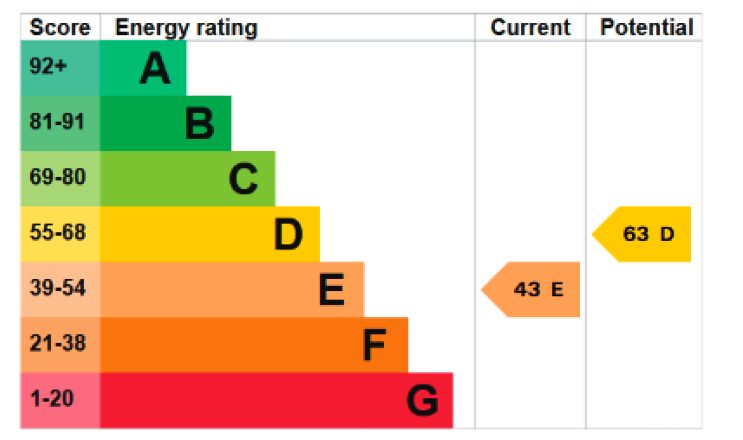
The current E minimum and the proposed move to C
The rules that bite today are the private rented sector minimum standards. If a property is currently let with an EPC rating of F or G, and action has not already been taken, it must be improved to a minimum rating of E or an exemption registered where applicable6. That is the live requirement, and it applies to landlords rather than to owner occupiers selling a home.
The proposed change is larger. The UK Government has proposed raising the minimum EPC standard for domestic private rented properties to band C by 20307. The Climate Change Committee has recommended that by 2028 all homes for sale should be at EPC C or higher1. Those two positions are not the same thing: one is a government proposal for rented homes, the other is an advisory recommendation covering homes for sale, and neither is in force as a general sale requirement.
Scotland has its own trajectory. The Heat in Buildings strategy set out an intention to introduce regulations in 2025 to require all private rented sector properties to reach a minimum standard equivalent to EPC C, where technically feasible and cost effective at change of tenancy17. Separate scheme rules show how bands are treated in practice: under ECO4, any starting SAP band D or E property treated must be improved to at least a band C18, and under ECO4 Flex, properties with starting EPC bands F and G must be improved to an EPC D while properties with starting EPC bands E and D must be improved to an EPC C19.
Where improvements pay off at sale, and where they may not

The evidence on price is genuinely mixed, and the disagreement is unresolved. Research on energy rating and dwelling prices reported value increases of 27% for EPC A/B, 21% for EPC C, 18% for EPC D, 16% for EPC E and 12% for EPC F in one set of figures, and 38% for EPC A/B, 26% for EPC C, 23% for EPC D, 20% for EPC E and 15% for EPC F in another21. The two sets of figures come from the same source and disagree, so neither should be treated as a settled expectation.
What can be said with more confidence is where the certificate stops being informative. Ratings do not always capture the true efficiency of a retrofit, and measures such as PV panels or air source heat pumps may improve an EPC score but fail to address fundamental building issues such as poor insulation or moisture risks14. A seller who installs a heat pump to lift a band may leave a buyer with the same cold walls and the same damp risk, and a survey will find them.
Scotland adds a structural incentive in the other direction. The Home Report is intended to give sellers an incentive to carry out repairs before marketing their properties22. That is a repair incentive rather than an energy one, but it points the same way: work done before marketing is visible to buyers in a way that work promised afterwards is not.
The practical reading is that improvements which change the running cost of the home, and which a buyer can verify from the certificate and from a survey, are the ones with a chance of affecting a negotiation. Improvements that move a band without changing the building are the ones most likely to be discounted by an informed buyer.
Cost of an assessment: £50 to £150, and what it does not cover
There is no set fee for an EPC assessment, and the previous recommendation that an assessment may cost £60 upwards was removed from official guidance23. Published figures vary by source and by date. EPCs are described as quick and easy to get and usually cost £50 to £1505. In the domestic sector an assessment can be over £10024. An older consultation put the cost at around £40 to £50 for homeowners without an existing EPC25. The cost of the EPC varies from one company to another, depending on the size, location and age of the building, and households have to shop around for the best price4.
A retrofit assessment is a different and more expensive exercise. Costs range from £150 to £3005. That is a fuller survey of the building intended to plan work, and it is not the same product as the certificate needed for a sale.
What the EPC fee does not cover is any of the work. The certificate records the building as found and lists cost effective measures with indicative costs4. It does not commission those measures, does not verify them after installation, and does not warrant them. A seller paying for an assessment is buying a document, not a programme of works.

Exemptions and special cases
An EPC is not required where a housing association sells an additional share to an existing shared owner26. Beyond that, the requirement is broad: an EPC is needed even if there is no heating system or services, as in some commercial retail or warehouse units or incomplete dwellings27.
For landlords, the exemption regime is separate from the certificate itself. The PRS Exemptions Register is for properties which are legally required to have an EPC, are let on a relevant tenancy type, and cannot be improved to meet the minimum standard of EPC band E for one of the listed reasons28. A valid exemption is an alternative compliance status for a private rented sector property requiring an EPC29.
Two conditions matter at sale. Registered exemptions do not transfer with the property and cease to apply once the property is sold, though the EPC can transfer10. And exemptions expire: after the high cost exemption period ends, the landlord must try again to improve the property's EPC rating to meet the minimum level of energy efficiency, and if this still cannot be achieved a further exemption may be registered28. A temporary exemption for someone who has recently become a landlord expires after 6 months, after which the landlord must either have improved the property to at least EPC band E or have registered another valid exemption if they intend to continue letting28.
What buyers see: how the rating shapes offers and negotiations

Buyers see the band before they see the house. When a building is advertised for sale, the EPC rating must be included in the property advertisement2, and the EPC must be provided to the purchaser free of charge as a legal requirement2. Because EPCs are produced using standard information about buildings, buyers and tenants can compare energy efficiency and likely heating and lighting costs before entering a contract1. The certificate is doing its comparative job at exactly the moment a household is deciding what to offer.
What the buyer does not get is a condition report. The assessment reflects the energy performance of the building itself, not the way it is used by its occupants4, and the rating is based on heating costs rather than carbon3. A buyer reading a band C is reading a modelled running cost under standardised assumptions, not a promise about the boiler, the roof or the damp course.
The direction of travel is towards more disclosure rather than less. Scotland is reforming EPCs by introducing new ratings, redesigning the certificates, and improving the operational infrastructure30. New-style EPCs are introduced from 30 April 2028, with certificates valid for 5 years and assessors only able to issue new-style EPCs from that date8. From 30 April 2029 only new-style EPCs issued under the 2025 rules are accepted for sales, lettings and short-term lets, and from 30 April 2033 every large public building must display a new-style EPC meeting the 2025 regulations8. Existing valid EPCs issued under the 2008 Regulations may continue to be used during transitional periods beginning on 31 October 2026, ending by 31 October 2027 for sale and letting and 31 October 2031 for display8.
For a household, the certificate is a fixed point in a transaction that otherwise runs on impressions. It is also the only energy document most buyers will read. Whether it is worth improving the building before it is produced depends on whether the work changes the running cost a buyer will actually pay, and on whether the building itself, rather than the band, is what the buyer is assessing.
Sources30 cited
- Energy Performance Certificates, nidirect, 2026-02-26
- Buildings for sale, Scottish Government, 2026-08-24
- Energy Performance Certificates, Isle of Anglesey County Council, 2025-09
- Energy Performance Certificates guide, Scottish Government, 2026-08-24
- Five top tips from Which? to cut your energy bills, Welsh Government Climate Action, 2026-03-18
- Minimum energy efficiency standards, Carmarthenshire County Council, 2026-09-20
- Trading standards guidance, Isle of Anglesey County Council, 2026-05
- EPCs are changing, Scottish Government, 2028-04-30
- Reforms to the energy performance of buildings regime, UK Government, 2026-03-09
- The Green Deal Framework (Disclosure, Acknowledgment, Redress etc.) Regulations 2012, legislation.gov.uk, 2013-01-27
- Letter on reform of domestic EPC rating metrics to Lee Rowley MP, Climate Change Committee, 2026-09-19
- Letter on reform of domestic EPC rating metrics to Patrick Harvie MSP, Climate Change Committee, 2026-09-19
- Energy performance of buildings certificates statistical release, July to September 2023, UK Government, 2023-10-26
- Review of retrofit assessment in Scotland, Scottish Government, 2025-06-06
- Reforming energy performance certificates, Scottish Government, 2025-01-21
- What does an Energy Performance Certificate contain, Planning Portal, 2026
- Heat in Buildings strategy: fairer Scotland duty assessment, Scottish Government, 2025
- ECO4 delivery guidance version 4.0, Ofgem, 2026-03-26
- ECO flexibility funding, Ceredigion County Council, 2026-09-17
- ECO4 Flex and GBIS Flex information document, Ceredigion County Council, 2025-11
- Energy rating and dwelling prices research, UK Parliament Environmental Audit Committee, 2013-06-17
- Home Reports, Scottish Government, 2026-09-17
- Summary of updates to Boiler Upgrade Scheme guidance for property owners, Ofgem, 2023-12
- Delivering net zero for Scotland's buildings, Scottish Government, 2023-11
- Minor consequential improvements, Part L Building Regulations, UK Parliament, 2012-12
- Buildings for let, Scottish Government, 2023-11-29
- EPC leaflet, Building Control Northern Ireland, 2014
- Guidance on PRS exemptions and exemptions register evidence requirements, UK Government, 2026-05-05
- View private rented sector energy standards exemptions, UK Government, 2026-05-05
- Energy Performance of Buildings (Scotland) Regulations 2025 update, Scottish Government, 2025-10-10
 Energy Performance CertificatesAn Energy Performance Certificate rates how energy efficient your home is, from A down to G.
 Energy Checks Before BuyingHow energy efficient is the house, and what will it cost to heat?
 EPC Regulations and ReformSelling or renting out a home means you need an Energy Performance Certificate.
 Using Your EPC to Plan WorkAn EPC comes with a recommendations report, and that report is the part worth reading before you spend anything.
 Where to Start ImprovementsThe first steps are assessment, not purchase: read the home's EPC and its recommendation report, see actual consumption on a meter or in-home display, and take the no-cost adjustments such as turning the thermostat down one degree.
 Home Energy AssessmentsWhich home energy check do you actually need?