In this guide
A Delta inverter is the box that turns the direct current from a solar array into the 230 volts a UK home uses. Delta Electronics is a Taiwanese power electronics manufacturer, and its home energy offer is built around a cloud-based smart energy management system that converts sunlight into electricity, with monitoring, power management and solar optimisation as the stated benefits1. The company's most distinctive residential product is a bi-directional inverter that combines rooftop solar, battery storage and electric vehicle charging in a single unit, first launched in the United States in April 20221.
For a UK household, the practical position is narrower than the product range suggests. Delta's en-GB site carries a contact us service support page, so there is a UK-facing route for enquiries1, but the residential inverter line is not documented in the UK in the same depth as the established hybrid brands. The specification detail that matters, output rating, phase, battery compatibility, certification for the UK grid and warranty terms, has to be confirmed model by model with the installer and the distributor.
What a Delta inverter does for independence is the same as any inverter: it makes self-generated electricity usable in the home. What it does not do is remove the grid. A hybrid unit can run without batteries like a grid-tie inverter, or use them for backup2, and when the grid goes down a hybrid disconnects from the utility and continues powering the home from solar and battery2. That is a real capability, and it is bounded by battery capacity and by the certification the unit holds.
What Delta offers for homes
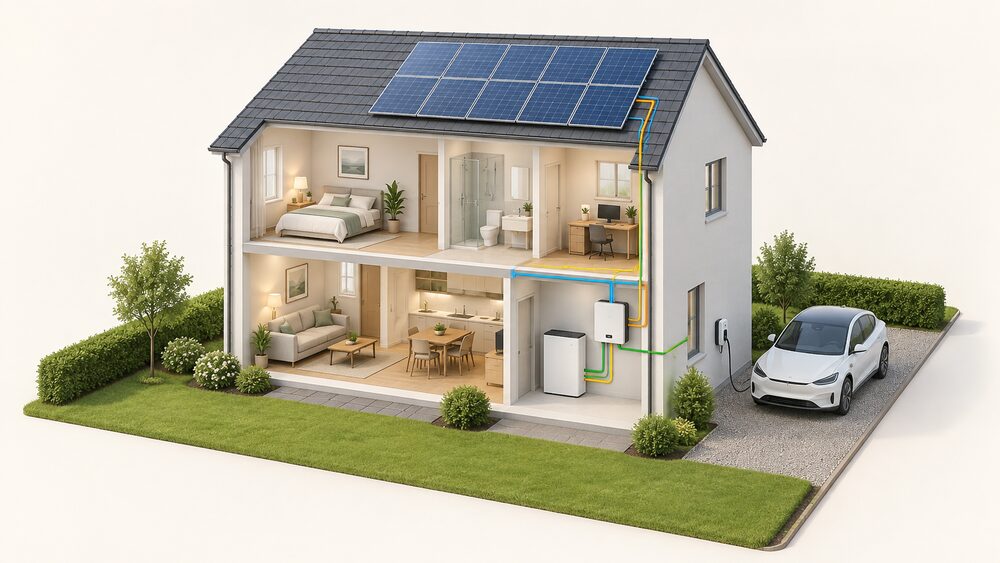
An inverter sits between the array and the house wiring. A device called an inverter connects the solar panels or wind turbine to the main wiring in the house5, and its job is to convert the low voltage DC output of the panels into the 230 volts needed in the home3. Every grid-connected solar system has one, and it is the component that determines how much of the array's output actually reaches the appliances.
Delta's residential proposition is framed around the Home Energy Solution, which the company describes as a cloud-based smart energy management system to efficiently convert sunlight into electricity1. The stated household benefits are monitoring energy consumption, managing power usage intelligently, optimising solar power generation, reducing energy costs and achieving energy savings and carbon reduction1. Those are management functions layered on top of the conversion job, and they are the part of the offer that depends on connectivity.
The range itself is not published in the UK as a simple list of domestic models with datasheets attached. Delta's public product pages lean towards commercial and infrastructure equipment, with the residential line presented through the home solution page rather than a UK model table1. That matters for a buyer: the specification that governs a UK installation, including the grid protection settings and the certification the local network operator expects, is confirmed at the point of quotation rather than from a national brochure.
For a household, the inverter choice is really a choice about what the system can do later. A grid-tie inverter exports surplus and stops there. A hybrid inverter is designed for residential and commercial energy management6 and is aimed at homeowners wanting to lower bills and have backup power during outages2. Delta's bi-directional product sits in the second category, and the rest of this page deals with what that means in practice.
The bi-directional inverter: solar, storage and EV charging in one unit
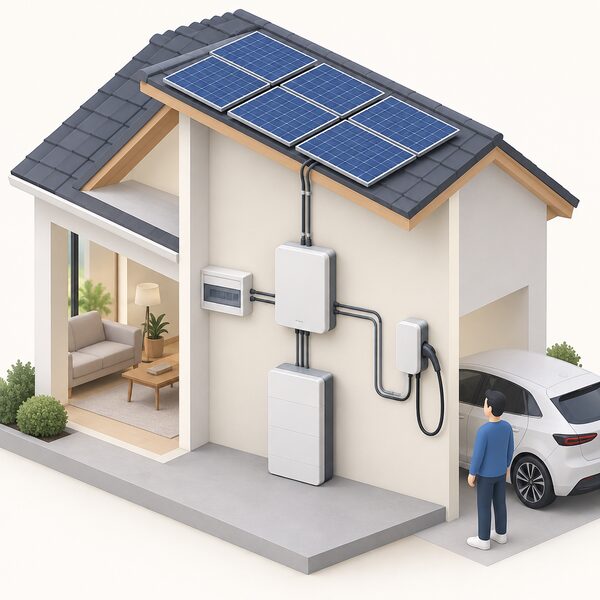
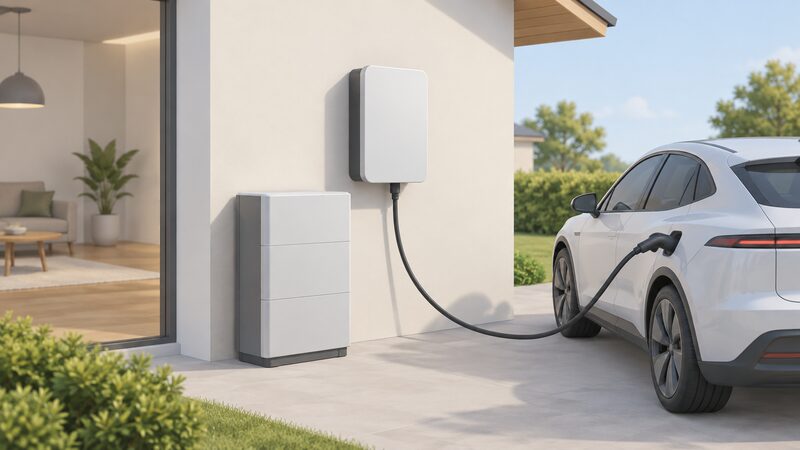
Delta announced its bi-directional inverter in April 2022 as an all-in-one solution integrating rooftop solar, energy storage batteries and EV charging, first launched in the United States and certified to IEEE 1547-2018, UL2202, UL9741 and UL 95401. The same launch describes it as an optical storage and charging bi-directional inverter, and the product family has since been presented alongside Delta's wider smart energy infrastructure portfolio at trade events in Europe and Australia1.
The technical idea is straightforward. A hybrid inverter is bi-directional in power flow terms, moving energy between solar or battery, the grid and the loads2. That is what allows one unit to charge a battery from the array, discharge it to the house, export to the grid and, in Delta's case, feed an EV charger from the same platform. The alternative is three separate boxes: a string inverter, a battery inverter and a charger.
For a home with an EV, the features that matter are the ones that decide whether the car runs on sunshine or on imported electricity. Independent guidance lists solar diversion, which allows the charger to prioritise solar power for EV charging and minimise reliance on the grid, app control and dynamic scheduling as the desirable features7. An inverter that integrates charging can support that behaviour, but the charging logic sits in the charger and its controls, not in the inverter alone.
The all-in-one approach is not unique to Delta. Sunsynk describes a combined hybrid inverter and battery storage in a single unit8, and Duracell Energy integrates home battery storage, a hybrid inverter and an EV charger through a smart app9. What distinguishes Delta's version is the bi-directional charging capability and the US certification set, which is not the same as UK grid approval. A UK buyer needs the UK certification confirmed separately.
Specifications to compare before choosing a model
Inverter specifications are where a quotation either works or does not. The headline numbers are the continuous output rating, the phase (single or three phase), the maximum DC input voltage and current, the battery voltage range, the number of MPPT trackers and the efficiency curve. Delta's UK residential pages do not publish a model-by-model table, so the comparison has to be made against the datasheet for the specific unit quoted.
Scalability is one specification that separates domestic units from larger ones. The Celtic Sea three-phase hybrid inverter, for example, allows up to four 12 kW inverters in parallel to create a scalable 48 kW system for larger homes and commercial properties10. That is a different product from Delta's, but it shows the shape of the question: a domestic inverter is usually sized to the array, and parallel capability only matters if the system is expected to grow.
Warranty length is a specification in its own right, and the market range is wide. Most inverters have warranties of five years as a minimum, which can often be extended by up to 15 years4. Some makers tie the longer term to cloud connectivity: SolaX upgrades an inverter warranty to 5 years standard plus 1 year parts when the unit is connected to its cloud and generation data is uploaded11, and to 10 years standard on certain models under the same condition11. SMA offers 5 years, or 10 years with registration in Sunny Portal or Sunny Places12.
| Specification | Why it matters | Typical UK position |
|---|---|---|
| Output rating and phase | Determines how much generation the unit can pass through | Sized to the array; three-phase for larger homes10 |
| Battery compatibility | Decides whether storage can be added later | Hybrid designs accept batteries; grid-tie units do not2 |
| Backup capability | Whether the home runs during a power cut | Hybrid disconnects from the grid and runs on solar and battery2 |
| Warranty term | Sets the replacement risk period | Five years minimum on most inverters, often extendable4 |
| Connectivity | Enables monitoring and remote management | Cloud connection can be a condition of an extended warranty11 |
Efficiency, noise and enclosure rating are the remaining variables. None of these can be settled from a brand name; they are settled from the datasheet for the exact model, and the installer is the party who holds it. A comparison of inverter types generally is set out in solar inverters explained, and the hybrid category specifically in hybrid solar inverters.
Where Delta sits in the UK market
The UK solar market is overwhelmingly domestic in installation count. At the start of 2026, domestic solar comprised 30% of UK solar capacity and 84% of total UK solar installations13. That is the market any inverter brand is selling into, and it is a market where the installer, not the manufacturer, chooses the equipment on most jobs.
The battery side of that market is described as strong, with no evidence that other battery companies plan to stop operating14. Inverter brands compete on warranty length, cloud platform and the breadth of the ecosystem, which is why several makers now sell an inverter, a battery and a charger as one connected package9. Delta's bi-directional unit is a direct response to that pattern.
Two structural features of the UK market shape what a household can actually buy. Plug-in solar, the small balcony-scale category, is currently not available to the UK market15, although the government has consulted on connecting plug-in solar systems without batteries directly to a standard mains socket16. And the retail electricity market remains concentrated, with the six biggest electricity companies holding 91.2% of domestic electricity market share in Q1 202517. The UK is also the second-largest offshore wind market in the world, behind China18, which is the context for how much of a home's electricity is grid-supplied regardless of what inverter is on the wall.
Delta's position within that is as a large international power electronics manufacturer rather than a UK-focused solar brand. Its public activity in Europe has been at trade events and in commercial and infrastructure products, including inverters with software tuning for Switzerland's ripple control signal requirements and a C Series energy storage system1. For a UK household, that means the brand is credible on engineering and thinner on domestic UK presence than the specialist hybrid brands.
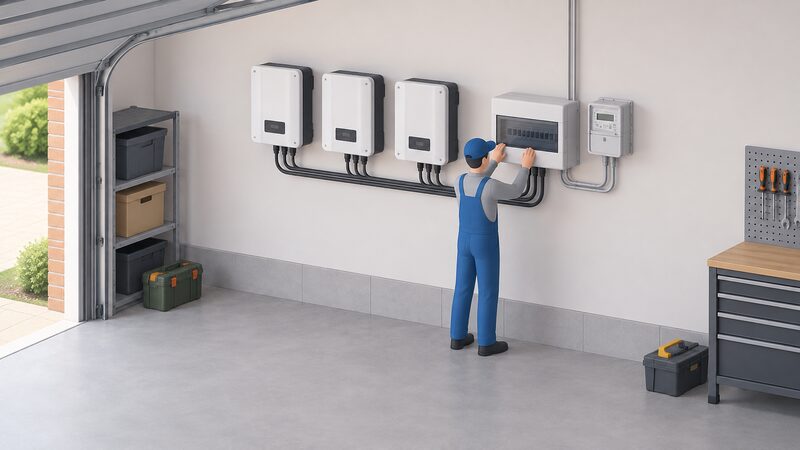
Delta's wider smart energy portfolio and recent activity
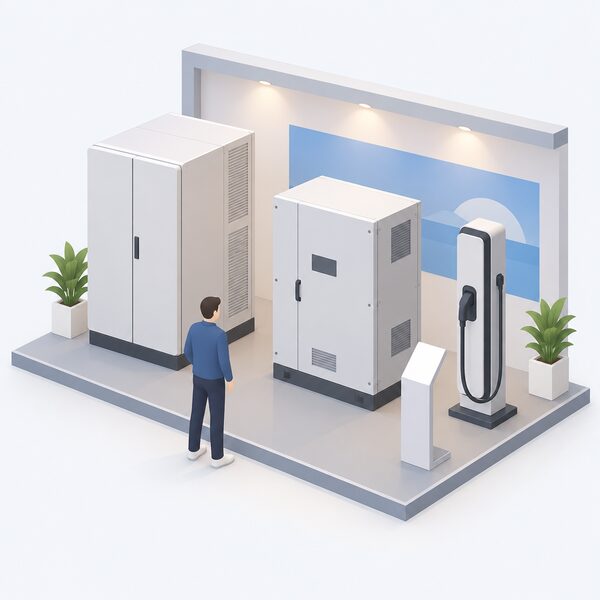
Delta's smart energy work extends well beyond a domestic inverter. The company presented an upgraded Smart Energy Infrastructure portfolio at The Smarter E Europe 2025 in May, including a 50 kW DC Wallbox, an All-in-One energy storage system scalable to 1.25 MW/2.61 MWh, DP225U and DP350U inverters and hydrogen solutions1. It debuted EV charging, energy storage and DeltaGrid solutions at the 38th International Electric Vehicle Symposium in Gothenburg in June 20251.
European activity continued through the year. Delta exhibited at Solar & Storage LIVE Zurich in October 2025, presenting the M15/20/30A Flex and M50/70/100A Flex inverters with software tuning for Switzerland's ripple control signal requirements, alongside the C Series energy storage system1. It was named Gold Sponsor of Forum Solar Plus 2025 in Berlin, held on 18 to 19 November1, and planned to show the DP225U and DP350U inverters, C-Series storage and the 50 kW DC Wallbox at EnerGaïa 2025 in Montpellier on 10 to 11 December1.
The company also received the "Herausragend, Outstanding" distinction in the Best of E-Mobility 2025/26 customer satisfaction study, ranking among the top 20% of brands for overall customer satisfaction1. Earlier, Delta exhibited at All Energy Australia 2024 in Melbourne on 23 to 24 October1.
Read together, this is a company whose European profile is built on commercial inverters, large-scale storage and EV charging infrastructure, with customer satisfaction recognition in e-mobility. The residential bi-directional unit sits at the small end of that portfolio. A household buying one is buying into a manufacturer with deep power electronics capability and a product line whose centre of gravity is elsewhere.
What owning a Delta inverter means for household energy independence
An inverter is the component that makes self-generation possible at all. An inverter is installed along with the system to convert DC electricity to AC19, and it converts the solar power from DC, generated by the panels, into AC, which most home appliances including EVs use7. Without it, a rooftop array produces nothing a household can use.
The independence a Delta inverter delivers depends on which version is installed. A grid-tie unit converts and exports, and the home remains fully dependent on the grid for everything after dark. A hybrid unit adds two things: it can store surplus generation for later, and when the grid goes down it disconnects from the utility and continues powering the home using solar panels and battery storage2. Hybrid inverters are described as enabling households to maintain power during outages, preventing damage to devices or loss of food from refrigeration, and the claimed householder benefits are reduced electricity bills, energy independence and a smaller carbon footprint20.
What remains is substantial and worth stating plainly. The home stays connected to the distribution network, and a hybrid inverter's backup capability is limited by battery capacity and by how much solar is available at the time. The unit still needs a network connection for export and for grid synchronisation, and it will disconnect when grid voltage moves outside its permitted operating range21. Where the inverter's monitoring and management run through a cloud platform, the household also depends on broadband, the manufacturer's servers and an app for those functions.
The wider context is that domestic solar is now a mainstream part of UK generation, at 84% of installations13, and the grid itself is supplied predominantly by a small number of large suppliers17. An inverter changes what a household generates and stores. It does not change who supplies the electricity when generation is short. The routes to greater independence, including storage and off-grid designs, are set out in solar panels and household energy independence and adding battery storage to a solar system.
Warranty, support and registration
Warranty terms for inverters are set by the manufacturer and are frequently conditional. The market floor is five years as a minimum on most inverters, often extendable by up to 15 years4. Some makers make the extension automatic on condition of connectivity: SolaX upgrades to 5 years standard plus 5 year parts on certain models when the inverter is connected to its cloud and generation data is uploaded11, and to 10 years standard on others under the same condition11. SolaX also sets a registration deadline of within 90 days of the commissioning date22, and states that where no registration is completed the warranty start date can default to the shipment date from the factory22.
Registration deadlines can be much tighter than that on publicly funded schemes. The Barcud Solar Panel Installation Scheme specification requires inverter product registrations to activate guarantees and warranties to be completed within 48 hours of commissioning23. That is a scheme rule rather than a Delta term, but it shows how quickly the paperwork can expire.
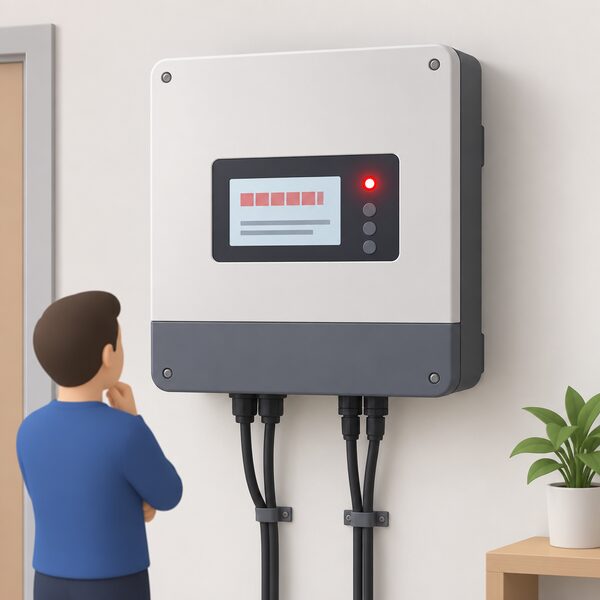
Support for a Delta installation runs through the en-GB contact us service support page1 and, in the first instance, through the installer who commissioned the system. Fault diagnosis is not a generic exercise: fault codes are not standardised across brands, models or firmware versions, and the same number can have different meanings on different inverter brands and models21. A red fault light alone does not identify the problem, and the display carries the complete code and message21. Grid voltage mismatch is a recognised cause of solar inverter faults21, and abnormal grid voltage outside the inverter's permitted operating range will cause it to disconnect21. For comparison, a heat pump inverter board fault can be triggered by incoming mains voltage outside permissible tolerances, incorrect phases, reverse polarity or poor earthing24, which is the same principle in a different product.
Serial number location and format vary by maker. Duracell Energy asks owners to include the hyphen and the PH at the end of the serial number, giving 2418-60480143PH as an example, and its app returns a data unavailable message when the inverter serial number is invalid25. Delta's own documentation for the specific model is the place to confirm where the label sits.
Sources25 cited
- Delta Home Energy Solution, Delta Electronics, 2026
- Off-grid vs hybrid inverter, SolaX Power, 2026
- Solar photovoltaic, CAT, 2026
- Solar panels advice, Energy Saving Trust, 2026
- What is domestic distributed generation, UK Power Networks, 2026
- Sunsynk, Sunsynk, 2026
- Integrating solar panels with EV charging, Uswitch, 2025
- Duracell Energy, Duracell Energy, 2026
- Smart diverters, energy-saving materials, legislation.gov.uk, 2026
- Celtic Sea three-phase hybrid inverter, Eleven Energy, 2026
- SolaX warranty, SolaX Power, 2026
- SMA Sunny Tripower Smart Energy hybrid inverters, Wind & Sun, 2026
- UK solar and domestic generation, UK Parliament POST, 2026
- GivEnergy FAQs, ESA, 2026
- Setting the standard: product certification and the future of UK solar, MCS Certified, 2025
- Plug-in solar consultation, GOV.UK, 2026
- Energy statistics, Uswitch, 2025
- Renewable energy in the UK, ECIU, 2025
- Heat pump fault codes, Vaillant, 2026
- Sungrow 5kW hybrid inverter, Sungrow, 2026
- Managing voltage changes in your property, Electricity North West, 2026
- Solar inverter warranty, SolaX Power, 2026
- Barcud Solar Panel Installation Scheme Specification, Sell2Wales, 2026
- Solar inverter fault codes, SolaX Power, 2026
- Solar panel battery storage, Which?, 2026