
In this guide
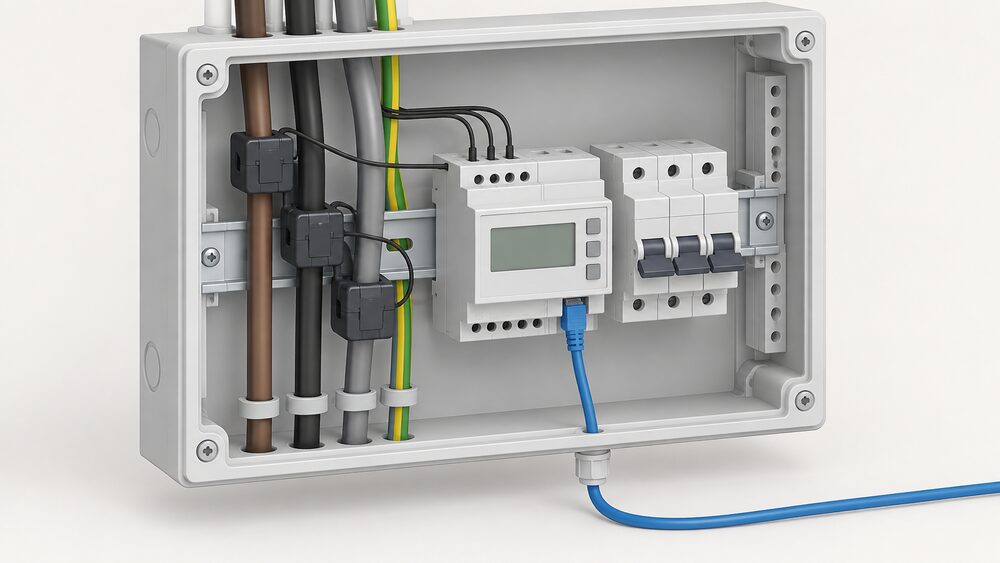
The Shelly Pro 3EM is a DIN-rail energy meter that measures a single- or three-phase supply up to 120 A per phase, with an optional neutral channel, and reports whole-home consumption and solar export across all three phases1. It is a named meter rather than a whole system: it measures and reports, and it does not by itself switch, store or generate anything.
Its appeal in home energy management builds is that it sits on the DIN rail inside the distribution board, uses current transformers rather than breaking the supply, and offers wired LAN alongside Wi-Fi and Bluetooth, so it can be read locally without a cloud account1. The maker's published measurement accuracy is 1%, with a tighter breakdown across the current range2.
For a household, the meter's contribution to energy independence is informational. It shows what each phase is importing or exporting, which is the evidence base for sizing solar, battery or a heat pump, and it can serve as a generation meter for a solar array3. What it does not do is remove any dependence: the home still draws from the grid, still buys from a supplier, and any remote feature still runs through a network and a manufacturer's platform.
What the Shelly Pro 3EM is and what it measures
The Pro 3EM v2 is described by its maker as a next-generation DIN-rail energy meter that measures a single- or three-phase supply up to 120 A per phase, plus an optional neutral, and continuously reports whole-home consumption and solar export across all three phases1. That combination, three phases plus export, is what separates it from the single-phase clamp meters that dominate the consumer market.
The measured quantities are broader than a simple watt reading. The meter reports active and apparent power, active and apparent energy, power factor, and fundamental active and fundamental reactive energy2. The ammeter range is 0 to 120 A RMS via current transformer for each phase and the neutral2. A temperature sensor is included, and the unit consumes under 3 W2.
That set of quantities matters because a three-phase supply is not simply three single-phase supplies added together. Measuring three-phase power properly means a current transformer and a voltage reference on each phase, with total power as the sum of the three5. A meter that reads only one phase, or that assumes a balanced load, will misreport a home where the phases carry different loads, which is common where a heat pump, an EV charger and a solar inverter sit on different phases.
The practical result is a device that answers two questions at once: how much the house is drawing, and how much it is sending back. For a household with solar, that second figure is the one that matters for export payments and for deciding whether a battery would earn its place.
The range: 120A v2 and 3CT 63 compared
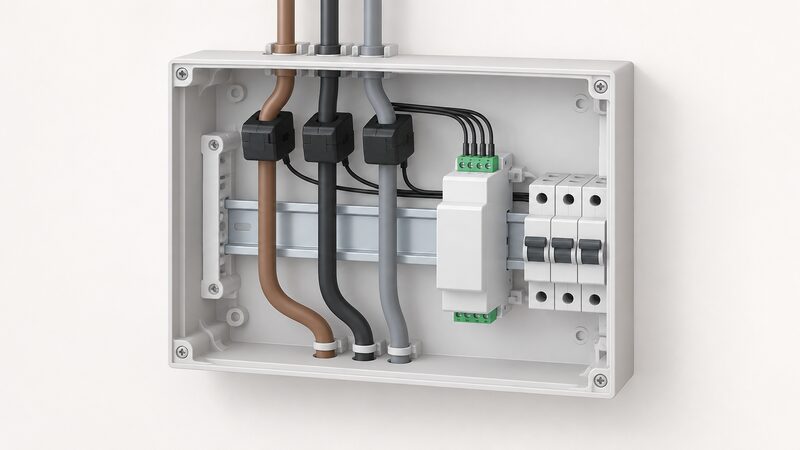
Shelly sells more than one three-phase meter, and the difference between them is capacity rather than function. The Pro 3EM 120A v2 measures up to 120 A per phase1. The Pro 3EM 3CT 63 is described as a next-generation DIN-rail mountable single- or three-phase energy meter with a combined 63 A, three-phase current transformer6. A 400 A variant of the current transformer is also listed6.
The choice between them follows the main circuit breaker. Anker's guidance on its own smart meter states the principle plainly: the CT rating for the grid measurement point must match the rating of the main circuit breaker, with a 63 A CT sufficient for breakers rated 63 A or below and a 120 A CT needed where incoming grid current exceeds 63 A7. The same logic applies to any CT-based meter, including the Pro 3EM.
| Variant | Current transformer rating | Notes |
|---|---|---|
| Pro 3EM 120A v2 | up to 120 A per phase, optional neutral1 | Single- or three-phase1 |
| Pro 3EM 3CT 63 | combined 63 A, three-phase CT6 | Suits supplies at or below 63 A |
| Pro 3EM-400 CT | 400 A variant6 | Larger supplies |
For most UK homes the 63 A variant matches the incoming fuse, and the 120 A version gives headroom where the supply is larger or where a future upgrade is expected. The 400 A transformer is aimed at supplies well beyond a domestic board. Getting this wrong in either direction is a wiring problem rather than a software one: an undersized CT saturates and under-reads, and an oversized one loses resolution at low currents.
Accuracy: 1% and what it covers
Shelly publishes an active energy measurement accuracy of 1% for its three-phase metering range6, and the Pro 3EM-120A is listed with measurement accuracy to 1%2. The current accuracy is stated more finely: plus or minus 1% between 2 and 120 A, plus or minus 2% between 1 and 2 A, and plus or minus 5% between 0 and 1 A2.
That three-band breakdown is the honest part of the specification. Accuracy is not a single number across the whole range; it degrades as current falls, which is exactly the region a household occupies overnight when the house is drawing a few hundred watts. A meter that is 1% accurate at 100 A may be 5% accurate at half an amp. The published figures say so rather than hiding it.
For context, 1% is a common figure across the metering market. Chameleon's Energy Clamp is listed at 1% measurement accuracy on the standard Zigbee profile8, Smappee's EV Wall is described as a kWh meter compliant with IEC 62053-21 with an accuracy of 1%9, and Sigen's power sensor datasheet gives 1% power accuracy10. A solar panel datasheet, by contrast, may state a power measurement tolerance of plus or minus 3%7. The Pro 3EM's figure sits at the tighter end of what domestic monitoring offers.
What 1% does not mean is billing-grade. A utility meter is a regulated instrument; a monitoring meter is not, and its reading is for the householder's own use. Where a generation meter is required for a Feed-in Tariff installation, the official guidance is that it must be able to calculate the electricity generated by the installation separately from any other energy source, unless pro-rating is available4. Whether a particular monitoring device satisfies that requirement is a question for the scheme administrator, not for the meter's accuracy figure alone.
Connections: LAN, Wi-Fi and Bluetooth
The 120A v2 is Matter-ready, with wired LAN, Wi-Fi and Bluetooth1. The Wi-Fi protocol is 802.11 b/g/n and the Bluetooth protocol is 4.22. The RF band is 2400 to 2495 MHz and maximum RF power is under 20 dBm2.
The wired LAN option is the significant one for a device that lives inside a distribution board. A metal consumer unit is an effective shield, and Wi-Fi from inside one is unreliable. A cable removes that problem entirely and gives the meter a stable address on the local network. The maker describes the unit as enhanced with gen2 firmware flexibility and LAN connectivity2, and a third-party system integration datasheet lists the Pro 3EM with LAN and Wi-Fi as its connection options3.
Bluetooth serves setup rather than operation, which is the usual pattern for DIN-rail devices: it gives a local pairing route for initial configuration without needing the network to be working first. Matter support matters for households building a mixed system, since it allows the meter to present itself to a hub rather than requiring a manufacturer-specific integration.
The comparison with the wider market is instructive. Some EV chargers offer Bluetooth, Wi-Fi, 4G and Ethernet11, and others offer Wi-Fi or Ethernet with no 4G option at all12. The Pro 3EM's combination of LAN, Wi-Fi and Bluetooth, without a cellular radio, means it depends on the home's own network for anything beyond local operation. That is a deliberate trade: no subscription, no cellular module, but also no remote access if the broadband goes down.
Roles it can play: main meter, energy meter or generation meter
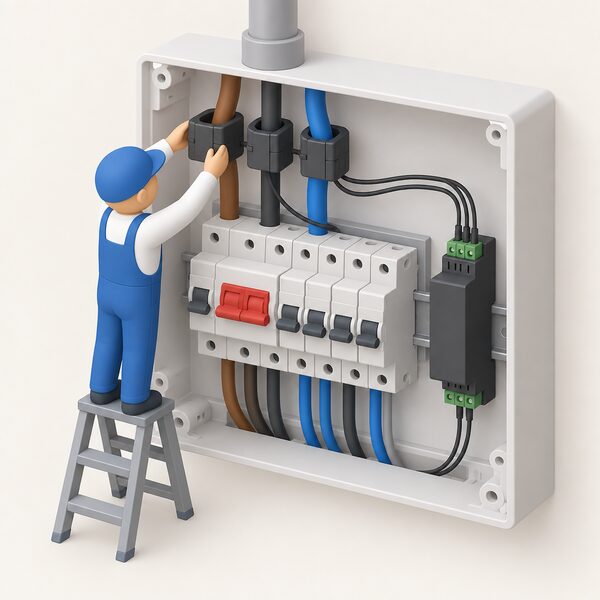
A system integration datasheet lists the Pro 3EM under three functions: main meter, energy meter and generation meter3. Those are three different jobs, and the same hardware can do any of them depending on where the current transformers are clamped.
As a main meter, it sits at the incoming supply and measures everything the house imports and exports. As an energy meter, it measures a specific circuit or sub-board, which is how a household separates a heat pump or an EV charger from the rest of the load. As a generation meter, it measures the output of a solar array. The Energy Saving Trust describes a generation meter simply as one that measures how much electricity is being generated13.
The generation meter role carries obligations. Under Feed-in Tariff rules, the meter must be able to measure the electricity generated or exported from the installation separately from any other source, unless pro-rating is allowable4. The consumer is responsible for ensuring the generation meter records accurately, reporting suspected faults to the FIT company as soon as possible, and arranging replacement by the company that originally installed it14.
For a household with solar, a meter that measures both production and consumption is the useful configuration, and Netatmo's guidance notes that a smart energy meter will likely allow measurement of both15. The Pro 3EM's four-quadrant measurement with multiple connection types2 is what makes the export direction visible rather than inferred. More on this sits in export metering and export limitation devices and three-phase homes: metering and energy monitoring.
Installation on a DIN rail and current transformers
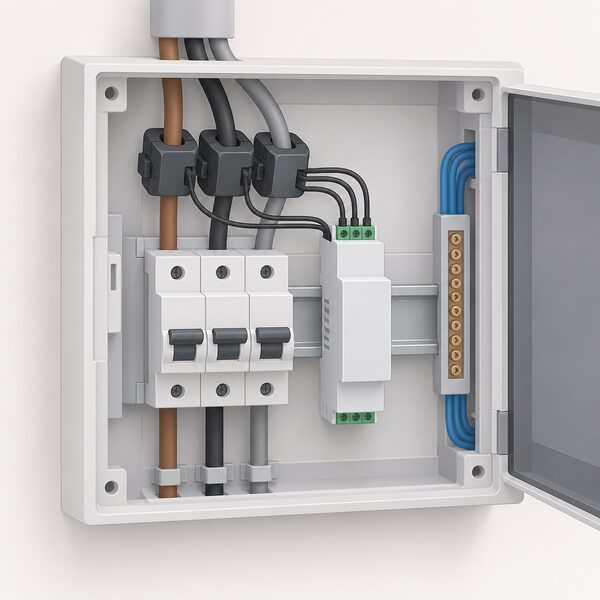
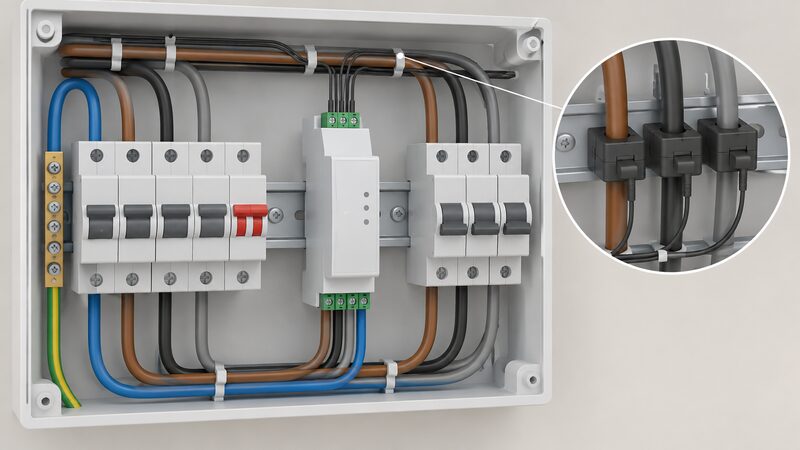
The Pro 3EM mounts on a DIN rail2, the standard fixing inside a UK consumer unit or distribution board. The same mounting method appears across the metering and control market: Hoymiles lists DIN rail installation for its three-phase smart meter16, and Legrand's DIN-rail actuator uses a DIN-rail adaptor17. It is the form factor that lets a meter live alongside the protective devices rather than in a separate enclosure.
Installation is a current transformer job, not a supply interruption. The CT clamps go around the phase conductors and the meter takes a voltage reference, so the supply does not need to be broken to fit the sensing. The screw terminals take a maximum torque of 0.4 Nm2, and the unit is rated for a maximum altitude of 2000 m2. Power supply voltage is 110 to 240 V at 50 or 60 Hz2.
The phase sequence error detection option2 is the diagnostic that matters most during commissioning. On a three-phase supply, the meter's calculations assume a known rotation, and a swapped pair of phases will produce readings that look plausible but are wrong. The flag exists to catch that before the data is trusted.
What owning a Pro 3EM means for household energy independence
The meter is photovoltaic ready2, and its role in independence is to make the household's own generation and consumption legible. Solar Energy UK's position is that more homegrown energy means greater energy independence8, and a meter that separates import from export is the instrument that shows whether that is happening.
The dependence it leaves in place is worth stating as plainly as the benefit. The home remains connected to the grid and buys from a supplier; the meter changes none of that. It measures a supply, it does not create one. Where the household has no solar or battery, the Pro 3EM is a measurement device and nothing more.
There is also a data dependence. The 120A v2 works locally without the cloud1, and it keeps up to 60 days of 1-minute data on device in non-volatile memory1. That local retention is the strongest independence feature in the specification: the history survives a network outage and does not require an account to exist. But remote access, app features and any cloud history do depend on a network and on the manufacturer's platform, and the device has no cellular fallback.
The comparison with a smart meter is worth drawing. A smart meter measures the energy used, records consumption and sends readings to the supplier through a secure network that does not require Wi-Fi18. It is the supplier's instrument, and its data flows to the supplier. The Pro 3EM is the household's own instrument, and its data stays with the household unless the household chooses otherwise. That is the difference in kind, and it is the reason a named meter appears in so many home energy management builds. For the wider picture, see home energy management systems: what a HEMS does and smart meters, monitoring and energy independence.
Sources18 cited
- Shelly Pro 3EM 120A v2, Enphase
- Shelly Pro 3EM-120A product page, Zendure, 2026-09-19
- EnergyManager pro datasheet, Solarwatt, 2024-06-08
- Guidance for FIT Generators V18, Ofgem, 2026-04-01
- Three-phase power theory, OpenEnergyMonitor, 2026-09-17
- Energy Metering collection, Shelly, 2026-09-20
- Anker SOLIX Smart Meter Gen 2, Anker SOLIX, 2026-09-19
- Solar Energy Scotland manifesto, Solar Energy UK, 2026-09-17
- What is a smart meter, Smart Energy GB, 2026-08-10
- Sigen Power Sensor datasheet, Sigenergy, 2026-09-17
- Pulsar Pro EV charger, Wallbox, 2026-09-17
- emonTx3 technical documentation, OpenEnergyMonitor, 2026-09-17
- Installing solar panels to help reduce your carbon footprint, Energy Saving Trust, 2025-09-24
- Feed-in Tariffs, Energy Ombudsman, 2026-09-20
- Solar energy comfort guide, Netatmo, 2026-09-20
- Hoymiles Smart Meter (Three Phases), Hoymiles, 2026-09-17
- MyHOME DIN Rail Actuator, Legrand, 2026-09-17
- What is a smart thermostat, Smart Energy GB, 2026-08-19
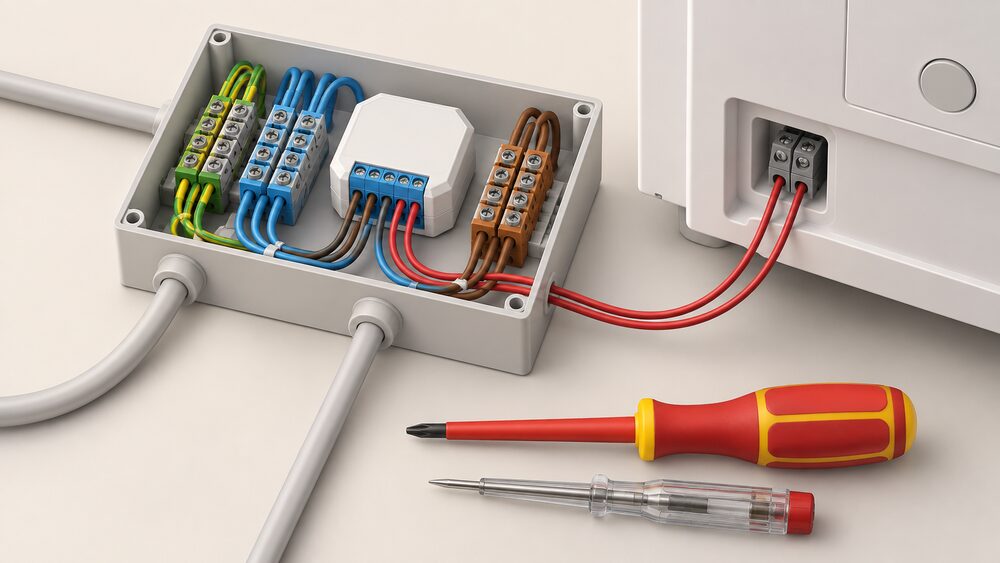 Shelly Smart Switches for HeatingCan a Shelly switch make your existing heating smart without changing the boiler?
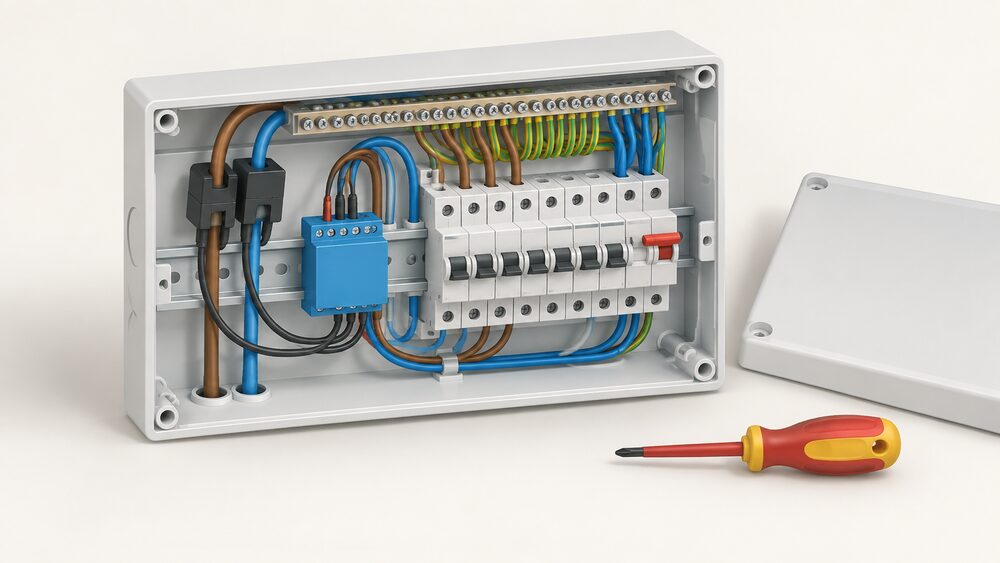 Shelly Smart Relays and Energy Monitoring DevicesShelly devices fit inside your fuse box to track how much electricity your home uses.
 Shell EnergyShell Energy left the UK domestic market when Octopus Energy took over its 1.3 million household accounts on 1 December 2023; what the transfer means for former customers, tariffs and independence.